


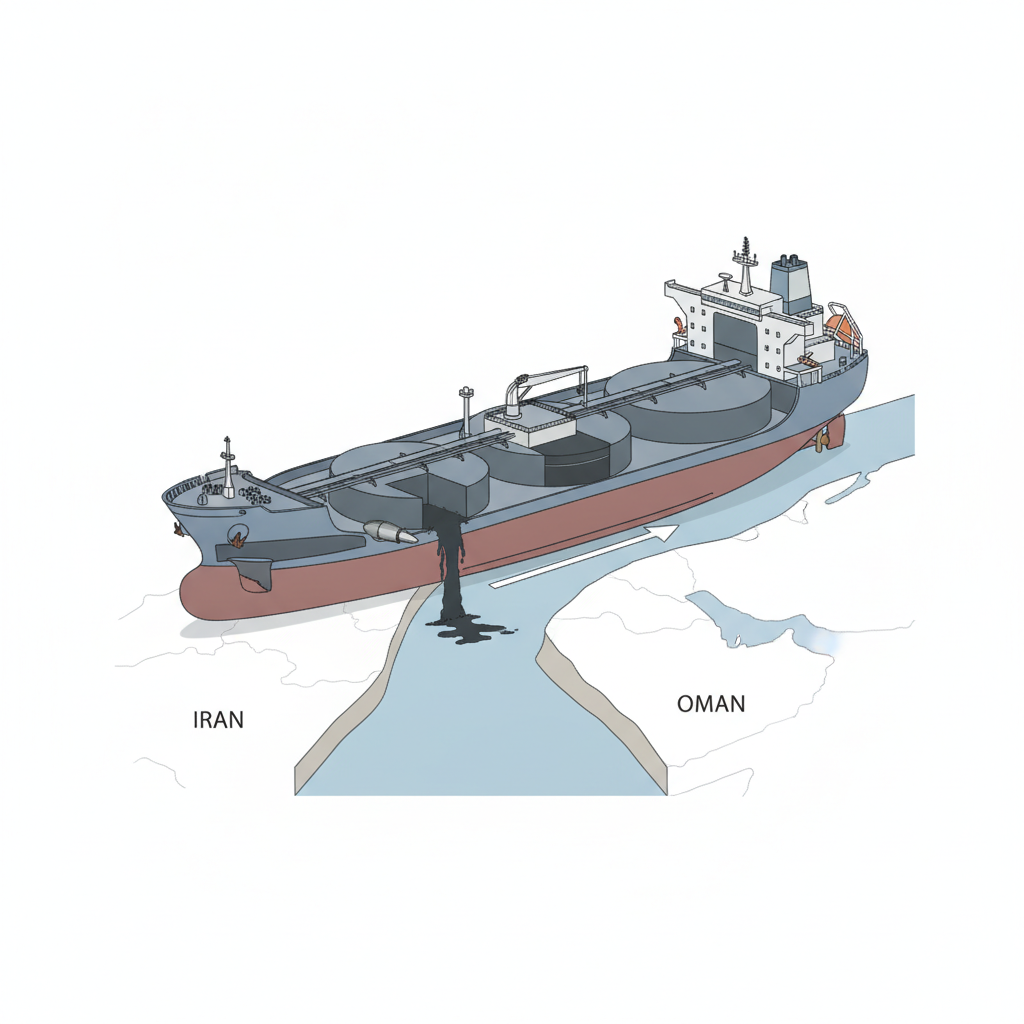
18 Sep Iran Strikes Togo-Flagged Oil Tanker in Strait of Hormuz: UPSC Geography Analysis
✎ The Strait of Hormuz is a legally defined ‘strait used for international navigation’ under UNCLOS, through which 20-30% of global seaborne oil transits; its disruption poses systemic risks to energy security and global trade.
Subject Relevance — Where This Topic Fits
- GS Paper II — International Relations — Regional and Global Groupings and Agreements involving India and/or affecting India’s interests | GS Paper III — Security — Challenges to Internal Security through External State and Non-State Actors | GS Paper III — Economy — Infrastructure: Energy, Ports, Roads, Airports, and Their Connectivity
- Prelims: Strait of Hormuz, Maritime chokepoint, Revolutionary Guard Corps (IRGC), UNCLOS (United Nations Convention on the Law of the Sea), Maritime Security Strategy, Chokepoint vulnerability, Oil supply disruption, Gulf of Aden, Piracy, Maritime trade routes
- Essay: Maritime security in the 21st century: Challenges and governance, Energy security and geopolitics: The Strait of Hormuz dilemma
Quick Revision: The Strait of Hormuz is a legally defined ‘strait used for international navigation’ under UNCLOS, through which 20-30% of global seaborne oil transits; its disruption poses systemic risks to energy security and global trade.
Why is this in the news?
The reported strike by Iran’s Revolutionary Guard Corps (IRGC) on a Togo-flagged oil tanker in the Strait of Hormuz underscores the persistent geopolitical volatility in a critical maritime chokepoint. This incident, occurring amid heightened regional tensions, highlights the fragility of global oil supply chains and the strategic importance of maritime security governance. It also prompts examination of the legal and operational frameworks governing transit through international straits, as well as the role of external powers in safeguarding commercial shipping in high-risk zones.
Background
- The Strait of Hormuz is a narrow maritime passage between the Persian Gulf and the Gulf of Oman, through which approximately 20-30% of the world’s seaborne oil passes, making it one of the most strategically vital chokepoints in global energy trade.
- The strait lies within the territorial waters of Iran and Oman, and its legal status is governed by the United Nations Convention on the Law of the Sea (UNCLOS), which provides for the right of innocent passage through straits used for international navigation.
- Tensions in the Strait of Hormuz have escalated in recent years due to geopolitical rivalries, including the US-Iran conflict, regional proxy wars, and the targeting of commercial vessels by state and non-state actors.
- Maritime security incidents in the Strait of Hormuz and adjacent waters (e.g., Gulf of Aden) have prompted nations to deploy naval assets for protection of commercial shipping, including South Korea’s Cheonghae Unit and the US-led maritime security initiatives.
What is the Strait of Hormuz and Why is it Strategically Significant?
- The Strait of Hormuz is a 39-kilometre-wide waterway connecting the Persian Gulf to the Gulf of Oman and the Arabian Sea, serving as the sole maritime route for oil exports from several Gulf states, including Saudi Arabia, Iraq, the UAE, Kuwait, and Iran.
- Under the United Nations Convention on the Law of the Sea (UNCLOS), the strait is classified as a ‘strait used for international navigation,’ entailing the right of ‘transit passage’ for all vessels, including military ships, subject to the requirement that such passage is not prejudicial to the peace, good order, or security of the coastal states.
- Approximately 20-30% of global seaborne oil transits the Strait of Hormuz daily, with an estimated 17 million barrels passing through on average, making it a critical node in the global energy supply chain.
- The strait’s strategic importance is amplified by the concentration of oil and gas reserves in the Persian Gulf, which account for nearly one-third of the world’s proven oil reserves and one-fifth of its natural gas reserves.
- Geopolitical tensions in the region, including sanctions, military posturing, and asymmetric warfare tactics (e.g., drone strikes, limpet mine attacks), have periodically disrupted maritime traffic, raising concerns about energy security and supply chain resilience.
- The legal framework governing the strait is complemented by regional and international maritime security initiatives, such as the US-led International Maritime Security Construct (IMSC) and the European Union’s Operation Atalanta in the Gulf of Aden, aimed at safeguarding commercial shipping.
- The Strait of Hormuz is flanked by critical infrastructure, including major oil terminals (e.g., Ras Tanura in Saudi Arabia) and military bases, which are often targeted in regional conflicts, further underscoring its geopolitical salience.
- Oman, as the southern littoral state, plays a pivotal role in managing regional maritime security, including through its control of the Musandam Peninsula and participation in confidence-building measures with Iran.
Key Features
| Feature | Significance |
|---|---|
| Strait of Hormuz | A critical chokepoint for global oil transit, handling approximately 20-30% of the world’s seaborne oil shipments, making its security vital for international energy markets. |
| Iranian Revolutionary Guard Corps (IRGC) assertion | Tehran’s claim of control over the Strait reflects its strategic posture in the Persian Gulf, influencing regional maritime security dynamics and geopolitical negotiations. |
| South Korea’s naval deployment (Cheonghae Unit) | Demonstrates proactive measures by non-regional actors to safeguard commercial shipping in high-risk zones, balancing economic interests with conflict-avoidance. |
| US military escort operations | Highlights the role of external powers in ensuring safe passage through contested waters, underscoring the fragility of maritime security frameworks. |
| Houthis’ threat to shipping in the Gulf of Aden | Illustrates the spillover effects of regional conflicts into broader maritime security challenges, affecting global supply chains and energy prices. |
Why it Matters
Economic/Strategic
- Disruption in the Strait of Hormuz can trigger volatility in global oil prices, impacting inflation, fuel costs, and economic growth in energy-dependent nations.
- The Strait’s closure or heightened tensions could reroute oil shipments, increasing transportation costs and supply chain delays for major economies.
- South Korea’s consideration to expand naval operations reflects the economic imperative to protect its energy imports and export routes, particularly from the Middle East.
- Maritime insurance premiums for vessels transiting the region are likely to rise, reflecting elevated risk perceptions among underwriters.
Geopolitical
- Iran’s assertion of control over the Strait underscores its leverage in regional negotiations, particularly regarding nuclear diplomacy and sanctions relief.
- The involvement of external naval powers (US, South Korea) introduces complexities in balancing sovereignty, freedom of navigation, and collective security.
- The Houthis’ actions in the Gulf of Aden demonstrate the interconnectedness of conflicts in Yemen, Iran, and broader maritime security in the Indian Ocean region.
Legal/Institutional
- The principle of ‘freedom of navigation’ under the United Nations Convention on the Law of the Sea (UNCLOS) is central to resolving disputes over maritime access.
- Regional and international institutions (e.g., International Maritime Organization) play a critical role in establishing norms for safe and secure shipping in contested waters.
Challenges
1. Maritime Security Threats
- Escalation of attacks on commercial vessels risks destabilising global energy markets and supply chains.
- The proliferation of non-state actors (e.g., Houthis) complicates traditional naval deterrence strategies.
- Limited enforcement mechanisms for maritime security in the absence of a unified regional or international response.
UPSC Link: GS Paper 2: International Relations – Maritime Security
2. Economic Vulnerabilities
- Dependence on the Strait of Hormuz for oil transit makes economies vulnerable to sudden supply disruptions.
- Rising insurance costs and operational delays for shipping companies could erode profitability in global trade.
- Geopolitical tensions may deter foreign investment in energy infrastructure in the Middle East.
UPSC Link: GS Paper 3: Economy – Energy Security
3. Diplomatic Constraints
- Balancing national security interests with international law (e.g., UNCLOS) poses challenges for states navigating regional conflicts.
- The reluctance of non-regional actors (e.g., South Korea) to intervene directly highlights the limits of multilateral cooperation.
- Sanctions and retaliatory measures (e.g., by Iran) further constrain diplomatic solutions.
UPSC Link: GS Paper 2: International Relations – Diplomacy
4. Humanitarian and Environmental Risks
- Collateral damage from attacks on vessels risks environmental disasters, particularly in ecologically sensitive zones.
- Disruptions to humanitarian aid shipments (e.g., to Gaza) exacerbate civilian suffering in conflict zones.
UPSC Link: GS Paper 1: Humanitarian Issues
Challenges — UPSC Perspective
| Issue | Concern |
|---|---|
| Freedom of Navigation vs. Sovereignty Claims | Potential for unilateral actions by coastal states to restrict passage, conflicting with international maritime law. |
| Non-State Actor Threats (Houthis) | Targeting of commercial vessels in the Gulf of Aden, complicating traditional naval security frameworks. |
| Rising Insurance Costs | Increased operational expenses for shipping companies, potentially leading to higher consumer prices. |
| Energy Market Volatility | Sudden supply disruptions in the Strait of Hormuz could trigger price shocks in global oil markets. |
| Limited Multilateral Response | Absence of a unified international strategy to address maritime security challenges in the region. |
Way Forward
- Strengthen international cooperation under UNCLOS to clarify and enforce rules governing maritime access and security.
- Enhance regional maritime security dialogues, including Gulf Cooperation Council (GCC) states, to address shared threats.
- Invest in alternative shipping routes and energy supply diversification to reduce dependence on the Strait of Hormuz.
- Promote the deployment of multinational naval task forces to deter attacks and ensure safe passage for commercial vessels.
- Expand maritime domain awareness (MDA) capabilities, including satellite monitoring and real-time intelligence sharing.
- Encourage private sector resilience through insurance schemes and contingency planning for shipping companies.
- Support humanitarian aid shipments and civilian infrastructure protection in conflict zones to mitigate collateral damage.
UPSC Value Addition
Keywords for Mains Answer-Writing
Strait of Hormuz · Freedom of Navigation · Maritime Security · UNCLOS · Revolutionary Guard Corps · Gulf of Aden · Maritime Chokepoints · International Maritime Law · Regional Security Architecture · Maritime Dispute Resolution · Geopolitical Flashpoints · Maritime Trade Routes
Concept Flow
Escalation of regional conflict (e.g., US-Iran tensions) → Assertion of control over Strait of Hormuz by Iran → Disruption of global oil transit → Volatility in energy markets → Increased insurance costs and rerouting of shipments → Expansion of naval operations by non-regional actors (e.g., South Korea) → Heightened maritime security risks → Diplomatic efforts to restore stability.
Prelims Practice Questions
Q1. Consider the following statements regarding the Strait of Hormuz:
1. It is a narrow waterway connecting the Persian Gulf to the Gulf of Oman.
2. The strait is governed by the provisions of the United Nations Convention on the Law of the Sea (UNCLOS), 1982.
3. Iran has claimed control over the strait since the US and Israel launched a war on February 28.
4. The strait is a critical chokepoint for global oil trade, with approximately 20% of the world’s oil passing through it.
How many of the above statements are correct?
- Only one
- Only two
- Only three
- All four
Answer: All four — Statements 1, 2, and 4 are correct. Statement 3 is incorrect as Iran’s assertion of control over the Strait of Hormuz is not a universally accepted legal claim under UNCLOS.
Q2. Assertion (A): The Revolutionary Guard Corps (IRGC) of Iran has warned that unauthorized passage through the Strait of Hormuz will result in the ‘destruction’ of offending vessels.
Reason (R): The IRGC’s assertion is based on Iran’s claim of sovereignty over the Strait of Hormuz under the principle of ‘historic waters’.
- Both A and R are true, and R is the correct explanation of A
- Both A and R are true, but R is not the correct explanation of A
- A is true, but R is false
- A is false, but R is true
Answer: A is true, but R is false — Assertion (A) is factually accurate based on recent reports. Reason (R) is true in that Iran claims historic waters, but the IRGC’s warning is not directly justified by this claim under international law.
Q3. Match the following maritime chokepoints with their respective geographical locations:
Column I (Chokepoint)
A. Strait of Hormuz
B. Strait of Malacca
C. Bab el-Mandeb
D. Suez Canal
Column II (Location)
1. Connects the Red Sea to the Gulf of Aden
2. Connects the Persian Gulf to the Gulf of Oman
3. Connects the Mediterranean Sea to the Red Sea
4. Connects the Indian Ocean to the South China Sea
- {‘A’: ‘2’, ‘B’: ‘4’, ‘C’: ‘1’, ‘D’: ‘3’}
- {‘A’: ‘1’, ‘B’: ‘2’, ‘C’: ‘3’, ‘D’: ‘4’}
- {‘A’: ‘2’, ‘B’: ‘1’, ‘C’: ‘4’, ‘D’: ‘3’}
- {‘A’: ‘3’, ‘B’: ‘4’, ‘C’: ‘1’, ‘D’: ‘2’}
Answer: {‘A’: ‘2’, ‘B’: ‘4’, ‘C’: ‘1’, ‘D’: ‘3’} — Correct matches: A-2 (Strait of Hormuz connects the Persian Gulf to the Gulf of Oman), B-4 (Strait of Malacca connects the Indian Ocean to the South China Sea), C-1 (Bab el-Mandeb connects the Red Sea to the Gulf of Aden), D-3 (Suez Canal connects the Mediterranean Sea to the Red Sea).
Mains Practice Question
✍ The Strait of Hormuz remains one of the most critical maritime chokepoints in the world, with its geopolitical significance often overshadowing the legal frameworks governing its use. Critically examine the principles of ‘freedom of navigation’ and ‘innocent passage’ under international maritime law, particularly the United Nations Convention on the Law of the Sea (UNCLOS), 1982, in the context of recent incidents involving the Strait of Hormuz. Also, analyse the implications of unilateral assertions of control over such chokepoints for the global maritime order. (15 Marks)
Approach: MODEL-ANSWER SKELETON:
1. **Introduction (2 marks)**: Define the Strait of Hormuz and its strategic importance (20% of global oil trade). State the core tension between geopolitical assertions and international law.
2. **Freedom of Navigation and Innocent Passage (4 marks)**:
– **UNCLOS Provisions**: Article 38 (freedom of navigation in EEZ and high seas), Article 17 (right of innocent passage through territorial sea), Article 39 (duties of ships during innocent passage).
– **Strait of Hormuz Classification**: Regarded as an international strait under UNCLOS (Article 36), where all ships enjoy the right of transit passage.
– **Distinction**: Transit passage (no coastal state interference) vs. innocent passage (submission to coastal state laws).
3. **Recent Incidents and Legal Challenges (4 marks)**:
– **Iran’s Assertions**: IRGC warnings and claims of ‘historic waters’ or ‘internal waters’ (contradicting UNCLOS).
– **Incident Analysis**: 2026 incident involving a Togo-flagged tanker; Iran’s justification of ‘illegal attempt’ vs. international law.
– **State Practice**: US-led naval escort missions (e.g., Operation Sentinel) and South Korea’s Cheonghae Unit expansion in the Gulf of Aden.
4. **Implications for Global Maritime Order (3 marks)**:
– **Erosion of UNCLOS Norms**: Unilateral assertions undermine the rule-based maritime order.
– **Chokepoint Vulnerability**: Potential disruption to global supply chains and energy security.
– **Multilateral Responses**: Role of the International Maritime Organization (IMO) and regional security frameworks (e.g., Combined Maritime Forces).
5. **Conclusion (2 marks)**: Reiterate the primacy of UNCLOS in resolving disputes and the need for diplomatic solutions. Balance between national security concerns and international legal obligations.
Source: orissapost.com
Generated by AanyaAi for educational purpose.
Related guides on our sites
- Current affairs for upsc 2026
- How to prepare for GS paper 1 for UPSC CSE mains exam
- Best UPSC coaching for IFOS exam
- Best geography optional coaching

- Iran Strikes Togo-Flagged Oil Tanker in Strait of Hormuz: UPSC Geography Analysis - September 18, 2026
- उपराष्ट्रपति ने हैदराबाद मुक्ति दिवस पर राष्ट्र निर्माण की याद दिलाई, जानिए क्यों है खास - September 18, 2026
- UPSC Alert: VP Highlights Hyderabad Liberation Day’s Role in National Unity - September 18, 2026

No Comments