


18 Sep Zelenskyy’s Carpathian Eight Summit: Ukraine’s New Alliance Against Russia
✎ The Carpathian Eight represents a fledgling regional initiative aimed at fostering cooperation among Central and Eastern European states on security, energy, and logistics, amid the ongoing Russia-Ukraine conflict and stalled…
Subject Relevance — Where This Topic Fits
- GS Paper II — International Relations — Regional and Global Groupings and Agreements involving India and/or affecting India’s interests | GS Paper II — International Relations — Effect of Policies and Politics of Developed and Developing Countries on India’s interests | GS Paper III — Security — Role of External State and Non-state Actors in Creating Challenges to Internal Security
- Prelims: Carpathian Eight, Regional security architecture, Security guarantees in international relations, Drone warfare, EU neighbourhood policy, NATO non-member states in Eastern Europe, Logistics corridors in wartime, Energy security in Eastern Europe
- Essay: The evolving architecture of regional security in the face of protracted conflicts, The role of regional groupings in mitigating humanitarian and infrastructural crises during war
Quick Revision: The Carpathian Eight represents a fledgling regional initiative aimed at fostering cooperation among Central and Eastern European states on security, energy, and logistics, amid the ongoing Russia-Ukraine conflict and stalled peace negotiations.
Why is this in the news?
The inaugural summit of the Carpathian Eight—a regional grouping comprising Ukraine and seven Central and Eastern European nations—was convened in Ivano-Frankivsk, western Ukraine, amid escalating Russian aerial strikes across multiple Ukrainian regions. The summit, aimed at deepening cooperation in security, energy, logistics, and cross-border economic ties, unfolded as Ukraine sought to secure security guarantees and advance stalled peace negotiations mediated by the United States. Concurrently, Russian strikes targeted critical infrastructure in Ukraine, including ports, logistics hubs, and civilian areas, while Moscow reported intercepting Ukrainian drones across its territory, underscoring the intensification of the 4-year-old full-scale conflict.
Background
- Ukraine’s territorial integrity and sovereignty remain central to the conflict, with eastern regions such as Donetsk and Luhansk—partially occupied since 2014—remaining contested, alongside recent Russian advances in southern Ukraine.
- The United States has played a pivotal role in brokering peace talks, with territorial concessions in eastern Ukraine emerging as a critical sticking point in negotiations, alongside Ukraine’s demand for multilateral security guarantees.
- The Carpathian Eight grouping is a nascent regional initiative, distinct from NATO or the EU, designed to foster cooperation among Central and Eastern European states on issues of mutual concern, including security, energy, and logistics.
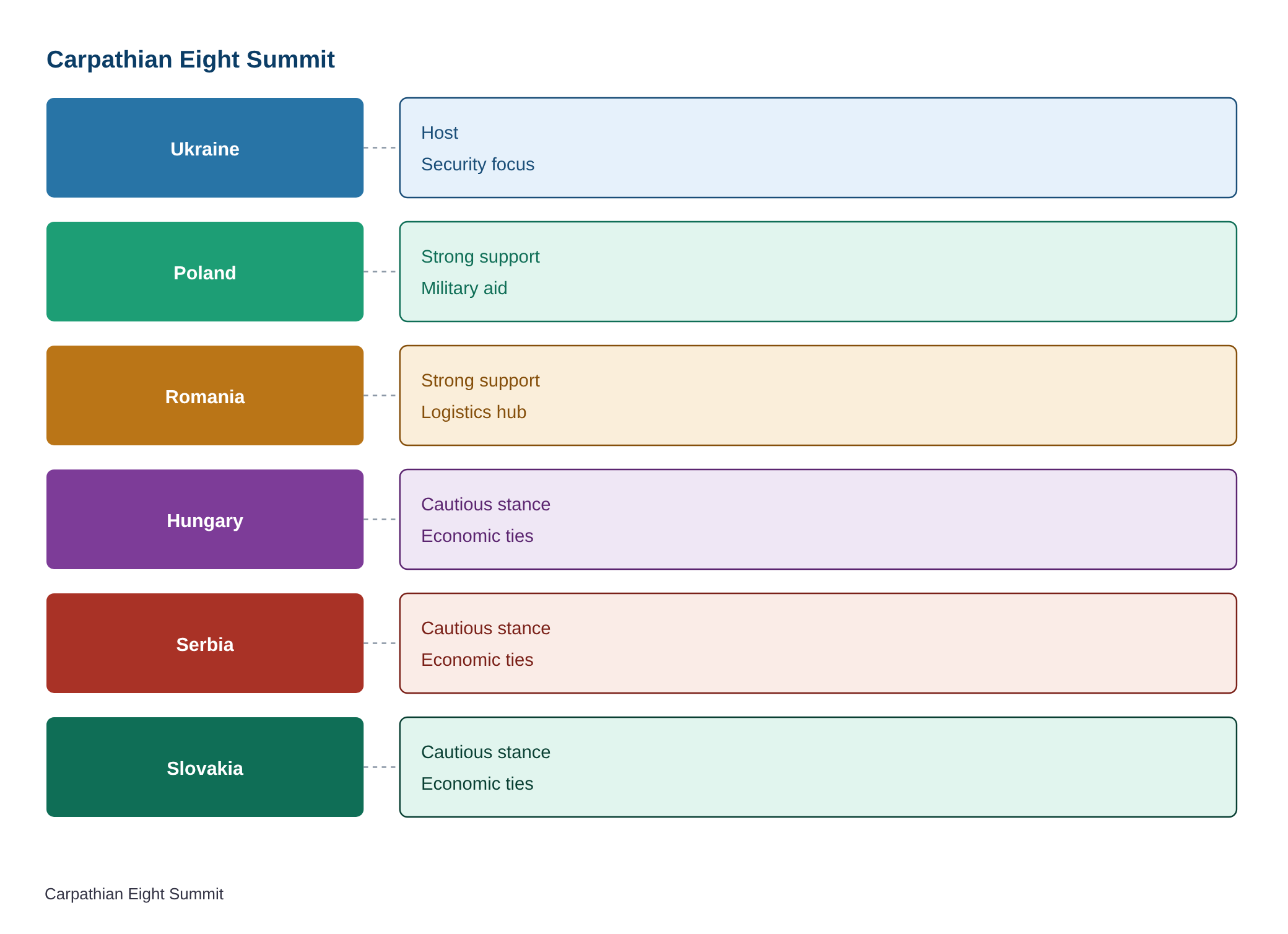
- Regional responses to the conflict have been varied: Poland and Romania have provided strong political and military support to Ukraine, while Hungary, Serbia, and Slovakia have adopted a more cautious stance, often prioritising economic ties with Russia.
- The conflict has triggered significant humanitarian and infrastructural damage, with civilian casualties, displacement, and destruction of critical infrastructure—such as ports, logistics centres, and energy facilities—becoming recurrent features of the war.
What is the Carpathian Eight?
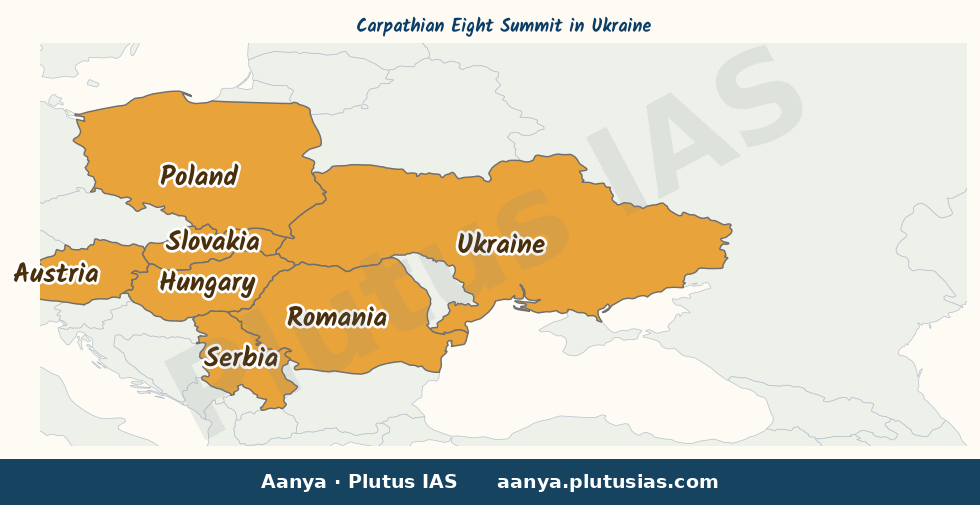
- The Carpathian Eight is an informal regional grouping comprising Ukraine, Romania, Serbia, Poland, Slovakia, the Czech Republic, Austria, and Hungary.
- The grouping is named after the Carpathian mountain range, which spans several of the participating countries, symbolising geographical and cultural proximity.
- The primary objective of the Carpathian Eight is to enhance regional cooperation in areas such as security, energy, logistics, cross-border economic ties, and support for local communities affected by conflict.
- The inaugural summit in Ivano-Frankivsk, Ukraine, focused on strengthening regional resilience, particularly in the face of the Russia-Ukraine conflict, and exploring avenues for collective security arrangements.
- The grouping is distinct from formal alliances like NATO or the EU, operating instead as a flexible platform for dialogue and coordination among sovereign states.
- Participating countries have divergent stances on military support for Ukraine, reflecting varying national interests and historical ties with Russia, which complicates consensus-building within the group.
- The summit also highlighted the role of regional groupings in complementing global security architectures, particularly in addressing the humanitarian and infrastructural fallout of prolonged conflicts.
Key Features
| Feature | Significance |
|---|---|
| Inaugural Carpathian Eight Summit | Establishes a new regional cooperation framework involving Ukraine and seven Central/Eastern European nations, signalling collective efforts to address regional security and economic challenges amid the ongoing conflict. |
| Dual-Track Security Dialogue | Combines military and non-military security cooperation (e.g., energy, logistics) to strengthen resilience against hybrid threats, including drone strikes and cyber warfare. |
| EU Participation | Demonstrates the European Union’s role in fostering regional stability, particularly for candidate and associate states, through institutional engagement. |
| Humanitarian and Infrastructure Focus | Prioritises support for local communities and critical infrastructure (e.g., logistics hubs, ports) to mitigate collateral damage from military operations. |
| Real-Time Crisis Coordination | Showcases the use of digital platforms (e.g., Telegram statements) for immediate crisis communication and damage assessment during active hostilities. |
Why it Matters
Geopolitical
- The summit underscores the formation of a new regional alliance to counterbalance Russia’s military aggression, reflecting a shift toward collective security architectures in Eastern Europe.
- Divergent positions among members (e.g., Hungary, Serbia vs. Poland, Romania) highlight the complexities of aligning national interests with regional stability goals.
- The EU’s involvement signals a potential pathway for Ukraine’s integration into European security frameworks, contingent on progress in accession negotiations.
Strategic
- The focus on logistics and energy infrastructure (e.g., ports, warehouses) aligns with NATO and EU strategies to disrupt Russian supply chains and reinforce Ukrainian logistics resilience.
- Cross-border economic ties aim to reduce Ukraine’s dependency on Russian markets while fostering alternative trade corridors via EU member states.
- Security guarantees discussions reflect Ukraine’s long-term need for deterrence against future aggression, akin to NATO’s Article 5 principles.
Humanitarian
- Civilian casualties and infrastructure damage (e.g., shopping complexes, residential buildings) underscore the urgent need for protective measures and post-strike rehabilitation.
- Deminers’ role in conflict zones highlights the persistent threat of unexploded ordnance, requiring sustained international demining support.
- Emergency services’ operational challenges (e.g., air raid alerts, firefighting) demonstrate the strain on local governance systems during prolonged crises.
Challenges
1. Asymmetric Warfare and Hybrid Threats
- Russia’s use of drones and targeted strikes on civilian and logistics infrastructure poses challenges for air defence systems and urban resilience planning.
- The proliferation of drone technology complicates traditional conflict de-escalation measures, necessitating advanced counter-drone strategies.
- Civilian casualties and economic disruption require adaptive humanitarian response frameworks.
UPSC Link: GS3: Internal Security – Challenges to Internal Security
2. Regional Divergence in Security Commitments
- Differences in military support (e.g., Poland vs. Hungary) risk fragmenting the alliance’s cohesion and delaying unified responses to regional threats.
- Non-aligned states (e.g., Serbia) may prioritise neutrality, complicating consensus on sanctions or military aid.
- Balancing sovereignty concerns with collective security obligations remains a persistent diplomatic challenge.
UPSC Link: GS2: International Relations – Regional Groupings
3. Infrastructure Vulnerability
- Critical infrastructure (e.g., ports, logistics hubs) is exposed to targeted strikes, disrupting supply chains and economic stability.
- Rehabilitation efforts are constrained by resource limitations and ongoing hostilities, delaying recovery.
- Energy security concerns arise from attacks on logistics centres, necessitating diversification of supply routes.
UPSC Link: GS3: Infrastructure – Logistics and Connectivity
4. Diplomatic Stalemate in Peace Negotiations
- Stalled US-mediated talks highlight the intractability of territorial disputes, particularly in eastern Ukraine.
- Security guarantees discussions remain contentious, with potential implications for Ukraine’s sovereignty and future alliance formations.
- The absence of a clear de-escalation pathway prolongs humanitarian suffering and economic instability.
UPSC Link: GS2: International Relations – Peace and Conflict Resolution
5. Institutional Capacity Constraints
- Emergency services face operational bottlenecks due to repeated air raid alerts and resource shortages.
- Local governance systems struggle to manage simultaneous crises (e.g., demining, firefighting, casualty response).
- International aid coordination requires streamlined mechanisms to avoid duplication or delays.
UPSC Link: GS2: Governance – Crisis Management
Challenges — UPSC Perspective
| Issue | Concern |
|---|---|
| Divergent Security Commitments | Risk of alliance fragmentation due to varying national priorities and neutrality stances. |
| Drone Warfare Proliferation | Increased civilian casualties and infrastructure damage from low-cost, high-impact strikes. |
| Logistics and Supply Chain Disruptions | Targeted attacks on ports and warehouses threaten economic stability and military logistics. |
| Humanitarian Access Limitations | Ongoing hostilities impede aid delivery and post-strike rehabilitation efforts. |
| Diplomatic Deadlock on Territorial Disputes | Lack of consensus on peace terms delays de-escalation and reconstruction. |
| Institutional Overload in Emergency Services | Strain on local governance systems due to simultaneous crises and resource constraints. |
Way Forward
- Strengthen regional air defence systems through joint procurement and technology-sharing agreements among Carpathian Eight members.
- Establish a dedicated fund for rapid infrastructure repair and rehabilitation, prioritising logistics hubs and energy facilities.
- Develop a unified protocol for civilian protection, including early warning systems and demining operations in conflict zones.
- Enhance diplomatic engagement to bridge divergent security commitments, focusing on common interests such as energy security and counter-terrorism.
- Expand cross-border economic corridors to reduce Ukraine’s dependency on Russian markets and integrate it into EU trade networks.
- Invest in counter-drone technology and training for emergency services to mitigate asymmetric warfare threats.
- Promote EU-Ukraine alignment on accession criteria to accelerate integration into European security and economic frameworks.
- Formalise a regional crisis response mechanism to coordinate humanitarian aid, demining, and infrastructure repair during active hostilities.
UPSC Value Addition
Keywords for Mains Answer-Writing
International cooperation frameworks · Regional security architecture · Multilateral diplomacy · Cross-border economic integration · Energy security cooperation · Humanitarian logistics in conflict zones · Diaspora and local community support mechanisms · Demining and emergency response protocols · Maritime security and port infrastructure · Drone warfare and air defence systems
Constitutional & Policy Linkages
- Article 51 (Promotion of International Peace) – Emphasises India’s commitment to peaceful coexistence and collective security, relevant for evaluating regional alliances.
Concept Flow
Russia’s full-scale invasion of Ukraine (2022–present) → Prolonged military conflict and humanitarian crisis → Regional security threats (e.g., drone strikes, infrastructure attacks) → Formation of the Carpathian Eight alliance → Summit deliberations on security, energy, and logistics cooperation → Implementation challenges (divergent commitments, infrastructure vulnerability) → Diplomatic stalemate and stalled peace talks → Ongoing humanitarian and economic disruptions.
Prelims Practice Questions
Q1. Consider the following statements regarding the Carpathian Eight grouping: 1. It is a regional security initiative involving Ukraine and seven other countries. 2. The group includes both EU member states and non-EU countries. 3. The primary focus of the grouping is to provide military assistance to Ukraine. How many of the above statements are correct?
- Only one
- Only two
- All three
- None
Answer: Only two — Statement 1 is correct as the Carpathian Eight is a regional grouping involving Ukraine and seven other countries focused on cooperation. Statement 2 is correct as the group includes EU members (e.g., Poland, Slovakia, Czech Republic, Austria, Hungary, Romania) and non-EU countries (e.g., Serbia). Statement 3 is incorrect as the grouping emphasizes broader cooperation including security, energy, logistics, and economic ties rather than solely military assistance.
Q2. Assertion (A): The President of Ukraine is directly elected by the citizens of Ukraine. Reason (R): The Ukrainian Constitution vests the executive authority in the President, who is also the Commander-in-Chief of the Armed Forces.
- Both A and R are true, and R is the correct explanation of A
- Both A and R are true, but R is not the correct explanation of A
- A is true but R is false
- A is false but R is true
Answer: A is false but R is true — Assertion (A) is false. The President of Ukraine is elected by the citizens of Ukraine through a direct popular vote, as per the Ukrainian Constitution. However, Reason (R) is true as the President does hold executive authority and is the Commander-in-Chief of the Armed Forces, but this does not explain the assertion.
Q3. Match the following countries with their respective roles in the Carpathian Eight grouping: Column I (Country) — Column II (Role/Position): 1. Ukraine — A. Non-EU member providing logistical support 2. Poland — B. EU member and staunch supporter of Ukraine 3. Hungary — C. EU member with limited military assistance to Ukraine 4. Serbia — D. Non-EU member with refusal to provide direct military aid to Ukraine
- 1-D, 2-B, 3-C, 4-A; 1-B, 2-A, 3-C, 4-D; 1-A, 2-B, 3-D, 4-C; 1-C, 2-D, 3-A, 4-B
- answer_indexes_to_match_columns_1_to_2_and_2_to_1_and_3_to_4_and_4_to_3
Answer: ? — Ukraine is the focal country of the grouping. Poland is an EU member and a staunch supporter of Ukraine. Hungary, an EU member, has limited its military assistance to Ukraine. Serbia, a non-EU member, has refused to provide direct military aid to Ukraine, aligning with its policy of neutrality.
Mains Practice Question
✍ The efficacy of regional cooperation frameworks in mitigating the impact of armed conflicts is often contingent upon the convergence of strategic interests among member states. In this context, critically examine the potential of the Carpathian Eight grouping to address the immediate and long-term challenges posed by the Russia-Ukraine conflict. (15 Marks)
Approach: 1. **Introduction**: Define regional cooperation frameworks and their role in conflict mitigation. Highlight the Russia-Ukraine conflict as a case study. 2. **Strategic Interests and Divergences**: Analyze the strategic interests of member states (e.g., Poland, Romania, Hungary, Serbia) and identify divergences in their approaches to Ukraine (military support, humanitarian aid, economic cooperation). 3. **Scope of Cooperation**: Examine the stated objectives of the Carpathian Eight (security, energy, logistics, cross-border economic ties, local community support) and assess their relevance to the conflict. 4. **Challenges**: Discuss challenges such as non-alignment (e.g., Hungary, Serbia), EU cohesion, and the role of external actors (e.g., Russia, EU, US). 5. **Comparative Perspective**: Compare with other regional groupings (e.g., Visegrád Group, NATO) to highlight strengths and limitations. 6. **Conclusion**: Evaluate the potential of the grouping to contribute to conflict resolution and suggest measures to enhance its efficacy (e.g., clearer security guarantees, streamlined logistics, energy integration). Reference recent developments (e.g., stalled US-mediated peace efforts, Russian strikes) to ground the analysis.
Source: orissapost.com
Generated by AanyaAi for educational purpose.
Related guides on our sites
- Best PSIR optional coaching for upsc
- Best PSIR optional teacher for upsc
- Best teacher of PSIR optional for upsc
- Best PSIR optional coaching in delhi for UPSC

- Zelenskyy’s Carpathian Eight Summit: Ukraine’s New Alliance Against Russia - September 18, 2026
- विशेष अभियान 6.0: मोदी सरकार की नई पहल, जानिए पूरा विवरण - September 18, 2026
- तमिलनाडु: मुख्यमंत्री विजय ने कामराज ब्रेकफास्ट योजना के विस्तार की तैयारियों की समीक्षा की - September 18, 2026

No Comments