


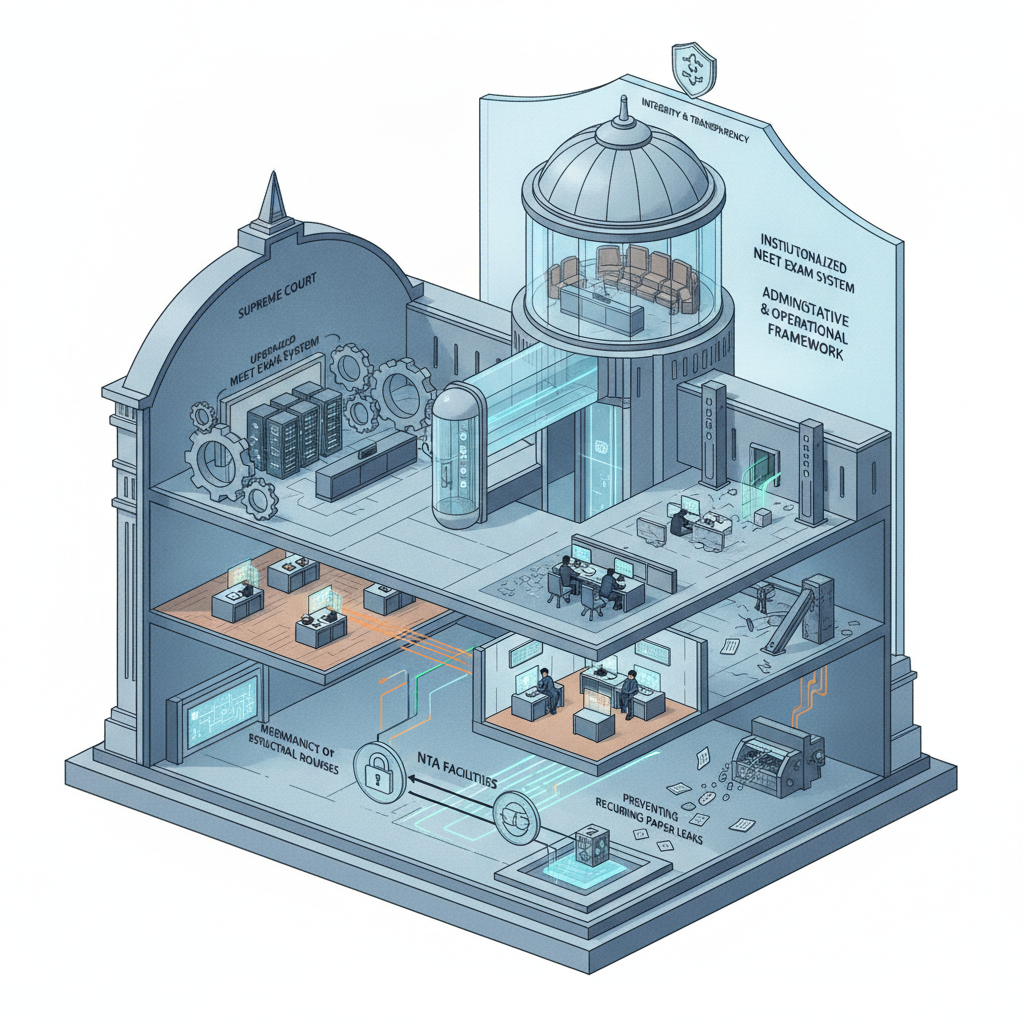
18 Sep Supreme Court to Inspect NTA’s Upgraded NEET Exam System for Leak Prevention
✎ The Supreme Court’s directive to institutionalise the NTA’s governance framework—ensuring permanency of staff, administrative structures, and technological safeguards—aims to restore public trust in NEET-UG by addressing systemic…
Subject Relevance — Where This Topic Fits
- GS Paper II — Governance, Transparency and Accountability | GS Paper III — Issues related to Education and Human Resource Development
- Prelims: National Eligibility-cum-Entrance Test (NEET-UG), National Testing Agency (NTA), Paper leaks in competitive exams, Institutionalisation of exam processes, Committee on Structural Reforms in NEET (Nilekani Panel), K. Radhakrishnan Committee recommendations
- Essay: The role of institutions in ensuring public trust in examinations: A case study of NEET-UG, Balancing innovation and integrity in India’s education system
Quick Revision: The Supreme Court’s directive to institutionalise the NTA’s governance framework—ensuring permanency of staff, administrative structures, and technological safeguards—aims to restore public trust in NEET-UG by addressing systemic vulnerabilities to malpractices.
Why is this in the news?
The Supreme Court, on September 18, 2026, indicated its intention to personally visit the National Testing Agency (NTA) facilities to assess the upgraded mechanisms introduced to prevent recurring paper leaks in the NEET-UG examination. The Court underscored the necessity of institutionalising the NTA’s administrative and operational framework to ensure long-term integrity and transparency in the conduct of the examination, highlighting concerns over the adequacy of human resources and the permanency of structural reforms.
Background
- The NEET-UG, conducted by the NTA, is the sole entrance examination for undergraduate medical and dental courses in India, making its integrity critical for fair access to professional education.
- Recurring incidents of paper leaks in NEET-UG over the past few years have eroded public confidence and led to multiple legal challenges, prompting judicial scrutiny of the NTA’s governance mechanisms.
- The NTA, established in 2017 as an autonomous body under the Ministry of Education, was tasked with conducting fair and transparent examinations, including NEET-UG, JEE Main, and other competitive tests.
- The Supreme Court’s intervention follows a series of petitions alleging systemic failures in the NTA’s examination processes, including allegations of paper leaks and procedural lapses.
- The Union Government constituted a high-powered committee led by Nandan Nilekani in 2026 to recommend structural reforms in NEET-UG, building on earlier recommendations by the K. Radhakrishnan Committee.
- The Court’s emphasis on institutionalisation reflects a broader constitutional principle of ensuring fairness and predictability in public examinations, as enshrined in Articles 14 and 19(1)(g) of the Constitution.
What is the National Testing Agency (NTA) and its role in NEET-UG?
- The NTA is an autonomous, self-sustained premier testing organisation established by the Ministry of Education in 2017 to conduct fair, transparent, and efficient entrance examinations for higher education in India.
- NEET-UG (National Eligibility-cum-Entrance Test for Undergraduate) is a national-level examination conducted by the NTA for admission to MBBS, BDS, AYUSH, and other allied undergraduate medical courses in government and private institutions.
- The NTA is responsible for the entire lifecycle of NEET-UG, including exam design, question paper setting, logistics, evaluation, and result declaration, with a mandate to ensure integrity and minimise malpractices.
- The agency operates under the administrative control of the Department of Higher Education, Ministry of Education, and is governed by a governing body chaired by an eminent academician.
- The NTA’s mandate includes the adoption of advanced technologies such as Artificial Intelligence (AI), machine learning, and blockchain for secure examination processes, though implementation challenges persist.
- The NTA’s role is distinct from that of the Medical Council of India (MCI) or the National Medical Commission (NMC), which regulate medical education standards but do not conduct entrance examinations.
- The NTA’s functioning is guided by the principles of transparency, fairness, and accountability, as mandated by the Right to Information (RTI) Act and judicial precedents on examination integrity.
- The agency’s operational challenges include managing large-scale examinations with over 20 lakh candidates, ensuring secure question paper delivery, and addressing allegations of malpractices.
Key Features
| Feature | Significance |
|---|---|
| Institutionalised NTA structure | Ensures permanency of administrative and operational frameworks to prevent systemic vulnerabilities in NEET conduct. |
| High-powered panel under Nandan Nilekani | Constituted to recommend structural reforms in NEET, incorporating stakeholder consultations and expert inputs. |
| Upgraded NTA facilities | Includes infrastructure overhaul, permanent staffing, and reduced reliance on deputation to enhance operational integrity. |
| Judicial oversight via Supreme Court visit | Demonstrates proactive judicial intervention to assess system readiness and ensure accountability in exam governance. |
| Affidavit filing and public feedback mechanism | Facilitates transparency by mandating NTA to upload affidavits online and invite public suggestions for system improvements. |
Why it Matters
Governance and Institutional Strengthening
- Demonstrates the judiciary’s role in ensuring robust institutional mechanisms for high-stakes examinations, aligning with constitutional principles of fairness and equity in education.
- Highlights the necessity of permanent administrative structures in public institutions to mitigate risks of malpractice and systemic failures.
- Emphasises the importance of stakeholder consultations in policy formulation, particularly for examinations that determine access to critical professional education pathways.
Judicial-Executive Coordination
- Showcases the collaborative approach between the judiciary and executive in addressing systemic deficiencies in public examinations, ensuring checks and balances.
- Illustrates the judiciary’s proactive stance in monitoring the implementation of reformative measures, rather than solely relying on post-incident corrective actions.
- Reinforces the principle that judicial oversight is not adversarial but facilitative, aimed at strengthening governance frameworks.
Public Trust in Examination Systems
- Underscores the critical need to restore public confidence in NEET, a gateway examination for medical education, which is essential for maintaining the integrity of the higher education ecosystem.
- Demonstrates the judiciary’s commitment to addressing recurring issues of paper leaks, which erode societal trust in institutional processes.
- Highlights the role of transparency and public participation in rebuilding credibility in examination governance.
Challenges
1. Systemic Vulnerabilities in Examination Governance
- Recurring paper leaks in NEET indicate deep-rooted structural weaknesses in the examination system, necessitating comprehensive reforms.
- Over-reliance on temporary staff and deputation-based structures compromises the permanency and accountability of the NTA’s operational framework.
- Implementation gaps in recommendations from previous committees (e.g., Radhakrishnan Committee) highlight the challenge of translating policy into practice.
UPSC Link: GS-II: Governance, Transparency & Accountability
2. Balancing Immediate Corrective Measures with Long-Term Institutionalisation
- While immediate measures (e.g., enhanced security protocols) are necessary, they are insufficient without permanent structural reforms in the NTA.
- The challenge lies in ensuring that short-term fixes do not overshadow the need for systemic institutionalisation, which requires sustained political and administrative commitment.
- Judicial intervention, while critical, must be complemented by executive ownership to ensure lasting solutions.
UPSC Link: GS-II: Public Policy & Institutional Reforms
3. Ensuring Human Resource Stability in NTA
- Partial human resource stability in the NTA, as acknowledged by the Centre, poses a risk to the operational readiness of the upgraded system.
- Temporary staffing and frequent deputation cycles undermine the institutional memory and expertise required for seamless examination conduct.
- The challenge extends to attracting and retaining qualified personnel in a high-pressure environment with stringent accountability measures.
UPSC Link: GS-II: Human Resource Management in Governance
4. Transparency and Public Participation in Reform Processes
- While affidavits and public feedback mechanisms are steps toward transparency, ensuring meaningful participation and addressing feedback in a timely manner remains a challenge.
- The judiciary’s directive to upload affidavits online is a positive step, but its effectiveness depends on proactive dissemination and accessibility for stakeholders.
- Balancing confidentiality (e.g., exam security protocols) with transparency is a delicate governance challenge.
UPSC Link: GS-II: Transparency & Citizen-Centric Governance
Challenges — UPSC Perspective
| Issue | Concern |
|---|---|
| Recurring Paper Leaks | Undermines the credibility of NEET and erodes public trust in the examination system. |
| Temporary Staffing Structures | Compromises institutional memory, accountability, and operational efficiency in the NTA. |
| Implementation Gaps in Recommendations | Previous committees’ suggestions (e.g., Radhakrishnan Committee) have not been fully implemented, delaying systemic reforms. |
| Human Resource Stability | Partial staffing stability in the NTA threatens the long-term functionality of the upgraded examination system. |
| Balancing Transparency and Security | Ensuring public participation without compromising exam confidentiality and security protocols. |
| Judicial-Executive Coordination | Sustaining collaborative oversight while avoiding overreach or delays in reform implementation. |
Way Forward
- Constitute a dedicated task force within the NTA to oversee the implementation of the Nilekani panel’s recommendations, ensuring time-bound action and accountability.
- Enhance permanent staffing in the NTA by expediting recruitment processes and reducing reliance on deputation-based appointments.
- Develop a comprehensive security protocol framework for NEET, incorporating technological advancements (e.g., AI-based monitoring, blockchain for answer sheets) and physical safeguards.
- Establish a grievance redressal mechanism for stakeholders (students, parents, institutions) to report anomalies in the examination process, with a dedicated portal for transparency.
- Mandate annual audits of the NTA’s operational and administrative systems by an independent body to assess compliance with reformative measures.
- Strengthen collaboration between the NTA, state agencies, and central investigating bodies (e.g., CBI) to investigate and deter malpractices in examination governance.
- Incorporate periodic judicial reviews of the NTA’s functioning to ensure sustained adherence to reformative measures and public accountability.
- Launch a public awareness campaign to educate stakeholders about the upgraded NEET system, its safeguards, and the role of transparency in rebuilding trust.
UPSC Value Addition
Keywords for Mains Answer-Writing
National Testing Agency · NEET-UG · examination reforms · institutionalisation of examinations · paper leaks · structural reforms in education · Supreme Court oversight · Nilekani Committee · Radhakrishnan Committee · permanent staffing in examinations · NTA infrastructure upgrade · governance of competitive examinations · examination security · institutional permanency · administrative reforms in education
Constitutional & Policy Linkages
- Article 14: Equality before Law – Ensures fairness and non-discrimination in the conduct of examinations like NEET, which are gateways to professional education.
- Article 21: Right to Life and Personal Liberty – Includes the right to a fair and transparent examination process, free from malpractices.
- Article 19(1)(g): Freedom of Profession – Protects the right of students to pursue medical education without systemic barriers caused by examination irregularities.
Concept Flow
Recurring NEET paper leaks → Erosion of public trust in examination governance → Judicial intervention via Supreme Court oversight → Centre’s submission of institutional reforms → Constitution of Nilekani panel for structural reforms → NTA’s upgraded facilities and permanent staffing → Judicial visit to assess system readiness → Public feedback and transparency measures → Implementation of reforms → Restoration of trust in NEET and higher education governance.
Prelims Practice Questions
Q1. Consider the following statements regarding the National Testing Agency (NTA) and NEET-UG:
1. The NTA conducts NEET-UG for admissions to undergraduate medical courses.
2. The Supreme Court has suggested that the NTA should have a permanent staff and verticals to prevent paper leaks.
3. The Nilekani Committee was constituted to recommend structural reforms in the conduct of NEET-UG.
How many of the above statements are correct?
- Only one
- Only two
- All three
- None
Answer: All three — Statements 1 and 3 are correct. Statement 2 is also correct as the Supreme Court emphasised the need for a permanent setup, permanent staff, and permanent verticals in the NTA to institutionalise the examination process and prevent paper leaks.
Q2. Assertion (A): The Supreme Court has directed the NTA to upload its affidavit on its website for public scrutiny.
Reason (R): The Supreme Court aims to ensure transparency and allow stakeholders to provide suggestions on the upgraded NEET-UG examination system.
Options:
A. Both A and R are true, and R is the correct explanation of A.
B. Both A and R are true, but R is NOT the correct explanation of A.
C. A is true, but R is false.
D. A is false, but R is true.
Answer: ? — Both the Assertion (A) and Reason (R) are true, and R correctly explains A. The Supreme Court directed the NTA to upload its affidavit on its website to invite public suggestions, thereby ensuring transparency in the examination reform process.
Q3. Match the following committees with their respective roles in the context of NEET-UG reforms:
Committee | Role
1. Nilekani Committee | A. Conducted exhaustive consultations with stakeholders to suggest structural reforms in NEET-UG.
2. Radhakrishnan Committee | B. Constituted to recommend administrative and infrastructure reforms in the NTA.
3. NTA | C. Conducted the NEET-UG examination and proposed institutionalisation of the examination process.
Options:
A. 1-A, 2-B, 3-C
B. 1-B, 2-A, 3-C
C. 1-A, 2-C, 3-B
D. 1-C, 2-A, 3-B
Answer: ? — 1-A: The Nilekani Committee was constituted to suggest structural reforms in NEET-UG. 2-B: The Radhakrishnan Committee was led by former ISRO chairman K Radhakrishnan and made recommendations on structural reforms. 3-C: The NTA is the agency responsible for conducting NEET-UG and has proposed institutionalisation of the examination process.
Mains Practice Question
✍ The Supreme Court has emphasised the need for the institutionalisation of the National Testing Agency (NTA) to prevent recurring paper leaks in NEET-UG. Critically examine the challenges in institutionalising competitive examinations in India and suggest measures to enhance the credibility and security of such examinations. (15 Marks)
Approach: MODEL-ANSWER SKELETON:
1. Introduction (2 marks): Define institutionalisation in the context of competitive examinations and highlight the recurring issue of paper leaks in NEET-UG.
2. Challenges in Institutionalisation (6 marks):
– Lack of permanent staff and verticals in NTA (as highlighted by the Supreme Court).
– Over-reliance on deputation and temporary appointments leading to administrative inefficiencies.
– Infrastructure gaps and lack of robust technological safeguards.
– Political and administrative interference in examination processes.
– Absence of a dedicated, autonomous regulatory framework for examinations.
3. Measures to Enhance Credibility and Security (5 marks):
– Strengthening administrative permanency: Permanent staff, verticals, and reduced deputation.
– Technological interventions: Blockchain for question paper security, AI-based proctoring, and encrypted question banks.
– Legal and regulatory framework: Enactment of a dedicated law for competitive examinations (e.g., Competitive Examinations (Regulation and Prevention of Malpractices) Act).
– Transparency and accountability: Public disclosure of reforms, stakeholder consultations, and grievance redressal mechanisms.
– Capacity building: Training for staff on cybersecurity, ethical conduct, and crisis management.
4. Conclusion (2 marks): Reiterate the need for a systemic, permanent solution to institutionalise examinations and restore public trust in NEET-UG.
Source: orissapost.com
Generated by AanyaAi for educational purpose.
Related guides on our sites
- Current affairs for upsc 2026
- Best PSIR optional coaching for upsc
- Best PSIR optional teacher for upsc
- Best teacher of PSIR optional for upsc

- Supreme Court to Inspect NTA’s Upgraded NEET Exam System for Leak Prevention - September 18, 2026
- ज़ेलेंस्की ने होस्ट किया क्षेत्रीय शिखर सम्मेलन, रूस ने यूक्रेन पर किया हमला - September 18, 2026
- Zelenskyy’s Carpathian Eight Summit: Ukraine’s New Alliance Against Russia - September 18, 2026

No Comments