


18 Sep Bombay HC Clears Versova-Madh Bridge: Mangroves Felling Approved for Traffic Relief
✎ The Versova-Madh connector bridge project exemplifies the tension between urban infrastructure development and mangrove conservation, with the Bombay High Court permitting mangrove felling only after ensuring compensatory…
Subject Relevance — Where This Topic Fits
- GS Paper II — Governance, Constitution, Polity, Social Justice and International Relations (Urban Governance, Environmental Governance) | GS Paper III — Environment and Disaster Management, Infrastructure (Urban Transport, Environmental Impact Assessment)
- Prelims: Mangrove ecosystems, Environmental Impact Assessment (EIA) 2006, Coastal Regulation Zone (CRZ) Notification 2019, Bombay High Court, Brihanmumbai Municipal Corporation (BMC), Public Interest Litigation (PIL), compensatory afforestation, in-situ restoration, cable-stayed flyover
- Essay: Urbanisation vs. Environmental Conservation: The Case of Mumbai’s Infrastructure Projects, Balancing Development and Ecology: Lessons from Coastal Urban Governance
Quick Revision: The Versova-Madh connector bridge project exemplifies the tension between urban infrastructure development and mangrove conservation, with the Bombay High Court permitting mangrove felling only after ensuring compensatory afforestation and restoration measures, as mandated by environmental governance frameworks.
Why is this in the news?
The Bombay High Court, in a judgment dated 17 September 2026, permitted the felling of 1,237 mangroves for the construction of the Versova-Madh connector bridge, a Rs 2,395-crore cable-stayed flyover in suburban Mumbai. The court held that the project, aimed at reducing travel time from 22 km to 1.5 km between Versova and Madh Island, serves a public purpose and is not for private commercial benefit. The judgment underscores the judiciary’s role in adjudicating conflicts between urban infrastructure development and ecological conservation, particularly in ecologically sensitive coastal zones.
Background
- Mumbai, India’s financial capital, faces severe traffic congestion due to unplanned urban growth and limited east-west connectivity in its western suburbs.
- The Versova-Madh connector bridge is proposed to alleviate traffic bottlenecks by providing a direct link over Malad Creek, reducing travel distance and time between Versova and Madh Island.
- Mangroves in Mumbai serve as critical ecological barriers against coastal erosion, storm surges, and flooding, while also acting as carbon sinks and biodiversity hotspots.
- The Coastal Regulation Zone (CRZ) Notification, 2019, regulates developmental activities in coastal areas to protect fragile ecosystems, including mangroves.
- The Bombay High Court’s 2018 ruling mandates judicial approval for projects involving mangrove felling, ensuring compliance with environmental safeguards.
- The Brihanmumbai Municipal Corporation (BMC) is the implementing authority for the project, with compensatory afforestation and restoration measures proposed as mitigation.
What is the Versova-Madh Connector Bridge Project?
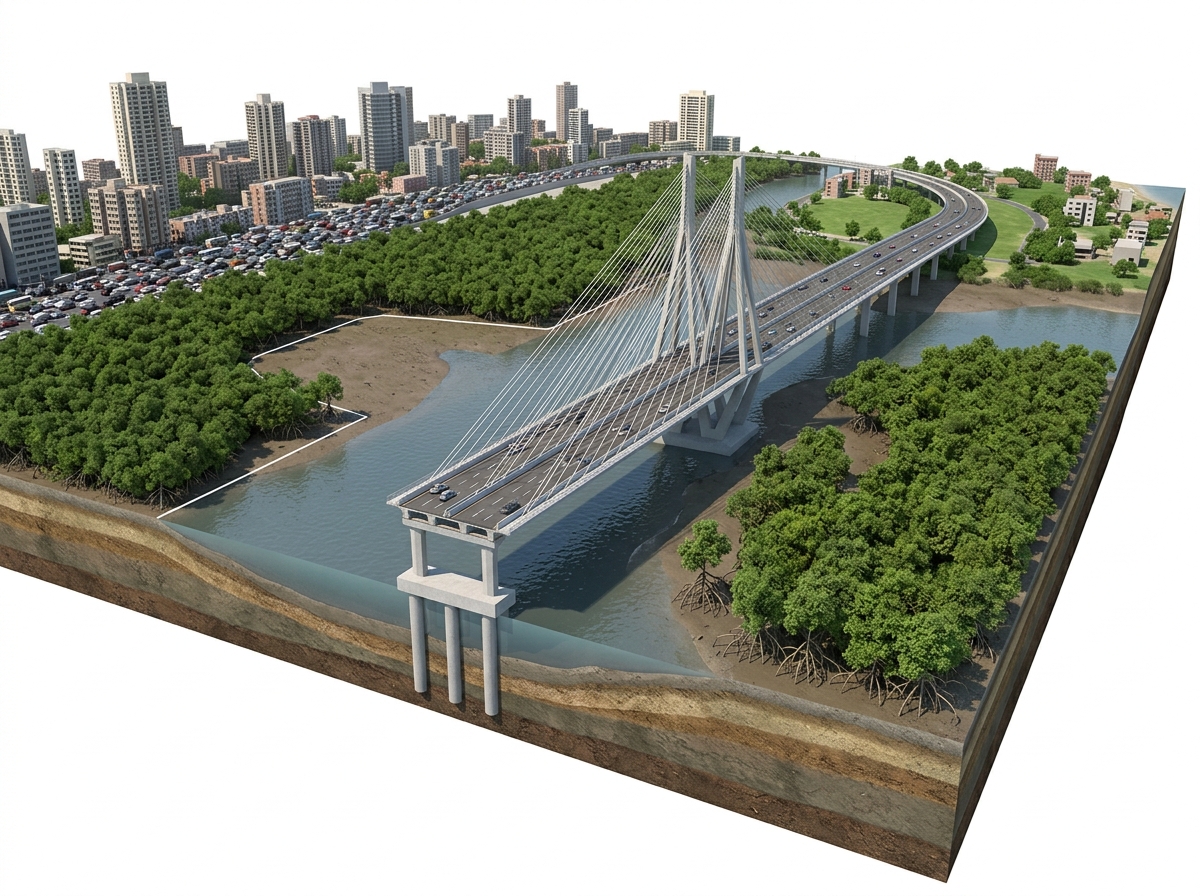
- The Versova-Madh connector is a proposed Rs 2,395-crore cable-stayed flyover spanning 2,064 metres over Malad Creek, aimed at improving connectivity between Versova and Madh Island in Mumbai’s western suburbs.
- The project seeks to reduce travel distance from 22 km to 1.5 km, addressing chronic traffic congestion and inordinate travel delays in the region.
- The bridge is designed as a public infrastructure project, not for private commercial benefit, as noted by the Bombay High Court in its judgment.
- The project involves the felling of 1,237 mangroves, necessitating compliance with the Bombay High Court’s 2018 ruling on mangrove conservation.
- The BMC has proposed compensatory measures, including the planting of 39,000 mangroves on 9 hectares of degraded land in the North Konkan region and in-situ restoration over 2.5 hectares.
- A financial provision of Rs 1.42 crore has been deposited for 10-year plantation, protection, and maintenance of compensatory mangroves.
- The project is subject to judicial oversight, with the Bombay High Court holding the BMC liable for civil and criminal consequences in case of breach of undertakings.
- The judgment reflects the judiciary’s role in balancing developmental imperatives with ecological conservation in urban governance.
Key Features
| Feature | Significance |
|---|---|
| Proposed cable-stayed flyover | A 2,064-metre bridge over Malad Creek to reduce travel time between Versova and Madh Island from 22 km to 1.5 km. |
| Mangrove felling permission | 1,237 mangroves permitted for felling under mandatory court approval for public projects, as per 2018 Bombay High Court ruling. |
| Mangrove restoration measures | 39,000 mangroves to be planted on 9 hectares of degraded land in North Konkan; 2.5 hectares for in-situ restoration; only 0.2 hectares permanently lost. |
| Financial provision for restoration | BMC deposited ₹1.42 crore for 10-year plantation, protection, and maintenance of mangroves. |
| Court’s public interest observation | HC noted the project’s intent to alleviate traffic congestion and improve connectivity, weighing public benefit against environmental impact. |
Why it Matters
Urban Infrastructure Development
- The Versova-Madh connector exemplifies the trade-offs between urban mobility needs and ecological conservation in densely populated metropolitan regions.
- Reduction in travel time from 22 km to 1.5 km addresses chronic traffic congestion in Mumbai’s western suburbs, a critical issue for economic productivity and quality of life.
- The project aligns with Mumbai’s broader urban planning goals to enhance intra-city connectivity via coastal corridors, reducing reliance on inland routes.
Environmental Governance & Mitigation
- The court’s conditional approval underscores the role of judicial oversight in balancing development imperatives with environmental safeguards under the 2018 ruling.
- Mandatory mangrove restoration (39,000 saplings) and in-situ conservation (2.5 hectares) demonstrate adherence to the ‘no net loss’ principle in ecological mitigation.
- The financial provision (₹1.42 crore) reflects a structured approach to long-term ecological restoration, addressing concerns of irreversible damage.
Judicial Precedent & Procedural Safeguards
- The 2018 Bombay High Court ruling mandating court permission for public projects involving environmental impact sets a procedural benchmark for similar infrastructure proposals.
- The HC’s emphasis on non-commercial public purpose (BMC’s submission) reinforces the distinction between developmental projects and private ventures in environmental clearances.
- The ruling’s stipulation of civil and criminal liability for breach of undertakings ensures accountability in project execution and mitigation compliance.
Challenges
1. Ecological Trade-offs in Urban Projects
- Mangrove ecosystems provide critical coastal protection, biodiversity habitat, and carbon sequestration; their felling risks irreversible ecological loss despite mitigation measures.
- Long-term viability of planted mangroves (39,000 saplings) depends on post-plantation maintenance, which is susceptible to urban pressures and funding continuity.
- The project’s environmental impact assessment must account for cumulative effects of similar infrastructure projects in the Mumbai Metropolitan Region.
UPSC Link: GS-III: Environmental Impact Assessment (EIA) 2006
2. Urban Congestion vs. Sustainable Mobility
- Flyovers may offer short-term traffic relief but can exacerbate long-term congestion by inducing demand (induced traffic effect) and discouraging public transport use.
- The project’s focus on road connectivity overlooks alternative sustainable mobility solutions (e.g., coastal metro corridors, water transport) that could reduce environmental footprint.
- Traffic congestion in Mumbai is exacerbated by inadequate public transport infrastructure, requiring systemic solutions beyond isolated road projects.
UPSC Link: GS-III: Sustainable Urban Mobility
3. Judicial Role in Environmental Governance
- Courts face the challenge of adjudicating between developmental urgency and ecological preservation, often lacking domain expertise in environmental sciences.
- The 2018 ruling’s reliance on court permission may lead to delays in critical infrastructure, necessitating streamlined but robust environmental appraisal mechanisms.
- Balancing public interest (traffic relief) with environmental justice requires nuanced judicial reasoning to avoid precedents that either stifle development or enable ecological degradation.
UPSC Link: GS-II: Judicial Review and Environmental Law
4. Financial and Administrative Feasibility
- The ₹2,395-crore project cost and ₹1.42-crore restoration fund highlight the financial burden of mitigating environmental impacts, raising questions about cost-effectiveness.
- BMC’s capacity to monitor and enforce long-term mangrove restoration (10-year commitment) is critical but often under-resourced in municipal governance.
- Delays in project execution due to legal or administrative hurdles may erode public trust in infrastructure delivery systems.
UPSC Link: GS-II: Municipal Governance and Financial Devolution
5. Climate Resilience and Coastal Vulnerability
- Mangroves act as natural barriers against storm surges and sea-level rise; their reduction could increase Mumbai’s vulnerability to climate-induced coastal hazards.
- The project’s location in Malad Creek, a tidal estuary, requires assessment of its impact on local hydrology and sediment dynamics.
- Urban heat island effects in Mumbai are exacerbated by loss of green-blue infrastructure like mangroves, necessitating integrated climate adaptation strategies.
UPSC Link: GS-III: Climate Change and Coastal Zone Management
Challenges — UPSC Perspective
| Issue | Concern |
|---|---|
| Mangrove loss | Irreversible ecological damage despite restoration measures; loss of biodiversity and coastal protection. |
| Traffic induction | Short-term congestion relief may lead to long-term increased traffic due to induced demand. |
| Judicial delays | Court-mandated clearances may slow critical infrastructure projects, affecting urban mobility. |
| Restoration funding | Sustainability of ₹1.42 crore fund over 10 years for mangrove maintenance. |
| Climate vulnerability | Reduced mangrove cover increases Mumbai’s exposure to storm surges and sea-level rise. |
| Public transport neglect | Focus on road infrastructure may sideline sustainable mobility solutions like metro or water transport. |
Way Forward
- Conduct a comprehensive Environmental Impact Assessment (EIA) for the Versova-Madh connector, including cumulative impact analysis with other Mumbai infrastructure projects.
- Explore integrated coastal zone management plans to balance developmental needs with ecological preservation, incorporating mangrove conservation as a priority.
- Strengthen municipal capacity for long-term ecological monitoring and enforcement of restoration commitments, with third-party audits for accountability.
- Develop a city-wide sustainable mobility strategy that integrates road, metro, and water transport to reduce reliance on private vehicles and flyovers.
- Enhance public consultation mechanisms in infrastructure projects to ensure transparency and address community concerns regarding environmental trade-offs.
- Invest in research on mangrove restoration techniques tailored to Mumbai’s urban estuarine conditions to improve survival rates of planted saplings.
- Align the project with climate adaptation plans for Mumbai, ensuring that coastal infrastructure enhances rather than compromises resilience to climate change.
UPSC Value Addition
Keywords for Mains Answer-Writing
Mumbai traffic congestion · Versova-Madh connector bridge · mangrove conservation · Bombay High Court environmental clearance · infrastructure vs ecology balance · public interest litigation environmental impact · cable-stayed flyover Mumbai · mangrove restoration measures · Brihanmumbai Municipal Corporation · Malad Creek bridge project · environmental mitigation in infrastructure · coastal zone regulation mangroves · urban mobility solutions Mumbai · environmental jurisprudence Bombay High Court · sustainable development public interest
Concept Flow
Urban traffic congestion → Public demand for mobility solutions → Proposal for Versova-Madh connector bridge → Environmental impact (mangrove felling) → Court-mandated clearance under 2018 ruling → Balancing public interest vs. ecological preservation → Conditional approval with restoration measures → Implementation with liability clauses → Long-term ecological and urban mobility outcomes.
Prelims Practice Questions
Q1. Consider the following statements regarding the Versova-Madh connector bridge project in Mumbai:
1. The project involves the construction of a cable-stayed flyover over Malad Creek.
2. The Bombay High Court permitted the felling of 1,237 mangroves for the project.
3. The project aims to reduce travel distance between Versova and Madh Island from 22 km to 1.5 km.
4. The civic body has deposited Rs 1.42 crore for mangrove restoration over a 10-year period.
How many of the above statements are correct?
- Only one
- Only two
- Only three
- All
Answer: All — Statements 1, 2, and 3 are correct. Statement 4 is incorrect as the amount deposited is Rs 1.42 crore for plantation, protection, and maintenance, not exclusively for restoration.
Q2. Assertion (A): The Bombay High Court permitted the felling of mangroves for the Versova-Madh connector bridge project under the public interest doctrine.
Reason (R): The project was deemed essential to alleviate traffic congestion and improve urban connectivity in Mumbai, with compensatory afforestation measures proposed.
Options:
A. Both A and R are true, and R is the correct explanation of A.
B. Both A and R are true, but R is not the correct explanation of A.
C. A is true, but R is false.
D. A is false, but R is true.
Answer: ? — Both the assertion and reason are true. The court permitted the felling under public interest, and the reason correctly explains the rationale behind the decision, supported by compensatory afforestation measures.
Mains Practice Question
✍ The Bombay High Court’s clearance for the Versova-Madh connector bridge project, involving the felling of mangroves, exemplifies the tension between developmental imperatives and environmental conservation in India. Critically analyse the legal and constitutional framework governing such trade-offs, with reference to relevant judicial precedents and statutory provisions. Also, examine the implications of compensatory afforestation measures in mitigating ecological losses. (15 Marks)
Approach: MODEL-ANSWER SKELETON:
1. **Introduction (2 marks)**: Define the core issue—balancing infrastructure development with environmental conservation in India’s urban context. Mention the Bombay High Court’s order and the Versova-Madh connector project as the case in point.
2. **Legal and Constitutional Framework (5 marks)**:
– **Right to Life (Article 21)**: Link to environmental protection as part of the right to life (e.g., Subhash Kumar v. State of Bihar, 1991).
– **Directive Principles of State Policy (Articles 48A and 51A(g))**: State’s obligation to protect and improve the environment.
– **Environment Protection Act, 1986**: Role of the Act in regulating projects with environmental impacts.
– **Forest Conservation Act, 1980**: Applicability to mangrove areas and the need for prior approval.
– **Coastal Regulation Zone (CRZ) Notification, 2019**: Provisions governing activities in coastal zones, including mangroves.
– **Judicial Precedents**: Cite landmark cases like T.N. Godavarman Thirumulpad v. Union of India (1997) on the protection of forests and Vellore Citizens Welfare Forum v. Union of India (1996) on sustainable development.
3. **Judicial Approach to Trade-offs (4 marks)**:
– **Public Interest Doctrine**: Explain how courts balance public interest (e.g., traffic congestion relief) with environmental harm (e.g., mangrove loss).
– **Compensatory Afforestation**: Discuss the compensatory afforestation fund (Compensatory Afforestation Fund Management and Planning Authority, CAMPA) and its role in mitigating ecological losses.
– **Precautionary Principle**: Reference the principle’s application in environmental jurisprudence (e.g., M.C. Mehta v. Union of India, 1997).
– **Procedural Safeguards**: Highlight the Bombay High Court’s emphasis on compensatory measures (e.g., planting 39,000 mangroves, in-situ restoration).
4. **Critique and Challenges (3 marks)**:
– **Effectiveness of Compensatory Measures**: Discuss limitations of compensatory afforestation (e.g., time lag, ecological equivalence, long-term viability).
– **Alternative Solutions**: Explore whether non-structural solutions (e.g., public transport expansion, congestion pricing) could have been prioritised.
– **Ecological Impact**: Highlight the permanent loss of 0.2 hectares of mangroves and the fragility of coastal ecosystems.
5. **Conclusion (1 mark)**: Summarise the need for a nuanced approach that integrates developmental goals with ecological sustainability, emphasising the role of judicial oversight and statutory compliance.
Source: The Indian Express
Generated by AanyaAi for educational purpose.
Related guides on our sites
- Best geography optional coaching
- Best geography optional coaching
- Best ias coaching in mumbai
- Best geography optional teacher

- HAL ने IAF को दो LCA ट्रेनर विमान सौंपे: सुरक्षा तैयारी में बड़ा कदम - September 19, 2026
- HAL delivers two LCA trainer jets to IAF: Key for UPSC & State PCS - September 19, 2026
- एनसीएल द्वारा शुरू हुआ ‘विशेष अभियान 6.0’: स्वच्छता और ई-कचरा प्रबंधन पर जोर - September 19, 2026

No Comments