


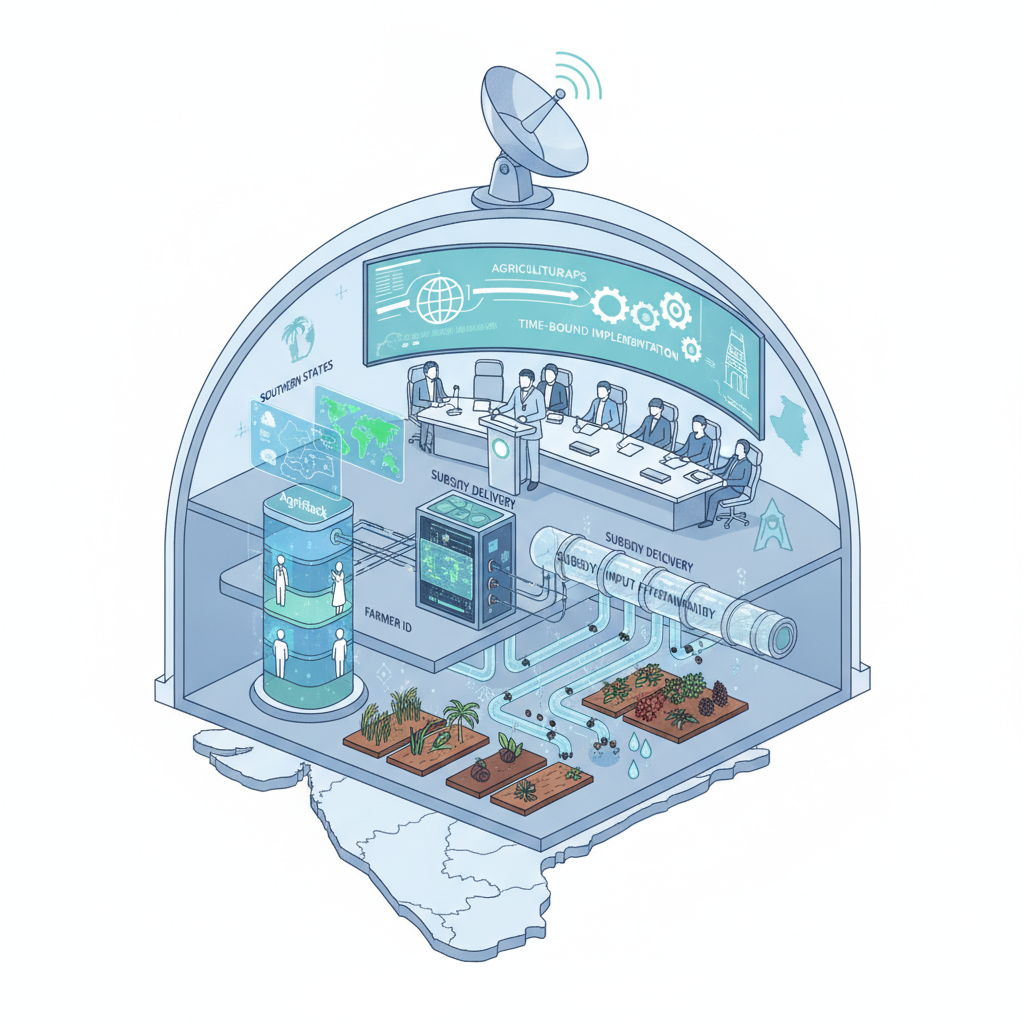
18 Sep Shivraj Singh Chouhan Urges Southern States to Fast-Track Agricultural Reforms for UPSC 2026
✎ AgriStack and Farmer ID are critical digital public goods that enable precision agriculture, targeted welfare delivery, and evidence-based policymaking in India's agricultural sector.
Subject Relevance — Where This Topic Fits
- GS Paper III — Agriculture | GS Paper III — Science and Technology (Digital Public Infrastructure) | GS Paper III — Government Policies and Interventions
- Prelims: National Mission on Sustainable Agriculture (NMSA), AgriStack, Farmer ID, Digital Crop Survey, Geo-referencing of land records, Krishi Vigyan Kendra (KVK), Pradhan Mantri Kisan Samman Nidhi (PM-KISAN), Rabi and Kharif crop planning
- Essay: Agrarian distress and the role of technology in transforming Indian agriculture, Federalism in India: Centre-State coordination in policy implementation
Quick Revision: AgriStack and Farmer ID are critical digital public goods that enable precision agriculture, targeted welfare delivery, and evidence-based policymaking in India’s agricultural sector.
Why is this in the news?
The Union Minister of Agriculture and Farmers’ Welfare addressed the Regional Agricultural Conclave for Southern States in Hyderabad, emphasizing the urgency of translating policy commitments into actionable outcomes. The event highlighted the progress and gaps in digital agricultural infrastructure, including Farmer ID and AgriStack, while underscoring the need for time-bound implementation of agricultural roadmaps to enhance productivity and sustainability in the region.
Background
- The Union Government has prioritized the digital transformation of agriculture through initiatives like AgriStack and Farmer ID to improve farmer welfare, enhance input efficiency, and streamline subsidy delivery.
- Southern states, including Telangana, Karnataka, Tamil Nadu, Kerala, and Andaman & Nicobar Islands, are critical agricultural hubs with diverse cropping patterns and high productivity potential.
- The Digital Crop Survey (DCS) and geo-referencing of land records are foundational to creating accurate farmer registries and land-use databases.
- The Pradhan Mantri Kisan Samman Nidhi (PM-KISAN) and other welfare schemes rely on accurate farmer identification for effective implementation.
- Regional Agricultural Conclaves are institutionalized platforms for Centre-State collaboration to align agricultural policies with local agro-climatic conditions.
Key Components of the Southern States’ Agricultural Roadmap
- **Farmer ID and AgriStack**: Digital identity systems for farmers to enable targeted interventions, input subsidies, and crop insurance. States like Telangana and Karnataka have achieved over 75% coverage, while Kerala, Tamil Nadu, and Andaman & Nicobar Islands require accelerated progress.
- **Geo-referencing of Land Records**: Precision mapping of agricultural land to resolve disputes, optimize resource allocation, and enhance land-use efficiency.
- **Scientific Outreach via KVKs**: Krishi Vigyan Kendras (KVKs) are tasked with bridging the gap between agricultural research and farm-level application by engaging directly with farmers and state officials.
- **Multi-lingual Advisory Services**: Expansion of agricultural advisory services in 13 regional languages to ensure inclusivity and accessibility for farmers across linguistic regions.
- **Centre-State Coordination**: The ‘Team Agriculture’ model emphasizes collaborative governance, where the Centre, states, scientists, and farmers work in unison to implement agricultural policies and resolve implementation bottlenecks.
- **Time-Bound Commitments**: The Union Minister underscored the necessity of adhering to deadlines for policy commitments to avoid inefficiencies and ensure accountability in agricultural governance.
- **Rabi Conference (28-29 September)**: A follow-up national-level conference in Delhi to finalize state-wise crop plans for the Rabi season, ensuring alignment with agro-climatic conditions and market demands.
Key Features
| Feature | Significance |
|---|---|
| Regional Agricultural Conference | Provides a platform for Centre-State coordination on agricultural policies, ensuring alignment with national priorities while addressing regional agronomic challenges. |
| Farmer ID System | A digital identity for farmers enabling targeted delivery of subsidies, insurance, and extension services; critical for precision agriculture and welfare schemes. |
| AgriStack | A unified digital ecosystem integrating land records, farmer data, and agricultural inputs to enhance productivity, transparency, and policy formulation. |
| Digital Crop Survey | Geospatial mapping of agricultural land to improve land-use planning, crop insurance assessment, and resource allocation. |
| Georeferencing of Land Parcels | Facilitates accurate land records, reduces disputes, and supports precision farming through spatial data integration. |
Why it Matters
Economic
- Enhances agricultural productivity through data-driven interventions, reducing input wastage and improving output quality.
- Facilitates seamless disbursement of agricultural subsidies and insurance claims, reducing leakages and corruption.
- Strengthens India’s position as a global food basket by improving supply chain efficiency and traceability.
Technological
- Promotes the adoption of digital tools in agriculture, bridging the gap between farmers and scientific research.
- Enables real-time monitoring of agricultural activities, aiding in climate-resilient farming practices.
- Supports the integration of AI and machine learning for predictive analytics in crop management.
Governance
- Demonstrates Centre-State collaboration in implementing national agricultural policies, ensuring uniformity in implementation.
- Encourages participatory governance by involving farmers, scientists, and policymakers in decision-making processes.
- Promotes accountability through time-bound commitments and measurable outcomes.
Social
- Empowers small and marginal farmers by providing access to digital resources and extension services.
- Reduces information asymmetry between farmers and markets, improving bargaining power.
- Enhances food security by ensuring accurate crop forecasting and supply chain optimization.
Challenges
1. Digital Divide and Infrastructure Gaps
- Uneven penetration of digital infrastructure across states, particularly in remote and tribal regions.
- Limited digital literacy among farmers, hindering adoption of digital tools like Farmer ID and AgriStack.
- Reliance on manual land records in some states, delaying digitization efforts.
UPSC Link: GS3: Science & Tech / GS3: Agriculture
2. Data Privacy and Security Concerns
- Risk of misuse of farmer data due to inadequate cybersecurity measures in digital platforms.
- Lack of clear legal frameworks for data ownership and consent in agricultural databases.
- Potential for exclusion of farmers from welfare schemes due to incomplete or inaccurate data.
UPSC Link: GS2: Governance / GS3: Security
3. Inter-State Coordination and Policy Fragmentation
- Variations in state-level implementation of digital agricultural schemes, leading to inconsistencies.
- Delays in land record digitization due to bureaucratic hurdles and inter-departmental coordination issues.
- Divergent priorities among states, with some prioritizing industrialization over agricultural digitization.
UPSC Link: GS2: Federalism / GS3: Agriculture
4. Farmer Resistance and Behavioral Barriers
- Skepticism among farmers regarding the benefits of digital tools, leading to low adoption rates.
- Cultural resistance to sharing personal and land data due to historical grievances with land records.
- Lack of awareness campaigns to educate farmers on the utility of digital platforms.
UPSC Link: GS1: Society / GS3: Agriculture
5. Climate Vulnerability and Adaptation
- Inadequate integration of climate-resilient practices in digital agricultural frameworks.
- Limited use of geospatial data for disaster management and crop insurance in vulnerable regions.
- Slow adoption of precision farming techniques due to high initial costs and lack of incentives.
UPSC Link: GS3: Environment / GS3: Agriculture
Challenges — UPSC Perspective
| Issue | Concern |
|---|---|
| Digital Literacy | Low awareness among farmers about digital tools and their benefits. |
| Data Accuracy | Incomplete or outdated land records leading to errors in Farmer ID and AgriStack. |
| Inter-State Disparities | Uneven progress in digitization across states, creating regional imbalances. |
| Cybersecurity Risks | Potential for data breaches and misuse of sensitive farmer information. |
| Climate Integration | Limited linkage between digital platforms and climate-resilient agricultural practices. |
Government Initiatives — Must-Memorise for Prelims
- AgriStack
- Farmer ID System
- Digital Crop Survey
- Pradhan Mantri Kisan Samman Nidhi (PM-KISAN) [for context, as it relies on Farmer ID]
- National Mission on Sustainable Agriculture (NMSA) [for context, as it aligns with digital agriculture]
Way Forward
- Accelerate the completion of Farmer ID and AgriStack in lagging states (Kerala, Tamil Nadu, Andaman & Nicobar) with targeted capacity-building programs.
- Establish a dedicated inter-state task force to monitor and resolve bottlenecks in land record digitization and georeferencing.
- Launch region-specific awareness campaigns in local languages to educate farmers on the benefits of digital tools and data-sharing protocols.
- Integrate climate-resilient practices into digital agricultural frameworks, leveraging geospatial data for disaster preparedness.
- Strengthen cybersecurity protocols for agricultural databases, including regular audits and farmer data protection policies.
- Incentivize private sector participation in developing low-cost digital solutions for small and marginal farmers.
- Ensure real-time monitoring of progress through a centralized dashboard, with periodic reviews by the Centre and States.
- Promote public-private partnerships to bridge the digital divide, particularly in remote and tribal regions.
UPSC Value Addition
Keywords for Mains Answer-Writing
Agricultural Roadmap for Southern States · Digital Public Infrastructure in Agriculture · Farmer Identification Database (Farmer ID) · AgriStack · Land Records Modernisation · Regional Agricultural Conference · Pradhan Mantri Kisan Samman Nidhi (PM-KISAN) · National Mission on Sustainable Agriculture (NMSA) · Krishi Vigyan Kendras (KVKs) · Georeferencing of Land Parcels · Digital Crop Survey · Agricultural Data Governance · Centre-State Coordination in Agriculture · Kisan Credit Card (KCC) Scheme · Agricultural Research and Extension · National Food Security Mission (NFSM) · Sustainable Agriculture · Agricultural Policy Coherence
Concept Flow
Regional Agricultural Conference → Centre-State coordination on agricultural policies → Farmer ID and AgriStack implementation → Digital Crop Survey and georeferencing → Data-driven agricultural governance → Enhanced productivity and welfare delivery. → Farmer ID System → Targeted subsidy disbursement → Reduced leakages and corruption → Improved farmer welfare. → AgriStack → Unified digital ecosystem → Integration of land records, farmer data, and inputs → Precision agriculture and policy formulation. → Digital Crop Survey → Geospatial mapping of agricultural land → Accurate land-use planning → Climate-resilient farming practices. → Georeferencing of Land Parcels → Accurate land records → Reduced disputes → Efficient resource allocation. → Centre-State collaboration → Uniform policy implementation → Reduced regional disparities → National food security.
Prelims Practice Questions
Q1. Consider the following statements regarding the Farmer Identification Database (Farmer ID) in India:
1. Farmer ID is a digital identity for farmers to access agricultural schemes and benefits.
2. The progress of Farmer ID creation is uniform across all states in India.
3. Farmer ID is a component of the AgriStack initiative.
4. Farmer ID creation is mandatory for availing benefits under the Pradhan Mantri Kisan Samman Nidhi (PM-KISAN) scheme.
How many of the above statements are correct?
- Only one
- Only two
- Only three
- All four
Answer: Only three — Statements 1 and 3 are correct as Farmer ID is a digital identity linked to AgriStack for accessing agricultural benefits. Statement 2 is incorrect because progress varies across states, with Telangana and Karnataka achieving over 75% coverage while Kerala, Tamil Nadu, and Andaman require more effort. Statement 4 is incorrect as PM-KISAN benefits are currently disbursed based on land records and Aadhaar, not exclusively through Farmer ID.
Q2. Assertion (A): The AgriStack initiative aims to create a unified digital infrastructure for agricultural data governance in India.
Reason (R): AgriStack integrates Farmer ID, land records, and crop survey data to enable targeted delivery of agricultural schemes and services.
In the context of the above two statements, which one of the following is correct?
- Both A and R are true, and R is the correct explanation of A
- Both A and R are true, but R is not the correct explanation of A
- A is true but R is false
- A is false but R is true
Answer: Both A and R are true, and R is the correct explanation of A — Both the Assertion (A) and Reason (R) are true. AgriStack is designed as a comprehensive digital public infrastructure for agriculture, integrating Farmer ID, land records, and crop survey data to streamline agricultural governance and service delivery. The Reason (R) correctly explains the Assertion (A).
Q3. Match the following agricultural initiatives with their respective objectives:
Column I (Initiative) | Column II (Objective)
———————————————–|————————————————-
A. AgriStack | 1. Digitisation of land records and farmer data
B. Farmer ID | 2. Unified digital identity for farmers
C. Digital Crop Survey | 3. Accurate estimation of crop acreage
D. Krishi Vigyan Kendras (KVKs) | 4. Agricultural extension and research
Select the correct match:
- A-1, B-2, C-3, D-4
- A-2, B-1, C-4, D-3
- A-3, B-4, C-1, D-2
- A-4, B-3, C-2, D-1
Answer: A-1, B-2, C-3, D-4 — The correct matches are: AgriStack (A) focuses on digitisation of land records and farmer data (1), Farmer ID (B) provides a unified digital identity for farmers (2), Digital Crop Survey (C) aims at accurate estimation of crop acreage (3), and Krishi Vigyan Kendras (KVKs) (D) are dedicated to agricultural extension and research (4).
Mains Practice Question
✍ The Regional Agricultural Conference for Southern States underscores the need for a coherent agricultural roadmap anchored in digital public infrastructure. In this context, critically examine the role of Farmer ID and AgriStack in transforming agricultural governance in India. Also, discuss the challenges in their implementation and suggest measures to ensure timely and effective rollout. (15 Marks)
Approach: MODEL-ANSWER SKELETON:
1. **Introduction (2 marks)**
– Briefly define Farmer ID and AgriStack as components of India’s digital agricultural ecosystem.
– Mention their alignment with the broader goals of agricultural transformation and data-driven governance.
2. **Role of Farmer ID and AgriStack (5 marks)**
– Farmer ID: Digital identity for farmers to access schemes (e.g., PM-KISAN, KCC), reduce leakages, and enable targeted delivery.
– AgriStack: Integrated platform linking land records, crop surveys, and farmer data for evidence-based policymaking and service delivery.
– Reference to the Regional Agricultural Conference’s emphasis on time-bound commitments and Centre-State coordination.
3. **Challenges in Implementation (5 marks)**
– **Data Disparities**: Uneven progress across states (e.g., Telangana/Karnataka vs. Kerala/Tamil Nadu/Andaman) due to administrative capacity and digital divide.
– **Interoperability**: Lack of seamless integration between land records, Farmer ID, and other databases (e.g., Aadhaar, revenue records).
– **Farmer Awareness**: Low digital literacy among farmers hindering adoption and utilisation.
– **Institutional Coordination**: Need for stronger collaboration between Centre, states, KVKs, and scientific institutions.
– **Privacy and Security**: Concerns over data misuse and lack of robust cybersecurity frameworks.
4. **Measures for Effective Rollout (3 marks)**
– **Time-bound Targets**: Strict adherence to deadlines for Farmer ID creation and land record digitisation, as emphasised in the conference.
– **Capacity Building**: Strengthening state agencies and KVKs to support farmers in adopting digital tools.
– **Awareness Campaigns**: Multi-lingual outreach (as mentioned for 13 regional languages) to educate farmers.
– **Data Governance Framework**: Clear legal provisions for data privacy, security, and interoperability under a national agricultural data policy.
– **Monitoring and Evaluation**: Regular audits and real-time dashboards to track progress and address bottlenecks.
5. **Conclusion (2 marks)**
– Reiterate the transformative potential of Farmer ID and AgriStack in achieving agricultural sustainability and food security.
– Emphasise the need for political will, institutional synergy, and farmer-centric design to realise these goals.
Source: PIB (Press Information Bureau)
Telangana PCS (TGPSC (TSPSC)) — State PCS Practice
Prelims: Which of the following initiatives was highlighted by Union Agriculture Minister Shri Shivraj Singh Chouhan during the Regional Agriculture Conference held in Hyderabad, focusing on the agricultural roadmap for southern states?
- A. Promotion of millet cultivation under the ‘Millet Mission’ to boost nutritional security and farmer incomes
- B. Launch of a new crop insurance scheme exclusively for Telangana farmers
- C. Introduction of a state-wide subsidy for hybrid seed distribution in rice and cotton
- D. Implementation of a 100% organic farming policy in all southern states by 2026
Answer: A. Promotion of millet cultivation under the ‘Millet Mission’ to boost nutritional security and farmer incomes — The Union Agriculture Minister emphasized the ‘Millet Mission’ during the conference to enhance nutritional security and improve farmer incomes, aligning with the central government’s focus on millet cultivation.
Mains: Discuss the significance of the Regional Agriculture Conference held in Hyderabad, chaired by Union Agriculture Minister Shri Shivraj Singh Chouhan, for Telangana’s agricultural sector. Highlight the key policy recommendations or initiatives proposed for southern states and their potential impact on Telangana’s farmers and rural economy.
Generated by AanyaAi for educational purpose.
Related guides on our sites
- How to prepare for GS paper 1 for UPSC CSE mains exam
- Best UPSC coaching for IFOS exam
- Best agriculture optional coaching
- Best mentorship programme for upsc

- दक्षिणी राज्यों के कृषि रोडमैप: शिवराज सिंह चौहान का लक्ष्य-निर्धारण और परिणामों पर जोर - September 18, 2026
- Shivraj Singh Chouhan Urges Southern States to Fast-Track Agricultural Reforms for UPSC 2026 - September 18, 2026
- भारतीय नौसेना के लिए दूसरी पीढ़ी के मिसाइल पोत की स्टील कटिंग: आत्मनिर्भरता की दिशा में बड़ा कदम - September 18, 2026

No Comments