


19 Sep Shivraj Singh Chouhan to Chair High-Level Meeting on SHG-Bank Linkage in Mumbai
✎ The SHG-Bank Linkage Programme under DAY-NRLM has mobilized 10 crore rural women into 93 lakh SHGs, facilitated ₹13.67 lakh crore in credit, and enabled 3.46 crore women to become 'Lakhpati Didis' through women-led enterprises.
Subject Relevance — Where This Topic Fits
- GS Paper II — Governance, Government Policies and Interventions | GS Paper III — Development, Inclusion and Associated Challenges
- Prelims: Self Help Groups (SHGs), Deendayal Antyodaya Yojana-National Rural Livelihoods Mission (DAY-NRLM), Financial Inclusion 2.0, NABARD, Priority Sector Lending, Rural Credit Cooperatives
- Essay: Role of women-led enterprises in rural economic transformation, Sustainable livelihoods and inclusive growth: Lessons from India’s rural development model
Quick Revision: The SHG-Bank Linkage Programme under DAY-NRLM has mobilized 10 crore rural women into 93 lakh SHGs, facilitated ₹13.67 lakh crore in credit, and enabled 3.46 crore women to become ‘Lakhpati Didis’ through women-led enterprises.
Why is this in the news?
The Union Minister for Agriculture and Farmers Welfare and Rural Development will chair a high-level meeting in Mumbai on 3 September 2026 to review the progress of the SHG-Bank Linkage Programme under DAY-NRLM and chart the future course for Financial Inclusion 2.0. The meeting, attended by senior representatives from RBI, NABARD, public and private sector banks, and state rural livelihood missions, aims to enhance credit flow to women-led enterprises, reduce processing delays, and expand financial services in rural India.
Background
- The SHG-Bank Linkage Programme, operationalized through DAY-NRLM, is a flagship initiative of the Government of India to promote community-based institutions and sustainable livelihoods in rural areas.
- Since its inception, DAY-NRLM has mobilized over 10 crore rural women into 93 lakh SHGs and their federations, making it one of the largest women’s empowerment programmes globally.
- Banks have extended cumulative credit of over ₹13.67 lakh crore to SHGs, with repayment rates consistently exceeding 90%, demonstrating robust financial discipline.
- The programme has enabled 3.46 crore women to transition into ‘Lakhpati Didis’, establishing and scaling micro-enterprises across rural India.
- As SHGs mature and new enterprises emerge, the focus has shifted to nurturing women-led businesses, improving credit access, and ensuring sustainable rural livelihoods.
- The upcoming meeting aligns with the vision of Financial Inclusion 2.0, which seeks to deepen access to formal financial services in rural and remote areas.
What is the SHG-Bank Linkage Programme under DAY-NRLM?
- A centrally sponsored scheme implemented by the Ministry of Rural Development to promote self-help groups in rural areas as vehicles for financial inclusion and livelihood enhancement.
- DAY-NRLM integrates the erstwhile National Rural Livelihoods Mission (NRLM) and Deendayal Antyodaya Yojana (DAY) to create a unified framework for rural poverty alleviation.
- The programme mobilizes rural women into SHGs of 10–20 members, which are then federated into larger clusters and village organizations for collective bargaining and resource mobilization.
- Banks provide credit linkages to SHGs through a three-tiered credit delivery model: SHG to member loans, SHG to bank loans, and bank to SHG federations for larger projects.
- NABARD acts as the nodal agency for refinancing SHG loans, providing liquidity support to banks and ensuring last-mile credit delivery through regional rural banks (RRBs) and cooperative banks.
- The programme emphasizes capacity building, financial literacy, and market linkages to transform SHGs into viable enterprises, thereby enhancing rural incomes and resilience.
Key Features
| Feature | Significance |
|---|---|
| Deendayal Antyodaya Yojana-National Rural Livelihood Mission (DAY-NRLM) | A centrally sponsored flagship programme operational since 2011, aimed at poverty alleviation through community-based institutions and sustainable livelihoods in rural India. |
| Self-Help Groups (SHGs) | Collective enterprises of 10-20 rural women providing mutual support, financial discipline, and collective bargaining power for livelihood enhancement. |
| SHG-Bank Linkage Programme | A structured mechanism enabling SHGs to access formal credit from banks, reducing dependence on informal credit markets and enhancing financial inclusion. |
| Cumulative Credit Disbursement (₹13.67 lakh crore) | Quantifies the financial resources mobilised by the banking sector for SHGs, demonstrating high repayment discipline and scalability of the model. |
| Lakhpati Didi Initiative | A strategic outcome of DAY-NRLM, empowering 3.46 crore rural women to transition from subsistence to entrepreneurial livelihoods, with potential for income generation beyond ₹1 lakh annually. |
Why it Matters
Economic Empowerment
- Transforms rural women from beneficiaries to economic agents by providing access to credit, markets, and entrepreneurship opportunities.
- Enhances household income security and reduces vulnerability to economic shocks through diversified livelihood portfolios.
- Contributes to India’s GDP growth by integrating rural women into the formal economy and fostering micro-enterprise ecosystems.
Financial Inclusion
- Demonstrates the efficacy of the SHG-Bank Linkage model in extending formal credit to underserved rural populations, particularly women.
- Highlights the role of banks—public, private, cooperative, and RRBs—in mainstreaming rural financial services with low default rates.
- Aligns with the RBI’s Financial Inclusion 2.0 vision, aiming for deeper penetration and higher-value financial services in rural India.
Social Transformation
- Fosters gender equality by enabling women-led enterprises, decision-making autonomy, and leadership roles in community institutions.
- Strengthens social capital through SHG federations, promoting collective action for local development and resilience.
- Reduces gender disparities in asset ownership and income generation, aligning with SDG 5 (Gender Equality).
Policy and Governance
- Showcases the Centre-State convergence model under DAY-NRLM, where central ministries, state missions, and financial institutions collaborate for scalable impact.
- Illustrates the role of statutory bodies like NABARD in refinancing, capacity-building, and policy guidance for SHG-linked credit.
- Demonstrates the integration of rural livelihood programmes with financial sector reforms to achieve inclusive growth.
Challenges
1. Geographical Asymmetry in Credit Penetration
- Persistent gaps in credit access for SHGs in remote, hilly, and tribal regions due to logistical constraints and lower bank branch density.
- Need for targeted interventions such as mobile banking units, digital literacy, and localised financial intermediaries to bridge these gaps.
UPSC Link: GS-III: Rural Development
2. Credit Demand vs. Supply Mismatch
- Rising aspirations of SHG members for higher-value enterprises often outpace the average loan sizes disbursed by banks, leading to unmet financing needs.
- Requirement for innovative financial products, such as graduated credit lines or venture capital for rural startups, to support scaling-up.
UPSC Link: GS-III: Financial Inclusion
3. Operational Bottlenecks in Loan Processing
- Delays in loan approvals and disbursements due to cumbersome documentation, bureaucratic hurdles, and risk-averse lending practices in formal banks.
- Need for streamlined digital platforms, such as the SHG-Platform for Unified Loan Management (SHG-PULM), to expedite processes.
UPSC Link: GS-III: Banking Sector Reforms
4. Sustainability of Women-Led Enterprises
- High attrition rates in micro-enterprises due to lack of market linkages, inadequate training in business management, and seasonal demand fluctuations.
- Importance of handholding support, mentorship, and access to value chains for ensuring long-term viability of enterprises.
UPSC Link: GS-III: MSMEs and Entrepreneurship
5. Regulatory and Compliance Burdens
- Compliance with KYC norms, anti-money laundering (AML) regulations, and periodic audits imposes administrative costs on SHGs and banks.
- Exploration of simplified compliance frameworks for SHGs, leveraging technology for real-time monitoring and reporting.
UPSC Link: GS-III: Regulatory Framework
Challenges — UPSC Perspective
| Issue | Concern |
|---|---|
| Low SHG saturation in aspirational districts | Limited financial infrastructure and outreach in districts lagging in development indices. |
| High transaction costs for banks | Marginal profitability in servicing small-ticket loans to SHGs despite high repayment rates. |
| Digital divide in rural areas | Low adoption of digital banking among SHG members due to limited internet penetration and digital literacy. |
| Seasonal income volatility | Fluctuations in agricultural and allied income streams affecting repayment capacity and enterprise stability. |
| Limited access to high-value markets | Barriers in accessing formal supply chains, e-commerce platforms, and export markets for SHG products. |
Government Initiatives — Must-Memorise for Prelims
- Deendayal Antyodaya Yojana-National Rural Livelihood Mission (DAY-NRLM)
- SHG-Bank Linkage Programme (SBLP)
- Lakhpati Didi Initiative
Way Forward
- Accelerate the expansion of SHG credit portfolios by doubling the average loan size and introducing graduated credit lines for scaling enterprises.
- Enhance digital infrastructure in rural areas, including mobile banking units, UPI-enabled transactions, and AI-driven credit scoring for SHGs.
- Strengthen cooperative credit structures at the district and primary levels to improve last-mile delivery and reduce transaction costs.
- Develop market linkages for SHG products through e-commerce platforms, government procurement (e.g., GeM portal), and localised value-addition hubs.
- Institutionalise mentorship programmes and business development services (BDS) to improve enterprise sustainability and innovation adoption.
- Streamline loan approval and disbursement processes through digital platforms, reducing turnaround time to under 15 days.
- Expand financial literacy programmes to cover digital banking, risk management, and enterprise scaling strategies for SHG members.
- Promote convergence with other schemes (e.g., PM-KISAN, MGNREGS) to create integrated livelihood support systems for rural households.
UPSC Value Addition
Keywords for Mains Answer-Writing
Deendayal Antyodaya Yojana-National Rural Livelihood Mission (DAY-NRLM) · Self-Help Groups (SHGs) · Lakhpati Didi initiative · SHG-Bank Linkage Programme · financial inclusion · women-led enterprises · rural entrepreneurship · credit flow to SHGs · NITI Aayog’s 3.0 strategy for SHGs · cooperative banking in rural India · Nabard’s role in rural credit · financial inclusion 2.0 · rural livelihoods · women empowerment through SHGs · credit saturation in SHGs · district central cooperative banks (DCCBs)
Concept Flow
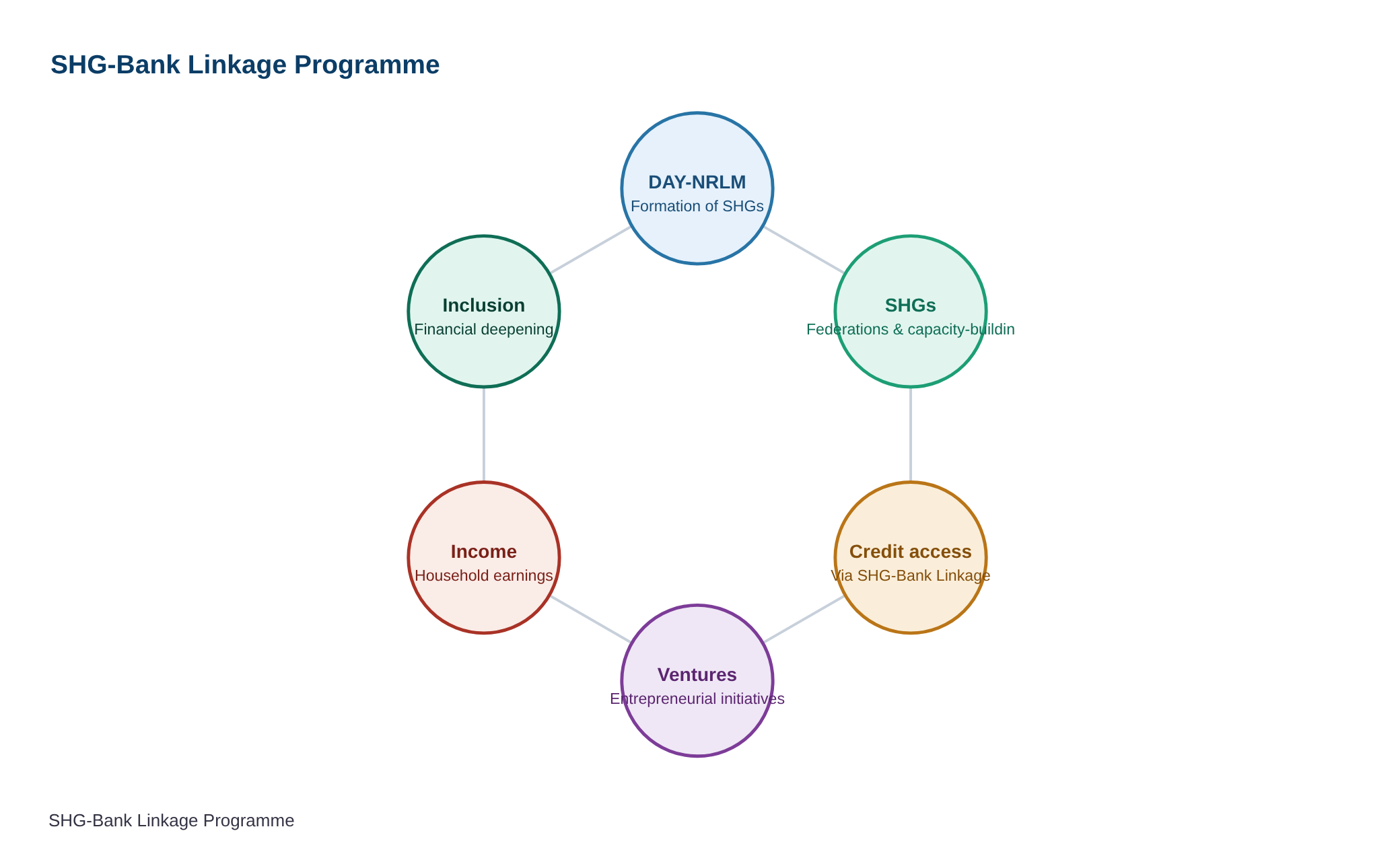
DAY-NRLM → Formation of SHGs → Federations and capacity-building → Access to formal credit via SHG-Bank Linkage → Entrepreneurial ventures → Income generation → Financial inclusion → Economic empowerment of rural women.
Prelims Practice Questions
Q1. Consider the following statements regarding the Deendayal Antyodaya Yojana-National Rural Livelihood Mission (DAY-NRLM):
1. DAY-NRLM is implemented by the Ministry of Rural Development, Government of India.
2. The mission aims to organise rural women into Self-Help Groups (SHGs) and their federations.
3. The cumulative credit disbursed to SHGs under the SHG-Bank Linkage Programme exceeds ₹10 lakh crore.
4. The mission has enabled over 3 crore rural women to become Lakhpati Didis.
How many of the above statements are correct?
- Only one
- Only two
- Only three
- All
Answer: Only three — Statements 1, 2, and 4 are correct. Statement 3 is incorrect as the cumulative credit disbursed exceeds ₹13.67 lakh crore, not ₹10 lakh crore.
Q2. Assertion (A): The SHG-Bank Linkage Programme is a key component of the DAY-NRLM.
Reason (R): It facilitates credit flow to SHGs, enabling rural women to establish and expand livelihood enterprises.
In the context of the above two statements, which one of the following is correct?
- Both A and R are true, and R is the correct explanation of A.
- Both A and R are true, but R is not the correct explanation of A.
- A is true, but R is false.
- A is false, but R is true.
Answer: Both A and R are true, and R is the correct explanation of A. — Both the Assertion (A) and Reason (R) are true, and the Reason (R) correctly explains the Assertion (A). The SHG-Bank Linkage Programme is indeed a critical component of DAY-NRLM, as it provides the necessary credit infrastructure for SHGs to thrive.
Q3. Match the following institutions with their roles in the SHG-Bank Linkage Programme:
Institution | Role
1. NABARD | A. Provides refinance support to banks for lending to SHGs
2. Reserve Bank of India (RBI) | B. Regulates and supervises cooperative banks and RRBs
3. District Central Cooperative Banks (DCCBs) | C. Acts as the apex institution for rural credit and SHG promotion
4. State Rural Livelihood Missions (SRLMs) | D. Implements DAY-NRLM at the state level and facilitates SHG formation
Select the correct match:
- 1-A, 2-B, 3-C, 4-D
- 1-C, 2-B, 3-A, 4-D
- 1-A, 2-C, 3-B, 4-D
- 1-C, 2-A, 3-B, 4-D
Answer: 1-A, 2-B, 3-C, 4-D — The correct matches are: 1-C (NABARD is the apex institution for rural credit and SHG promotion), 2-B (RBI regulates and supervises cooperative banks and RRBs), 3-A (DCCBs provide refinance support to banks for lending to SHGs), and 4-D (SRLMs implement DAY-NRLM at the state level and facilitate SHG formation).
Mains Practice Question
✍ The SHG-Bank Linkage Programme, a cornerstone of the Deendayal Antyodaya Yojana-National Rural Livelihood Mission (DAY-NRLM), has significantly enhanced financial inclusion and women-led entrepreneurship in rural India. Critically examine the institutional architecture, achievements, and challenges of this programme. Also, analyse how the proposed ‘Financial Inclusion 2.0’ initiative could further strengthen the programme’s impact on rural livelihoods. (15 Marks)
Approach: MODEL-ANSWER SKELETON:
1. **Institutional Architecture**:
– Role of DAY-NRLM (Ministry of Rural Development) in organising SHGs and federations.
– SHG-Bank Linkage Programme: collaboration between SHGs, banks (public, private, RRBs, cooperative), NABARD, RBI, and State Rural Livelihood Missions (SRLMs).
– Key institutions: NABARD (apex refinancing agency), RBI (regulatory oversight), DCCBs and PACS (last-mile credit delivery), SRLMs (implementation at state level).
2. **Achievements**:
– Quantitative: 93 lakh SHGs, 10 crore rural women organised; cumulative credit flow of ₹13.67 lakh crore; 3.46 crore Lakhpati Didis.
– Qualitative: Enhanced financial literacy, women empowerment, reduced poverty, and sustainable livelihoods.
– High repayment discipline (near 95%) and scalability of women-led enterprises.
3. **Challenges**:
– Credit saturation: Remaining SHGs in remote/aspirational districts face access barriers.
– Time lag in credit approval and disbursement.
– Limited access to formal credit in aspirational districts and Naxal-affected areas.
– Need for diversified financing beyond traditional SHG loans (e.g., venture capital, angel funding).
– Strengthening of cooperative banking structures (DCCBs, PACS) for last-mile delivery.
4. **Financial Inclusion 2.0**:
– Objectives: Double individual enterprise loan portfolio, increase average loan size to SHGs, reduce approval/disbursement time, achieve credit saturation, and strengthen cooperative credit structures.
– Strategies: Digital onboarding of SHGs, use of fintech for credit scoring, dedicated financing for women-led enterprises, and integration with other schemes (e.g., PM-KISAN, MGNREGA).
– Role of RBI and NABARD in policy support and refinancing.
5. **Conclusion**:
– The SHG-Bank Linkage Programme has been a transformative force in rural India, but challenges remain in achieving universal financial inclusion.
– Financial Inclusion 2.0, if implemented effectively, can address these gaps by leveraging technology, diversified financing, and stronger institutional linkages. The programme’s success hinges on multi-stakeholder collaboration and adaptive policy frameworks.
Source: PIB (Press Information Bureau)
Maharashtra PCS (MPSC) — State PCS Practice
Prelims: Which of the following is NOT a key focus area of the high-level meeting chaired by Union Minister Shivraj Singh Chouhan in Mumbai, as per the given context?
- A. Strengthening rural livelihood missions under state governments
- B. Enhancing coordination between banks and state rural livelihood missions
- C. Discussing the implementation of the National Rural Employment Guarantee Scheme (NREGS) in Maharashtra
- D. Addressing challenges in agricultural credit disbursement for small and marginal farmers
Answer: C. Discussing the implementation of the National Rural Employment Guarantee Scheme (NREGS) in Maharashtra — The context specifically mentions banks and state rural livelihood missions as key focus areas, not NREGS implementation.
Mains: Analyze the role of state rural livelihood missions in Maharashtra’s rural economy and discuss how improved coordination with banks can enhance financial inclusion and livelihood opportunities for rural communities. (250 words)
Generated by AanyaAi for educational purpose.
Related guides on our sites
- Anthropology VS PSIR
- Best PSIR optional coaching
- Best PSIR optional coaching online
- Best ias coaching in mumbai

- PM Modi Praises Youth-Led Nasha Mukt Yuva Abhiyan Momentum - September 27, 2026
- राजनाथ सिंह का बड़ा बयान: भारत किसी की ज़मीन कब्ज़ा नहीं करेगा, लेकिन सुरक्षा पर होगा कठोर - September 27, 2026
- Exercise Tarang Shakti 2026: India’s Mega Multi-Nation Air Power Showcase - September 27, 2026

No Comments