


21 Sep Odisha Launches Shree Jagannath Darshan Yojana for Senior Citizens Pilgrimage
✎ The Shree Jagannath Darshan Yojana is a state-led pilgrimage scheme in Odisha that facilitates spiritual access for senior citizens by providing logistical, health, and cultural support for their journey to the Srimandir in Puri.
Subject Relevance — Where This Topic Fits
- GS Paper II — Governance, Welfare Schemes for Vulnerable Sections | GS Paper III — Developmental Programmes and Schemes for Social Welfare
- Prelims: Shree Jagannath Darshan Yojana, OSRTC (Odisha State Road Transport Corporation), Senior Citizens Welfare, Puri Srimandir, Gram Panchayat to District Transport, Cultural and Health Facilitation Packages
- Essay: Role of state governments in preserving cultural heritage through welfare schemes, Balancing spiritual tourism with social welfare for marginalised groups
Quick Revision: The Shree Jagannath Darshan Yojana is a state-led pilgrimage scheme in Odisha that facilitates spiritual access for senior citizens by providing logistical, health, and cultural support for their journey to the Srimandir in Puri.
Why is this in the news?
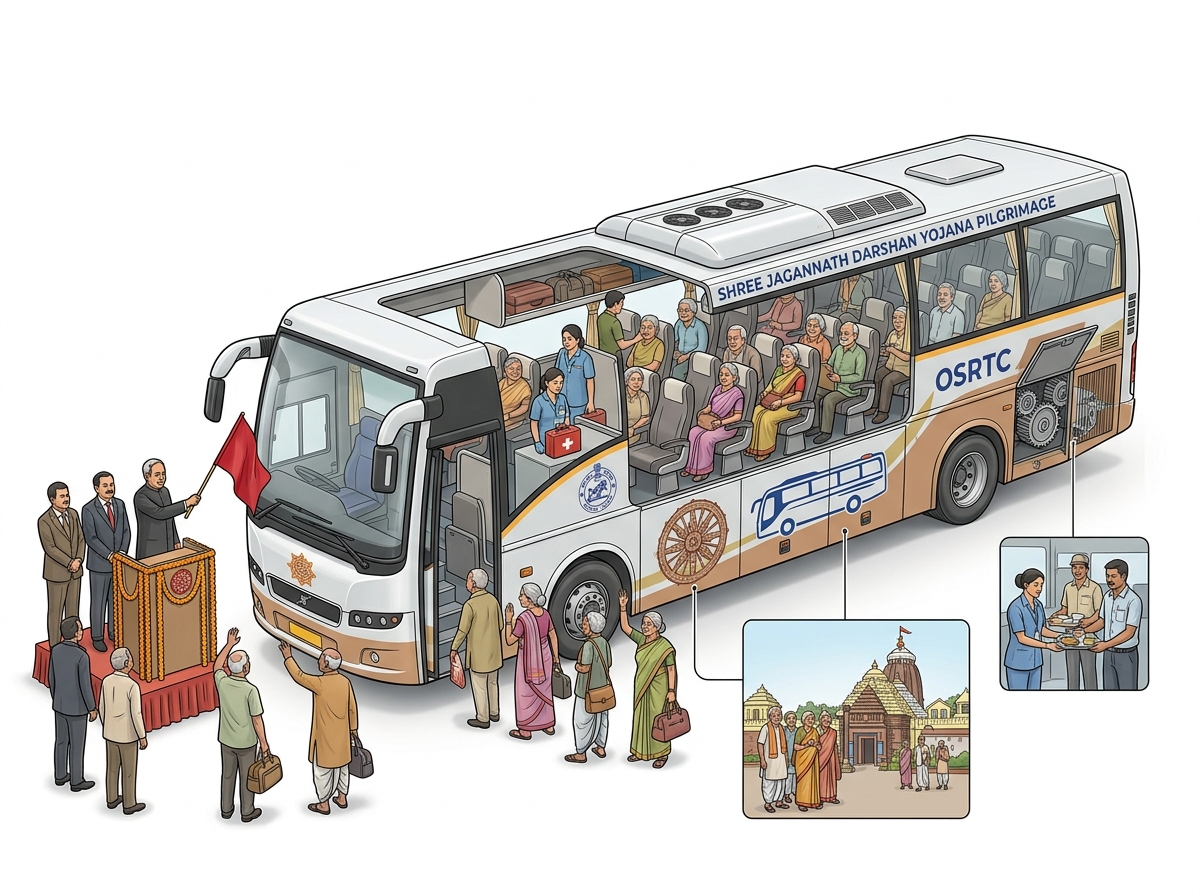
The Shree Jagannath Darshan Yojana has been flagged off by the Deputy Chief Minister of Odisha, marking the initiation of its first pilgrimage for senior citizens in the financial year 2025-26. This scheme is a significant governance intervention aimed at facilitating spiritual access for elderly citizens, particularly those from remote districts, by providing comprehensive logistical, health, and cultural support for their pilgrimage to the Srimandir in Puri.
Background
- The Shree Jagannath Darshan Yojana is a state-led initiative in Odisha, designed to address the spiritual and social needs of senior citizens by enabling their pilgrimage to the revered Srimandir in Puri.
- The scheme is implemented collaboratively by the Odisha Tourism Department and the Odisha State Road Transport Corporation (OSRTC), highlighting inter-departmental coordination in public service delivery.
- Senior citizens, particularly from tribal and remote districts such as Malkangiri, Koraput, and Nabarangpur, often face logistical and financial barriers in accessing religious sites, necessitating state intervention.
- Odisha’s focus on tourism as an economic driver, coupled with its rich cultural heritage, underscores the dual objectives of welfare and heritage preservation in this scheme.
What is the Shree Jagannath Darshan Yojana?
- A state-sponsored pilgrimage scheme launched by the Government of Odisha to facilitate darshan (divine viewing) of Lord Jagannath at the Srimandir in Puri for senior citizens.
- Pilgrims are transported from their gram panchayats to district headquarters and subsequently to Puri via dedicated buses operated by OSRTC, ensuring seamless connectivity.
- The package includes free health check-ups, four vegetarian meals per day, kit bags, identity cards, and participation in cultural programmes, ensuring holistic support during the pilgrimage.
- Special arrangements are made for senior citizens from tribal and remote districts, including escort officers and paramedical staff to monitor health and safety throughout the journey.
- The scheme is implemented in phases, with the first phase covering 10,434 pilgrims from 13 districts between September 20 and October 26, 2026.
- The initiative reflects the state’s commitment to preserving cultural heritage while promoting inclusive governance for vulnerable sections of society.
Key Features
| Feature | Significance |
|---|---|
| Virtual flag-off by Deputy Chief Minister | Demonstrates the state’s commitment to leveraging technology for inclusive governance and accessibility in public service delivery. |
| Pilgrimage for senior citizens from tribal districts | Targets socio-economically vulnerable groups, ensuring equitable access to cultural and spiritual heritage sites. |
| Free transportation and accommodation package | Removes financial barriers, enabling participation of marginalised sections such as senior citizens from remote areas. |
| Health monitoring and escort officers | Ensures safety and well-being of pilgrims during long-distance travel, addressing logistical and health-related challenges. |
| Cultural programmes and identity cards | Enhances the pilgrimage experience while ensuring systematic identification and participation tracking of beneficiaries. |
Why it Matters
Social and Cultural
- Promotes intergenerational transmission of cultural heritage by facilitating darshan of Lord Jagannath for senior citizens, a significant demographic for Odisha’s socio-religious fabric.
- Strengthens community cohesion by enabling collective pilgrimage experiences for tribal and rural populations who may otherwise face logistical barriers.
- Aligns with the constitutional directive under Article 49 to protect and preserve monuments and places of national importance, interpreted here as cultural heritage sites.
Administrative and Governance
- Showcases the state’s capacity for multi-departmental coordination between the Tourism Department and OSRTC, ensuring seamless implementation of welfare schemes.
- Demonstrates the use of technology (virtual flag-off) to enhance public participation and transparency in governance processes.
- Sets a precedent for scalable welfare delivery models that can be adapted for other vulnerable groups or regions.
Economic
- Boosts local economies in Puri and surrounding districts through increased footfall, benefiting hospitality, transport, and allied sectors during the pilgrimage period.
- Supports livelihoods of service providers (e.g., OSRTC staff, paramedical teams) through employment generation under the scheme.
Challenges
1. Logistical Coordination
- Ensuring timely and safe transportation for pilgrims from remote tribal districts with limited road connectivity and terrain challenges.
- Managing crowd control and queue management at the Srimandir, especially during peak pilgrimage seasons, to avoid overcrowding and ensure dignified darshan.
UPSC Link: GS-II: Governance, GS-III: Infrastructure
2. Health and Safety Risks
- Addressing health emergencies during long-distance travel, particularly for elderly pilgrims with pre-existing conditions.
- Mitigating risks of heatstroke, dehydration, or other travel-related ailments given the climatic conditions in Odisha.
UPSC Link: GS-II: Health, GS-III: Disaster Management
3. Equity and Inclusion
- Ensuring that the scheme does not inadvertently exclude other marginalised groups (e.g., persons with disabilities, low-income families) due to eligibility criteria or awareness gaps.
- Preventing the commercialisation of pilgrimage services, which could undermine the scheme’s welfare intent.
UPSC Link: GS-II: Social Justice
4. Sustainability
- Balancing the scale of pilgrimages with the carrying capacity of Puri’s infrastructure to avoid environmental degradation or strain on public resources.
- Ensuring long-term funding and institutional support for the scheme beyond the current fiscal year.
UPSC Link: GS-III: Environment, GS-II: Governance
Challenges — UPSC Perspective
| Issue | Concern |
|---|---|
| Transportation delays | Risk of extended travel time due to road conditions or weather, affecting pilgrims’ health and comfort. |
| Health emergencies en route | Limited access to medical facilities in remote areas, necessitating robust on-ground medical support. |
| Cultural sensitivity | Ensuring respect for religious protocols and local customs during pilgrimage to avoid community tensions. |
| Awareness and outreach | Reaching eligible beneficiaries in remote tribal districts who may lack access to information dissemination channels. |
| Resource allocation | Balancing the scheme’s budget with competing demands for other welfare initiatives in the state. |
Government Initiatives — Must-Memorise for Prelims
- Shree Jagannath Darshan Yojana
Way Forward
- Conduct a post-pilgrimage survey to assess beneficiary satisfaction, health outcomes, and logistical challenges for iterative improvements.
- Expand the scheme’s scope to include other vulnerable groups such as persons with disabilities or low-income families in subsequent phases.
- Strengthen inter-departmental coordination by establishing a dedicated task force for real-time monitoring of pilgrimage logistics.
- Invest in digital platforms for beneficiary registration and grievance redressal to enhance transparency and accessibility.
- Collaborate with local NGOs and community leaders to improve awareness and ensure equitable participation across districts.
- Develop contingency plans for health emergencies, including partnerships with local hospitals and mobile health units.
- Integrate the scheme with Odisha’s tourism policy to create a sustainable model for cultural tourism and heritage conservation.
UPSC Value Addition
Keywords for Mains Answer-Writing
pilgrimage · welfare schemes for senior citizens · public-private partnership in tourism · cultural heritage management · state-led social welfare initiatives · religious tourism governance · Odisha tourism policy · public health protocols in mass pilgrimages · gram panchayat convergence · sustainable pilgrimage management
Constitutional & Policy Linkages
- [‘Article 49: Protection of monuments and places of national importance’]
Concept Flow
Identification of socio-cultural barriers to pilgrimage for senior citizens in Odisha → Policy formulation: Shree Jagannath Darshan Yojana as a targeted welfare initiative → Implementation: Multi-departmental coordination (Tourism Department and OSRTC) → Execution: Logistics, health monitoring, and cultural programmes for pilgrims → Outcome: Enhanced access to cultural heritage, socio-economic benefits for local communities → Feedback loop: Post-pilgrimage assessment for policy refinement and scalability
Prelims Practice Questions
Q1. Consider the following statements regarding the ‘Shree Jagannath Darshan Yojana’ recently launched in Odisha:
1. The scheme is implemented jointly by the Tourism Department and the Odisha State Road Transport Corporation (OSRTC).
2. The scheme provides free health check-ups, four vegetarian meals a day, and cultural programmes to pilgrims.
3. The scheme is exclusively for senior citizens aged 80 years and above.
4. The scheme includes transportation from gram panchayats to Puri via dedicated buses.
How many of the above statements are correct?
- Only one
- Only two
- Only three
- All four
Answer: Only three — Statements 1, 2, and 4 are correct. Statement 3 is incorrect as the scheme targets senior citizens but does not specify an age threshold of 80 years.
Q2. Assertion (A): The ‘Shree Jagannath Darshan Yojana’ aims to facilitate darshan of the Holy Trinity at Srimandir for 1 lakh senior citizens over multiple years.
Reason (R): The scheme includes provisions for free health check-ups, meals, and cultural programmes to ensure the well-being of pilgrims during the journey.
In the context of the above two statements, which of the following is correct?
- Both A and R are true, and R is the correct explanation of A.
- Both A and R are true, but R is not the correct explanation of A.
- A is true, but R is false.
- A is false, but R is true.
Answer: Both A and R are true, but R is not the correct explanation of A. — Both Assertion (A) and Reason (R) are true. The scheme’s objective of facilitating darshan for 1 lakh senior citizens is supported by the comprehensive welfare measures outlined in Reason (R).
Q3. Match the following pairs related to the ‘Shree Jagannath Darshan Yojana’:
Column I (District) | Column II (Number of Pilgrims in First Phase)
1. Malkangiri | A. 210
2. Koraput | B. 490
3. Nabarangpur | C. 210
Select the correct match:
- 1-B, 2-A, 3-C
- 1-A, 2-B, 3-C
- 1-C, 2-A, 3-B
- 1-B, 2-C, 3-A
Answer: 1-B, 2-A, 3-C — The correct match is: Malkangiri (490 pilgrims), Koraput (210 pilgrims), and Nabarangpur (210 pilgrims).
Mains Practice Question
✍ Critically examine the significance of the ‘Shree Jagannath Darshan Yojana’ in the context of Odisha’s tourism policy and its implications for social welfare governance. (15 Marks)
Approach: MODEL-ANSWER SKELETON:
1. Introduction (2 marks):
– Briefly define the scheme: A state-led pilgrimage initiative for senior citizens to facilitate darshan of Lord Jagannath at Puri.
– Contextualise within Odisha’s tourism policy: Emphasis on religious and cultural tourism as a driver of socio-economic development.
2. Objectives and Features (3 marks):
– Facilitate spiritual aspirations of senior citizens.
– Provide comprehensive welfare measures: transport, health check-ups, meals, cultural programmes, and darshan arrangements.
– Convergence with gram panchayats for last-mile connectivity.
– Public-private partnership (OSRTC) for logistical efficiency.
3. Governance and Implementation (3 marks):
– Multi-departmental coordination: Tourism Department, OSRTC, district administrations, and local MLAs.
– Safety protocols: Deployment of escort officers and paramedical staff.
– Phased implementation: Target of 1 lakh pilgrims over multiple years, with 30,000 beneficiaries in the current year.
4. Social Welfare Implications (3 marks):
– Inclusive development: Addressing the needs of marginalised senior citizens from tribal districts (Malkangiri, Koraput, Nabarangpur).
– Health and cultural integration: Combining spiritual and health-related welfare.
– Potential for replication: Model for other states with rich religious heritage.
5. Challenges and Critique (2 marks):
– Sustainability: Long-term funding and scalability.
– Inclusivity: Ensuring participation from all socio-economic groups.
– Balancing religious tourism with environmental and infrastructural constraints.
6. Conclusion (2 marks):
– Summarise the scheme’s role in promoting cultural heritage, social welfare, and tourism.
– Highlight its potential as a template for state-led welfare initiatives in India.
Source: orissapost.com
Generated by AanyaAi for educational purpose.
Related guides on our sites
- Current affairs for upsc 2026
- Best PSIR optional coaching for upsc
- Best PSIR optional teacher for upsc
- Best teacher of PSIR optional for upsc

- Odisha Launches Shree Jagannath Darshan Yojana for Senior Citizens Pilgrimage - September 21, 2026
- ग्वालियर में एशिया के पहले दूरसंचार विनिर्माण क्षेत्र की आधारशिला: जानिए पूरा विवरण और महत्व - September 21, 2026
- Gwalior to host Asia’s 1st Telecom Manufacturing Zone: ₹5,500 Cr Investment & 18K Jobs - September 21, 2026

No Comments