


21 Sep Xi Jinping’s US Visit: Key Takeaways for UPSC & State PCS Aspirants
✎ State visits are the apex of diplomatic engagement, governed by international conventions, and serve as platforms for high-stakes negotiations, symbolic gestures, and the issuance of joint declarations that shape the trajectory…
Subject Relevance — Where This Topic Fits
- GS Paper II — International Relations: Bilateral, Regional and Global Groupings and Agreements involving India and/or affecting India’s interests | GS Paper II — International Relations: Effect of Policies and Politics of Developed and Developing Countries on India’s interests, Indian Diaspora
- Prelims: Bilateral summit, Strategic dialogue, Global economic governance, US-China relations, Joint Base Andrews, State visit protocol, Foreign policy instruments
- Essay: The role of diplomacy in mitigating geopolitical tensions in the 21st century, Economic interdependence and strategic competition: Can great powers coexist?
Quick Revision: State visits are the apex of diplomatic engagement, governed by international conventions, and serve as platforms for high-stakes negotiations, symbolic gestures, and the issuance of joint declarations that shape the trajectory of bilateral relations.
Why is this in the news?
The scheduled state visit of Chinese President Xi Jinping to the United States from September 23 to 25, 2026, at the invitation of US President Donald Trump, marks a critical juncture in US-China relations. This high-level summit, following their last meeting in Beijing in May 2026, is expected to address pressing issues in bilateral ties, including trade, technology transfer, climate action, and geopolitical stability. The visit underscores the evolving dynamics of global governance, where major powers engage in strategic dialogues to manage competition and cooperation amid shifting international power structures.
Background
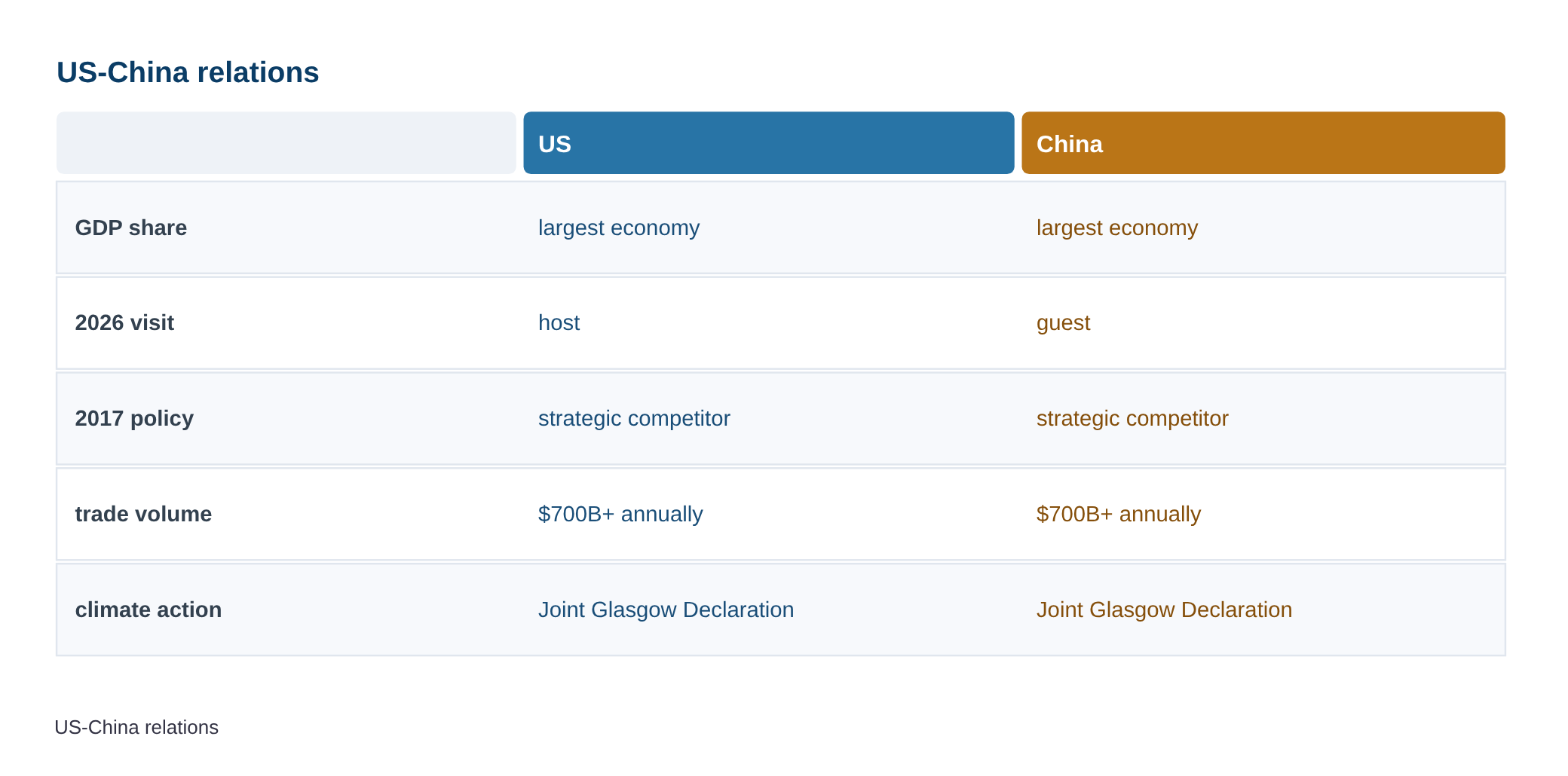
- The United States and the People’s Republic of China are the world’s two largest economies, collectively accounting for over 40% of global GDP, making their bilateral relationship a cornerstone of international economic stability.
- US-China relations have oscillated between cooperation and confrontation since the establishment of diplomatic ties in 1979, with key inflection points including the 1990s Asian financial crisis, the 2008 global financial crisis, and the 2018–2020 trade war under the Trump administration.
- Climate change mitigation remains a critical area of potential collaboration, despite geopolitical rivalries, as evidenced by the 2021 US-China Joint Glasgow Declaration on Enhancing Climate Action in the 2020s.
- The concept of ‘strategic competition’ has gained prominence in US foreign policy since the 2017 National Security Strategy, framing China as a ‘strategic competitor’ and redefining the bilateral engagement framework.
- Institutional mechanisms such as the US-China Strategic and Economic Dialogue (established in 2006) and the US-China Comprehensive Economic Dialogue have historically served as platforms for managing disputes and fostering cooperation.
What is a state visit and how does it function in international diplomacy?
- A state visit is the highest form of diplomatic engagement between two sovereign nations, typically involving the head of state or government and accompanied by extensive protocol, security arrangements, and symbolic gestures to underscore mutual respect and importance.
- The host country’s protocol department, often under the Ministry of External Affairs or equivalent, coordinates logistics such as airport arrivals, motorcades, state banquets, and bilateral meetings, ensuring adherence to diplomatic norms and national prestige.
- Airport receptions, such as the one planned at Joint Base Andrews for President Xi, are rare honours reserved for close allies or leaders of significant strategic importance, symbolising personal diplomacy and the elevation of bilateral ties to a higher level of engagement.
- State visits often culminate in the issuance of joint statements or declarations that outline areas of agreement, disagreements, and future roadmaps for cooperation, serving as tangible outcomes of high-level engagement.
- Security protocols during state visits are stringent, involving inter-agency coordination between host nation’s intelligence, law enforcement, and military agencies to mitigate risks of espionage, terrorism, or public-order disruptions.
- The frequency of state visits between major powers reflects the health of bilateral relations; reduced frequency often correlates with periods of heightened tension, while increased visits signal efforts to stabilise or improve relations.
- Cultural exchanges, including art exhibitions, university collaborations, and people-to-people initiatives, are frequently integrated into state visits to foster long-term soft-power diplomacy and mutual understanding.
Key Features
| Feature | Significance |
|---|---|
| State visit by Xi Jinping to the US | High-level diplomatic engagement between the leaders of the world’s two largest economies, signalling intent to stabilise bilateral relations amid geopolitical tensions. |
| Summit talks between Xi and Trump | Focus on trade, technology, climate change, and regional security, with potential to reset strained diplomatic and economic ties. |
| Airport reception by US President | Symbolic gesture indicating the importance of the visit and the US’s willingness to accord high protocol to the visiting head of state. |
| Previous meeting in Beijing (May 2026) | Contextual backdrop for ongoing negotiations and the evolution of bilateral discussions over time. |
Why it Matters
Economic Significance
- Bilateral trade and investment flows between the US and China, valued at over $700 billion annually, remain critical for global economic stability.
- Technology transfers, intellectual property rights, and semiconductor supply chains are key areas of negotiation, given their strategic importance.
- Currency and exchange rate policies, including the role of the US dollar and Chinese yuan, may be discussed to address trade imbalances.
Strategic and Geopolitical Significance
- The Indo-Pacific region, including the South China Sea and Taiwan Strait, is a focal point for discussions on maritime security and freedom of navigation.
- Nuclear non-proliferation, arms control, and the management of strategic rivalries (e.g., in the Korean Peninsula) are likely agenda items.
- Climate change cooperation, despite geopolitical tensions, remains a potential area for joint action given the global nature of the challenge.
Diplomatic Significance
- High-level diplomatic engagement serves as a confidence-building measure to prevent escalation of tensions, particularly in trade and technology domains.
- The visit may pave the way for structured dialogue mechanisms, such as the resumption of the US-China Strategic and Economic Dialogue.
- Symbolic gestures, like the airport reception, reinforce the importance of personal diplomacy in managing complex international relations.
Domestic and Global Implications
- Domestic political considerations in both countries may influence the tone and outcomes of the summit, given the proximity to national elections in the US.
- Global supply chains, particularly in sectors like pharmaceuticals, electronics, and renewable energy, could be impacted by any agreements or disagreements.
- The visit may set the tone for multilateral engagements, including interactions within the G20, UN, and other international forums.
Challenges
1. Trade and Economic Disputes
- Persistent tariffs and non-tariff barriers on goods such as steel, aluminium, and agricultural products remain unresolved.
- Intellectual property rights violations and forced technology transfers continue to strain economic relations.
- Currency manipulation allegations and exchange rate policies may hinder progress in trade negotiations.
UPSC Link: GS Paper 2: Bilateral Groupings & Agreements
2. Technology and Security Concerns
- Restrictions on technology exports, particularly in semiconductors and 5G infrastructure, create friction in bilateral ties.
- Cybersecurity threats and espionage allegations pose challenges to trust-building in digital and defence sectors.
- The militarisation of artificial intelligence and quantum computing may emerge as new areas of contention.
UPSC Link: GS Paper 3: Science & Technology
3. Geopolitical Rivalries
- Divergent strategic interests in the Indo-Pacific, including Taiwan, the South China Sea, and the Korean Peninsula, complicate negotiations.
- Alliances such as the Quad (US, India, Japan, Australia) and China’s partnerships with Russia and North Korea add layers of complexity.
- Proxy conflicts and regional tensions (e.g., in the South China Sea) may spill over into bilateral discussions.
UPSC Link: GS Paper 2: Effect of Policies & Politics of Countries
4. Climate Change and Environmental Policy
- Divergent approaches to carbon emissions, renewable energy transitions, and environmental regulations hinder joint climate action.
- Disputes over funding for climate adaptation and mitigation, particularly in developing economies, remain contentious.
- The role of fossil fuel industries in both countries may limit progress on decarbonisation commitments.
UPSC Link: GS Paper 3: Environmental Pollution & Degradation
5. Domestic Political Constraints
- Election cycles in both countries may limit the scope for long-term agreements, favouring short-term symbolic outcomes.
- Public opinion and media narratives in both nations can constrain negotiating flexibility and frame diplomatic outcomes.
- Bureaucratic resistance and institutional inertia may slow the implementation of any agreements reached.
UPSC Link: GS Paper 2: Pressure Groups & Formal/Informal Associations
Challenges — UPSC Perspective
| Issue | Concern |
|---|---|
| Tariffs and trade barriers | Economic protectionism and retaliatory measures hinder market access and supply chain integration. |
| Technology export controls | Restrictions on high-tech exports limit cooperation in critical sectors like semiconductors and AI. |
| Maritime security disputes | Competing claims in the South China Sea and Taiwan Strait pose risks of military escalation. |
| Intellectual property rights | Enforcement challenges and alleged violations undermine innovation and economic growth. |
| Climate policy divergence | Differences in emissions targets and energy transition strategies complicate global climate governance. |
Way Forward
- Establish structured dialogue mechanisms, such as a revived US-China Strategic and Economic Dialogue, to institutionalise negotiations.
- Prioritise trade and technology agreements that address core disputes, including tariffs, IPR, and supply chain resilience.
- Enhance confidence-building measures in the Indo-Pacific, such as joint maritime exercises or crisis communication channels.
- Promote people-to-people exchanges, including educational and cultural programmes, to foster long-term mutual understanding.
- Encourage multilateral cooperation on global challenges like climate change, pandemics, and nuclear non-proliferation.
- Address domestic political constraints by engaging stakeholders in both countries to build domestic support for agreements.
- Leverage third-party mediation or neutral forums (e.g., UN, G20) to facilitate complex negotiations and reduce bilateral tensions.
UPSC Value Addition
Keywords for Mains Answer-Writing
Great Power Diplomacy · Bilateral Summits · Strategic Stability · Economic Statecraft · Geopolitical Realignment · Multipolar World Order · Diplomatic Immunity · Track-II Diplomacy · Global Governance · Sino-US Relations
Concept Flow
Geopolitical tensions between US and China → Escalation in trade, technology, and security disputes → Diplomatic efforts to stabilise relations → High-level summit talks → Potential agreements on trade, climate, and security → Implementation challenges due to domestic constraints → Long-term impact on global governance and supply chains.
Prelims Practice Questions
Q1. Consider the following statements regarding diplomatic immunity and state visits:
1. The Vienna Convention on Diplomatic Relations, 1961 grants immunity to heads of state during official visits.
2. The receiving state may waive the immunity of a visiting head of state if it deems necessary.
3. Diplomatic immunity applies to all actions of a visiting head of state, including private acts.
How many of the above statements are correct?
- Only one
- Only two
- All three
- None
Answer: Only two — Statement 1 is correct: The Vienna Convention on Diplomatic Relations, 1961, grants immunity to heads of state during official visits. Statement 2 is incorrect: The receiving state cannot unilaterally waive immunity; it requires the consent of the sending state. Statement 3 is incorrect: Diplomatic immunity does not extend to private acts unrelated to official duties.
Q2. Assertion (A): The President of the United States, as head of state, can receive a visiting head of state at an airport tarmac without violating diplomatic protocol.
Reason (R): Diplomatic protocol permits such symbolic gestures as a mark of respect and to enhance bilateral relations.
Options:
A. Both A and R are true, and R is the correct explanation of A.
B. Both A and R are true, but R is not the correct explanation of A.
C. A is true, but R is false.
D. A is false, but R is true.
- A
- B
- C
- D
Answer: A — Assertion (A) is true: The President of the United States can receive a visiting head of state at an airport tarmac as a symbolic gesture of respect. Reason (R) is also true and correctly explains (A), as diplomatic protocol permits such gestures to enhance bilateral relations.
Q3. Which of the following best describes the primary objective of a state visit by a head of state to another country?
- To conduct trade negotiations and sign bilateral agreements
- To participate in international conferences and summits
- To enhance bilateral relations, symbolise diplomatic ties, and discuss strategic issues
- To inspect military installations and assess security cooperation
Answer: To enhance bilateral relations, symbolise diplomatic ties, and discuss strategic issues — The primary objective of a state visit by a head of state is to enhance bilateral relations, symbolise diplomatic ties, and discuss strategic issues of mutual interest. While trade negotiations or military inspections may occur, they are not the primary focus of such visits.
Mains Practice Question
✍ The conduct of high-level bilateral summits between great powers is often framed as a mechanism for maintaining strategic stability in a multipolar world. Critically examine this proposition with reference to the evolving nature of Sino-US relations. (15 Marks)
Approach: MODEL-ANSWER SKELETON:
1. **Introduction (2 marks)**: Define strategic stability in the context of great power relations and outline the role of bilateral summits (e.g., summits between the US and China) in managing geopolitical tensions.
2. **Mechanisms of Strategic Stability (4 marks)**:
– **Diplomatic Channels**: Track-I and Track-II diplomacy, confidence-building measures (CBMs), and crisis communication mechanisms (e.g., hotlines).
– **Economic Interdependence**: The role of trade, investment, and sanctions in shaping bilateral relations (e.g., US-China trade war, semiconductor restrictions).
– **Military Postures**: Arms control agreements, military transparency, and avoidance of unintended escalation (e.g., naval encounters in the South China Sea).
3. **Evolving Nature of Sino-US Relations (5 marks)**:
– **Competition vs. Cooperation**: The duality of competition (e.g., technology decoupling, ideological rivalry) and cooperation (e.g., climate change, non-proliferation) in bilateral engagements.
– **Institutional Frameworks**: The role of existing institutions (e.g., UN, G20) and ad-hoc mechanisms (e.g., summits) in managing tensions.
– **Recent Developments**: Reference the 2026 Xi-Trump summit and its potential outcomes (e.g., tariff reductions, military de-escalation agreements).
4. **Critique and Limitations (3 marks)**:
– **Structural Constraints**: The limits of summits in addressing deep-seated structural issues (e.g., Taiwan, South China Sea disputes).
– **Domestic Constraints**: The influence of domestic politics (e.g., US elections, Chinese nationalism) on summit outcomes.
– **Multipolarity Challenges**: The difficulty of maintaining stability in a multipolar world where other powers (e.g., Russia, EU) play significant roles.
5. **Conclusion (1 mark)**: Summarise the argument and offer a balanced view on whether summits alone can ensure strategic stability.
Source: orissapost.com
Generated by AanyaAi for educational purpose.
Related guides on our sites
- Current affairs for upsc 2026
- Best PSIR optional coaching for upsc
- Best PSIR optional teacher for upsc
- Best teacher of PSIR optional for upsc

- Xi Jinping’s US Visit: Key Takeaways for UPSC & State PCS Aspirants - September 21, 2026
- UPSC Civil Services (Main) Examination 2026 — Animal Husbandry and Veterinary Science Optional Paper I: Question Paper | Plutus IAS - September 21, 2026
- UPSC Civil Services (Main) Examination 2026 — Malayalam (Compulsory): Question Paper | Plutus IAS - September 21, 2026

No Comments