


21 Sep Odisha CM Majhi to Decide on Teachers’ Issues via Tripathy Panel Report
✎ The Ashok Tripathy Committee’s report on teachers’ issues in Odisha exemplifies the governance process of addressing sectoral grievances through structured consultations, expert recommendations, and inter-departmental…
Subject Relevance — Where This Topic Fits
- GS Paper II — Governance, Transparency and Accountability | GS Paper III — Human Resource Development in Education
- Prelims: Right to Education (RTE) Act, 2009, National Education Policy (NEP) 2020, State Public Service Commissions, Departmental Promotion Committees (DPCs), Pay Commission recommendations, Teacher Eligibility Test (TET), Right to Information (RTI) Act, 2005
- Essay: The role of governance in addressing social sector grievances, Balancing administrative efficiency with participatory decision-making in public service delivery
Quick Revision: The Ashok Tripathy Committee’s report on teachers’ issues in Odisha exemplifies the governance process of addressing sectoral grievances through structured consultations, expert recommendations, and inter-departmental coordination, aligning with constitutional and statutory frameworks for education governance.
Why is this in the news?
The Odisha government’s decision to examine the recommendations of the Ashok Tripathy Committee on teachers’ issues, submitted after extensive consultations with 104 teachers’ associations, underscores the procedural governance mechanisms employed to address systemic grievances in the education sector. This development highlights the state’s commitment to evidence-based policymaking and participatory governance in resolving long-standing teacher welfare concerns, which are critical to the quality of school education as envisaged under constitutional provisions and national policies.
Background
- The Right to Education (RTE) Act, 2009 mandates free and compulsory education for children aged 6–14, placing a constitutional obligation on states to ensure equitable and quality education, thereby increasing the demand for qualified teachers and their welfare.
- The National Education Policy (NEP) 2020 emphasizes teacher professional development, equitable service conditions, and career progression, aligning with global best practices in education governance.
- Teacher welfare issues often intersect with service conditions, pay parity, promotions, transfers, and workload management, which are governed by state-specific rules framed under the All-India Services (Conduct) Rules and state service regulations.
- The Odisha government constituted the Ashok Tripathy Committee on December 6, 2025, to examine the demands of teachers across primary, upper primary, high school, and higher secondary levels, reflecting a structured approach to addressing sectoral grievances.
- The committee’s reconstitution on February 3, 2026, indicates iterative governance, allowing for broader stakeholder consultations and refinement of recommendations before final submission.
- Teacher associations serve as key stakeholders in education governance, providing a platform for collective bargaining and policy feedback, which is essential for responsive public administration.
What is the Ashok Tripathy Committee and its role in teacher governance?
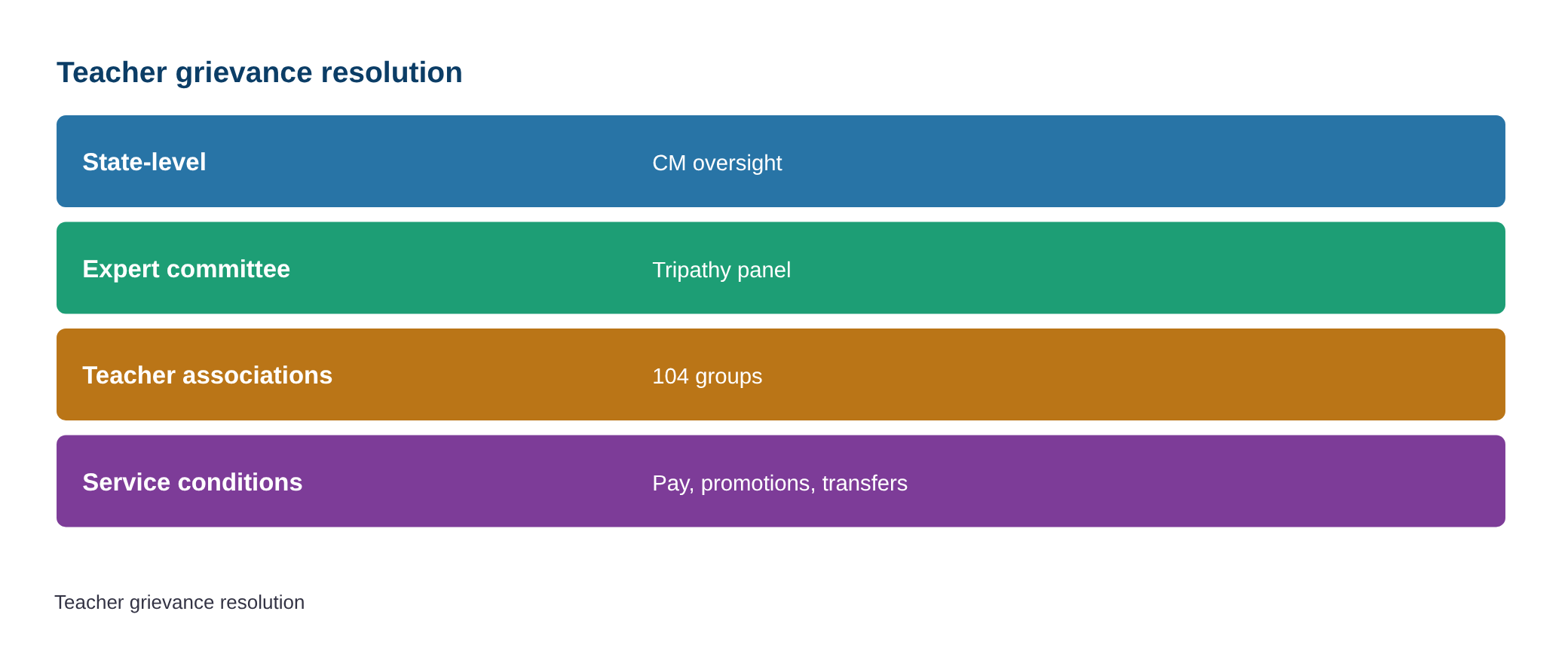
- The Ashok Tripathy Committee was constituted by the Odisha government to examine systemic issues faced by teachers, including service conditions, pay scales, promotions, transfers, workload, and professional development opportunities.
- The committee’s mandate included consulting 104 teachers’ associations across the state, ensuring participatory governance and representation of diverse teacher categories (primary, upper primary, high school, and higher secondary).
- Through 90 deliberative meetings and the submission of 79 reports, the committee adopted a multi-stage consultative process, reflecting a commitment to evidence-based policymaking and transparency in governance.
- The committee’s recommendations are expected to align with statutory frameworks like the RTE Act, 2009.
- The committee’s report is part of a broader governance mechanism where state governments examine teacher welfare issues within the framework of fiscal federalism, balancing state autonomy with national education goals.
- The committee’s work exemplifies the role of expert committees in public administration, where domain specialists and stakeholders collaborate to identify policy gaps and propose actionable solutions.
- The committee’s recommendations will be examined by the state government through inter-departmental consultations, including the School and Mass Education Department, Higher Education Department, Finance Department, and the Chief Secretary’s office, ensuring cross-sectoral coordination.
- The committee’s approach reflects the principles of cooperative federalism, where state-level initiatives complement national policies while addressing localised challenges in education delivery.
Key Features
| Feature | Significance |
|---|---|
| Constitution of the Tripathy Committee | Provides a structured mechanism for addressing systemic grievances of teachers across all education levels in Odisha. |
| Multi-stage deliberations | Ensures comprehensive examination of demands through 90 meetings and 79 reports, reflecting thorough stakeholder engagement. |
| Inclusive representation | Involvement of 104 teachers’ associations ensures diverse perspectives are considered in policy formulation. |
| Inter-departmental coordination | Meeting chaired by the Chief Minister with participation from School, Higher Education, Finance, and other key departments ensures holistic governance. |
| Committee reconstitution | Reconstitution in February 2026 demonstrates the government’s commitment to revisiting and refining the committee’s mandate. |
Why it Matters
Governance and Policy Process
- Demonstrates the institutional mechanism for resolving sectoral grievances through expert committees and structured deliberations.
- Highlights the role of the Chief Minister in directly overseeing the resolution of administrative issues affecting a critical workforce segment.
- Showcases the importance of inter-departmental collaboration in addressing multi-faceted challenges in the education sector.
Human Resource Management in Education
- Addresses the professional concerns of teachers, whose morale and working conditions directly impact the quality of school education.
- Underscores the need for periodic review of service conditions, including salary structures, workload, and career progression pathways.
- Emphasises the role of teachers as frontline educators whose welfare is integral to achieving educational outcomes under the Right to Education (RTE) Act, 2009.
Stakeholder Engagement
- Illustrates the process of participatory governance where associations of teachers act as intermediaries between the state and the teaching workforce.
- Highlights the value of structured feedback mechanisms in policy-making to ensure legitimacy and effectiveness of decisions.
Challenges
1. Teacher Shortages and Vacancies
- Odisha faces a deficit in the number of teachers, particularly in rural and tribal areas, affecting the student-teacher ratio.
- Vacancies persist due to delays in recruitment processes, inadequate training infrastructure, and lack of incentives for postings in remote regions.
UPSC Link: DPSP Article 45
2. Professional Development and Career Growth
- Teachers often lack structured pathways for career advancement, leading to stagnation and reduced motivation.
- Inadequate opportunities for in-service training and skill upgradation hinder pedagogical effectiveness.
UPSC Link: RTE Act 2009, Section 23
3. Workload and Service Conditions
- Excessive administrative duties and non-teaching assignments divert teachers from core educational responsibilities.
- Inadequate infrastructure, including lack of proper classrooms, teaching aids, and digital resources, exacerbates workload pressures.
UPSC Link: Article 21A
4. Equity in Education Delivery
- Disparities in teacher distribution between urban and rural areas perpetuate educational inequities.
- Lack of standardised service conditions for teachers across different management types (government, aided, private) creates inconsistencies in quality.
UPSC Link: Article 15(3)
Challenges — UPSC Perspective
| Issue | Concern |
|---|---|
| Recruitment Delays | Prolonged vacancies in teaching positions disrupt classroom continuity and learning outcomes. |
| Service Conditions | Inadequate salary structures, lack of housing, and poor working environments demoralise teachers. |
| Professional Isolation | Limited access to peer networks and mentorship programmes affects pedagogical innovation. |
| Infrastructure Gaps | Poor school infrastructure forces teachers to compensate with additional effort, reducing teaching efficiency. |
| Equity in Deployment | Over-concentration of teachers in urban areas leaves rural schools understaffed and under-resourced. |
| Career Stagnation | Absence of promotion policies and lack of recognition for meritorious service discourage long-term commitment. |
Way Forward
- Constitute a high-powered task force to expedite the implementation of the Tripathy Committee’s recommendations within a six-month timeline.
- Introduce a transparent and merit-based recruitment process for teachers, with a focus on filling vacancies in underserved regions.
- Develop a state-wide teacher mentorship programme to foster professional growth and peer learning networks.
- Allocate dedicated funds in the annual budget for teacher housing, infrastructure upgrades, and digital resource provisioning in rural schools.
- Establish a grievance redressal mechanism with a dedicated helpline and online portal for teachers to report service-related issues.
- Launch periodic performance reviews for teachers, linking career progression to professional development and student outcomes.
- Strengthen the Right to Education (RTE) monitoring framework to ensure compliance with teacher-student ratios and infrastructure standards.
- Conduct a state-wide survey to assess the actual number of vacancies and service conditions, ensuring data-driven policy formulation.
UPSC Value Addition
Keywords for Mains Answer-Writing
Teacher Policy in India · State Public Service Commissions · Right to Education Act 2009 · Teacher Recruitment Boards · National Council for Teacher Education · Odisha School Education Department · Public Service Commission (Odisha) · Teacher Grievance Redressal Mechanisms · State Education Reforms · Constitutional Provisions for Education (Article 21A, 45, 46) · National Education Policy 2020 · Teacher Accountability Frameworks
Constitutional & Policy Linkages
- {‘Article 45’: ‘Directive Principle mandating free and compulsory education for children’}
- {‘Article 21A’: ‘Fundamental Right to Education’}
- {‘Article 15(3)’: ‘Special provisions for women and children in education’}
- {‘Article 39(f)’: ‘Directive Principle ensuring children’s healthy development’}
Concept Flow
State-level grievance escalation → Formation of Tripathy Committee (Dec 2025) → Reconstitution (Feb 2026) → Multi-stage deliberations (90 meetings, 79 reports) → Committee submits recommendations → Chief Minister-led review → Government decision-making process → Implementation of reforms → Impact on teacher welfare and educational outcomes → Feedback loop for continuous improvement
Prelims Practice Questions
Q1. Consider the following statements regarding the Right to Education (RTE) Act, 2009:
1. The Act mandates free and compulsory education for children aged 6 to 14 years.
2. It stipulates that no child shall be held back, expelled, or required to pass a board examination until the completion of elementary education.
3. The Act requires private schools to reserve 25% of seats for children from weaker sections and disadvantaged groups.
4. The Act establishes a National Commission for Protection of Child Rights (NCPCR) to monitor its implementation.
How many of the above statements are correct?
- Only one
- Only two
- Only three
- All four
Answer: All four — Statements 1, 2, and 3 are correct as per the RTE Act. Statement 4 is incorrect because the NCPCR is a statutory body under the Commissions for Protection of Child Rights Act, 2005, but it is not established by the RTE Act itself.
Q2. Assertion (A): The National Council for Teacher Education (NCTE) is a statutory body responsible for the regulation and development of teacher education in India.
Reason (R): The NCTE was established under the National Council for Teacher Education Act, 1993, and its mandate includes ensuring quality teacher education and maintaining standards.
Options:
A. Both A and R are true, and R is the correct explanation of A.
B. Both A and R are true, but R is not the correct explanation of A.
C. A is true, but R is false.
D. A is false, but R is true.
Answer: ? — Both the Assertion and Reason are true. The NCTE is indeed a statutory body established under the NCTE Act, 1993, and its functions include regulating and developing teacher education in India. The Reason correctly explains the Assertion.
Q3. Match the following committees/reports with their respective areas of focus:
Column I (Committee/Report) | Column II (Focus Area)
——————————————————|——————————————————
A. Ashok Tripathy Committee | 1. Teacher recruitment and service conditions
B. Kothari Commission (1964-66) | 2. Education policy and structure
C. Justice Verma Committee (2012) | 3. Teacher grievances and service issues
D. National Education Policy (NEP) 2020 | 4. Higher education reforms and governance
- A-3, B-2, C-4, D-1
- A-3, B-2, C-1, D-4
- A-1, B-2, C-3, D-4
- A-2, B-1, C-4, D-3
Answer: A-3, B-2, C-1, D-4 — The Ashok Tripathy Committee was constituted to examine teachers’ issues, hence matches with focus area 3. The Kothari Commission focused on education policy and structure (2). The Justice Verma Committee addressed higher education reforms (4). The NEP 2020 is concerned with higher education reforms and governance (4).
Mains Practice Question
✍ The establishment of expert committees to address teachers’ grievances and service conditions is a critical governance mechanism in the education sector. In this context, critically examine the role of such committees in ensuring teacher accountability and welfare, with reference to the Ashok Tripathy Committee report and the constitutional framework for education in India. Also, analyse how the recommendations of such committees can be effectively implemented at the state level. (15 Marks)
Approach: MODEL-ANSWER SKELETON:
1. **Introduction (2 marks)**
– Briefly define the role of expert committees in governance, particularly in the education sector.
– Mention the constitutional provisions related to education: Article 21A (Right to Education), Article 45 (Directive Principles of State Policy for early childhood care and education), Article 46 (Promotion of educational and economic interests of Scheduled Castes, Scheduled Tribes, and weaker sections).
– Highlight the significance of teachers in achieving educational goals under the Right to Education (RTE) Act, 2009.
2. **Role of Expert Committees in Teacher Welfare and Accountability (5 marks)**
– **Teacher Grievance Redressal**: Explain how committees like the Ashok Tripathy Committee provide a structured mechanism for teachers to voice their concerns (e.g., service conditions, promotions, transfers).
– **Policy Formulation**: Discuss how such committees contribute to evidence-based policy-making by gathering data from stakeholders (e.g., 104 teachers’ associations in Odisha).
– **Accountability Mechanisms**: Link committee recommendations to accountability frameworks, such as the National Council for Teacher Education (NCTE) guidelines and state-level Public Service Commissions (e.g., Odisha Public Service Commission).
– **Balancing Welfare and Performance**: Address the dual mandate of ensuring teacher welfare while maintaining academic standards (e.g., through performance-based appraisals).
3. **Constitutional and Legal Framework (4 marks)**
– **Article 309**: Discuss the constitutional provision governing the recruitment and conditions of service of persons appointed to public services and posts in connection with the affairs of the Union or of any State.
– **State Public Service Commissions**: Explain the role of State Public Service Commissions (e.g., Odisha PSC) in recruiting teachers and addressing service-related disputes.
– **Right to Education Act, 2009**: Highlight provisions related to teacher qualifications (Section 23) and the prohibition of deployment of teachers for non-educational purposes (Section 27).
– **Judicial Precedents**: Cite relevant Supreme Court judgments (e.g., T.M.A. Pai Foundation v. State of Karnataka, 2002) on the autonomy of educational institutions and the state’s role in regulating teacher service conditions.
4. **Implementation Challenges and Strategies (4 marks)**
– **Challenges**:
– Delay in processing recommendations due to bureaucratic hurdles.
– Lack of uniformity in implementation across states.
– Resistance from vested interests (e.g., unions, administrative inertia).
– **Strategies for Effective Implementation**:
– **Time-bound Action Plans**: Governments should set clear timelines for implementing recommendations (e.g., as seen in the Odisha government’s commitment to examine the Tripathy Committee report).
– **Stakeholder Engagement**: Involve teachers’ associations, educationists, and civil society in the implementation process.
– **Monitoring and Evaluation**: Establish independent bodies to monitor the progress of implementation (e.g., State Education Departments with dedicated grievance cells).
– **Capacity Building**: Train administrative officials and teachers on the provisions of committee recommendations and legal frameworks.
5. **Conclusion (2 marks)**
– Summarise the importance of expert committees in bridging the gap between policy and implementation.
– Emphasise the need for a collaborative approach involving the state, teachers, and civil society to ensure sustainable reforms in the education sector.
Source: orissapost.com
Generated by AanyaAi for educational purpose.
Related guides on our sites
- Best PSIR optional teacher
- best teacher of economics optional
- Best PSIR optional teacher for upsc
- Best teacher of PSIR optional for upsc

- तमिलनाडु में बस किराए में संशोधन: सरकार को चार सप्ताह और समय मिला, उच्च न्यायालय का फैसला - September 22, 2026
- Madras HC gives Tamil Nadu 4 weeks to revise bus fares amid diesel price surge - September 22, 2026
- कुल्लू: NHPC की पार्वती-2 परियोजना के खिलाफ एफआईआर, 12 सदस्यीय जांच समिति गठित - September 21, 2026

No Comments