


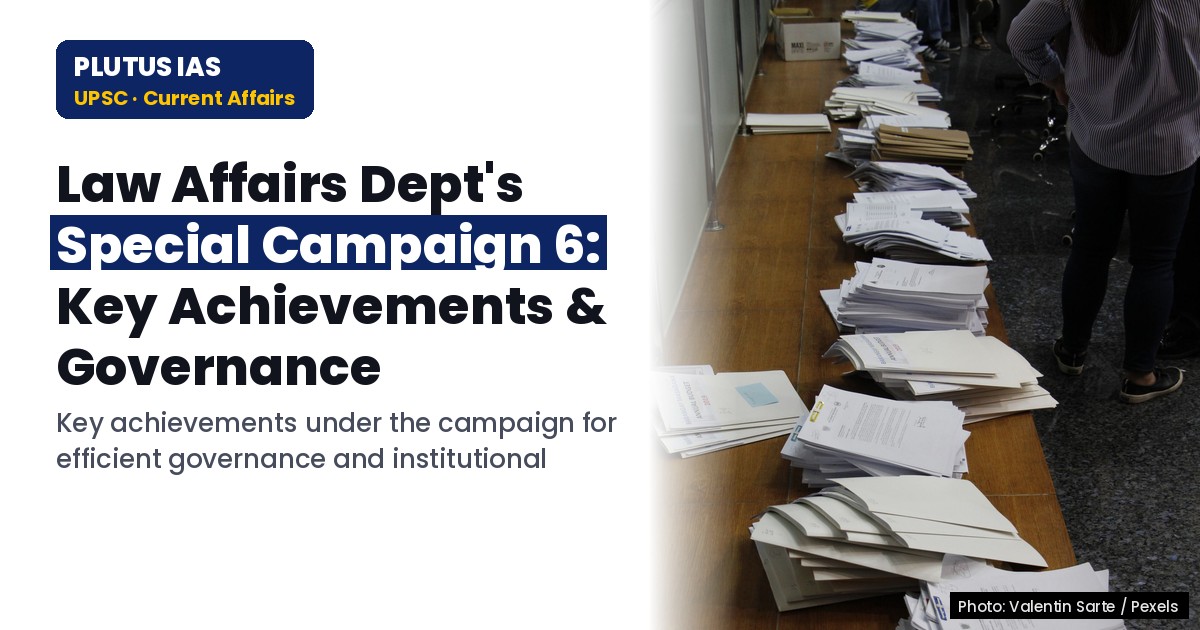
09 Nov Law Affairs Dept’s Special Campaign 6: Key Achievements & Governance
✎ 'Special Campaign 6' underscores the government's commitment to enhancing administrative efficiency, promoting cleanliness, and ensuring responsible resource management through systematic record-keeping, waste disposal, and…
Subject Relevance — Where This Topic Fits
- GS Paper II — Governance, Transparency and Accountability; Government Policies and Interventions for Development in various sectors and Issues arising out of their Design and Implementation | GS Paper III — Environment and Ecology; Disaster Management
- Prelims: Special Campaign 6, Swachhta Hi Seva, e-waste management, file management, administrative reforms, revenue generation from scrap, digitalisation of records, parliamentary assurances
- Essay: Administrative Reforms and Good Governance, Sustainable Waste Management in Public Administration
Quick Revision: ‘Special Campaign 6’ underscores the government’s commitment to enhancing administrative efficiency, promoting cleanliness, and ensuring responsible resource management through systematic record-keeping, waste disposal, and digital transformation.
Why is this in the news?
The Department of Legal Affairs, under the Ministry of Law and Justice, has reported significant achievements under ‘Special Campaign 6’, demonstrating its commitment to efficient administration, institutional strengthening, environmental sustainability, transparency, and citizen-centric governance. The campaign involved comprehensive activities focused on cleanliness, disposal of pending matters, review and weeding out of old records, digitisation, and optimal space utilisation, among others.
Background
- ‘Special Campaign 6’ is a government-wide initiative aimed at enhancing administrative efficiency and promoting a cleaner, more organised work environment across various ministries and departments.
- The campaign’s preparatory phase involved sensitising senior officials in field offices about the objectives of ‘Swachhta Hi Seva’ and ‘Special Campaign 6’.
- Key activities undertaken during the implementation phase included cleanliness drives, resolution of pending issues, systematic review and disposal of obsolete records, digitisation efforts, and the responsible disposal of unserviceable ICT and electrical equipment.
- Emphasis was placed on systematic file management, reduction of administrative pendency, environmental protection, and fostering a productive workplace.
- The campaign also sought to strengthen institutional practices, encourage active participation from officials and staff, and promote principles of cleanliness in daily administration.
- Revenue generation from the disposal of scrap and unserviceable materials was an additional outcome, contributing to efficient resource management.
Key Aspects and Outcomes of ‘Special Campaign 6’
- **Cleanliness Initiatives:** A total of 30 cleanliness drives were conducted across department offices and premises, fostering a cleaner and healthier work environment.
- **Revenue Generation from Scrap Disposal:** The systematic identification and disposal of e-waste, scrap, and other unserviceable items generated revenue of ₹4,71,881, ensuring proper disposal and efficient utilisation of government assets.
- **Efficient File Management and Pendency Reduction:** Out of 27,289 physical files reviewed, 15,679 were weeded out. Similarly, 17,798 e-files were closed from 20,572 reviewed, significantly reducing record accumulation and improving access to essential government information.
- **Disposal of Obsolete ICT and Electrical Equipment (E-waste):** A total of 1,484 obsolete ICT and electrical items were identified and disposed of, generating ₹4.15 lakh in revenue, promoting environmentally responsible disposal practices.
- **Optimisation of Space:** The systematic removal of old records, scrap, unserviceable furniture, and other redundant materials freed up 4,889 square feet of office space, enhancing workplace organisation and operational efficiency.
- **Effective Management of Important References:** The campaign successfully disposed of 58 references from Members of Parliament and 19 Inter-Ministerial Committee references, achieving a 100% target. Progress was also made in uploading ‘Implementation Reports’ for parliamentary assurances.
Key Features
| Feature | Significance |
|---|---|
| Swachhta Abhiyan (Cleanliness Drive) | Promotes a hygienic and conducive work environment, aligning with broader national initiatives for cleanliness. |
| Revenue Generation from Scrap Disposal | Optimises resource utilisation and generates revenue, demonstrating fiscal prudence and responsible waste management. |
| Efficient File Management and Arrear Reduction | Enhances administrative efficiency, reduces clutter, and facilitates quicker access to essential government information. |
| Disposal of Obsolete ICT and Electrical Equipment (E-waste) | Contributes to environmental sustainability through responsible e-waste management and improves office infrastructure utility. |
| Space Optimisation and Better Utilisation of Office Premises | Frees up valuable office space for more effective governmental functions, improving workplace organisation and operational efficiency. |
| Effective Management and Disposal of Important References | Ensures prompt resolution of critical official communications, thereby strengthening accountability in administrative functioning. |
Why it Matters
Administrative Efficiency
- The systematic review and weeding out of physical and e-files significantly reduces administrative backlogs, streamlining governmental operations.
- Improved file management practices enhance the speed and accuracy of information retrieval, crucial for timely decision-making.
- The disposal of obsolete equipment and optimisation of office space contribute to a more organised and productive work environment.
Fiscal Prudence and Resource Management
- Revenue generated from scrap disposal demonstrates efficient management of public assets and conversion of waste into economic value.
- Responsible disposal of e-waste and other unusable items prevents unnecessary expenditure on storage and maintenance of redundant assets.
Environmental Sustainability
- The focus on systematic disposal of e-waste and other scrap materials aligns with national environmental protection goals.
- Promoting cleanliness and efficient resource use within government offices sets a precedent for sustainable practices in public administration.
Transparency and Accountability
- Effective management and disposal of parliamentary references and inter-ministerial committee matters enhance accountability in governance.
- Digitisation of records, though not explicitly detailed in achievements, is an underlying principle that promotes transparency and accessibility of information.
Challenges
1. Sustaining Momentum
- Ensuring that such campaigns are not one-off events but integrated into routine administrative practices requires continuous effort and monitoring.
- Maintaining the enthusiasm and active participation of officials and staff beyond the campaign period can be challenging.
UPSC Link: Governance: transparency & accountability
2. Resistance to Change
- Overcoming ingrained habits and resistance to adopting new, more efficient file management and disposal protocols can be difficult.
- The transition from physical to digital record-keeping may face resistance due to familiarity with traditional methods.
UPSC Link: Public Administration: administrative reforms
3. Technological Upgradation and Training
- Effective digitisation and e-waste management require continuous technological upgradation and adequate training for personnel.
- Ensuring data security and integrity during digitisation processes is a significant technical challenge.
UPSC Link: E-governance: applications, models, successes, limitations & potential
4. Standardisation Across Departments
- Achieving uniform standards for file management, record retention, and waste disposal across all government departments and ministries is complex.
- Variations in departmental needs and existing infrastructure can hinder a standardised approach.
UPSC Link: Governance: institutional framework
Challenges — UPSC Perspective
| Issue | Concern |
|---|---|
| Volume of Legacy Records | The sheer volume of historical physical records across government departments poses a significant challenge for comprehensive review and digitisation. |
| Data Security during Digitisation | Ensuring the confidentiality, integrity, and availability of sensitive information during the process of digitising physical files is paramount. |
| E-waste Management Infrastructure | Adequate infrastructure for the environmentally sound collection, segregation, and recycling of e-waste generated by government offices is often insufficient. |
| Inter-Departmental Coordination | Achieving consistent implementation of cleanliness and record management protocols across various ministries and departments requires robust coordination mechanisms. |
| Resource Allocation for Sustained Efforts | Securing consistent budgetary and human resources for ongoing cleanliness drives, file management, and e-waste disposal beyond specific campaigns. |
Way Forward
- Institutionalise ‘Special Campaigns’ as regular, periodic exercises rather than isolated events to ensure continuous administrative improvement.
- Develop and implement standardised operating procedures (SOPs) for file management, record retention, and disposal across all government entities.
- Invest in advanced technological solutions for comprehensive digitisation of records, ensuring data security and accessibility.
- Strengthen training and capacity building programs for government personnel on efficient record management, e-waste handling, and cleanliness protocols.
- Establish robust monitoring and evaluation mechanisms to track progress, identify bottlenecks, and ensure accountability in achieving campaign objectives.
- Promote inter-departmental collaboration and knowledge sharing of best practices in administrative efficiency and sustainable resource management.
- Explore public-private partnerships for efficient and environmentally sound e-waste collection, processing, and recycling.
- Integrate principles of ‘Swachhta’ and ‘Minimum Government, Maximum Governance’ into the core work culture of all government departments.
UPSC Value Addition
Keywords for Mains Answer-Writing
Special Campaign 6.0 · Swachhta Abhiyan · Administrative efficiency · Record management · Digitalisation of records · E-waste management · Space optimisation · Citizen-centric governance · Transparency in administration · Sustainable waste disposal
Concept Flow
Special Campaign initiated for administrative efficiency and cleanliness. → Review and identification of physical and e-files, obsolete equipment, and scrap. → Weeding out of unnecessary files and disposal of unusable assets. → Revenue generation from scrap and e-waste, and space optimisation. → Improved administrative efficiency, cleaner work environment, and enhanced resource utilisation.
Prelims Practice Questions
Q1. Consider the following statements regarding ‘Special Campaign 6.0’:
1. The campaign primarily focuses on the disposal of physical files and generation of revenue from scrap.
2. It includes initiatives for e-file management and the disposal of obsolete ICT equipment.
3. The campaign aims to enhance environmental sustainability and administrative accountability.
How many of the above statements are correct?
- Only one
- Only two
- All three
- None
Answer: All three — Statement 1 is incorrect as the campaign encompasses a broader scope including e-files and space optimisation, not just physical files and scrap revenue. Statements 2 and 3 are correct as the campaign explicitly includes e-file review, ICT equipment disposal, and aims to strengthen institutional practices, environmental protection, and accountability.
Q2. Which of the following activities are integral to the ‘Special Campaign’ initiatives undertaken by government departments?
1. Conducting Swachhta Abhiyans.
2. Review and weeding out of old and redundant records.
3. Digitisation of records.
4. Effective resolution of public grievances.
Select the correct answer using the code given below:
- 1 and 2 only
- 2, 3 and 4 only
- 1, 3 and 4 only
- 1, 2, 3 and 4
Answer: 1, 2, 3 and 4 — All four activities listed are explicitly mentioned as integral components of the ‘Special Campaign’ initiatives, aiming for efficient administration, institutional strengthening, and citizen-centric governance.
Mains Practice Question
✍ The ‘Special Campaign’ initiatives, such as ‘Special Campaign 6.0’, aim to enhance administrative efficiency and promote good governance within government departments. Discuss the multi-faceted approach of these campaigns and evaluate their significance in fostering a transparent and citizen-centric administration. (15 Marks)
Approach: MODEL-ANSWER SKELETON:
1. Introduction: Briefly define ‘Special Campaign’ initiatives as government-wide efforts to improve internal administration and public service delivery.
2. Multi-faceted Approach (Discuss):
a. Swachhta Abhiyans: Promoting cleanliness and environmental awareness in workplaces.
b. Efficient File Management: Review, weeding out, and digitisation of physical and e-files to reduce pendency and improve accessibility.
c. E-waste and Scrap Management: Systematic identification and disposal of obsolete ICT and electrical equipment, generating revenue and ensuring responsible disposal.
d. Space Optimisation: Reclaiming office space through the removal of redundant materials for more effective utilisation.
e. Grievance Redressal: Effective management and disposal of parliamentary references and public grievances.
f. Institutional Strengthening: Encouraging active participation of officials, promoting principles of cleanliness in daily administration, and strengthening institutional work practices.
3. Significance in Fostering Transparent and Citizen-Centric Administration (Evaluate):
a. Enhanced Transparency: Better record management and digitisation lead to easier information access and reduced opacity.
b. Improved Accountability: Timely disposal of grievances and parliamentary assurances strengthens accountability mechanisms.
c. Operational Efficiency: Streamlined processes, reduced clutter, and optimised space contribute to a more productive work environment.
d. Environmental Sustainability: Responsible disposal of e-waste and scrap aligns with sustainable practices.
e. Resource Optimisation: Revenue generation from scrap and efficient space utilisation demonstrate prudent use of public resources.
f. Citizen Trust: A more efficient and transparent administration builds greater public trust and confidence.
4. Conclusion: Summarise the holistic impact of such campaigns in transforming government functioning towards greater efficiency, transparency, and citizen-centricity, aligning with the broader goals of good governance.
Source: PIB (Press Information Bureau)
Generated by AanyaAi for educational purpose.
Related guides on our sites
- Current affairs for upsc 2026
- Best PSIR optional coaching for upsc
- Best Law optional coaching for upsc
- Best PSIR optional teacher for upsc

- Law Affairs Dept’s Special Campaign 6: Key Achievements & Governance - November 9, 2026
- आठवां वेतन आयोग: एक साल का सफर, 6 महीने में तय होगा भविष्य - November 9, 2026
- 8th Pay Commission: One Year On, Salary Hike & Fitment Factor Update - November 9, 2026

No Comments