


22 Sep Punjab to Challenge Kishau Project in Supreme Court: Key Polity & Governance Issue for UPSC
✎ The Kishau Multipurpose Project exemplifies the complexities of inter-state water governance under India's federal structure, where constitutional provisions (Article 262), statutory frameworks (Inter-State Water Disputes Act…
Subject Relevance — Where This Topic Fits
- GS Paper II — Functions and Responsibilities of the Union and the States, Issues and Challenges Pertaining to the Federal Structure | GS Paper III — Water Resources, Environmental Conservation
- Prelims: Inter-State Water Disputes Act, 1956, River Board Act, 1956, National Water Policy, 2012, Inter-State River Water Disputes Tribunal, Yamuna Water Sharing Agreement, 1954, Kishau Multipurpose Project, Tons River, National Project Status
- Essay: Federalism and Centre-State Relations: Balancing Development and Equity, Sustainable Water Resource Management in India
Quick Revision: The Kishau Multipurpose Project exemplifies the complexities of inter-state water governance under India’s federal structure, where constitutional provisions (Article 262), statutory frameworks (Inter-State Water Disputes Act, 1956), and historical agreements (1954 Yamuna Accord) converge to determine equitable water sharing.
Why is this in the news?
The Punjab Government has announced its intention to approach the Supreme Court over the exclusion of Punjab from a multi-state agreement for the Kishau Multipurpose Project, citing historical water rights and constitutional concerns. This development underscores the persistent challenges in inter-state water resource governance and the legal recourse available under the constitutional framework.
Background
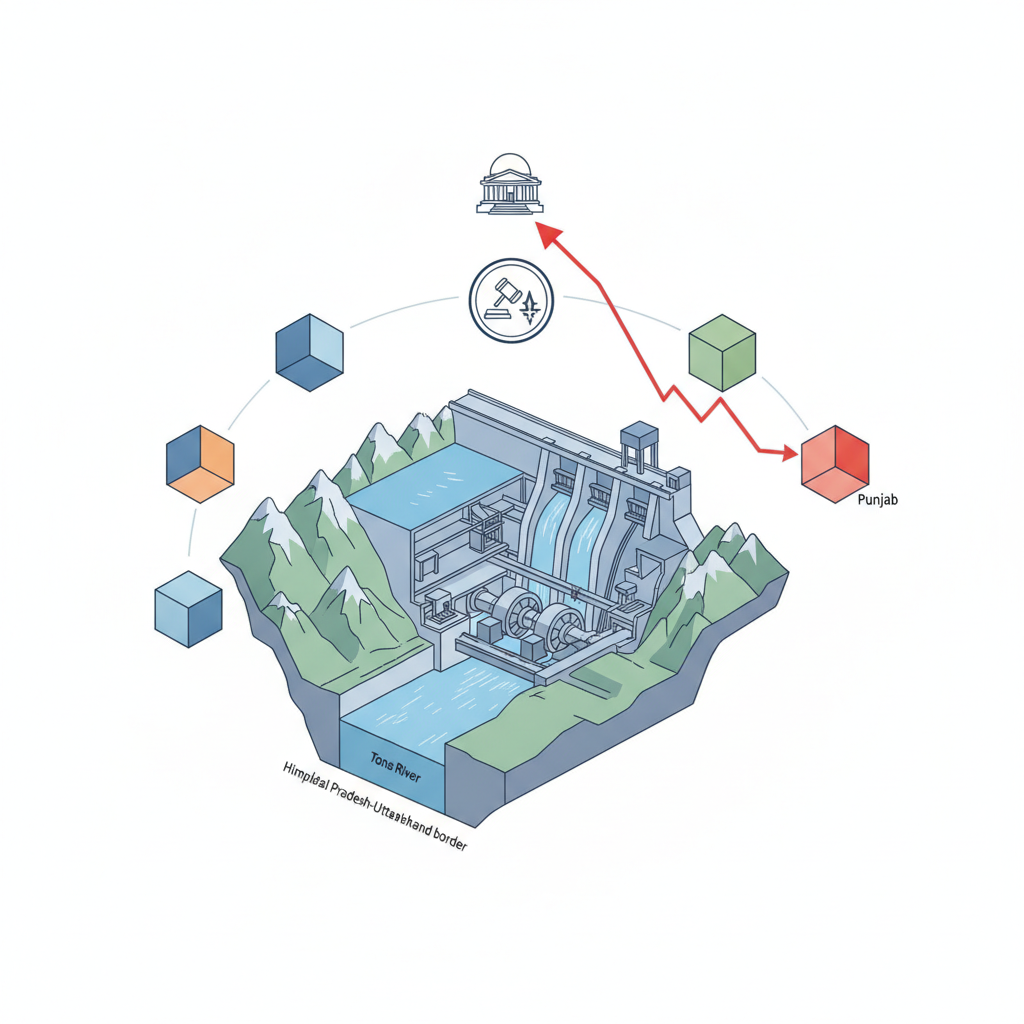
- The Kishau Multipurpose Project is proposed on the Tons River, a major tributary of the Yamuna, at the Himachal Pradesh-Uttarakhand border.
- On 15 September 2026, six states—Uttar Pradesh, Uttarakhand, Himachal Pradesh, Haryana, Rajasthan, and Delhi—signed an agreement for the project, excluding Punjab.
- Punjab has historically asserted water rights over the Yamuna basin, as recognised in the 1954 agreement between Punjab, Rajasthan, and Delhi.
- The Union Government has declared the project a ‘National Project,’ with 90% of the financial burden borne by the Centre.
- Inter-state water disputes in India are governed by the Inter-State Water Disputes Act, 1956, and adjudicated by tribunals or the Supreme Court under Article 262 of the Constitution.
What is the Kishau Multipurpose Project?
- The Kishau Project is a proposed multipurpose dam on the Tons River, a tributary of the Yamuna, located at the confluence of Himachal Pradesh and Uttarakhand.
- It is envisaged to provide irrigation to approximately 97,000 hectares of land across beneficiary states.
- The project has been accorded ‘National Project’ status by the Union Government, ensuring 90% central funding.
- The Tons River is a critical tributary of the Yamuna, contributing significantly to the river’s flow, particularly during the monsoon season.
- The agreement excludes Punjab, which has historically asserted rights over Yamuna waters, citing the 1954 agreement and post-reorganisation legal continuity.
- The project’s development has been delayed due to inter-state disagreements over water allocation and utilisation.
Key Features
| Feature | Significance |
|---|---|
| Project Type | Multi-purpose inter-state river valley project aimed at water storage, irrigation, and hydroelectric power generation. |
| River Basin | Tons River, a major tributary of the Yamuna, shared by Himachal Pradesh and Uttarakhand. |
| Storage Capacity | 1,562 million cubic meters (MCM) of water, addressing regional water scarcity and drought mitigation. |
| Hydroelectric Power | 422 MW capacity, contributing to India’s renewable energy targets and grid stability. |
| Irrigation Coverage | 97,000 hectares of agricultural land across six states, enhancing food security and rural livelihoods. |
| Funding Mechanism | Declared a National Project; 90% financial burden borne by the Central Government, ensuring equitable resource allocation. |
Why it Matters
Economic
- Augments agricultural productivity through enhanced irrigation, reducing dependence on monsoon variability.
- Generates clean energy, reducing carbon footprint and supporting India’s climate commitments under the Paris Agreement.
- Boosts regional economic growth via job creation in construction, agriculture, and allied sectors.
Strategic
- Strengthens inter-state cooperation in water resource management, a critical aspect of India’s federal structure.
- Mitigates water disputes by formalizing allocation mechanisms, reducing the risk of future conflicts.
- Enhances energy security by diversifying the power mix, reducing reliance on fossil fuels.
Environmental
- Promotes sustainable water use through regulated storage and controlled release, preventing downstream water scarcity.
- Supports biodiversity conservation by maintaining ecological flows in the Tons River basin.
- Contributes to India’s renewable energy targets, reducing greenhouse gas emissions.
Governance
- Demonstrates Centre-State collaboration in large-scale infrastructure projects, setting a precedent for future initiatives.
- Highlights the role of the National Project designation in expediting clearance and funding processes.
- Showcases the judiciary’s role in resolving inter-state disputes, ensuring constitutional compliance.
Challenges
1. Inter-State Water Disputes
- Historical grievances over water rights, particularly concerning the Yamuna basin, resurface due to exclusion of Punjab.
- Lack of consensus among riparian states on allocation formulas, leading to legal and political friction.
- Risk of unilateral actions by states to secure water rights, undermining cooperative federalism.
UPSC Link: GS-II: Federalism, Inter-State Relations
2. Legal and Constitutional Challenges
- Ambiguity in the interpretation of the 1954 Punjab-Yamuna agreement and its applicability post-Punjab Reorganisation Act, 1966.
- Potential violation of Article 262 of the Constitution, which empowers Parliament to adjudicate inter-state water disputes.
- Need for judicial intervention to clarify the status of pre-existing agreements in the context of new projects.
UPSC Link: GS-II: Constitutional Provisions, Judiciary
3. Equitable Resource Allocation
- Ensuring fair distribution of benefits among all riparian states, including those excluded from initial agreements.
- Balancing the interests of upstream and downstream states to prevent ecological and economic harm.
- Addressing concerns of Punjab and other excluded states through transparent negotiations and legal recourse.
UPSC Link: GS-II: Water Resource Management
4. Environmental and Ecological Impact
- Assessing the long-term impact of dam construction on river ecosystems, including fish migration and sediment flow.
- Mitigating downstream water scarcity in the Yamuna basin, particularly in states like Punjab and Haryana.
- Ensuring compliance with environmental laws and sustainable development principles.
UPSC Link: GS-III: Environment, Sustainable Development
5. Implementation and Funding Delays
- Coordinating between multiple state governments and central agencies for timely project execution.
- Managing financial flows and ensuring transparency in expenditure to avoid corruption and inefficiencies.
- Overcoming bureaucratic hurdles and procedural delays in land acquisition and regulatory clearances.
UPSC Link: GS-II: Governance, Public Policy
Challenges — UPSC Perspective
| Issue | Concern |
|---|---|
| Exclusion of Punjab | Legal challenge to the validity of the agreement without Punjab’s consent, citing historical water rights. |
| Water Allocation Formula | Disputes over the fairness of the 633 MCM allocation to Haryana compared to other states. |
| Environmental Clearances | Potential delays due to stringent environmental impact assessments and compliance requirements. |
| Land Acquisition | Challenges in acquiring land for the dam and associated infrastructure, particularly in hilly regions. |
| Inter-State Coordination | Need for continuous dialogue among states to prevent unilateral actions and ensure project success. |
| Judicial Intervention | Risk of prolonged litigation, delaying project implementation and increasing costs. |
Way Forward
- Convene a high-level inter-state meeting under the aegis of the Ministry of Jal Shakti to address Punjab’s concerns and explore mutually acceptable solutions.
- Initiate a judicial review of the 1954 agreement and its applicability in the context of the Kishau Project, ensuring constitutional compliance.
- Establish a transparent water allocation formula based on hydrological data, historical usage, and equitable distribution principles.
- Accelerate environmental impact assessments and obtain necessary clearances from statutory bodies like the National Green Tribunal.
- Develop a robust grievance redressal mechanism to address disputes among riparian states, including Punjab, in a time-bound manner.
- Ensure adequate funding and institutional support for project implementation, leveraging the National Project designation for expedited clearances.
- Promote public awareness and stakeholder consultations to build consensus and mitigate opposition from local communities.
- Strengthen data-sharing mechanisms among states to enhance transparency and trust in water resource management.
UPSC Value Addition
Keywords for Mains Answer-Writing
Inter-State Water Disputes · Kishau Multipurpose Project · Yamuna Water Sharing · Inter-State Water Agreements · National Projects · Supreme Court and Water Disputes · Inter-State River Water Disputes Act, 1956 · Tons River Basin · Federalism and Water Governance · Constitutional Provisions on Water Rights · Inter-State Water Disputes Tribunal · National Water Policy 2023 · Water Security and Interstate Cooperation · Judicial Intervention in Water Disputes · Punjab’s Water Rights · Yamuna Water Allocation · Cauvery Model of Water Dispute Resolution
Constitutional & Policy Linkages
- Article 262: Adjudication of inter-state water disputes by Parliament.
Concept Flow
Historical water rights agreements (e.g., 1954 Punjab-Yamuna accord) → → Punjab’s exclusion from the Kishau Project agreement → → Legal challenge citing violation of water rights → → Potential judicial intervention under Article 262 → → Need for equitable resource allocation and inter-state cooperation → → Project implementation delays and environmental impact assessments → → Resolution through high-level negotiations and policy reforms.
Prelims Practice Questions
Q1. Consider the following statements regarding the Kishau Multipurpose Project:
1. The Kishau Project is proposed on the Tons River, a tributary of the Yamuna.
2. The project has been declared a National Project by the Government of India.
3. The project aims to provide irrigation facilities to approximately 1,20,000 hectares of land.
4. The project’s power generation capacity is 422 MW.
How many of the above statements are correct?
- Only one
- Only two
- Only three
- All four
Answer: All four — Statements 1, 2, and 4 are correct. Statement 3 is incorrect as the project targets approximately 97,000 hectares for irrigation, not 1,20,000 hectares.
Q2. Assertion (A): The Inter-State River Water Disputes Act, 1956, empowers the Union Government to constitute tribunals for resolving inter-state water disputes.
Reason (R): The Act provides for the adjudication of disputes through a tribunal, whose decision is binding on the parties involved.
In the context of the above two statements, which one of the following is correct?
- Both A and R are true, and R is the correct explanation of A
- Both A and R are true, but R is not the correct explanation of A
- A is true, but R is false
- A is false, but R is true
Answer: Both A and R are true, but R is not the correct explanation of A — Both the Assertion (A) and Reason (R) are true. The Inter-State River Water Disputes Act, 1956, indeed empowers the Union Government to constitute tribunals for resolving inter-state water disputes, and the tribunal’s decision is binding on the parties involved.
Q3. Match the following rivers with their respective tributaries involved in inter-state water disputes in India:
Column I (River) Column II (Tributary)
A. Krishna 1. Tons
B. Godavari 2. Bhima
C. Yamuna 3. Manjra
D. Cauvery 4. Kabini
Select the correct match:
- A-2, B-3, C-1, D-4
- A-1, B-2, C-3, D-4
- A-3, B-2, C-1, D-4
- A-2, B-1, C-3, D-4
Answer: A-1, B-2, C-3, D-4 — A-2 (Krishna-Bhima), B-3 (Godavari-Manjra), C-1 (Yamuna-Tons), D-4 (Cauvery-Kabini).
Mains Practice Question
✍ The Kishau Multipurpose Project, a proposed inter-state water-sharing initiative, has recently become a subject of legal contention due to the exclusion of Punjab from the agreement. Critically examine the constitutional and legal framework governing inter-state water disputes in India, with particular reference to the role of the Supreme Court and tribunals. Also, analyse the implications of such exclusions on federalism and cooperative federalism in water governance. (15 Marks)
Approach: MODEL-ANSWER SKELETON:
1. **Constitutional Framework**:
– Article 262 of the Constitution: Exclusion of jurisdiction of courts in inter-state water disputes; Parliament’s power to provide for adjudication.
– Inter-State River Water Disputes Act, 1956: Provisions for tribunal formation, reference by states, and binding nature of tribunal awards.
– Article 263: Provision for Inter-State Councils to facilitate coordination.
2. **Legal and Institutional Mechanisms**:
– **Tribunals**: Composition, powers, and limitations (e.g., Cauvery Water Disputes Tribunal, Krishna-Godavari Tribunal).
– **Supreme Court’s Role**: Jurisdiction under Article 136 (special leave petitions), Article 32 (writs), and Article 142 (doctrine of complete justice). Recent judgments (e.g., Krishna-Godavari disputes, Cauvery case) highlighting judicial intervention.
– **National Water Policy 2023**: Emphasis on integrated water resource management and cooperative federalism.
3. **Kishau Project Context**:
– **Legal Basis for Exclusion**: Whether Punjab’s exclusion violates the principle of natural justice or prior agreements (e.g., 1954 Punjab-Yamuna agreement).
– **Federalism Implications**: Impact of unilateral exclusion on cooperative federalism; necessity of consensus in inter-state projects.
– **Judicial Precedents**: Reference to cases like *State of Karnataka v. State of Tamil Nadu* (Cauvery dispute) and *State of Maharashtra v. State of Gujarat* (Krishna-Godavari dispute), where tribunals and courts played pivotal roles.
4. **Balancing Views and Way Forward**:
– **Pro-Federalism Argument**: Need for inclusive negotiations to ensure all stakeholders’ rights are protected.
– **Pro-Efficiency Argument**: Centralised decision-making may expedite project implementation and reduce conflicts.
– **Policy Recommendations**: Strengthening Inter-State Councils, early consultations, and transparent data sharing to prevent disputes.
5. **Conclusion**:
– Reiterate the need for a balanced approach that upholds federalism while ensuring equitable water distribution and project viability.
Source: amarujala.com
Punjab PCS (PPSC) — State PCS Practice
Prelims: Recently, the Punjab Government decided to approach the Supreme Court regarding the Kishau Dam project dispute. What is the primary contention of the Punjab Government in this matter?
- The project violates the Indus Waters Treaty by diverting water from the Sutlej-Beas basin
- The project includes Punjab’s share of water in the agreement without its consent
- The project will submerge large parts of Punjab’s fertile land
- The project is being constructed without environmental clearance
Answer: The project includes Punjab’s share of water in the agreement without its consent — The Punjab Government argues that the Kishau Dam project includes Punjab’s share of water in the agreement without its consent, making it unacceptable.
Mains: Discuss the legal, political, and inter-state implications of the Kishau Dam project dispute from the perspective of Punjab’s water rights and federalism in India. (200 words)
Generated by AanyaAi for educational purpose.
Related guides on our sites
- Best PSIR optional coaching for upsc
- Best PSIR optional teacher for upsc
- Best teacher of PSIR optional for upsc
- Best PSIR optional coaching in delhi for UPSC

- Punjab to Challenge Kishau Project in Supreme Court: Key Polity & Governance Issue for UPSC - September 22, 2026
- दिल्ली हाईकोर्ट ने बदले ‘वरिष्ठ अधिवक्ता’ के नियम, 100-प्वाइंट प्रणाली हुई खत्म - September 22, 2026
- Delhi HC Drops 100-Point System for Senior Advocate Designations - September 22, 2026

No Comments