


22 Sep Telangana HC takes suo motu PIL on illegal baby adoption & trafficking
✎ The Juvenile Justice (Care and Protection of Children) Act, 2015, read with CARA guidelines, mandates that all adoptions must be ethical, transparent, and in the best interests of the child, with strict penalties for trafficking…
Subject Relevance — Where This Topic Fits
- GS Paper I — Social Empowerment: Issues related to Children | GS Paper II — Mechanisms, Laws, Institutions and Bodies constituted for the Protection and Betterment of these Vulnerable Sections | GS Paper III — Challenges to Internal Security
- Prelims: Juvenile Justice (Care and Protection of Children) Act, 2015, Central Adoption Resource Authority (CARA), Shishu Kendra, Child trafficking, Amicus Curiae, Suo Motu PIL, Trafficking of Persons (Prevention, Protection and Rehabilitation) Bill, 2021, Protection of Children from Sexual Offences (POCSO) Act, 2012, National Commission for Protection of Child Rights (NCPCR), State Commission for Protection of Child Rights (SCPCR)
- Essay: The Role of Judiciary in Protecting the Rights of Vulnerable Sections: A Case Study of Child Trafficking in India, Balancing Child Welfare and Legal Adoption: The Challenge of Preventing Trafficking in the Era of Globalisation
Quick Revision: The Juvenile Justice (Care and Protection of Children) Act, 2015, read with CARA guidelines, mandates that all adoptions must be ethical, transparent, and in the best interests of the child, with strict penalties for trafficking and illegal adoption under the IPC and POCSO Act.
Why is this in the news?
The Telangana High Court took up a suo motu Public Interest Litigation (PIL) to examine the alleged widespread illegal adoption and trafficking of infants and young children in the state, following reports from a writ appeal involving a child adopted through non-CARA compliant processes and later alleged to be trafficked. The case underscores systemic gaps in the implementation of the Juvenile Justice Act, 2015, and the Central Adoption Resource Authority (CARA) guidelines, as well as the operational challenges of child protection institutions like Shishu Kendra. The court’s intervention highlights the judiciary’s proactive role in addressing child rights violations and the need for coordinated governance between law enforcement, child welfare authorities, and judicial bodies.
Background
- The Juvenile Justice (Care and Protection of Children) Act, 2015 (JJ Act, 2015) is the primary legislation governing the care, protection, and adoption of children in India, replacing the earlier Juvenile Justice Act, 2000.
- The Central Adoption Resource Authority (CARA), established under the JJ Act, 2015, regulates inter-country and in-country adoptions to ensure they are ethical, transparent, and in the best interests of the child.
- India is a signatory to the United Nations Convention on the Rights of the Child (UNCRC), 1989, which mandates the protection of children from all forms of exploitation, including trafficking and illegal adoption.
- Child trafficking in India often involves forced labour, domestic servitude, sexual exploitation, and illegal adoption, with traffickers exploiting socio-economic vulnerabilities and weak enforcement mechanisms.
- The Protection of Children from Sexual Offences (POCSO) Act, 2012, provides a legal framework for the protection of children from offences of sexual assault, harassment, and pornography, including during trafficking incidents.
- State-level child protection institutions, such as Shishu Kendras, operate under the Integrated Child Protection Scheme (ICPS) to provide shelter, care, and rehabilitation to children in need of protection.
Legal and Institutional Framework for Prevention of Child Trafficking and Illegal Adoption in India
- The Juvenile Justice (Care and Protection of Children) Act, 2015 (JJ Act, 2015) is the apex legal instrument for the protection of children in distress, including those at risk of trafficking or illegal adoption. Key provisions include: (i) establishment of Child Welfare Committees (CWCs) to determine the best interests of the child; (ii) regulation of adoption processes through CARA; and (iii) mandatory reporting of offences under Section 22 of the Act.
- The Central Adoption Resource Authority (CARA), an autonomous body under the Ministry of Women and Child Development, functions as the nodal authority for adoption of Indian children and regulates both in-country and inter-country adoptions. CARA’s guidelines mandate that adoptions must follow due process, including consent of biological parents, home studies, and judicial approval, to prevent trafficking and illegal adoptions.
- The Protection of Children from Sexual Offences (POCSO) Act, 2012, criminalises sexual offences against children and mandates stringent punishment for offenders. The Act also requires mandatory reporting of such offences, including those linked to trafficking, to the local police or Child Welfare Committee (CWC).
- State Commissions for Protection of Child Rights (SCPCRs) and the National Commission for Protection of Child Rights (NCPCR) act as statutory bodies to monitor the implementation of child rights and investigate complaints of violations, including trafficking and illegal adoption.
- The Integrated Child Protection Scheme (ICPS), launched in 2009, provides a comprehensive framework for the protection of children in need of care and protection. The scheme supports the establishment and functioning of child protection institutions, such as Shishu Kendras, and promotes convergence between government departments, NGOs, and civil society.
- The National Crime Records Bureau (NCRB) publishes annual data on crimes against children, including trafficking, to enable evidence-based policymaking and resource allocation. However, underreporting and lack of disaggregated data remain challenges in addressing the issue effectively.
- Judicial pronouncements, such as the Supreme Court’s directives in *Lakshmi Kant Pandey v. Union of India* (1984) and subsequent cases, have reinforced the principle that adoption must prioritise the welfare of the child and adhere to legal safeguards to prevent exploitation.
Key Features
| Feature | Significance |
|---|---|
| Suo Motu PIL by Telangana High Court | Demonstrates judicial activism in addressing systemic failures in child protection, ensuring accountability of executive agencies. |
| Absence of traceable biological parents | Highlights gaps in birth registration and documentation systems, exacerbating vulnerabilities in child trafficking prevention. |
| CARA Guidelines non-compliance | Underscores the need for strict adherence to statutory adoption protocols to prevent exploitation of adoption processes. |
| Role of Shishu Kendra (Nalgonda) | Acts as a temporary protective institution under the Juvenile Justice Act, but raises questions about oversight and rehabilitation standards. |
| Amicus Curiae appointment | Ensures expert legal guidance in complex cases involving child rights and trafficking, enhancing judicial deliberation quality. |
Why it Matters
Legal and Judicial
- The suo motu PIL reflects the judiciary’s proactive stance in safeguarding child rights under Article 21 (Right to Life and Personal Liberty) and Article 39(f) (Protection of children’s interests).
- Examines enforcement gaps in the Juvenile Justice (Care and Protection of Children) Act, 2015, particularly Section 2(14) (child in need of care and protection) and Section 42 (prohibition on sale/purchase of children).
- Reinforces the constitutional mandate under Article 24 (prohibition of child labour) and Article 39(e) (protection from moral and material abandonment).
Governance and Institutional
- Exposes systemic failures in inter-departmental coordination between the Home Department, Women and Child Welfare Directorate, and police forces in trafficking prevention.
- Highlights the critical role of Child Welfare Committees (CWCs) under the Juvenile Justice Act in verifying adoption legitimacy and preventing trafficking.
- Underscores the necessity for robust monitoring mechanisms in childcare institutions (CCIs) to prevent misuse and ensure rehabilitation standards.
Social and Human Rights
- Reveals the exploitation of socio-economically vulnerable families through illegal adoption rackets, often facilitated by unscrupulous intermediaries.
- Emphasises the need for universal birth registration under the Registration of Births and Deaths Act, 1969, to establish legal parentage and prevent trafficking.
- Raises concerns about the psychological and social impact on trafficked children, including identity loss and lack of familial bonds.
Challenges
1. Trafficking Infrastructure
- Proliferation of unregulated intermediaries exploiting legal loopholes in adoption and guardianship processes.
- Lack of real-time data integration between state agencies (police, CWCs, civil registration) to track child movements and prevent trafficking.
- Inadequate forensic and investigative capacity to trace biological parents and dismantle trafficking networks.
UPSC Link: GS2: Governance, GS3: Internal Security
2. Legal and Procedural Gaps
- Non-compliance with Central Adoption Resource Authority (CARA) guidelines due to weak enforcement and awareness among stakeholders.
- Delays in judicial proceedings under the Juvenile Justice Act, leading to prolonged institutionalisation and potential re-trafficking risks.
- Ambiguities in the definition of ‘trafficking’ under the Protection of Children from Sexual Offences (POCSO) Act and the Immoral Traffic (Prevention) Act, 1956.
UPSC Link: GS2: Judiciary, GS3: Laws
3. Institutional Capacity Deficits
- Overburdened Child Welfare Committees (CWCs) with insufficient staff and resources to conduct thorough background checks on adoptions.
- Limited rehabilitation infrastructure in childcare institutions (CCIs) to provide psychological support and social reintegration for trafficked children.
- Absence of a dedicated anti-trafficking unit in Telangana’s police force, despite the state being a known transit hub.
UPSC Link: GS2: Government Policies
4. Socio-Economic Vulnerabilities
- Poverty and lack of awareness among marginalised communities making them susceptible to trafficking through false promises of better lives.
- Gender disparities in rural areas where female children are disproportionately targeted for illegal adoption and trafficking.
- Lack of community-based child protection mechanisms to identify and report suspicious activities.
UPSC Link: GS1: Social Issues
5. Data and Monitoring Deficiencies
- Fragmented data systems across states and union territories, impeding cross-border trafficking investigations.
- No national-level repository to track adoption and guardianship cases, leading to jurisdictional conflicts.
- Inadequate use of technology (e.g., biometric databases, AI-driven pattern recognition) to detect trafficking hotspots.
UPSC Link: GS2: Governance
Challenges — UPSC Perspective
| Issue | Concern |
|---|---|
| Unregulated intermediaries | Exploitation of legal loopholes in adoption and guardianship processes. |
| Delayed judicial proceedings | Prolonged institutionalisation increases risks of re-trafficking and psychological harm. |
| Weak inter-departmental coordination | Failure to share intelligence and track child movements across agencies. |
| Inadequate rehabilitation infrastructure | CCIs lack resources to provide psychological and social support. |
| Poverty and lack of awareness | Marginalised communities remain vulnerable to trafficking through false promises. |
| Fragmented data systems | Impedes cross-border trafficking investigations and national-level monitoring. |
Way Forward
- Strengthen enforcement of CARA guidelines by mandating digital verification of adoption documents and real-time tracking of adoptions.
- Establish a dedicated Anti-Human Trafficking Unit (AHTU) in Telangana with trained personnel and forensic capabilities.
- Mandate universal birth registration under the Registration of Births and Deaths Act, 1969, with incentives for late registrations.
- Enhance capacity of Child Welfare Committees (CWCs) by increasing staffing, training, and resource allocation for background verifications.
- Develop a state-wide database integrating police records, CWC reports, and civil registration data to monitor child movements.
- Launch community awareness campaigns in vulnerable districts to educate families about trafficking risks and legal adoption processes.
- Amend the Juvenile Justice Act, 2015, to include stricter penalties for non-compliance with adoption protocols and trafficking prevention.
- Collaborate with NGOs and civil society to establish rehabilitation centres with psychological and vocational training for trafficked children.
UPSC Value Addition
Keywords for Mains Answer-Writing
Juvenile Justice Act 2015 · Central Adoption Resource Authority (CARA) · Child trafficking · Illegal adoption · Child Protection · Suo motu PIL · High Court jurisdiction · Shishu Kendra · Juvenile Justice Boards · Child Welfare Committees · Trafficking of Persons (Prevention, Protection and Rehabilitation) Bill 2021 · UN Convention on the Rights of the Child · Child in Need of Care and Protection · Adoption regulations under CARA guidelines · Inter-country adoption · Institutional care for children
Constitutional & Policy Linkages
- [‘Article 21: Right to Life and Personal Liberty (child protection).’]
- [‘Article 24: Prohibition of child labour (trafficking nexus).’]
- [‘Article 39(f): Directive Principle on child development and protection.’]
Concept Flow
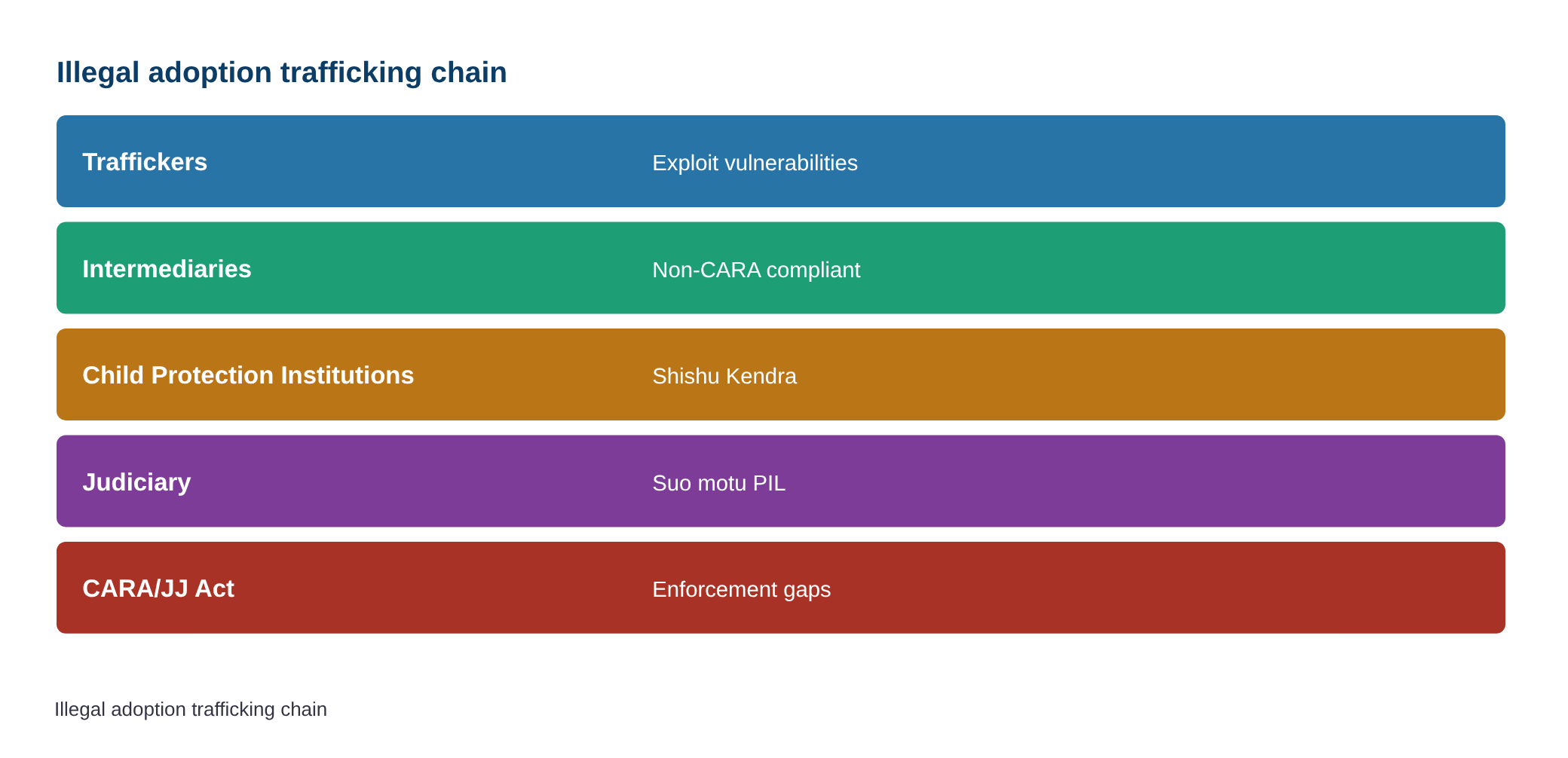
Trafficking networks exploit socio-economic vulnerabilities → Illegal adoptions bypass CARA guidelines → Weak enforcement by agencies → Children enter unregulated childcare institutions → Judicial intervention via suo motu PIL → High Court examines Juvenile Justice Act compliance → Systemic reforms proposed in governance and legal frameworks.
Prelims Practice Questions
Q1. Consider the following statements regarding the Juvenile Justice Act 2015:
1. The Act mandates the establishment of Juvenile Justice Boards in every district.
2. The Act provides for the mandatory registration of all child care institutions.
3. The Act empowers the Child Welfare Committees to declare a child legally free for adoption.
4. The Act prohibits the adoption of children by foreign nationals under all circumstances.
How many of the above statements are correct?
- Only one
- Only two
- Only three
- All four
Answer: Only three — Statements 1, 2, and 3 are correct as per Sections 4, 32, and 50 of the Juvenile Justice Act 2015. Statement 4 is incorrect as the Act allows inter-country adoption under CARA guidelines.
Q2. Assertion (A): The Central Adoption Resource Authority (CARA) is a statutory body under the Ministry of Women and Child Development.
Reason (R): CARA regulates the process of adoption of orphan, abandoned, and surrendered children under the Juvenile Justice Act 2015.
In the context of the above two statements, which one of the following is correct?
- Both A and R are true, and R is the correct explanation of A.
- Both A and R are true, but R is not the correct explanation of A.
- A is true, but R is false.
- A is false, but R is true.
Answer: Both A and R are true, but R is not the correct explanation of A. — CARA is a statutory body established under the Juvenile Justice Act 2015, and it regulates adoption processes for orphaned, abandoned, and surrendered children.
Q3. Match the following institutions with their respective roles under the Juvenile Justice Act 2015:
Column I (Institution)
A. Juvenile Justice Board
B. Child Welfare Committee
C. District Child Protection Unit
D. Special Juvenile Police Unit
Column II (Role)
1. Declares a child legally free for adoption
2. Investigates cases involving children in conflict with law
3. Coordinates implementation of child protection schemes
4. Handles cases of children in need of care and protection
Select the correct match:
- A-2, B-1, C-3, D-4
- A-4, B-1, C-3, D-2
- A-2, B-4, C-1, D-3
- A-1, B-2, C-4, D-3
Answer: A-2, B-1, C-3, D-4 — A. Juvenile Justice Board (Section 4) handles children in conflict with law. B. Child Welfare Committee (Section 27) declares a child legally free for adoption. C. District Child Protection Unit (Section 106) coordinates child protection schemes. D. Special Juvenile Police Unit (Section 107) investigates cases involving children.
Mains Practice Question
✍ The Juvenile Justice Act 2015 provides a robust legal framework for the protection and welfare of children in India. However, recent judicial observations in the Telangana High Court regarding illegal adoption and trafficking of infants highlight systemic gaps in implementation. Critically analyse the efficacy of the Juvenile Justice Act 2015 in preventing child trafficking and illegal adoption, with reference to institutional mechanisms, regulatory oversight, and ground-level challenges. (15 Marks)
Approach: 1. **Legal Framework**: Outline the key provisions of the Juvenile Justice Act 2015 relevant to adoption and trafficking (Sections 2(14), 2(45), 4, 27, 50, 56, 86-89). Highlight the definition of ‘child in need of care and protection’ and ‘legally free for adoption’.
2. **Institutional Mechanisms**: Discuss the roles of:
– Juvenile Justice Boards (Section 4) for children in conflict with law.
– Child Welfare Committees (Section 27) for declaring children legally free for adoption.
– District Child Protection Units (Section 106) for coordination.
– CARA (Central Adoption Resource Authority) for regulating adoption processes.
3. **Regulatory Oversight**: Examine the oversight mechanisms under the Act, including mandatory registration of child care institutions (Section 32), inspection by State Commissions for Protection of Child Rights (SCPCR), and monitoring by the National Commission for Protection of Child Rights (NCPCR).
4. **Ground-Level Challenges**: Analyse systemic gaps such as:
– Weak implementation of CARA guidelines in inter-state and inter-country adoptions.
– Lack of traceability of biological parents in trafficking cases.
– Absence of stringent penalties for middlemen and unregistered agencies.
– Inadequate coordination between police, child welfare authorities, and judicial bodies.
5. **Comparative Perspective**: Contrast the Indian framework with international standards under the UN Convention on the Rights of the Child (1989) and the Trafficking of Persons (Prevention, Protection and Rehabilitation) Bill 2021.
6. **Judicial Interventions**: Cite recent High Court and Supreme Court judgments (e.g., *Lakshmi Kant Pandey v. Union of India*, 1984; *Bachpan Bachao Andolan v. Union of India*, 2011) that have shaped adoption and trafficking jurisprudence.
7. **Way Forward**: Propose measures such as:
– Strengthening of District Child Protection Units with dedicated personnel.
– Mandatory use of the ‘TrackChild’ portal for tracing missing children.
– Enhanced penalties for trafficking and illegal adoption under the Protection of Children from Sexual Offences (POCSO) Act and the Juvenile Justice Act.
– Capacity-building of child welfare committees and police personnel.
8. **Balanced View**: Acknowledge successes (e.g., increased institutional care facilities, awareness campaigns) while critiquing failures (e.g., delayed justice, lack of rehabilitation for trafficked children).
Source: The Hindu
Telangana PCS (TGPSC (TSPSC)) — State PCS Practice
Prelims: Which constitutional provision empowers the High Court of Telangana to take suo motu cognizance of issues related to illegal adoption and trafficking of babies in the state?
- Article 226 (Power of High Courts to issue certain writs)
- Article 32 (Right to Constitutional Remedies)
- Article 142 (Enforcement of decrees and orders of Supreme Court)
- Article 21 (Protection of life and personal liberty)
Answer: Article 226 (Power of High Courts to issue certain writs) — Article 226 empowers High Courts to issue writs for enforcement of fundamental rights and other purposes, enabling suo motu PILs on issues like illegal adoption and trafficking.
Mains: Critically analyze the role of the High Court of Telangana in addressing the issue of illegal adoption and trafficking of babies, with reference to suo motu PILs and constitutional safeguards. Discuss the socio-legal implications and suggest measures to strengthen enforcement mechanisms in the state.
Generated by AanyaAi for educational purpose.
Related guides on our sites
- Best PSIR optional coaching for upsc
- Best economics optional coaching for upsc
- Best PSIR optional teacher for upsc
- Best teacher of PSIR optional for upsc

- केरल में एंटीमाइक्रोबियल रेजिस्टेंस: सरकारी रिपोर्ट में चौंकाने वाले आँकड़े सामने - September 23, 2026
- Kerala’s AMR Crisis: Rising Drug Resistance Threatens Public Health in 2025 - September 23, 2026
- सुप्रीम कोर्ट ने दवाओं की ऊंची कीमतों को ‘लूट’ बताया, सरकार से पूछा- क्या है कानून? - September 23, 2026

No Comments