


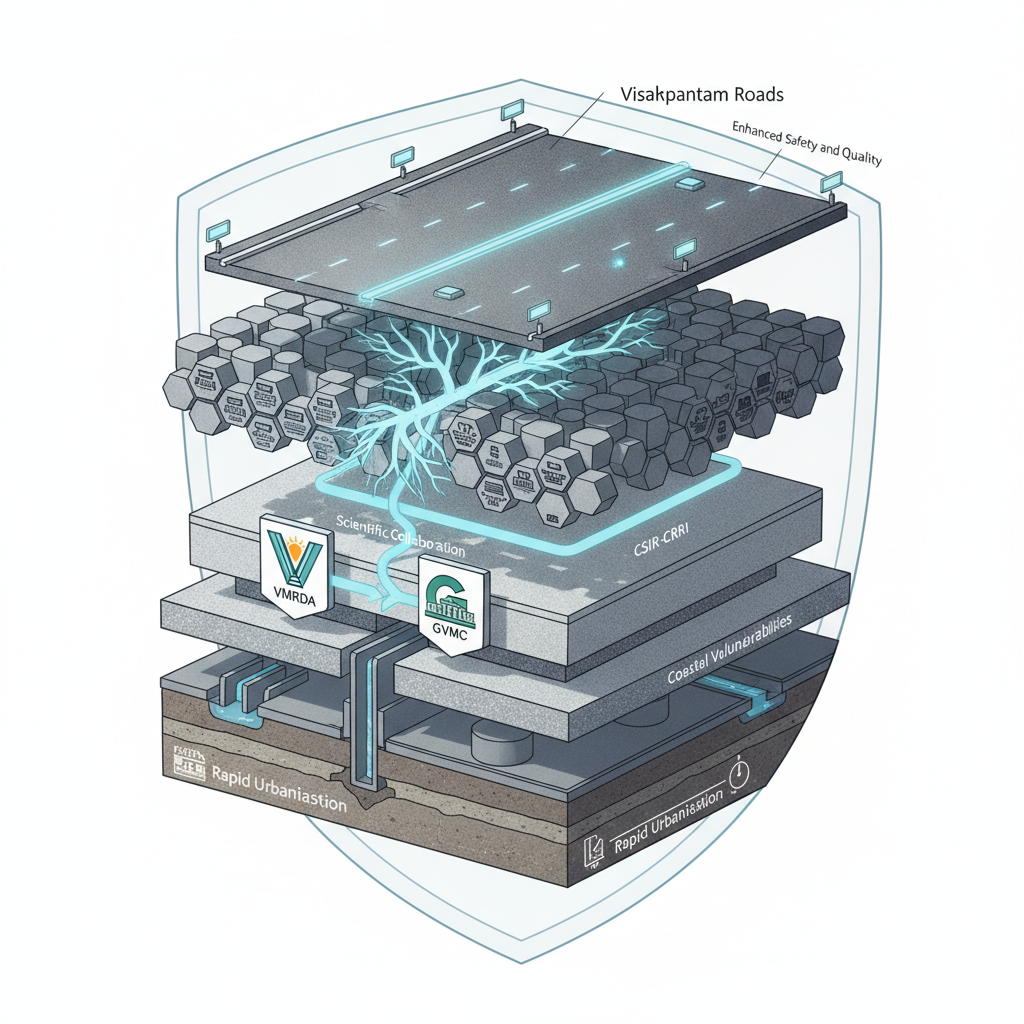
23 Sep CSIR-CRRI to Enhance Road Safety in Visakhapatnam: UPSC & State PCS Insights
✎ CSIR-CRRI’s engagement in Visakhapatnam exemplifies the integration of scientific research with urban governance to deliver resilient, safe, and sustainable road infrastructure through structured partnerships with VMRDA and GVMC.
Subject Relevance — Where This Topic Fits
- GS Paper II — Governance, Constitution, Polity, Social Justice and International Relations (Urban Governance) | GS Paper III — Infrastructure: Energy, Ports, Roads, Airports and Railways (Urban Infrastructure Development)
- Prelims: CRRI (Central Road Research Institute), VMRDA (Visakhapatnam Metropolitan Region Development Authority), GVMC (Greater Visakhapatnam Municipal Corporation), i-RASTE (Intelligent Solutions for Road Safety through Technology and Engineering), Road Asset Management System (RAMS), Subgrade improvement, Flexible pavement design, Urban flood mitigation, Coastal erosion control
- Essay: Urban Infrastructure: The Backbone of Sustainable Cities, Science and Technology in Governance: Bridging the Implementation Gap
Quick Revision: CSIR-CRRI’s engagement in Visakhapatnam exemplifies the integration of scientific research with urban governance to deliver resilient, safe, and sustainable road infrastructure through structured partnerships with VMRDA and GVMC.
Why is this in the news?
The collaboration between the Council of Scientific and Industrial Research–Central Road Research Institute (CSIR-CRRI), Visakhapatnam Metropolitan Region Development Authority (VMRDA), and Greater Visakhapatnam Municipal Corporation (GVMC) marks a significant governance intervention aimed at enhancing the scientific planning, quality, and sustainability of urban road infrastructure in Visakhapatnam. This initiative aligns with the city’s rapid urbanisation, coastal vulnerabilities, and the need for evidence-based infrastructure development, as highlighted in a high-level meeting convened by the local Member of Parliament on 21 September 2026.
Background
- Visakhapatnam, a major port city in Andhra Pradesh, is undergoing rapid urban expansion with a growing metropolitan population exceeding 2 million, necessitating robust urban infrastructure.
- The city’s coastal geography exposes it to risks of urban flooding, coastal erosion, and saltwater intrusion, requiring specialised engineering solutions for resilient road networks.
- Urban road networks in Visakhapatnam currently face challenges such as inadequate pavement quality, frequent waterlogging, and safety hazards due to poor design and maintenance.
- The GVMC, in collaboration with VMRDA, has initiated a large-scale road upgradation programme covering 228 km of roads, 34 km of central dividers, and 1,550 street lights to meet BT/CC standards, demanding technical expertise for quality assurance.
- India’s urban road infrastructure deficit is estimated at over 50% of the required length, with poor subgrade conditions and lack of standardised asset management systems exacerbating maintenance challenges.
- The Government of India’s National Urban Transport Policy (2014) and Smart Cities Mission (2015) emphasise scientific urban planning, sustainable mobility, and resilient infrastructure, providing the policy framework for this initiative.
What is the CSIR-CRRI’s Role in Visakhapatnam’s Road Infrastructure Development?
- CSIR-CRRI, a premier research institute under the Ministry of Science and Technology, specialises in road engineering, pavement design, and urban transport systems, with 75 years of road research experience.
- The collaboration involves scientific assessment of road conditions, including subgrade stability, pavement performance, and drainage systems to address waterlogging and erosion risks.
- CSIR-CRRI will provide technical inputs for the design of flexible pavements, rigid pavements, and hybrid solutions tailored to Visakhapatnam’s coastal and urban terrain.
- The institute will conduct road safety audits, recommend speed limit rationalisation, and integrate intelligent systems such as i-RASTE (Intelligent Solutions for Road Safety through Technology and Engineering) for real-time traffic management.
- A key focus area is the development of a modern Road Asset Management System (RAMS) to enable data-driven maintenance, prioritisation of repairs, and long-term sustainability of the road network.
- CSIR-CRRI will also facilitate structured training programmes for engineers and contractors on best practices in road construction, quality control, and maintenance protocols.
- The collaboration includes studies on pedestrian infrastructure, including the implementation of ‘Right-to-Walk’ facilities to enhance safety and accessibility for vulnerable road users.
- Scientific interventions will address coastal erosion and urban flooding through stabilisation techniques, permeable pavements, and integrated drainage solutions.
Key Features
| Feature | Significance |
|---|---|
| Scientific road improvement programme | Leverages CSIR-CRRI’s 75 years of road research expertise to enhance durability, safety, and performance of urban roads in Visakhapatnam. |
| Flexible pavement technology | Provides adaptive solutions for varying load conditions and subgrade stability, reducing premature failures in coastal urban terrain. |
| Urban flood and coastal erosion mitigation | Incorporates scientific studies to address waterlogging and erosion risks, critical for coastal cities with high rainfall and tidal exposure. |
| Road asset management system | Enables systematic inventory, condition assessment, and lifecycle maintenance planning for the city’s road network. |
| Intelligent road safety systems (e.g., i-RASTE) | Deploys data-driven traffic calming, speed enforcement, and pedestrian safety measures to reduce accidents. |
Why it Matters
Urban Infrastructure Development
- Aligns with the 74th Constitutional Amendment Act’s mandate for urban local bodies to plan and maintain sustainable infrastructure.
- Supports the Smart Cities Mission’s objective of creating pedestrian-friendly, resilient, and technologically integrated urban spaces.
- Enhances connectivity for Visakhapatnam’s port, industrial zones, and residential areas, fostering economic integration.
Scientific Governance of Public Works
- Demonstrates the role of scientific institutions (CSIR-CRRI) in providing evidence-based solutions for civic infrastructure challenges.
- Institutionalises quality control mechanisms in road construction, addressing common issues like poor subgrade preparation and premature deterioration.
- Promotes standardised training for engineers and contractors, ensuring adherence to best practices in urban road engineering.
Coastal Resilience and Sustainability
- Integrates climate-resilient design principles to mitigate urban flooding and coastal erosion, critical for a city with a 100+ km coastline.
- Supports the National Disaster Management Authority’s guidelines for resilient infrastructure in hazard-prone urban areas.
- Contributes to the Sustainable Development Goals (SDG 9, 11, and 13) by improving urban mobility and reducing environmental degradation.
Institutional Collaboration
- Facilitates a tripartite partnership between CSIR-CRRI, GVMC, and VMRDA, ensuring coordinated planning and implementation.
- Strengthens the role of municipal bodies in leveraging national research institutions for local governance challenges.
- Sets a precedent for replicable models of scientific collaboration in urban infrastructure development across Indian cities.
Challenges
1. Coastal Urban Terrain Vulnerabilities
- High groundwater table and saline soil conditions in Visakhapatnam necessitate specialised subgrade treatments to prevent road failures.
- Frequent urban flooding due to inadequate drainage systems exacerbates road damage and disrupts mobility.
- Coastal erosion threatens road infrastructure in low-lying areas, requiring long-term mitigation strategies.
UPSC Link: Geography: Coastal Landforms and Processes
2. Quality Assurance in Public Works
- Historical issues with substandard materials and poor construction practices in urban road projects undermine durability.
- Lack of standardised training for municipal engineers and contractors leads to inconsistent implementation of road safety norms.
- Absence of a unified asset management system complicates maintenance planning and resource allocation.
UPSC Link: Public Administration: Quality Control in Infrastructure Projects
3. Pedestrian Safety and Accessibility
- Inadequate footpath infrastructure and encroachments by hawkers or vehicles restrict pedestrian movement.
- Absence of dedicated pedestrian crossings and signalised intersections increases accident risks.
- Non-compliance with accessibility standards (e.g., for persons with disabilities) limits inclusive urban mobility.
UPSC Link: Social Justice: Inclusive Urban Planning
4. Institutional Coordination Gaps
- Fragmented responsibilities between GVMC and VMRDA may lead to overlapping or conflicting interventions in road planning.
- Limited technical capacity within municipal bodies to absorb and implement advanced scientific solutions.
- Delays in approvals and clearances for road projects due to bureaucratic hurdles.
UPSC Link: Public Administration: Inter-Governmental Coordination
5. Climate Change Adaptation
- Increased frequency of extreme weather events (e.g., cyclones, heavy rainfall) poses risks to road infrastructure.
- Rising sea levels may exacerbate coastal erosion and saltwater intrusion into road subgrades.
- Need for climate-proofing road designs to ensure long-term resilience.
UPSC Link: Environment: Climate Change Impacts and Adaptation
Challenges — UPSC Perspective
| Issue | Concern |
|---|---|
| Subgrade instability due to saline soils | Requires specialised soil stabilisation techniques to prevent road deformation. |
| Urban flooding and waterlogging | Demands integrated stormwater drainage solutions to protect road surfaces. |
| Poor quality control in construction | Undermines durability; necessitates third-party audits and material testing. |
| Encroachments on footpaths | Restricts pedestrian movement; requires strict enforcement of urban planning norms. |
| Lack of pedestrian crossings | Increases accident risks; needs signalised intersections and zebra crossings. |
| Coastal erosion threats | Endangers road infrastructure; requires erosion control measures like seawalls or mangrove plantations. |
Way Forward
- Constitute joint task forces comprising CSIR-CRRI, GVMC, and VMRDA officials to finalise the road improvement plan within 30 days.
- Prioritise pilot projects in high-risk zones (e.g., low-lying areas, coastal stretches) to demonstrate impact and refine designs.
- Develop a standardised training module for municipal engineers and contractors on scientific road construction and maintenance.
- Establish a city-wide road asset management system with real-time condition monitoring and predictive maintenance scheduling.
- Integrate climate resilience criteria into road design specifications, aligning with NDMA and Smart Cities Mission guidelines.
- Conduct regular road safety audits, including pedestrian accessibility checks, and publish audit reports for public transparency.
- Implement intelligent traffic management systems (e.g., i-RASTE) in phases, starting with accident-prone intersections.
- Create a public grievance redressal mechanism for road-related issues to ensure community participation in monitoring progress.
UPSC Value Addition
Keywords for Mains Answer-Writing
Urban road infrastructure · CSIR-CRRI · Scientific road improvement · Greater Visakhapatnam Municipal Corporation (GVMC) · Visakhapatnam Metropolitan Region Development Authority (VMRDA) · Road asset management system · Urban flood mitigation · Coastal erosion management · i-RASTE intelligent road safety system · Right-to-Walk facilities · Road safety audit · Subgrade improvement · Flexible pavement technology · Sustainable urban transport · Public-private partnership in urban governance · National Urban Transport Policy 2014
Constitutional & Policy Linkages
- 74th Constitutional Amendment Act – Urban Local Bodies’ responsibilities for infrastructure (Article 243W)
- Directive Principles of State Policy – Article 39(e) on equitable distribution of resources
Concept Flow
High urbanisation and coastal vulnerabilities → Increased demand for resilient road infrastructure → Need for scientific expertise → Collaboration with CSIR-CRRI → Joint road improvement programme → Poor subgrade conditions and flooding → Road failures and safety risks → Adoption of flexible pavement technology and drainage solutions → Enhanced durability and safety → Fragmented municipal governance → Overlapping responsibilities → Tripartite MoUs (CSIR-CRRI, GVMC, VMRDA) → Coordinated implementation framework → Lack of standardised training → Inconsistent construction practices → Capacity-building programmes → Improved quality control in public works → Absence of asset management systems → Reactive maintenance → Implementation of road asset management system → Proactive and cost-effective upkeep
Prelims Practice Questions
Q1. Consider the following statements regarding the role of CSIR-CRRI in urban road infrastructure development:
1. CSIR-CRRI is mandated to conduct road safety audits and recommend traffic calming measures.
2. CSIR-CRRI provides technical expertise for the design and construction of flexible pavements.
3. CSIR-CRRI is authorised to formulate national road safety policies under the Motor Vehicles Act, 1988.
How many of the above statements are correct?
- Only one
- Only two
- All three
- None
Answer: Only two — Statement 1 and 2 are correct as CSIR-CRRI is known for road safety audits and pavement technology. Statement 3 is incorrect as policy formulation under the Motor Vehicles Act is the domain of the Ministry of Road Transport and Highways, not CSIR-CRRI.
Q2. Assertion (A): The i-RASTE intelligent road safety system is designed to reduce road accidents by leveraging real-time traffic data and AI.
Reason (R): The i-RASTE system is developed by the Ministry of Road Transport and Highways in collaboration with CSIR-CRRI and IIT Madras.
- Both A and R are true, and R is the correct explanation of A.
- Both A and R are true, but R is not the correct explanation of A.
- A is true, but R is false.
- A is false, but R is true.
Answer: Both A and R are true, but R is not the correct explanation of A. — The i-RASTE system is indeed an AI-driven road safety initiative developed through collaboration between CSIR-CRRI, IIT Madras, and the Ministry of Road Transport and Highways. It uses real-time data to mitigate accidents.
Q3. Match the following initiatives with their respective implementing agencies:
Column I (Initiative) Column II (Agency)
A. National Urban Transport Policy 2014 1. Ministry of Housing and Urban Affairs
B. i-RASTE intelligent road safety system 2. CSIR-CRRI
C. Coastal erosion management in Visakhapatnam 3. Greater Visakhapatnam Municipal Corporation (GVMC)
D. Road asset management system 4. Ministry of Road Transport and Highways
- A-1, B-2, C-3, D-4; A-4, B-3, C-2, D-1; A-2, B-4, C-1, D-3; A-1, B-4, C-2, D-3
- answer_array_indexes_to_match_columns_in_order_1_2_3_4
- explain_in_two_lines
- format_match
Answer: ? — The National Urban Transport Policy 2014 is implemented by the Ministry of Housing and Urban Affairs, while i-RASTE is a CSIR-CRRI initiative. Coastal erosion management is a local governance function under GVMC, and road asset management systems are typically overseen by the Ministry of Road Transport and Highways.
Mains Practice Question
✍ The integration of scientific expertise from institutions like CSIR-CRRI into urban road infrastructure projects is critical for achieving sustainable and resilient urban transport systems. Critically examine the challenges and opportunities in leveraging such collaborations for cities like Visakhapatnam, with reference to the proposed road improvement programme. (15 Marks)
Approach: MODEL-ANSWER SKELETON:
1. **Context and Rationale (2 marks)**
– Briefly explain the role of CSIR-CRRI in urban road infrastructure development, citing its mandate and expertise in pavement technology, road safety audits, and sustainable transport solutions.
– Highlight the significance of the Visakhapatnam road improvement programme (228 km roads, 34 km central dividers, 1,550+ street lights) and its alignment with the National Urban Transport Policy 2014.
2. **Opportunities (4 marks)**
– **Technical Expertise**: CSIR-CRRI’s role in designing flexible pavements, subgrade improvement, and coastal erosion mitigation to address Visakhapatnam’s unique geographical challenges (long coastline, urban flooding).
– **Institutional Collaboration**: Partnership between GVMC, VMRDA, and CSIR-CRRI to ensure scientific rigour in planning, quality control, and asset management.
– **Innovation Integration**: Deployment of intelligent systems like i-RASTE for real-time traffic monitoring and accident reduction.
– **Capacity Building**: Structured training for engineers and contractors on modern road construction techniques and safety standards.
3. **Challenges (5 marks)**
– **Funding and Resource Constraints**: High capital expenditure for scientific interventions; reliance on central/state funds and potential delays in fund disbursement.
– **Regulatory and Bureaucratic Hurdles**: Coordination between multiple agencies (GVMC, VMRDA, CSIR-CRRI) and adherence to procurement norms under the Public Works Department.
– **Geographical Vulnerabilities**: Addressing coastal erosion, urban flooding, and soil instability in a time-bound manner without compromising long-term sustainability.
– **Public Participation and Right-to-Walk Facilities**: Ensuring inclusive design that prioritises pedestrian safety and accessibility.
– **Data-Driven Decision Making**: Challenges in collecting, analysing, and utilising real-time traffic and environmental data for adaptive management.
4. **Way Forward (4 marks)**
– **Multi-Stakeholder Governance**: Establish a dedicated nodal authority for seamless coordination between CSIR-CRRI, GVMC, and VMRDA, with clear timelines and accountability.
– **Phased Implementation**: Prioritise high-impact zones (e.g., flood-prone areas, accident hotspots) and adopt a modular approach for scalability.
– **Leverage Technology**: Expand the use of AI-driven systems (i-RASTE) and Geographic Information Systems (GIS) for dynamic road asset management.
– **Community Engagement**: Conduct public consultations to identify pedestrian priorities and integrate ‘Right-to-Walk’ facilities in the design.
– **Monitoring and Evaluation**: Develop a robust framework for regular audits, performance benchmarking, and adaptive corrections based on CSIR-CRRI’s recommendations.
**Balanced View**: Acknowledge that while scientific collaborations enhance quality and durability, their success depends on robust institutional mechanisms, adequate funding, and sustained political will.
Source: PIB (Press Information Bureau)
Andhra Pradesh PCS (APPSC) — State PCS Practice
Prelims: Which of the following organizations is collaborating with CSIR-CRRI to improve and ensure safer roads in Visakhapatnam?
- A) Andhra Pradesh Road Development Corporation (APRDC)
- B) Visakhapatnam Metropolitan Region Development Authority (VMRDA) and Greater Visakhapatnam Municipal Corporation (GVMC)
- C) National Highways Authority of India (NHAI)
- D) Ministry of Road Transport and Highways (MoRTH)
Answer: B) Visakhapatnam Metropolitan Region Development Authority (VMRDA) and Greater Visakhapatnam Municipal Corporation (GVMC) — CSIR-CRRI is partnering with VMRDA and GVMC to enhance road safety and quality in Visakhapatnam.
Mains: Discuss the significance of the collaboration between CSIR-CRRI, VMRDA, and GVMC in improving road infrastructure in Visakhapatnam. Highlight the potential challenges and suggest measures to ensure sustainable development in this sector.
Generated by AanyaAi for educational purpose.
Related guides on our sites
- How to prepare for GS paper 1 for UPSC CSE mains exam
- Best UPSC coaching for IFOS exam
- Best mentorship programme for upsc
- UPSC+BA degree

- सर्वसम्मति से पारित SIR आदेश: चुनाव आयोग ने फॉर्म 6 बदलावों को बताया वैध - September 26, 2026
- Supreme Court Upholds Form 6 Changes: EC Clarifies SIR Row for UPSC - September 26, 2026
- कर्नाटक में रोके जाएंगे मातृ मृत्यु, जिला स्तर पर होगा कार्यान्वयन - September 26, 2026

No Comments