


23 Sep TRAI’s Gujarat Highway Mobile Network Assessment: Key Findings for UPSC & State PCS
✎ TRAI’s Independent Drive Tests (IDTs) are regulatory assessments that objectively evaluate mobile network quality on national highways, using advanced handsets and real-time monitoring to measure key parameters like call drop…
Subject Relevance — Where This Topic Fits
- GS Paper II — Governance, Transparency and Accountability | GS Paper III — Infrastructure: Digital Communications
- Prelims: Telecom Regulatory Authority of India (TRAI), Independent Drive Test (IDT), Mobile Network Quality Parameters, Quality of Service (QoS), Call Drop Rate (CDR), Call Setup Success Rate (CSSR), Data Throughput, Latency, Jitter, Packet Drop Rate, NH-27 (Gandhidham to Santalpur), Telecom Service Providers (TSPs), 2G/3G/4G/5G Networks
- Essay: Digital infrastructure as a catalyst for India’s socio-economic transformation, Balancing technological advancement with equitable access in rural and semi-urban India
Quick Revision: TRAI’s Independent Drive Tests (IDTs) are regulatory assessments that objectively evaluate mobile network quality on national highways, using advanced handsets and real-time monitoring to measure key parameters like call drop rates, data throughput, and coverage gaps, thereby ensuring transparency and consumer empowerment in India’s telecom sector.
Why is this in the news?
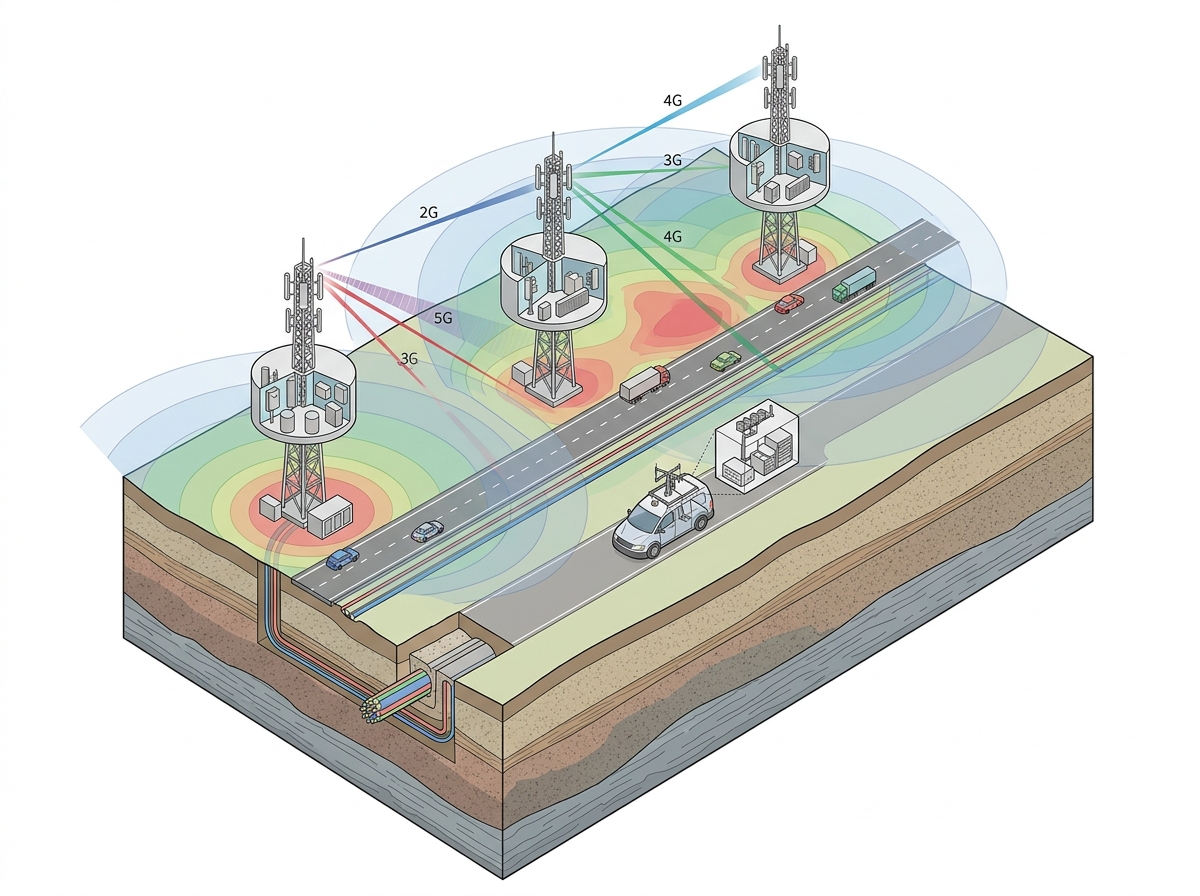
The Telecom Regulatory Authority of India (TRAI) released the findings of its Independent Drive Test (IDT) conducted on National Highway-27 (NH-27) between Gandhidham and Santalpur in Gujarat in July 2026. The assessment evaluated the real-time performance of mobile network services (voice and data) across 2G, 3G, 4G, and 5G technologies for all telecom service providers, providing a benchmark for service quality on a critical national highway corridor. This exercise underscores TRAI’s role in ensuring transparency, accountability, and consumer protection in India’s telecom sector.
Background
- TRAI, established under the Telecom Regulatory Authority of India Act, 1997, is the statutory body responsible for regulating the telecom sector in India, including the monitoring of Quality of Service (QoS) standards.
- Independent Drive Tests (IDTs) are a regulatory tool used by TRAI to objectively assess the performance of telecom service providers (TSPs) in real-world conditions, including highways, urban areas, and public transport hubs.
- NH-27 is a key national highway in Gujarat, connecting Gandhidham (Kutch district) to Santalpur (Patan district), and serves as a critical corridor for trade, logistics, and connectivity in the region.
- The assessment of mobile network quality on national highways is essential to ensure seamless digital connectivity for commuters, emergency services, and economic activities.
- TRAI’s IDTs are part of a broader framework to enhance transparency in the telecom sector and empower consumers with data-driven insights into service quality.
- The results of such assessments are published to encourage TSPs to improve service quality and to inform consumers about network performance in specific geographies.
What is an Independent Drive Test (IDT)?
- Independent Drive Tests (IDTs) are regulatory assessments conducted by TRAI to evaluate the real-time performance of mobile network services across various technologies (2G, 3G, 4G, 5G) in diverse usage environments, including highways, urban areas, and public transport hubs.
- IDTs utilise advanced testing handsets equipped with specialised software to monitor and analyse live data and voice sessions in real time, ensuring objective and unbiased measurement of network quality.
- The tests assess key performance parameters such as coverage gaps, call drop rates (CDR), call setup success rates (CSSR), call silence instances, data download/upload throughput, latency, jitter, and packet drop rates.
- IDTs are designed to simulate actual user experiences, providing a holistic view of network performance under varying conditions of mobility, signal strength, and user density.
- The results of IDTs are published to enhance transparency, enable consumers to make informed choices, and incentivise telecom service providers (TSPs) to improve service quality.
- IDTs are conducted by TRAI through empanelled agencies and are supervised by regional offices to ensure methodological rigour and impartiality.
- The findings of IDTs are used by TRAI to issue recommendations, directives, or penalties to TSPs for non-compliance with QoS standards, as mandated under the Telecom Regulatory Authority of India (Quality of Service) Regulations, 2009.
Key Features
| Feature | Significance |
|---|---|
| Independent Drive Test (IDT) | Ensures objective, third-party assessment of telecom service quality, free from provider bias, using live data and advanced handsets. |
| Coverage Gap Analysis | Quantifies areas with inadequate signal strength across 2G/3G/4G/5G networks, critical for rural and highway connectivity. |
| Call Drop Rate (CDR) | Measures the percentage of initiated calls that terminate prematurely, directly impacting user experience and communication reliability. |
| Call Setup Success Rate (CSSR) | Assesses the efficiency of network in establishing calls, reflecting infrastructure robustness and latency. |
| Data Throughput (Download/Upload) | Evaluates real-world data speeds, essential for assessing the feasibility of digital services, remote work, and IoT applications. |
| Latency and Jitter | Measures delay and variability in data packet transmission, crucial for real-time applications like video conferencing and online gaming. |
Why it Matters
Economic Connectivity
- High-speed, reliable mobile networks on national highways reduce transaction costs for logistics and e-commerce, enhancing supply chain efficiency.
- Improved connectivity in Gujarat’s industrial and trade corridors (e.g., Kandla Port) supports Gujarat’s economic growth trajectory and national trade.
Digital Inclusion
- Reliable mobile networks are prerequisites for digital governance initiatives like Direct Benefit Transfer (DBT) and e-Residency services.
- Ensures equitable access to digital services in rural and semi-urban areas along the highway, aligning with the Digital India mission.
Strategic Infrastructure
- National Highway 27 is a critical east-west corridor; robust telecom infrastructure supports disaster management, emergency response, and national security communications.
- Enhances interstate connectivity, facilitating seamless movement of people and goods, thereby strengthening national integration.
Regulatory Governance
- TRAI’s IDT framework exemplifies independent regulatory oversight, ensuring transparency and accountability in telecom service provision.
- Publication of performance metrics empowers consumers to make informed choices and incentivizes telecom providers to improve service quality.
Challenges
1. Inadequate Coverage in Highway Corridors
- Highway routes often traverse sparsely populated or geographically challenging terrain, leading to inconsistent signal propagation.
- Limited infrastructure deployment in such areas due to high costs and low immediate returns on investment.
UPSC Link: GS3: Infrastructure – Telecom
2. Call Drop and Latency Issues
- Network congestion during peak hours or in high-traffic zones (e.g., toll plazas) exacerbates call drops and latency.
- Legacy network infrastructure (2G/3G) struggles to meet modern data demands, necessitating phased upgrades to 4G/5G.
UPSC Link: GS3: Communication Technology
3. Data Throughput Disparities
- Urban-centric network deployment results in lower speeds in rural and highway segments, widening the digital divide.
- Limited spectrum availability and inefficient spectrum allocation hinder optimal network performance.
UPSC Link: GS3: Digital Divide
4. Regulatory Enforcement Gaps
- Despite TRAI’s guidelines, non-compliance by telecom providers persists due to weak penalties or delayed enforcement.
- Lack of real-time monitoring mechanisms to address service quality violations promptly.
UPSC Link: GS2: Regulatory Bodies – TRAI
Challenges — UPSC Perspective
| Issue | Concern |
|---|---|
| Spectrum Scarcity | Limited availability of spectrum bands constrains network expansion and quality improvement. |
| High Infrastructure Costs | Rural and highway deployments incur high capital expenditure, deterring private investment. |
| Interoperability Challenges | Inconsistent standards across telecom providers hinder seamless roaming and service continuity. |
| Consumer Awareness Deficit | Users lack knowledge of network performance metrics, limiting their ability to demand better services. |
| Climate and Terrain Constraints | Geographical barriers (e.g., hills, forests) and extreme weather disrupt signal propagation. |
| Policy Fragmentation | Overlapping jurisdictions of central, state, and local authorities complicate infrastructure deployment. |
Way Forward
- Strengthen TRAI’s enforcement mechanisms with stricter penalties for non-compliance to Quality of Service (QoS) norms.
- Promote public-private partnerships (PPPs) to accelerate telecom infrastructure deployment in underserved highway corridors.
- Accelerate spectrum auctions and rationalize spectrum allocation to optimize network performance.
- Invest in advanced network technologies (e.g., small cells, fiber backhaul) to enhance coverage and throughput in rural and highway segments.
- Enhance consumer education campaigns to raise awareness about network performance metrics and redressal mechanisms.
- Integrate telecom infrastructure planning with national highway development projects to ensure synergy.
- Leverage BharatNet’s fiber-optic backbone to extend last-mile connectivity to highway corridors.
- Establish a real-time monitoring dashboard for telecom service quality, enabling proactive issue resolution.
UPSC Value Addition
Keywords for Mains Answer-Writing
Telecom Regulatory Authority of India (TRAI) · Independent Drive Test (IDT) · Quality of Service (QoS) · Telecom Service Providers (TSPs) · Right of Way (RoW) · Universal Service Obligation Fund (USOF) · Digital India · BharatNet · Telecom Disputes Settlement and Appellate Tribunal (TDSAT) · Spectrum Management · Telecom Infrastructure Sharing · Consumer Protection in Telecom · Network Coverage and Quality Parameters · Telecom Sector Regulation · National Digital Communications Policy 2018 · Telecom Act 2023 · 5G Deployment · Telecom Infrastructure Penetration · Rural Connectivity · Telecom Consumer Rights
Concept Flow
National Highway 27 as a critical transport corridor → Demand for robust telecom infrastructure → TRAI’s Independent Drive Test (IDT) framework → Objective assessment of network quality → Publication of performance metrics → Consumer empowerment and regulatory accountability → Incentives for telecom providers to improve services → Enhanced economic connectivity and digital inclusion → Alignment with Digital India and BharatNet objectives.
Prelims Practice Questions
Q1. Consider the following statements regarding the Telecom Regulatory Authority of India (TRAI):
1. TRAI is a statutory body established under the Telecom Regulatory Authority of India Act, 1997.
2. TRAI regulates both telecom and broadcasting services in India.
3. TRAI’s recommendations are binding on the Government of India.
4. TRAI conducts Independent Drive Tests (IDTs) to assess the quality of mobile network services.
How many of the above statements are correct?
- Only one
- Only two
- Only three
- All
Answer: Only three — Statements 1, 2, and 4 are correct. TRAI is a statutory body under the TRAI Act, 1997, and regulates both telecom and broadcasting services. However, its recommendations are not binding on the Government; they are advisory in nature. Statement 3 is incorrect.
Q2. Assertion (A): The Telecom Regulatory Authority of India (TRAI) conducts Independent Drive Tests (IDTs) to evaluate the real-time performance of telecom service providers.
Reason (R): IDTs are designed to measure parameters such as call drop rates, data speed, and network coverage across different geographical regions.
In the context of the above two statements, which one of the following is correct?
- Both A and R are true, and R is the correct explanation of A.
- Both A and R are true, but R is not the correct explanation of A.
- A is true, but R is false.
- A is false, but R is true.
Answer: Both A and R are true, but R is not the correct explanation of A. — Both the Assertion (A) and Reason (R) are true. TRAI indeed conducts IDTs to assess real-time performance, and the Reason correctly explains the purpose of these tests, which include measuring call drop rates, data speed, and network coverage.
Q3. Match the following telecom regulatory bodies with their respective functions:
Column I (Body)
A. Telecom Regulatory Authority of India (TRAI)
B. Telecom Disputes Settlement and Appellate Tribunal (TDSAT)
C. Wireless Planning and Coordination Wing (WPC)
D. Universal Service Obligation Fund (USOF)
Column II (Function)
1. Resolves disputes between telecom service providers and consumers
2. Manages spectrum allocation and licensing
3. Ensures universal access to telecom services in rural and remote areas
4. Regulates tariffs, quality of service, and interconnection issues
Select the correct match:
- A-4, B-1, C-2, D-3
- A-1, B-2, C-3, D-4
- A-3, B-4, C-1, D-2
- A-2, B-3, C-4, D-1
Answer: A-4, B-1, C-2, D-3 — The correct matches are: A (TRAI) regulates tariffs, QoS, and interconnection (4); B (TDSAT) resolves disputes (1); C (WPC) manages spectrum allocation (2); D (USOF) ensures universal access (3).
Mains Practice Question
✍ The Telecom Regulatory Authority of India (TRAI) conducts Independent Drive Tests (IDTs) to assess the quality of mobile network services across India. In this context, critically examine the role of TRAI in ensuring consumer rights and service quality in the telecom sector. Also, discuss the challenges faced by TRAI in maintaining uniform service standards across diverse geographical regions. (15 Marks)
Approach: MODEL-ANSWER SKELETON:
1. **Introduction (2 Marks)**:
– Define TRAI and its statutory mandate under the TRAI Act, 1997.
– Mention TRAI’s role in regulating telecom services, including tariffs, interconnection, and quality of service (QoS).
– Highlight the significance of IDTs in assessing real-time network performance.
2. **TRAI’s Role in Ensuring Consumer Rights and Service Quality (6 Marks)**:
– **Regulatory Framework**: Discuss TRAI’s powers under the TRAI Act, 1997, and the Telecom Act, 2023, to enforce QoS standards.
– **Consumer Protection**: Explain TRAI’s initiatives such as the Telecom Consumers Protection Regulations, 2012, and the Telecom Ombudsman Scheme.
– **IDTs and QoS Parameters**: Detail the key QoS parameters assessed during IDTs (e.g., call drop rates, data speed, network coverage) and their relevance to consumer rights.
– **Transparency and Accountability**: Discuss how TRAI publishes IDT reports to hold telecom service providers (TSPs) accountable and empowers consumers with data-driven insights.
3. **Challenges in Maintaining Uniform Service Standards (5 Marks)**:
– **Geographical Diversity**: Explain the challenges posed by India’s diverse terrain (e.g., hilly regions, rural areas) in ensuring uniform network coverage.
– **Infrastructure Gaps**: Discuss issues such as Right of Way (RoW) clearances, delays in tower installations, and lack of last-mile connectivity.
– **Spectrum Management**: Highlight the complexities in spectrum allocation and the need for efficient spectrum utilization to improve QoS.
– **Financial Constraints**: Mention the role of the Universal Service Obligation Fund (USOF) in bridging the digital divide and its limitations.
– **Technological Advancements**: Discuss the challenges in transitioning to 5G and ensuring backward compatibility with older technologies.
4. **Conclusion (2 Marks)**:
– Summarize TRAI’s pivotal role in balancing consumer rights and industry growth.
– Suggest measures such as incentivizing infrastructure sharing, expediting RoW clearances, and leveraging public-private partnerships to enhance QoS.
– Emphasize the need for a multi-stakeholder approach involving TSPs, government, and consumers to address challenges effectively.
Source: PIB (Press Information Bureau)
Gujarat PCS (GPSC) — State PCS Practice
Prelims: As per the recent TRAI assessment (2024), which of the following mobile network parameters showed the MOST significant improvement along the Gandhidham to Santalpur National Highway-27 (NH-27) in Gujarat?
- Call Drop Rate (CDR)
- Network Latency
- Data Speed (4G/5G)
- Spectrum Utilization Efficiency
Answer: Call Drop Rate (CDR) — TRAI’s 2024 assessment highlighted Gandhidham-Santalpur NH-27 as a key route where Call Drop Rate (CDR) showed the most notable improvement due to telecom infrastructure upgrades.
Mains: Analyze the key challenges and policy interventions required to further enhance mobile network quality along the Gandhidham to Santalpur stretch of NH-27 in Gujarat, with a focus on rural connectivity and last-mile connectivity issues.
Generated by AanyaAi for educational purpose.
Related guides on our sites
- Current affairs for upsc 2026
- How to prepare for GS paper 1 for UPSC CSE mains exam
- Best UPSC coaching for IFOS exam
- Best mentorship programme for upsc

- संयुक्त राष्ट्र की विफलता पर तुर्की राष्ट्रपति ने उठाया बड़ा सवाल, जानिए पूरा मामला - September 23, 2026
- UN’s Failure in Peacekeeping: Erdoğan’s Critique on UNSC Reforms for UPSC 2026 - September 23, 2026
- मद्रास उच्च न्यायालय ने 50 वर्ष से अधिक उम्र की विदेशी महिला को दिया आईवीएफ उपचार का अधिकार - September 23, 2026

No Comments