


23 Sep Supreme Court Slams ECI Over ‘Mechanical’ SIR Notices in Delhi
✎ The Special Intensive Revision (SIR) of electoral rolls is a statutory process aimed at purifying voter lists, but its procedural fairness—particularly the clarity of notices and the adequacy of responses—must align with…
Subject Relevance — Where This Topic Fits
- GS Paper II — Constitutional and Statutory Bodies (Election Commission of India) | GS Paper III — Electoral Reforms and Governance
- Prelims: Electoral Rolls, Special Intensive Revision (SIR), ECI, logical discrepancy, voter verification, electoral justice, Section 21 of the Representation of the People Act, 1950, Form 7, Model Code of Conduct, voter awareness, electoral integrity
- Essay: Electoral integrity and democratic accountability: Balancing efficiency with fairness in voter registration, The role of judicial oversight in safeguarding constitutional institutions
Quick Revision: The Special Intensive Revision (SIR) of electoral rolls is a statutory process aimed at purifying voter lists, but its procedural fairness—particularly the clarity of notices and the adequacy of responses—must align with constitutional principles of natural justice to prevent unintended disenfranchisement.
Why is this in the news?
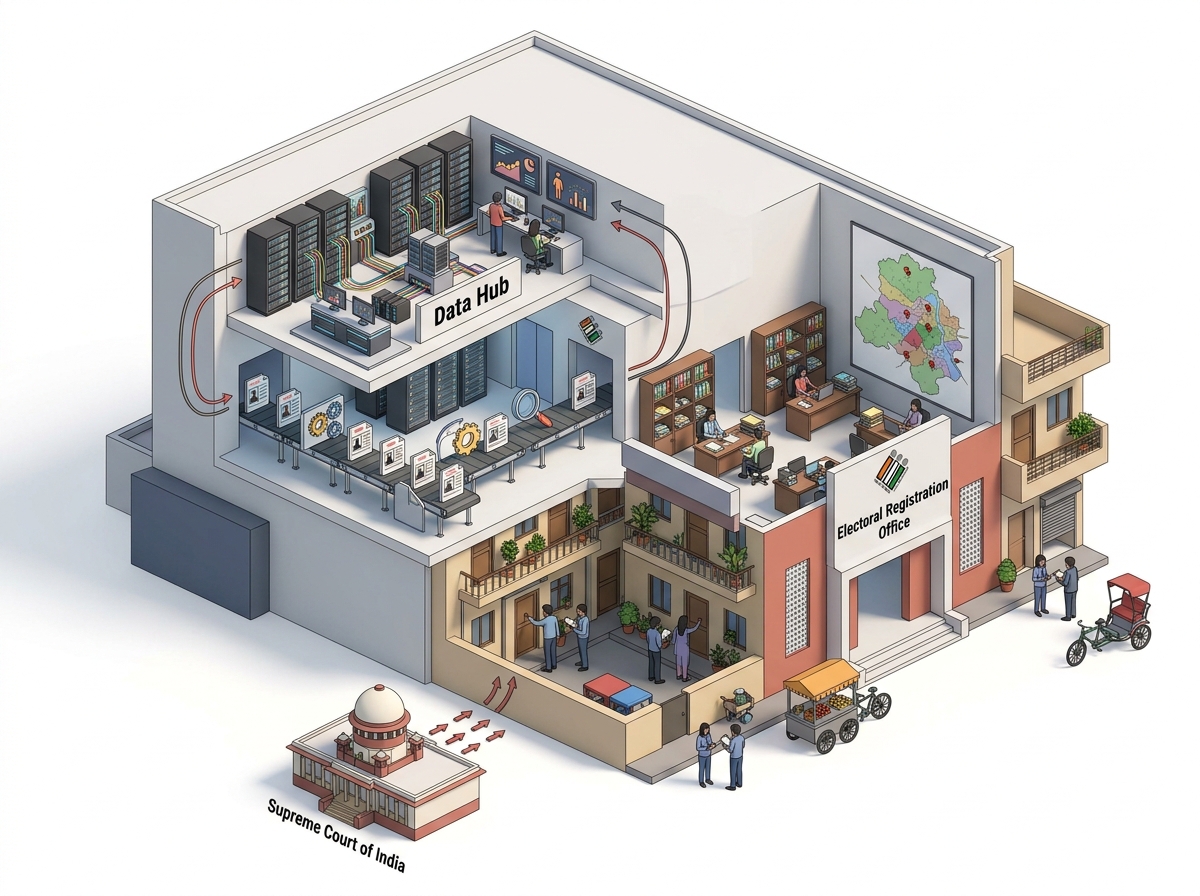
The Supreme Court of India, while hearing a petition highlighting concerns over the Special Intensive Revision (SIR) of electoral rolls in Delhi, observed that notices issued to voters appeared to be ‘mechanical’ and potentially machine-generated. The Court directed the Election Commission of India (ECI) to examine whether additional filters were necessary to refine the process and sought a status report on the deletion of names and the reasons for discrepancies. The case underscores the tension between electoral efficiency and procedural fairness in voter verification processes.
Background
- The Special Intensive Revision (SIR) is a periodic exercise conducted by the Election Commission of India (ECI) to update and purify electoral rolls, ensuring accuracy and eliminating duplicate or erroneous entries.
- In Delhi, the SIR exercise has led to the deletion of over 47 lakh names and the issuance of notices to more than 33 lakh voters due to ‘logical discrepancies’, raising concerns about the transparency and fairness of the process.
- The petitioners, including activists Anjali Bhardwaj and Amrita Johri, alleged that the ECI and the Delhi Chief Electoral Officer had failed to adequately disclose the names deleted from the electoral rolls or the reasons for issuing notices, thereby violating the principles of natural justice.
- The Supreme Court’s intervention reflects growing judicial scrutiny over electoral processes, particularly in matters concerning voter disenfranchisement and procedural opacity.
- The ECI’s reliance on automated systems for issuing notices has been questioned, with the Court emphasizing the need for human oversight to ensure that notices are not merely perfunctory but provide meaningful information to voters.
- The case also highlights broader concerns about voter awareness and the accessibility of documentation required to address discrepancies, especially for marginalized or less informed electorates.
What is the Special Intensive Revision (SIR) of Electoral Rolls?
- The Special Intensive Revision (SIR) is a statutory exercise conducted by the Election Commission of India (ECI) under the Representation of the People Act, 1950, to update and purify electoral rolls before elections.
- The primary objective of the SIR is to ensure the accuracy, completeness, and authenticity of the electoral rolls by identifying and removing duplicate, erroneous, or ineligible entries, such as deceased voters or those who have shifted residences.
- The process involves door-to-door verification, scrutiny of records, and the issuance of notices to voters whose entries are flagged for discrepancies, such as ‘logical discrepancies’ (e.g., inconsistent address or voting history).
- Voters are required to respond to notices within a stipulated period, failing which their names may be deleted from the electoral rolls.
- The ECI uses a combination of manual verification and automated tools to streamline the process, but concerns arise when notices are perceived as ‘mechanical’ or lack sufficient detail to enable meaningful responses from voters.
- The SIR is distinct from the Continuous Updating of Electoral Rolls (CER), which is an ongoing process, whereas the SIR is a periodic, intensive revision conducted at specific intervals.
- The exercise is critical for maintaining electoral integrity, preventing voter disenfranchisement, and ensuring that only eligible voters are registered in the electoral rolls.
Key Features
| Feature | Significance |
|---|---|
| Special Intensive Revision (SIR) of electoral rolls | A statutory process under the Representation of the People Act, 1951, to ensure accuracy and integrity of electoral rolls through systematic verification of voter details. |
| Mechanical issuance of notices | Automated generation of discrepancy notices without contextual verification, raising concerns about fairness and procedural justice in the revision process. |
| Logical discrepancy in voter records | A technical term for inconsistencies in voter data, such as mismatched addresses or voting history, which may not necessarily indicate electoral fraud but require clarification. |
| Transparency in deletion of voter names | The requirement for the Election Commission of India (ECI) to disclose reasons for deletions to maintain public trust and accountability in electoral processes. |
| Judicial oversight of electoral processes | The Supreme Court’s role in ensuring adherence to constitutional and statutory norms in electoral roll revisions, safeguarding democratic principles. |
Why it Matters
Electoral Integrity
- The SIR process is critical for maintaining the accuracy of electoral rolls, which directly impacts the legitimacy of elections and public confidence in the electoral system.
- Mechanical notices undermine the credibility of the revision process, potentially leading to erroneous deletions or undue burden on genuine voters.
- Transparency in deletions and reasons for discrepancies is essential to prevent arbitrary disenfranchisement and ensure procedural fairness.
Judicial Review and Governance
- The Supreme Court’s intervention highlights the judiciary’s role in safeguarding constitutional rights, particularly the right to vote under Article 326 of the Constitution.
- Judicial scrutiny ensures that executive actions (here, the ECI’s processes) comply with legal and procedural standards, reinforcing the separation of powers.
- The Court’s emphasis on refining tools and adding filters demonstrates the need for adaptive governance to address emerging challenges in electoral administration.
Administrative Efficiency
- Automation in electoral roll revisions can improve efficiency but must be balanced with human oversight to prevent errors and ensure fairness.
- The scale of notices issued (over 33 lakh) underscores the administrative complexity of managing electoral rolls for a large electorate like Delhi.
- The ECI’s response to judicial directives will determine the robustness of future electoral roll revisions across the country.
Challenges
1. Mechanical Notices and Lack of Context
- Automated notices without contextual details may confuse or mislead genuine voters, leading to unnecessary documentation burdens.
- The term ‘logical discrepancy’ is ambiguous and requires clearer definitions to avoid arbitrary interpretations by electoral officers.
- Voters may lack the specific documents needed to refute discrepancies, particularly if the notices do not specify the required evidence.
UPSC Link: Representation of the People Act, 1951, Section 21
2. Transparency and Accountability in Deletions
- The ECI’s failure to adequately disclose reasons for deletions raises concerns about accountability and the right to a fair hearing.
- Without clear communication, voters may be unaware of the grounds for deletion, impeding their ability to appeal or rectify errors.
- Judicial scrutiny is necessary to ensure that deletions are based on verifiable evidence rather than procedural lapses.
UPSC Link: Article 326 of the Constitution (Adult Suffrage)
3. Scale and Complexity of Electoral Roll Management
- Managing electoral rolls for over 97 lakh voters in Delhi requires robust technological and human resources, which may be stretched during intensive revision exercises.
- The deletion of over 47 lakh names during the current SIR highlights the potential for large-scale disenfranchisement if processes are not carefully monitored.
- Ensuring consistency across multiple electoral rolls (e.g., Delhi vs. Chandigarh addresses) demands inter-state coordination and data integration.
UPSC Link: Representation of the People Act, 1951, Section 15
4. Judicial-Executive Coordination
- The Supreme Court’s directives require the ECI to refine its tools and processes, but the implementation must balance judicial oversight with administrative autonomy.
- Over-reliance on judicial intervention may indicate systemic weaknesses in the ECI’s internal grievance redressal mechanisms.
- The Court’s role in defining procedural fairness sets a precedent for future electoral disputes, necessitating clear guidelines.
UPSC Link: Article 324 of the Constitution (Superintendence, direction and control of elections)
5. Public Trust and Perception
- Erroneous notices or deletions can erode public trust in the electoral process, particularly if high-profile individuals are affected.
- The perception of arbitrary action, even if unintentional, can lead to allegations of political bias or administrative incompetence.
- Transparent and well-documented processes are essential to maintain the legitimacy of the ECI’s actions in the eyes of the electorate.
UPSC Link: Article 325 of the Constitution (No person to be ineligible for inclusion in electoral rolls)
Challenges — UPSC Perspective
| Issue | Concern |
|---|---|
| Ambiguity in ‘logical discrepancy’ | Lack of clear definitions may lead to inconsistent application and arbitrary notices. |
| Scale of notices issued | Over 33 lakh notices risk overwhelming the ECI’s grievance redressal mechanisms. |
| Transparency in deletions | Failure to disclose reasons for deletions undermines accountability and voter rights. |
| Automation without oversight | Mechanical notices without human review may result in unfair disenfranchisement. |
| Inter-state data inconsistencies | Voters with addresses across states (e.g., Delhi vs. Chandigarh) face confusion due to fragmented electoral records. |
| Judicial-Executive balance | Excessive judicial intervention may constrain the ECI’s operational autonomy and efficiency. |
Way Forward
- The ECI should refine its automated notice generation system by incorporating contextual filters to reduce mechanical issuance and ensure relevance.
- Clear guidelines must be issued to electoral officers on the definition and application of ‘logical discrepancy’ to standardise the process.
- A robust grievance redressal mechanism should be established to address voter concerns promptly and transparently, with clear documentation of deletions.
- Inter-state coordination mechanisms should be strengthened to resolve address discrepancies and ensure consistency in voter records across jurisdictions.
- The ECI should conduct periodic audits of the SIR process to identify systemic issues and implement corrective measures proactively.
- Public awareness campaigns should be launched to educate voters on the SIR process, their rights, and the steps to rectify discrepancies.
- The Supreme Court’s directives should be translated into binding guidelines for the ECI to ensure long-term compliance with judicial expectations.
UPSC Value Addition
Keywords for Mains Answer-Writing
Electoral Rolls · Special Intensive Revision (SIR) · Electoral Discrepancies · Election Commission of India (ECI) · Supreme Court of India · Right to Vote · Electoral Integrity · Judicial Review of Electoral Processes · Mechanical Notices in Electoral Rolls · Logical Discrepancy in Voter Rolls · Constitutional Provisions on Elections · Electoral Reforms · Judicial Oversight of Election Machinery
Constitutional & Policy Linkages
- Article 324: Superintendence, direction and control of elections vested in the ECI.
- Article 325: Prohibition of disqualification on grounds of religion, race, caste, or sex in electoral rolls.
- Article 326: Adult suffrage as the basis for electoral rolls.
- Article 19(1)(a): Freedom of speech and expression, which includes the right to participate in electoral processes.
Concept Flow
Initiation of Special Intensive Revision (SIR) → → Automated generation of discrepancy notices → → Issuance of mechanical notices to 33+ lakh voters → → Concerns raised by petitioners and judicial scrutiny → → Supreme Court’s observation on lack of context in notices → → ECI’s response and refinement of tools → → Transparency in deletions and appeals process → → Judicial oversight ensuring constitutional compliance
Prelims Practice Questions
Q1. Consider the following statements regarding the Special Intensive Revision (SIR) of electoral rolls in India:
1. The SIR is conducted by the Election Commission of India (ECI) to update and rectify discrepancies in electoral rolls.
2. The Supreme Court of India has recently observed that notices issued during the SIR process appear to be ‘mechanical’ and lack sufficient clarity.
3. The SIR process is mandated under Article 324 of the Constitution of India.
How many of the above statements are correct?
- Only one
- Only two
- All three
- None
Answer: All three — Statements 1 and 2 are correct. The SIR is indeed conducted by the ECI to update electoral rolls and rectify discrepancies. The Supreme Court has recently highlighted concerns about the mechanical issuance of notices during the SIR process in Delhi. Statement 3 is incorrect because the SIR process is not explicitly mandated under Article 324; it is a procedural exercise under the Representation of the People Act, 1950, and the Constitution empowers the ECI under Article 324 to superintend, direct, and control elections.
Q2. Assertion (A): The Supreme Court of India has the power to review the procedural fairness of the Special Intensive Revision (SIR) of electoral rolls.
Reason (R): The Constitution of India, under Article 32, empowers the Supreme Court to issue writs for the enforcement of fundamental rights, including the right to vote under Article 326.
- Both A and R are true, and R is the correct explanation of A
- Both A and R are true, but R is not the correct explanation of A
- A is true, but R is false
- A is false, but R is true
Answer: Both A and R are true, but R is not the correct explanation of A — Both the Assertion (A) and Reason (R) are true. The Supreme Court has the constitutional authority under Article 32 to review procedural fairness, including the SIR process, to ensure compliance with fundamental rights such as the right to vote (Article 326). The Reason (R) correctly explains why the Supreme Court can intervene in such matters.
Mains Practice Question
✍ The Supreme Court of India has recently expressed concerns over the ‘mechanical’ issuance of notices during the Special Intensive Revision (SIR) of electoral rolls in Delhi, highlighting issues of procedural opacity and lack of clarity in the notices. Critically examine the constitutional and statutory framework governing the SIR process, and analyse the implications of the Court’s observations on electoral integrity and judicial oversight of election machinery. (15 Marks)
Approach: MODEL-ANSWER SKELETON:
1. **Constitutional and Statutory Framework**:
– Constitutional basis: Article 324 of the Constitution empowers the Election Commission of India (ECI) to superintend, direct, and control elections, including the preparation of electoral rolls (Article 326 guarantees universal adult suffrage).
– Statutory basis: The Representation of the People Act, 1950, and the Representation of the People (Preparation of Electoral Rolls) Rules, 1960, govern the SIR process. The ECI’s Model Code of Conduct and guidelines for electoral rolls provide procedural norms.
– Judicial precedents: Reference to cases such as *Union of India v. Association for Democratic Reforms* (2002) and *Krishna Kumar Singh v. State of Bihar* (2017) on judicial oversight of electoral processes.
2. **Procedural Concerns Highlighted by the Supreme Court**:
– Mechanical issuance of notices: Lack of specificity in reasons (e.g., ‘logical discrepancy’) and absence of clear instructions for electors to respond.
– Opacity in deletions: Petitioners highlighted non-disclosure of names deleted from electoral rolls, raising concerns about transparency.
– Judicial intervention: The Court’s directive to the ECI to refine the notice-issuance process and introduce additional filters to avoid arbitrary exclusions.
3. **Implications for Electoral Integrity**:
– Right to vote (Article 326): Ensuring that electors are not arbitrarily disenfranchised due to procedural lapses.
– Fairness and transparency: The need for clear, comprehensible notices to enable electors to respond effectively.
– Preventing misuse: Concerns about potential misuse of the SIR process for political or extraneous purposes.
4. **Judicial Oversight and Balance of Powers**:
– Role of the judiciary: The Supreme Court’s power to review procedural fairness under Article 32 and Article 226 of the Constitution.
– Separation of powers: Balancing judicial oversight with the ECI’s autonomy in conducting elections (as per *S. R. Bommai v. Union of India*, 1994).
– Suggestions for reform: Introduction of digital verification systems, AI-driven anomaly detection, and public audits to enhance credibility.
5. **Conclusion**:
– The Supreme Court’s observations underscore the need for procedural safeguards in the SIR process to uphold electoral integrity.
– A collaborative approach between the judiciary and the ECI is essential to address concerns while preserving the autonomy of the election machinery.
Source: The Indian Express
Generated by AanyaAi for educational purpose.
Related guides on our sites
- Best PSIR optional coaching in delhi for UPSC
- Best PSIR optional coaching for upsc
- Best PSIR optional teacher for upsc
- Best teacher of PSIR optional for upsc

- NAMASTE Scheme: Enhancing Sanitation Workers’ Livelihoods & Safety - November 14, 2026
- एमएसएमई का विशेष अभियान 6.0: स्वच्छता और लंबित मामलों का निपटारा - November 14, 2026
- Sea Vigil-26: Coastal Defence Drills Off Visakhapatnam - November 14, 2026

No Comments