


23 Sep UPSC Focus: Assam’s Cultural Heritage in PM Memorabilia E-Auction 2026
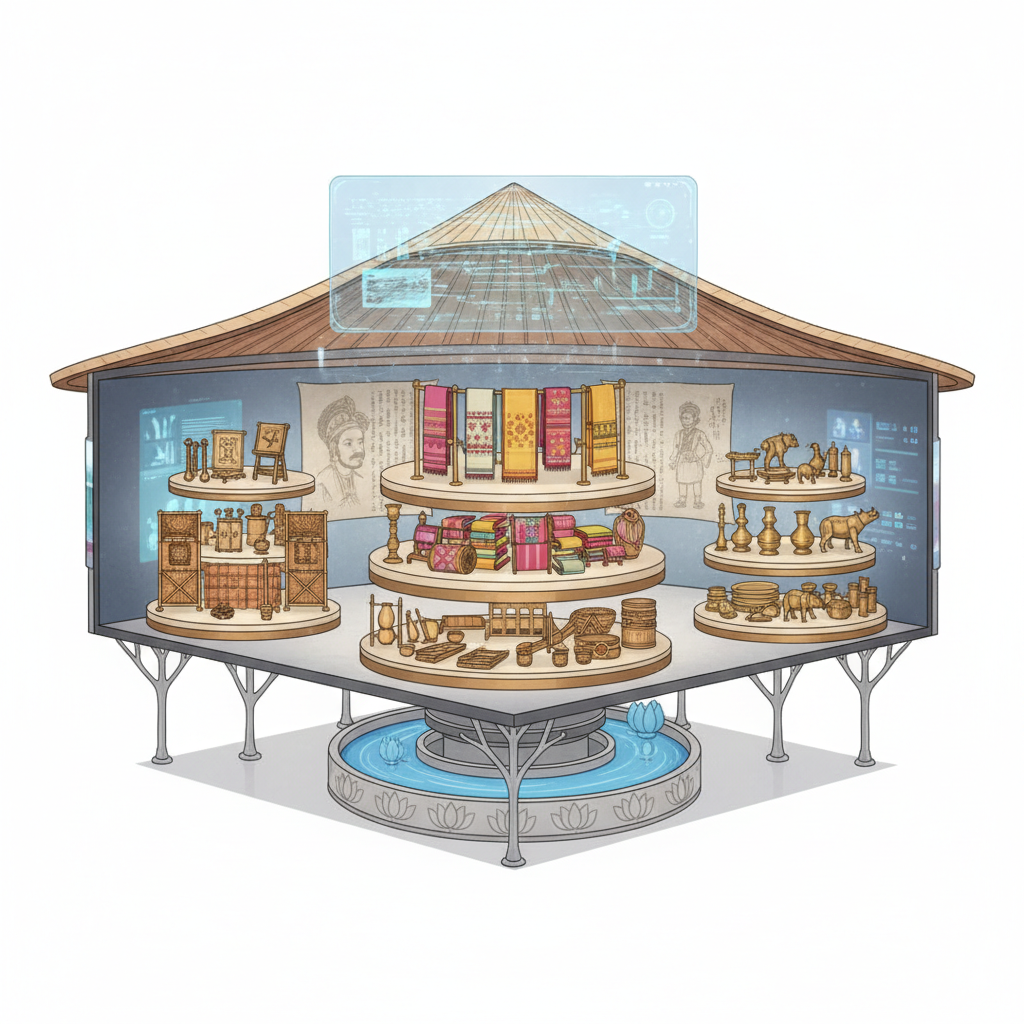
✎ The PM Smriti-Chinh E-Auction 2026, organised by the Ministry of Culture, showcases Assam’s cultural heritage through handloom, bamboo, cane, and brass artefacts, with proceeds supporting the Namami Gange programme.
Subject Relevance — Where This Topic Fits
- GS Paper I — Indian Culture: Salient Features and Important Aspects of Art Forms | GS Paper I — Indian Society: Role of Art and Culture in Social Integration
- Prelims: PM Smriti-Chinh E-Auction, National Mission for Clean Ganga (Namami Gange), National Gallery of Modern Art (NGMA), Assamese handloom and handicraft traditions, Muga silk, Bihu and other Assamese festivals
- Essay: The role of cultural heritage in nation-building, Sustainable livelihoods through traditional crafts
Quick Revision: The PM Smriti-Chinh E-Auction 2026, organised by the Ministry of Culture, showcases Assam’s cultural heritage through handloom, bamboo, cane, and brass artefacts, with proceeds supporting the Namami Gange programme.
Why is this in the news?
The PM Smriti-Chinh E-Auction 2026, organised by the Ministry of Culture, has prominently featured Assam’s rich cultural heritage through 1,498 memorabilia, including handloom textiles, bamboo crafts, brassware, and artefacts linked to historical figures and events. This initiative not only highlights Assam’s artisanal traditions but also aligns with broader objectives of cultural preservation and sustainable livelihoods. The auction, accessible via the official portal, contributes proceeds to the Namami Gange programme, underscoring the intersection of cultural promotion and environmental conservation.
Background
- The PM Smriti-Chinh E-Auction is an annual initiative by the Ministry of Culture to auction gifts received by the Prime Minister, thereby promoting public participation in cultural heritage.
- The auction is conducted through the National Gallery of Modern Art (NGMA), New Delhi, and proceeds are directed to the Namami Gange programme, a central sector scheme for the rejuvenation of the Ganga river basin.
- Assam’s cultural heritage is deeply rooted in its indigenous crafts, including Muga silk, bamboo and cane work, and brass metal craft, which are integral to the state’s identity and socio-economic fabric.
- The auction’s 2026 edition coincides with efforts to document and revive traditional art forms, particularly in the wake of global interest in sustainable and eco-friendly crafts.
- Assam’s cultural institutions, such as Sattras (Vaishnavite monasteries) and historical sites like the Borduwa Satra, are central to the state’s spiritual and artistic traditions.
- The inclusion of artefacts related to historical figures like Gopinath Bordoloi, Srimanta Sankardeva, and Ahom queen Sati Sadhani reflects Assam’s layered historical narrative.
What is the PM Smriti-Chinh E-Auction?
- The PM Smriti-Chinh E-Auction is an annual digital auction platform where gifts presented to the Prime Minister are made available for public purchase, thereby democratising access to cultural artefacts.
- The initiative is administered by the Ministry of Culture in collaboration with the National Gallery of Modern Art (NGMA), New Delhi, ensuring curatorial oversight and public engagement.
- Proceeds from the auction are earmarked for the Namami Gange programme, linking cultural heritage promotion with environmental conservation efforts.
- The auction features memorabilia that encapsulate India’s diverse cultural traditions, with each state’s contributions reflecting its unique artisanal and historical legacy.
- Assam’s participation in the 2026 edition highlights the state’s handloom, bamboo, cane, and brass crafts, alongside artefacts tied to its historical and spiritual heritage.
- The auction includes both functional and decorative items, such as traditional Assamese *japi* (headgear), which are emblematic of Assam’s craftsmanship.
- The initiative also serves as a platform for artisans to showcase their skills, fostering sustainable livelihoods and preserving intangible cultural heritage.
- A concurrent exhibition at NGMA allows visitors to appreciate the artistic and cultural significance of the memorabilia, enhancing public awareness and appreciation.
Key Features
| Feature | Significance |
|---|---|
| Hathkargha (handloom) textiles | Showcases Assam’s centuries-old weaving traditions, including the famous Muga and Eri silk, and represents the state’s textile heritage inscribed in UNESCO’s Intangible Cultural Heritage list. |
| Bamboo and cane craft | Demonstrates sustainable utilisation of natural resources, aligning with India’s National Bamboo Mission and supporting rural livelihoods through traditional artisanal practices. |
| Brass artifacts (Khorahi) | Reflects Assam’s metal craft traditions, particularly the symbolic brass kettles used in hospitality, a cultural practice tied to the state’s social customs. |
| Gamusa textiles | Symbolises Assamese identity and hospitality; its intricate motifs and red-white designs are integral to the state’s textile heritage and daily cultural life. |
| Historical memorabilia | Includes artifacts linked to key figures like Gopinath Bordoloi and Srimanta Shankardev, preserving Assam’s socio-political and spiritual history for educational and cultural continuity. |
Why it Matters
Cultural Preservation
- Facilitates the documentation and display of Assam’s intangible cultural heritage, ensuring transmission to future generations through tangible artifacts.
- Highlights the synergy between material culture (handicrafts) and intangible traditions (music, rituals, oral histories) as per UNESCO’s 2003 Convention for the Safeguarding of the Intangible Cultural Heritage.
- Promotes regional identity by showcasing Assam’s unique craft forms, such as Muga silk and Gamusa, which are deeply embedded in the state’s social fabric.
Economic Empowerment
- Supports artisans and weavers by providing a market for their products through e-auction platforms, thereby enhancing livelihoods in rural and tribal communities.
- Encourages sustainable livelihoods by integrating eco-friendly materials (e.g., water hyacinth crafts) with modern design, aligning with India’s commitment to the SDGs on decent work and economic growth.
- Contributes to the ‘One District, One Product’ (ODOP) initiative by promoting region-specific handicrafts and their commercial viability.
Policy and Governance
- Demonstrates the role of the Ministry of Culture in preserving and promoting cultural heritage through institutional mechanisms like the PM Smriti Chinh e-auction platform.
- Links cultural conservation with environmental goals, as proceeds from the auction support the Namami Gange Mission, reflecting an integrated approach to heritage and ecology.
- Illustrates the use of digital governance (e-auction portal) to democratise access to cultural artifacts and ensure transparency in heritage management.
Educational and Diplomatic Value
- Serves as a public engagement tool, enabling citizens to connect with India’s diverse cultural expressions through curated exhibitions at the National Gallery of Modern Art (NGMA).
- Enhances India’s soft power by showcasing Assam’s cultural diplomacy through globally recognisable handicrafts and historical artifacts.
Challenges
1. Artisan Livelihood Vulnerability
- Marginalisation of traditional artisans due to limited market access, competition from mass-produced goods, and lack of formal training in modern design integration.
- Seasonal demand fluctuations and dependence on local fairs reduce year-round income stability for weavers and craftsmen.
UPSC Link: GS3: Employment, Skill Development
2. Cultural Heritage Erosion
- Gradual loss of indigenous knowledge systems, including weaving techniques and motifs, due to urbanisation and migration of younger generations away from traditional occupations.
- Inadequate documentation of oral histories and rituals linked to artifacts, risking their contextual understanding and transmission.
UPSC Link: GS1: Indian Culture
3. Sustainability of Natural Resources
- Over-exploitation of raw materials like bamboo and water hyacinth for craft production, if not managed through sustainable harvesting practices.
- Climate change impacts on silk production (e.g., Muga silk) due to temperature and humidity variations affecting silkworm rearing.
UPSC Link: GS3: Environment, Conservation
4. Digital Divide in Heritage Access
- Limited digital literacy among rural artisans hinders their ability to participate in e-auction platforms or leverage online markets for their products.
- Uneven internet penetration in Assam’s rural and tribal areas may restrict equitable access to heritage promotion initiatives.
UPSC Link: GS2: Governance, Digital India
5. Institutional Coordination Gaps
- Fragmented implementation of cultural heritage schemes across central and state agencies may lead to duplication or gaps in support for artisans.
- Lack of standardised valuation mechanisms for cultural artifacts, complicating fair pricing in e-auctions and market transactions.
UPSC Link: GS2: Government Policies
Challenges — UPSC Perspective
| Issue | Concern |
|---|---|
| Market Access | Limited reach beyond local fairs and exhibitions, constraining artisans’ income potential. |
| Skill Transmission | Declining interest among youth in traditional crafts due to perceived low remuneration and prestige. |
| Resource Depletion | Unsustainable extraction of raw materials (e.g., bamboo) threatens ecological balance and craft viability. |
| Digital Literacy | Low adoption of e-commerce platforms among rural artisans due to language barriers and technical illiteracy. |
| Policy Fragmentation | Overlapping schemes without clear convergence between cultural and livelihood promotion policies. |
| Valuation Challenges | Absence of transparent pricing mechanisms for heritage artifacts, leading to exploitation of artisans. |
Way Forward
- Strengthen artisan cooperatives and self-help groups (SHGs) to aggregate production and improve bargaining power in e-auction platforms.
- Integrate modern design training with traditional crafts under schemes like ODOP to enhance market appeal and value addition.
- Expand digital literacy programmes in Assam’s rural and tribal belts to enable artisans to utilise online marketplaces and e-auction portals.
- Promote sustainable sourcing of raw materials (e.g., bamboo, water hyacinth) through community-based resource management and certification schemes.
- Establish a heritage valuation council to standardise pricing of cultural artifacts, ensuring fair remuneration for artisans.
- Leverage NGMA exhibitions and school outreach programmes to educate youth on the economic and cultural value of traditional crafts.
- Foster public-private partnerships to scale up eco-friendly craft production, aligning with India’s SDG commitments.
- Document oral histories and rituals associated with artifacts through partnerships with universities and cultural institutions.
UPSC Value Addition
Keywords for Mains Answer-Writing
PM Smriti Chinh e-auction 2026 · Assam cultural heritage · handloom traditions · bamboo and cane crafts · Muga silk art · Assamese Gamosa · National Mission for Clean Ganga (Namami Gange) · National Gallery of Modern Art (NGMA) · cultural diplomacy · intangible cultural heritage · sustainable livelihoods · PMO e-auction portal · Assamese brassware (Khorai) · Ahom Kingdom heritage · eco-friendly handicrafts
Concept Flow
Assam’s rich cultural heritage → Documentation and preservation of artifacts → Digital curation via PM Smriti Chinh e-auction → Market access for artisans → Income generation and livelihood support → Reinvestment in heritage conservation and environmental goals (Namami Gange) → Sustainable cultural and economic development.
Prelims Practice Questions
Q1. Consider the following statements regarding the PM Smriti Chinh e-auction 2026:
1. The auction is conducted by the Ministry of Culture through the National Gallery of Modern Art (NGMA), New Delhi.
2. The proceeds from the auction are directed towards the Namami Gange Programme.
3. The auction includes artefacts exclusively from Assamese cultural heritage.
How many of the above statements are correct?
- Only one
- Only two
- All
- None
Answer: All — Statements 1 and 2 are correct. Statement 3 is incorrect as the auction includes artefacts from various states, not exclusively Assamese heritage.
Q2. Assertion (A): The PM Smriti Chinh e-auction 2026 features artefacts that reflect Assam’s intangible cultural heritage.
Reason (R): The auction includes traditional Assamese crafts such as Muga silk art, bamboo and cane crafts, and Gamosa, which are emblematic of the state’s living traditions.
Options:
A. Both A and R are true, and R is the correct explanation of A.
B. Both A and R are true, but R is NOT the correct explanation of A.
C. A is true, but R is false.
D. A is false, but R is true.
Answer: ? — Both A and R are true, and R correctly explains A as the artefacts listed are direct representations of Assam’s intangible cultural heritage.
Q3. Match the following Assamese cultural artefacts with their descriptions:
Column I (Artefact) — Column II (Description)
1. Muga Silk Art — A. Traditional bamboo and cane craft
2. Gamosa — B. Handwoven silk art depicting Ahom royalty
3. Khorai — C. Embroidered red and gold patterned cloth
4. Bamboo and Cane Craft — D. Brassware symbolising hospitality
Options for matching:
A. 1-B, 2-C, 3-D, 4-A
B. 1-C, 2-B, 3-A, 4-D
C. 1-A, 2-D, 3-C, 4-B
D. 1-D, 2-A, 3-B, 4-C
Answer: ? — Correct matching: 1-B (Muga Silk Art depicts Ahom royalty), 2-C (Gamosa is an embroidered cloth), 3-D (Khorai is brassware), 4-A (Bamboo and Cane Craft is a traditional craft).
Mains Practice Question
✍ The PM Smriti Chinh e-auction 2026 serves as a platform for showcasing India’s cultural diplomacy through the lens of state-specific heritage. Critically examine the role of such initiatives in preserving intangible cultural heritage and promoting sustainable livelihoods in India. (15 Marks)
Approach: MODEL-ANSWER SKELETON:
1. **Introduction**: Define intangible cultural heritage (ICH) as per UNESCO 2003 Convention and its significance in India’s cultural policy.
2. **Role in Preservation**:
– Highlight how the PM Smriti Chinh e-auction documents and disseminates Assamese ICH (e.g., Muga silk art, Gamosa, bamboo crafts) through curated collections.
– Link to Article 49 of the Constitution (protection of monuments and places of historical importance) and the National Culture Fund (1996) for heritage conservation.
– Cite the Sangeet Natak Akademi’s ‘Manch’ initiative or the ‘Intangible Cultural Heritage of India’ inventory as parallel efforts.
3. **Cultural Diplomacy**:
– Explain how such auctions project India’s soft power globally, aligning with the Ministry of Culture’s ‘Ek Bharat Shreshtha Bharat’ programme.
– Reference the PMO’s role in institutionalising cultural exchanges (e.g., through the e-auction portal).
4. **Sustainable Livelihoods**:
– Discuss how the auction platform empowers local artisans (e.g., weavers, bamboo craftsmen) by providing market access and fair pricing.
– Cite examples like the ‘Muga P silk cluster’ in Assam or the ‘Sustainable Livelihoods Mission’ (DAY-NRLM) for artisan upliftment.
5. **Challenges**:
– Critique the limitations: commercialisation vs. authenticity, lack of standardisation in pricing, and digital divide in rural artisan communities.
– Highlight the need for a National ICH Policy (drafted by the Ministry of Culture in 2019) to formalise such initiatives.
6. **Conclusion**: Balance the benefits (preservation, livelihoods, diplomacy) against the gaps, and propose a way forward (e.g., integrating ICH into school curricula, public-private partnerships).
Source: PIB (Press Information Bureau)
Assam PCS (APSC) — State PCS Practice
Prelims: Under the ‘PM Smriti Chinh E-Auction 2026’, which initiative aims to showcase Assam’s vibrant traditions and cultural heritage through digital auction of memorabilia?
- A. ‘Assam Heritage Digital Auction’ under the Ministry of Culture
- B. ‘PM Smriti Chinh E-Auction 2026’ as a national platform for state-specific cultural artifacts
- C. ‘Sankalp Se Siddhi’ initiative for tribal heritage preservation
- D. ‘Assam Darshan’ project for tourism promotion
Answer: B. ‘PM Smriti Chinh E-Auction 2026’ as a national platform for state-specific cultural artifacts — The ‘PM Smriti Chinh E-Auction 2026’ is a national digital auction platform where Assam will showcase its cultural heritage and traditions through memorabilia.
Mains: Discuss how the ‘PM Smriti Chinh E-Auction 2026’ can be leveraged by Assam to preserve and promote its intangible cultural heritage while ensuring economic benefits to local artisans and communities. Suggest a framework for its implementation.
Generated by AanyaAi for educational purpose.
Related guides on our sites
- How to prepare for GS paper 1 for UPSC CSE mains exam
- Best UPSC coaching for IFOS exam
- Best mentorship programme for upsc
- UPSC+BA degree

- आपातकाल में ‘गायब’ शाह आयोग रिपोर्ट का रहस्यमयी पुनर्प्राप्ति - September 23, 2026
- What happened to the Shah Commission report on Emergency? UPSC analysis - September 23, 2026
- तमिलनाडु के लिए क्या है ‘एल नीनो’ और उत्तर-पूर्वी मानसून का खतरा? - September 23, 2026

No Comments