


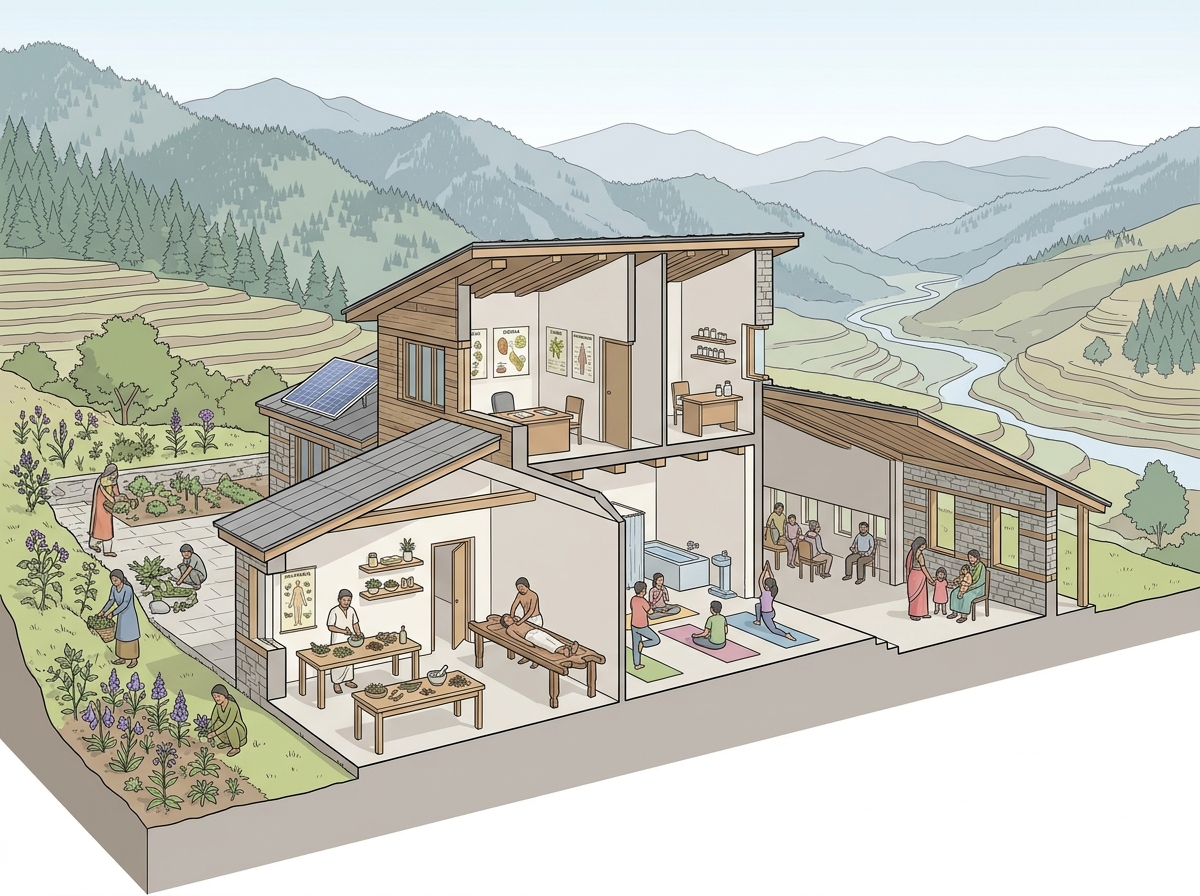
23 Sep Himachal Pradesh Leads in Ayush Adoption: 57.2% Households Embrace Traditional Medicine
✎ AYUSH systems in India, governed by the Ministry of Ayush, are increasingly being adopted for their affordability, accessibility, and cultural relevance, with Himachal Pradesh leading utilisation rates at 57.2%.
Subject Relevance — Where This Topic Fits
- GS Paper II — Governance, Social Justice and Welfare | GS Paper III — Science and Technology
- Prelims: AYUSH Mission, National Ayush Mission, AYUSH Health Index, Ayurveda, Yoga and Naturopathy, Unani, Siddha and Homoeopathy (AYUSH), Traditional Knowledge Digital Library (TKDL), National Health Mission (NHM), Sustainable Development Goals (SDGs) 3
- Essay: Holistic healthcare models in India: Balancing tradition and modernity, The role of indigenous knowledge systems in public health
Quick Revision: AYUSH systems in India, governed by the Ministry of Ayush, are increasingly being adopted for their affordability, accessibility, and cultural relevance, with Himachal Pradesh leading utilisation rates at 57.2%.
Why is this in the news?
A recent household survey in Himachal Pradesh has revealed that 57.2% of the state’s population is now using AYUSH systems for primary healthcare, significantly higher than the national average of 28.4%. This trend underscores the growing trust in traditional medicine systems and their integration into mainstream healthcare delivery, particularly in Himalayan states rich in medicinal flora. The findings, part of the 79th All India AYUSH Survey (2022-23), highlight the state’s leadership in promoting AYUSH-based healthcare accessibility and affordability.
Background
- AYUSH (Ayurveda, Yoga and Naturopathy, Unani, Siddha and Homoeopathy) systems are recognised under the Ministry of Ayush, Government of India, as part of the country’s healthcare infrastructure.
- The National Ayush Mission (NAM), launched in 2014, aims to promote the development and propagation of AYUSH systems through education, research, and healthcare delivery.
- Himachal Pradesh, with its rich biodiversity and cultural heritage, has historically integrated traditional healing practices, particularly Ayurveda and herbal medicine, into local healthcare.
- The 79th All India AYUSH Survey (2022-23), conducted by the Ministry of Ayush, covered 1,81,298 households across rural and urban India to assess the utilisation and awareness of AYUSH systems.
- The survey data indicates that 95% of Indians are aware of AYUSH systems, with utilisation rates varying significantly across states, reflecting regional healthcare preferences and infrastructure.
- The Himalayan region’s abundance of medicinal plants and traditional knowledge systems has facilitated the adoption of AYUSH practices, particularly in preventive and promotive healthcare.
What are AYUSH Systems?
- AYUSH is an acronym for five traditional Indian medical systems: Ayurveda, Yoga and Naturopathy, Unani, Siddha, and Homoeopathy, all recognised under the Indian Systems of Medicine.
- Ayurveda, the most widely practised AYUSH system, is based on the principles of balance among the body’s doshas (Vata, Pitta, Kapha) and uses herbal formulations, diet, and lifestyle modifications for treatment.
- Yoga and Naturopathy emphasise holistic wellness through physical postures, breathing techniques, and natural therapies like hydrotherapy and mud therapy.
- Unani medicine, derived from Greek and Persian traditions, uses herbal and mineral-based formulations to treat ailments based on humoural theory.
- Siddha, a Dravidian system, focuses on the use of metals, minerals, and herbs in specific combinations for therapeutic purposes.
- Homoeopathy operates on the principle of ‘like cures like,’ using highly diluted substances to stimulate the body’s self-healing mechanisms.
- AYUSH systems are governed by the Ministry of Ayush, which regulates education, research, and clinical practice through statutory bodies like the Central Council of Indian Medicine (CCIM) and the Central Council of Homoeopathy (CCH).
- The integration of AYUSH into mainstream healthcare is guided by the National Health Policy 2017 and the Ayushman Bharat initiative, which promotes preventive and promotive healthcare.
Key Features
| Feature | Significance |
|---|---|
| High utilisation rate (57.2%) of AYUSH in Himachal Pradesh | Demonstrates strong public trust in indigenous healthcare systems, exceeding the national average of 28.4%, indicating cultural and systemic acceptance. |
| Integration of AYUSH facilities in public health infrastructure | Enhances accessibility and affordability of healthcare, particularly in rural and remote Himalayan regions. |
| Expansion of AYUSH health centres and technical training | Supports employment generation in paramedical and therapeutic roles, aligning with the National AYUSH Mission’s objectives. |
| Cultural and ecological context of medicinal plants | Leverages Himachal Pradesh’s rich biodiversity for sustainable healthcare practices, reducing dependency on allopathic drugs. |
| Affordability and minimal side-effects of AYUSH therapies | Makes preventive and curative care accessible to economically weaker sections, promoting inclusive health outcomes. |
Why it Matters
Healthcare Delivery
- Validates the efficacy of AYUSH systems in primary healthcare, particularly for chronic and lifestyle-related ailments.
- Reduces pressure on allopathic healthcare infrastructure by providing alternative treatment modalities.
- Promotes preventive healthcare through natural therapies, aligning with the WHO’s global health strategy.
Economic Impact
- Boosts local economies through the cultivation, processing, and trade of medicinal plants and AYUSH products.
- Generates employment in rural areas via AYUSH paramedical roles, technical training, and therapeutic services.
- Reduces out-of-pocket expenditure on healthcare, particularly for marginalised communities.
Environmental Sustainability
- Encourages the conservation of biodiversity by promoting the use of indigenous medicinal plants.
- Supports sustainable agriculture through the cultivation of herbs and medicinal flora, reducing chemical dependency.
Policy and Governance
- Demonstrates the success of decentralised healthcare models, where state-level initiatives can achieve high public participation.
- Highlights the role of district-level AYUSH officers in implementing grassroots healthcare strategies.
Challenges
1. Standardisation and Quality Control
- Ensuring uniform quality of AYUSH drugs and therapies across public and private sectors to prevent substandard practices.
- Addressing variability in practitioner training and certification to maintain clinical efficacy.
UPSC Link: AYUSH Act, 1999; National AYUSH Mission
2. Integration with Allopathic Systems
- Overcoming institutional resistance to AYUSH within mainstream healthcare due to lack of interoperability in treatment protocols.
- Developing evidence-based protocols for co-management of diseases using both systems.
UPSC Link: National Health Policy 2017; AYUSH-Allopathy integration guidelines
3. Research and Evidence Base
- Limited clinical trials and peer-reviewed studies validating AYUSH therapies, hindering global acceptance.
- Need for robust research infrastructure to document efficacy and safety of traditional practices.
UPSC Link: AYUSH Research Portal; ICMR guidelines
4. Supply Chain and Accessibility
- Ensuring consistent supply of medicinal plants despite seasonal and climatic variations in Himalayan regions.
- Bridging urban-rural divide in access to AYUSH facilities and trained practitioners.
UPSC Link: National Medicinal Plants Board; AYUSH Health Wellness Centres
5. Public Awareness and Skepticism
- Addressing misconceptions about AYUSH efficacy among urban populations and younger demographics.
- Promoting scientific temper while preserving traditional knowledge systems.
UPSC Link: AYUSH Vigyan Yatra; National Health Education Programme
Challenges — UPSC Perspective
| Issue | Concern |
|---|---|
| Regulatory gaps in AYUSH drug manufacturing | Risk of adulteration and inconsistent efficacy due to inadequate enforcement of quality standards. |
| Limited AYUSH infrastructure in remote areas | Geographical barriers hinder equitable access to AYUSH healthcare services. |
| Lack of standardised treatment protocols | Variability in practitioner approaches reduces confidence among patients. |
| Dependence on seasonal medicinal plants | Climate change and overharvesting threaten sustainable supply chains. |
| Low adoption in urban centres | Preference for allopathic treatments due to perceived modernity and faster relief. |
Government Initiatives — Must-Memorise for Prelims
- National AYUSH Mission (NAM)
- AYUSH Health Wellness Centres (AHWCs)
- National Medicinal Plants Board (NMPB) schemes for cultivation support
Way Forward
- Strengthen regulatory frameworks under the AYUSH Act, 1999, to enforce quality control in drug manufacturing and practitioner certification.
- Expand AYUSH Health Wellness Centres in underserved Himalayan districts to improve rural accessibility.
- Establish dedicated research centres under ICMR and AYUSH to conduct clinical trials on indigenous therapies.
- Promote public-private partnerships for the cultivation and processing of medicinal plants, ensuring sustainable supply chains.
- Integrate AYUSH modules into medical education curricula (MBBS, BDS) to foster inter-system collaboration.
- Launch targeted awareness campaigns in urban centres to dispel myths and highlight evidence-based benefits of AYUSH.
- Develop standardised treatment protocols for chronic diseases (e.g., diabetes, hypertension) using AYUSH interventions.
- Leverage digital platforms (e.g., e-Sanjeevani) to provide tele-AYUSH consultations, bridging urban-rural gaps.
UPSC Value Addition
Keywords for Mains Answer-Writing
AYUSH Mission, National AYUSH Mission, Ayurveda, Yoga and Naturopathy, Unani, Siddha and Homoeopathy (AYUSH) systems, primary healthcare, preventive healthcare, medicinal plants, Himalayan biodiversity, affordable healthcare, AYUSH Health Surveys, National Health Policy 2017, sustainable healthcare practices, traditional knowledge systems, public health infrastructure, WHO Traditional Medicine Strategy 2014-2023
Concept Flow
Cultural acceptance of traditional medicine in Himachal Pradesh → Expansion of AYUSH infrastructure → High utilisation rate (57.2%) → Validation of indigenous healthcare systems → Policy emphasis on AYUSH integration → Sustainable and inclusive health outcomes.
Prelims Practice Questions
Q1. Consider the following statements regarding the National AYUSH Mission (NAM):
1. NAM is a centrally sponsored scheme launched by the Ministry of AYUSH, Government of India.
2. The scheme aims to develop AYUSH infrastructure and promote the growth of medicinal plants.
3. Under NAM, only Ayurveda and Homoeopathy systems are covered for financial assistance.
4. The scheme includes the establishment of AYUSH hospitals and dispensaries in rural areas.
How many of the above statements are correct?
- Only one
- Only two
- Only three
- All
Answer: Only three — Statements 1, 2, and 4 are correct. Statement 3 is incorrect as NAM covers Ayurveda, Yoga and Naturopathy, Unani, Siddha, and Homoeopathy (AYUSH) systems.
Q2. Assertion (A): The National AYUSH Mission (NAM) primarily focuses on curative healthcare rather than preventive healthcare.
Reason (R): The NAM scheme includes provisions for the promotion of medicinal plants and sustainable healthcare practices.
In the context of the above two statements, which one of the following is correct?
- Both A and R are true, and R is the correct explanation of A
- Both A and R are true, but R is NOT the correct explanation of A
- A is true, but R is false
- A is false, but R is true
Answer: ? — Assertion (A) is false because NAM emphasizes both curative and preventive healthcare. Reason (R) is true as NAM indeed promotes medicinal plants and sustainable practices.
Q3. Match the following AYUSH systems with their primary therapeutic approaches:
Column I (AYUSH System) Column II (Primary Therapeutic Approach)
A. Ayurveda 1. Use of natural substances and lifestyle modifications
B. Yoga and Naturopathy 2. Use of herbal medicines and detoxification therapies
C. Unani 3. Use of plant, animal, and mineral-based formulations
D. Homoeopathy 4. Use of highly diluted substances to stimulate healing
Select the correct match:
- A-2, B-1, C-3, D-4
- A-3, B-1, C-2, D-4
- A-1, B-2, C-3, D-4
- A-4, B-3, C-2, D-1
Answer: A-3, B-1, C-2, D-4 — Ayurveda primarily uses herbal medicines and detoxification therapies (A-2). Yoga and Naturopathy focus on natural substances and lifestyle modifications (B-1). Unani employs plant, animal, and mineral-based formulations (C-3). Homoeopathy uses highly diluted substances to stimulate healing (D-4).
Mains Practice Question
✍ The National AYUSH Mission (NAM) represents a paradigm shift in India’s healthcare strategy by integrating traditional knowledge systems with modern public health infrastructure. Critically examine the role of NAM in promoting preventive and curative healthcare in India, with particular reference to its impact on primary healthcare delivery. Also, discuss the challenges faced by the mission in achieving its objectives. (15 Marks)
Approach: MODEL-ANSWER SKELETON:
1. **Introduction (2 marks)**: Define NAM, its launch year (2014), and its alignment with the National Health Policy 2017 and WHO Traditional Medicine Strategy 2014-2023.
2. **Role in Preventive Healthcare (4 marks)**:
– Promotion of medicinal plants and sustainable practices (e.g., herbal gardens, agroforestry).
– Integration of Yoga and Naturopathy for lifestyle interventions.
– Community-based health awareness programs (e.g., Swasthya Rakshan Kendras).
– Data from the 79th AYUSH Survey highlighting increased adoption in states like Himachal Pradesh.
3. **Role in Curative Healthcare (4 marks)**:
– Establishment of AYUSH hospitals, dispensaries, and wellness centers (e.g., 1,500+ centers under NAM).
– Integration with Ayushman Bharat for affordable healthcare (e.g., AYUSH facilities under Health and Wellness Centers).
– Training of AYUSH practitioners and paramedical staff (e.g., Panchakarma technicians).
4. **Impact on Primary Healthcare (3 marks)**:
– Enhanced accessibility in rural and tribal areas (e.g., Himachal Pradesh’s 57.2% adoption rate).
– Reduction in out-of-pocket expenditure due to affordable AYUSH services.
– Strengthening of local health ecosystems through medicinal plant cultivation.
5. **Challenges (2 marks)**:
– Limited awareness and acceptance in urban and metro areas.
– Regulatory and quality control issues in herbal medicine production.
– Inadequate infrastructure and human resource gaps in remote regions.
6. **Conclusion (2 marks)**: Balanced assessment of NAM’s progress and the need for multi-stakeholder collaboration (e.g., Ministry of AYUSH, State Governments, and traditional healers) to overcome challenges.
Source: amarujala.com
Himachal Pradesh PCS (HPPSC (HAS)) — State PCS Practice
Prelims: As per a recent survey in Himachal Pradesh, what percentage of people are using AYUSH (Ayurveda, Yoga & Naturopathy, Unani, Siddha, and Homoeopathy) practices according to the report on increased reliance on AYUSH in the state?
- A. 45.8%
- B. 52.3%
- C. 57.2%
- D. 61.5%
Answer: C. 57.2% — The survey highlights that 57.2% of people in Himachal Pradesh are using AYUSH practices, reflecting growing trust in traditional healthcare systems.
Mains: Examine the factors contributing to the increasing reliance of people in Himachal Pradesh on AYUSH healthcare systems. Suggest measures to further integrate AYUSH with modern healthcare for holistic public health outcomes.
Generated by AanyaAi for educational purpose.
Related guides on our sites
- Current affairs for upsc 2026
- Best PSIR optional coaching for upsc
- Best economics optional coaching for upsc
- Best PSIR optional teacher for upsc

- Himachal Pradesh Leads in Ayush Adoption: 57.2% Households Embrace Traditional Medicine - September 23, 2026
- आपातकाल में ‘गायब’ शाह आयोग रिपोर्ट का रहस्यमयी पुनर्प्राप्ति - September 23, 2026
- What happened to the Shah Commission report on Emergency? UPSC analysis - September 23, 2026

No Comments