


23 Sep What happened to the Shah Commission report on Emergency? UPSC analysis
✎ The Shah Commission (appointed in 1978) was India’s first judicial inquiry into Emergency-era excesses, documenting abuses under MISA and press censorship; its rediscovery underscores the need for robust institutional memory and…
Subject Relevance — Where This Topic Fits
- GS Paper II — Polity and Governance: Constitutional Provisions, Emergency Provisions, Judicial Review | GS Paper IV — Ethics and Integrity in Governance: Accountability, Transparency, and Institutional Memory
- Prelims: Shah Commission, Emergency 1975-77, Fundamental Rights Suspension, Representation of the People Act, 1951, Judicial Review, MISA (Maintenance of Internal Security Act), Allahabad High Court Judgment (1975), Janata Party Government
- Essay: Accountability in Governance: The Role of Constitutional Institutions, The Fragility of Democratic Norms During Crises
Quick Revision: The Shah Commission (appointed in 1978) was India’s first judicial inquiry into Emergency-era excesses, documenting abuses under MISA and press censorship; its rediscovery underscores the need for robust institutional memory and transparency in governance.
Why is this in the news?
The rediscovery of the Shah Commission report, originally submitted in 1978 to investigate excesses during the Emergency (1975–77), underscores critical issues in institutional memory, transparency, and the accountability of constitutional bodies. The report’s temporary disappearance after its submission—allegedly suppressed during Indira Gandhi’s return to power in 1980—highlights the challenges in preserving historical records of governance excesses and the need for robust archival systems in democratic institutions.
Background
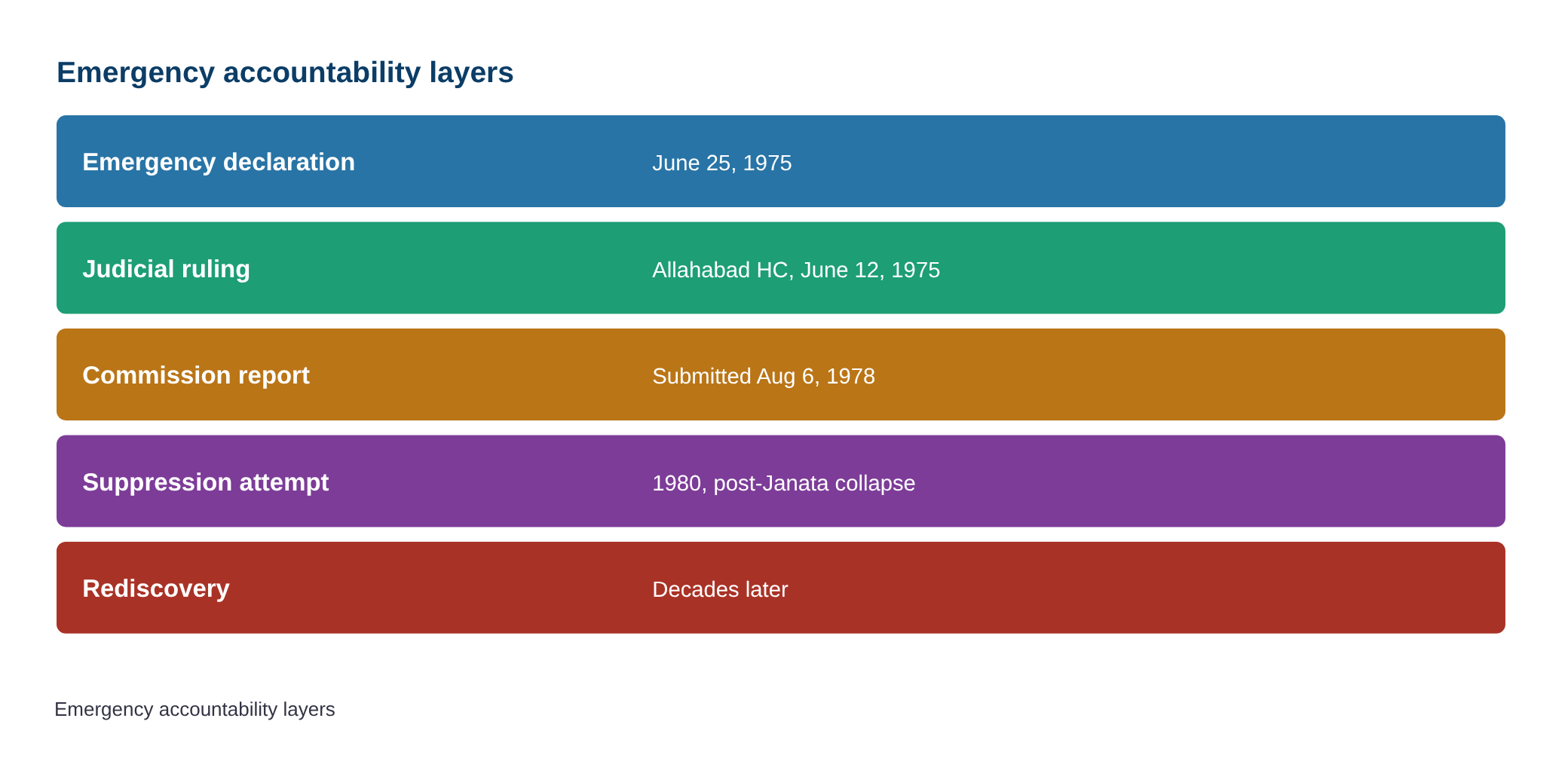
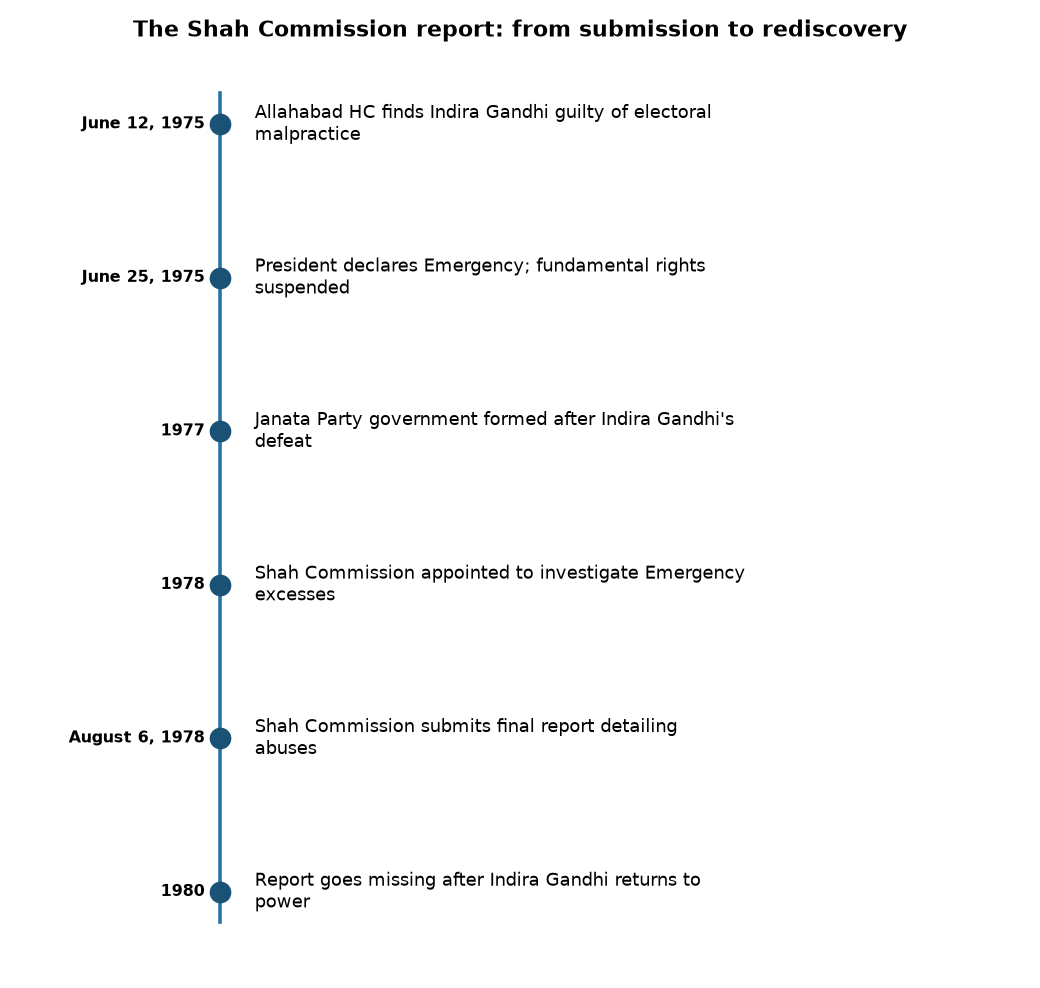
- On June 12, 1975, the Allahabad High Court, in *Indira Nehru Gandhi v. Raj Narain*, ruled that Prime Minister Indira Gandhi had violated Section 123(7) of the Representation of the People Act, 1951, by using government servants in her election campaign, leading to her disqualification from holding office for six years.
- Facing political instability, Indira Gandhi recommended the imposition of a national emergency to President Fakhruddin Ali Ahmed, which was declared on June 25, 1975. This led to the suspension of fundamental rights under Article 359 of the Constitution, mass detentions under the Maintenance of Internal Security Act (MISA), press censorship, and coercive policies such as forced sterilizations.
- The Commission submitted its final report on August 6, 1978, documenting abuses including arbitrary arrests, media censorship, and suppression of civil liberties.
- The Shah Commission’s findings were never fully acted upon due to the Janata Party’s internal divisions and its collapse in 1980, leading to Indira Gandhi’s return to power. Reports suggest attempts were made to suppress or recall the Commission’s reports during this period.
- The report’s rediscovery decades later raises questions about the preservation of official records, the role of judicial commissions in post-crisis accountability, and the mechanisms required to ensure transparency in governance.
- The case exemplifies the tension between executive power and institutional checks during crises, a recurring theme in India’s constitutional history.
What was the Shah Commission and its significance?
- Headed by former Chief Justice J.C. Shah, the Commission examined violations of fundamental rights, illegal detentions under MISA, press censorship, and coercive policies such as forced sterilizations, which were implemented during the Emergency.
- The Commission submitted two interim reports and a final report on August 6, 1978, which documented systemic excesses, including the misuse of administrative machinery, suppression of dissent, and the erosion of democratic norms.
- The report recommended punitive action against officials responsible for excesses and called for reforms to prevent recurrence, though its implementation was constrained by the political instability of the time.
- The Shah Commission’s work is a landmark in India’s post-Emergency accountability discourse, illustrating the role of judicial inquiries in documenting state excesses and the challenges in translating such findings into action.
- The temporary disappearance of the report after its submission highlights the vulnerability of institutional records to political interference and the need for independent archival systems to preserve historical accountability.
- The Commission’s findings remain a critical reference for understanding the constitutional and ethical implications of emergency powers and the limits of executive authority during crises.
- The rediscovery of the report serves as a case study in governance transparency, emphasizing the importance of preserving official documents for historical and legal scrutiny.
Key Features
| Feature | Significance |
|---|---|
| Constitutional Emergency Provisions (Articles 352-360) | Delineated the framework for suspending fundamental rights, imposing President’s Rule, and centralising executive authority during crises. |
| Shah Commission of Inquiry (1978) | First formal institutional mechanism to document excesses during the Emergency, including arbitrary detentions, press censorship, and coercive sterilisation campaigns. |
| Representation of the People Act, 1951 (Section 123(7)) | Provided the legal basis for the Allahabad High Court’s verdict annulling Indira Gandhi’s election, triggering the Emergency proclamation. |
| Fundamental Rights Suspension (Article 359) | Enabled the Union government to suspend rights under Part III of the Constitution, altering the federal democratic structure into a unitary regime. |
| Janata Party Government (1977–1980) | Established the Shah Commission to investigate Emergency excesses, marking a rare instance of post-Emergency accountability efforts. |
Why it Matters
Constitutional and Legal Significance
- Demonstrated the fragility of institutional checks during crises, where emergency powers were used to subvert judicial and electoral accountability.
- Highlighted the role of constitutional provisions (Articles 352–360) in enabling executive overreach, necessitating stricter safeguards in future emergency declarations.
- Established a precedent for post-crisis inquiry commissions, though its findings were suppressed, underscoring the need for transparent archival practices.
Political and Governance Significance
- Exposed the risks of political polarisation leading to institutional erosion, where electoral reversals triggered retaliatory measures against accountability mechanisms.
- Illustrated the challenges of multi-party coalitions in sustaining long-term governance reforms, as ideological fractures in the Janata Party undermined its agenda.
- Reinforced the cyclical nature of democratic backsliding, where emergency powers were later invoked by the same leader who had faced accountability.
Social and Civil Liberties Significance
- Documented systemic violations of civil liberties, including arbitrary arrests under Maintenance of Internal Security Act (MISA) and forced sterilisation campaigns.
- Revealed the disproportionate impact on marginalised groups, particularly political dissidents, journalists, and opposition leaders.
- Underscored the importance of press freedom, as censorship during the Emergency stifled public discourse and delayed accountability.
Archival and Historical Significance
- Raised questions about the preservation of historical records, particularly those documenting state excesses, and the need for independent archival commissions.
- Emphasised the role of investigative journalism and civil society in uncovering suppressed narratives, as seen in the eventual rediscovery of the Shah Commission report.
Challenges
1. Suppression of Accountability Mechanisms
- The attempted recall of the Shah Commission report by the Union government post-1980 demonstrated how executive power can obstruct institutional transparency.
- Lack of statutory protections for inquiry commissions’ reports, leaving them vulnerable to political interference or suppression.
- Need for legal frameworks to ensure the preservation and public accessibility of such reports, even after regime changes.
UPSC Link: GS-II: Role of institutions, accountability
2. Erosion of Institutional Safeguards During Emergencies
- Emergency provisions (Articles 352–360) were used to suspend judicial review, enabling unchecked executive actions without adequate checks.
- Failure of the judiciary to enforce constitutional limits during the Emergency, highlighting the need for stronger judicial independence mechanisms.
- Risk of normalising emergency powers, where their invocation becomes a tool for political survival rather than a last resort for national security.
UPSC Link: GS-II: Emergency provisions, judicial review
3. Fragmentation of Governance in Multi-Party Coalitions
- Ideological disagreements within the Janata Party government (1977–1980) led to policy paralysis, undermining its ability to sustain reforms.
- Short-lived mandates post-Emergency hindered long-term institutional strengthening, as political instability disrupted accountability efforts.
- Need for consensus-building mechanisms to ensure continuity in governance and institutional reforms.
UPSC Link: GS-II: Coalition politics, governance challenges
4. Preservation of Historical Records and Public Memory
- The ‘missing’ Shah Commission report underscored gaps in archival practices, particularly for documents critical to historical accountability.
- Lack of a national archival policy for sensitive historical records, risking the loss of evidence of state excesses.
- Importance of independent archival bodies to safeguard such records and ensure public access for research and accountability.
UPSC Link: GS-II: Archives, public records
5. Media Censorship and Its Long-Term Impact
- Censorship during the Emergency delayed public awareness of excesses, complicating post-crisis accountability.
- Need for statutory protections for press freedom, including mechanisms to prevent arbitrary censorship during crises.
- Role of investigative journalism in uncovering suppressed narratives, as seen in the eventual rediscovery of the Shah Commission report.
UPSC Link: GS-II: Freedom of speech, media ethics
Challenges — UPSC Perspective
| Issue | Concern |
|---|---|
| Suppression of Inquiry Reports | Political interference in the preservation and dissemination of accountability documents. |
| Judicial Erosion During Emergencies | Suspension of judicial review enabling unchecked executive actions. |
| Coalition Governance Instability | Ideological fractures leading to policy paralysis and disrupted reforms. |
| Archival Gaps for Historical Records | Lack of statutory protections for sensitive documents, risking loss of evidence. |
| Media Censorship and Delayed Accountability | Restrictions on press freedom complicating public awareness and post-crisis reckoning. |
Way Forward
- Enact a statutory framework to mandate the preservation and public accessibility of inquiry commission reports, including those documenting state excesses.
- Strengthen judicial safeguards during emergencies by codifying limits on executive powers and ensuring judicial review of emergency proclamations.
- Establish an independent National Archival Commission to oversee the preservation of historical records, particularly those related to human rights violations.
- Introduce legal protections for investigative journalism, including whistleblower provisions and penalties for arbitrary censorship.
- Promote inter-institutional consensus-building mechanisms to ensure continuity in governance reforms across political transitions.
- Conduct periodic reviews of emergency provisions (Articles 352–360) to assess their necessity and propose amendments to prevent misuse.
- Encourage civil society and academic institutions to document oral histories and alternative narratives of state excesses for public memory.
- Mandate the digitisation of historical records, including inquiry commission reports, to ensure their preservation and accessibility.
UPSC Value Addition
Keywords for Mains Answer-Writing
Shah Commission · Emergency 1975 · Fundamental Rights suspension · Representation of the People Act 1951 · Article 359 of the Constitution · Judicial review · Commission of Inquiry Act 1952 · Indira Gandhi · Janata Party government · Civil liberties suppression · Constitutional morality · Rule of law · Extra-constitutional authority · Censorship during Emergency · Political dissent detention
Constitutional & Policy Linkages
- [‘Article 352: Proclamation of Emergency’, ‘Enables suspension of fundamental rights and centralisation of power.’]
- [‘Article 358: Suspension of Fundamental Rights’, ‘Allows derogation of rights under Part III during emergencies.’]
- [‘Article 359: Suspension of Rights under Part III’, ‘Empowers the President to suspend specific rights during emergencies.’]
- [‘Article 360: Financial Emergency’, ‘Provides for economic centralisation during crises.’]
- [‘Article 32: Right to Constitutional Remedies’, ‘Underscored the need for judicial review even during emergencies.’]
Concept Flow
Electoral malpractice under Section 123(7) of the Representation of the People Act, 1951 → Allahabad High Court verdict annulling Indira Gandhi’s election → Proclamation of Emergency under Article 352 → Suspension of fundamental rights under Article 359 → Arbitrary detentions, press censorship, and forced sterilisation campaigns → Formation of Janata Party government in 1977 → Appointment of Shah Commission to investigate Emergency excesses → Publication of Shah Commission reports in 1978 → Political instability in Janata Party government → Return of Indira Gandhi to power in 1980 → Attempted suppression of Shah Commission reports → Rediscovery of reports decades later → Need for archival reforms and institutional safeguards.
Prelims Practice Questions
Q1. Consider the following statements regarding the Shah Commission:
1. It was constituted in 1978 by the Janata Party government to inquire into the excesses committed during the Emergency.
2. The Commission was headed by former Chief Justice J.C. Shah.
3. The final report of the Commission was submitted on August 6, 1978.
4. The Commission’s findings were implemented in full by the subsequent government in 1980.
How many of the above statements are correct?
- Only one
- Only two
- Only three
- All four
Answer: Only three — Statements 1, 2, and 3 are correct. Statement 4 is incorrect as the findings of the Shah Commission were not fully implemented by the government in 1980.
Q2. Assertion (A): The Shah Commission report on the Emergency was initially suppressed to avoid legal and political accountability.
Reason (R): The report detailed systemic abuse of power, including arbitrary arrests and censorship, which could have undermined the legitimacy of the government in power.
In the context of the above two statements, which of the following is correct?
- Both A and R are true, and R is the correct explanation of A.
- Both A and R are true, but R is not the correct explanation of A.
- A is true but R is false.
- A is false but R is true.
Answer: Both A and R are true, and R is the correct explanation of A. — Both the assertion and reason are true. The suppression of the report was motivated by the potential political fallout from its findings, making R the correct explanation of A.
Q3. Match the following provisions with their corresponding constitutional or statutory basis:
Column I (Provision)
A. Suspension of Fundamental Rights during Emergency
B. Electoral disqualification for corrupt practices
C. Inquiry into government excesses
D. Proclamation of National Emergency
Column II (Legal Basis)
1. Article 359 of the Constitution
2. Representation of the People Act, 1951
3. Commission of Inquiry Act, 1952
4. Article 352 of the Constitution
- A-1, B-2, C-3, D-4
- A-4, B-1, C-2, D-3
- A-2, B-3, C-1, D-4
- A-3, B-2, C-4, D-1
Answer: A-1, B-2, C-3, D-4 — A-1 (Article 359 suspends Fundamental Rights), B-2 (Section 123(7) of the Representation of the People Act, 1951), C-3 (Commission of Inquiry Act, 1952), D-4 (Article 352 empowers the President to proclaim Emergency).
Mains Practice Question
✍ The Shah Commission report on the Emergency (1975–77) remains a critical document in India’s constitutional history, yet its findings were deliberately sidelined in the political discourse of the 1980s. Critically examine the institutional, legal, and political implications of the suppression of this report. (15 Marks)
Approach: MODEL-ANSWER SKELETON:
1. **Institutional Implications (5 Marks)**
– Role of Commissions of Inquiry Act, 1952: Legal framework for constituting inquiry commissions and their mandate.
– Independence of judiciary vs. executive interference: How the suppression reflected a challenge to the separation of powers.
– Precedent for future commissions: Impact on the credibility of subsequent inquiry bodies (e.g., Nanavati Commission, Justice Lodha Committee).
2. **Legal Implications (5 Marks)**
– Constitutional provisions violated: Article 359 (suspension of Fundamental Rights), Article 21 (right to life and liberty), and Article 19 (freedom of speech).
– Judicial review and accountability: The role of the judiciary in upholding constitutional morality (e.g., ADM Jabalpur case vs. subsequent judicial review post-Emergency).
– Legal consequences of suppression: Whether the report’s findings could have informed legal reforms or reparations for victims.
3. **Political Implications (5 Marks)**
– Democratic backsliding: How the suppression of the report normalised extra-constitutional authority and undermined public trust in institutions.
– Partisan politics vs. constitutional governance: The Janata Party’s failure to institutionalise accountability and the subsequent electoral return of the Congress party.
– Comparative perspective: Lessons from other democracies where post-emergency accountability mechanisms were either strengthened (e.g., South Africa’s Truth and Reconciliation Commission) or weakened (e.g., Pakistan’s post-Zia era).
4. **Conclusion (Balanced View)**
– The suppression of the Shah Commission report was not merely an administrative lapse but a systemic failure to uphold the rule of law.
– Its rediscovery underscores the importance of transparency and institutional memory in democratic governance.
Source: The Hindu
Generated by AanyaAi for educational purpose.
Related guides on our sites
- Current affairs for upsc 2026
- Best PSIR optional coaching for upsc
- Best economics optional coaching for upsc
- Best PSIR optional teacher for upsc

- What happened to the Shah Commission report on Emergency? UPSC analysis - September 23, 2026
- तमिलनाडु के लिए क्या है ‘एल नीनो’ और उत्तर-पूर्वी मानसून का खतरा? - September 23, 2026
- El Nino & Northeast Monsoon: Impact on Tamil Nadu for UPSC 2026 - September 23, 2026

No Comments