


23 Sep El Niño 2026: A Critical Test for Climate Adaptation in UPSC Mains
✎ El Niño is a predictable climate phenomenon whose impacts are magnified by anthropogenic warming, necessitating adaptive governance, early warning systems, and resilient agricultural practices to safeguard food security and…
Subject Relevance — Where This Topic Fits
- GS Paper I — Geography (Climate and Weather Systems) | GS Paper III — Environment, Climate Change, and Disaster Management
- Prelims: El Niño-Southern Oscillation (ENSO), La Niña, Walker Circulation, Pacific Decadal Oscillation, teleconnections, climate resilience, food security, drought, flood, crop failure, seasonal forecasting, WMO, FAO, UNFCCC
- Essay: Climate change as a multiplier of existing vulnerabilities: The case of El Niño, The role of early warning systems in mitigating climate-induced disasters
Quick Revision: El Niño is a predictable climate phenomenon whose impacts are magnified by anthropogenic warming, necessitating adaptive governance, early warning systems, and resilient agricultural practices to safeguard food security and livelihoods.
Why is this in the news?
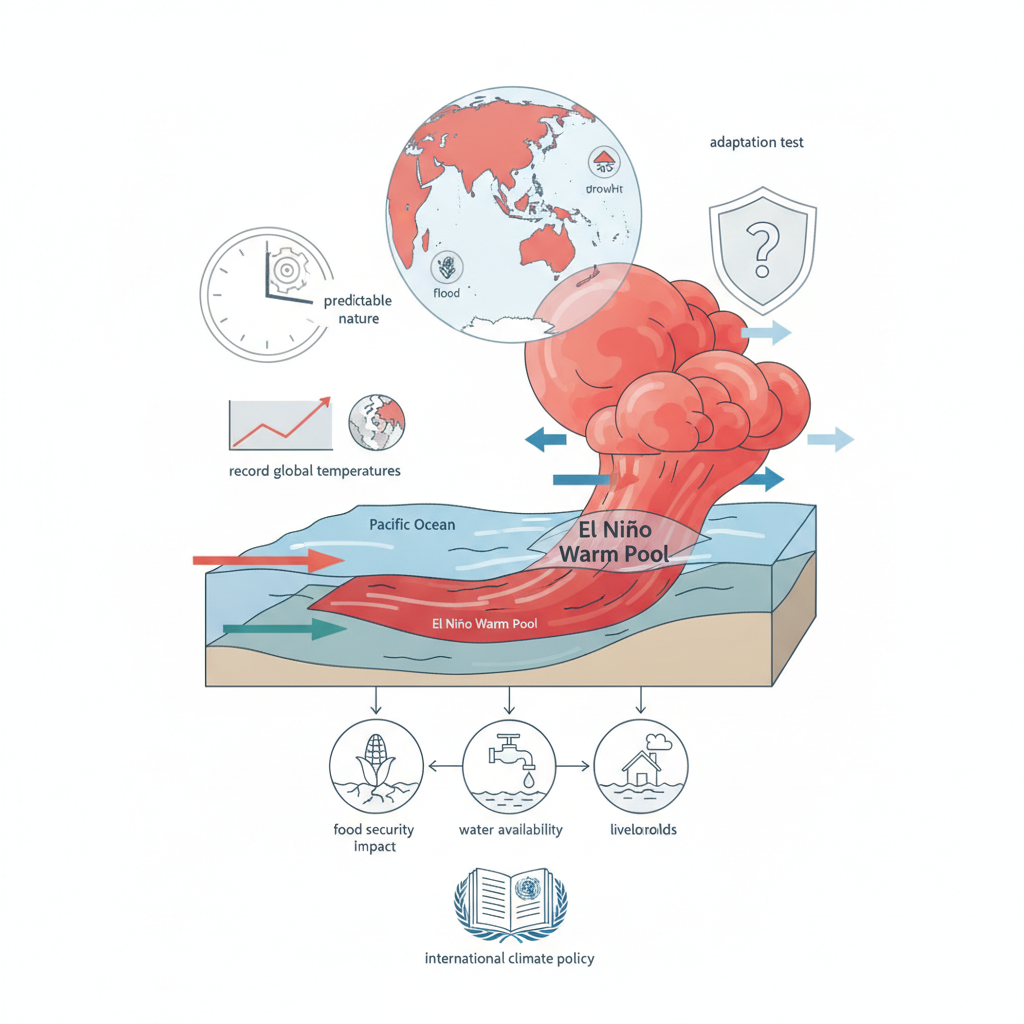
The strengthening of El Niño in 2026, occurring against a backdrop of record global temperatures, presents a critical test of global and national capacities for climate adaptation. Unlike sudden disasters, El Niño’s predictable nature allows for proactive governance, yet its impacts—intensified by anthropogenic warming—threaten food security, water availability, and livelihoods across climate-sensitive regions. The United Nations’ emphasis on this phenomenon during its 81st General Assembly underscores its relevance to international climate policy, disaster risk reduction, and sustainable development agendas.
Background
- El Niño-Southern Oscillation (ENSO) is a naturally occurring climate phenomenon characterized by periodic warming (El Niño) and cooling (La Niña) of sea surface temperatures in the tropical Pacific Ocean, disrupting global weather patterns.
- The current El Niño event is forecasted to be among the strongest on record, with the World Meteorological Organization (WMO) classifying it as a ‘very strong’ event, the highest tier in its classification system.
- Historically, strong El Niño events have been linked to significant agricultural losses, particularly in regions dependent on monsoon rains, such as South Asia, East Africa, and parts of Latin America.
What is El Niño and its Global Implications?
- El Niño is a phase of the El Niño-Southern Oscillation (ENSO) cycle, marked by the abnormal warming of sea surface temperatures in the central and eastern tropical Pacific Ocean, typically lasting 9–12 months.
- El Niño disrupts the Walker Circulation—a large-scale atmospheric loop that normally brings warm, moist air to the western Pacific and cooler, dry air to the eastern Pacific—leading to altered precipitation and temperature regimes worldwide.
- The current El Niño event is occurring in a hotter global climate, meaning its impacts—such as prolonged droughts in Australia, floods in South America, and erratic monsoons in South Asia—are likely to be more severe than in previous decades.
- Scientific agencies like the WMO use advanced climate models and ocean-atmosphere monitoring to predict El Niño’s onset, strength, and duration, providing governments with critical lead time for preparedness.
- El Niño’s predictability contrasts with sudden disasters like earthquakes or tsunamis, making it a unique case for proactive disaster risk reduction and climate adaptation strategies.
- The Food and Agriculture Organization (FAO) leverages decades of data on past El Niño events to map vulnerable agricultural regions, enabling targeted interventions such as drought-resistant crop distribution and water management strategies.
Key Features
| Feature | Significance |
|---|---|
| Natural Climate Phenomenon | El Niño is a naturally occurring climate pattern linked to warming of the tropical Pacific Ocean, disrupting global weather systems including monsoons and trade winds. |
| Predictability | El Niño events are forecastable months in advance due to ocean-atmosphere monitoring systems, enabling early preparedness measures unlike sudden disasters. |
| Amplification by Climate Change | Current El Niño events occur against a backdrop of elevated global temperatures, intensifying their adverse impacts such as droughts and floods. |
| Agricultural Impact | Disruptions in rainfall patterns directly affect crop yields, pasture availability, and livestock health, threatening food security in vulnerable regions. |
| Geospatial Precision in Risk Mapping | Modern data integration (satellite observations, historical records, seasonal forecasts) allows identification of high-risk areas at sub-national scales for targeted interventions. |
Why it Matters
Economic/Strategic
- Global food supply chains face heightened volatility due to El Niño-induced production shortfalls in key agricultural regions like South America, East Africa, and Southeast Asia.
- Commodity price spikes in staple crops (wheat, rice, maize) can trigger inflationary pressures, disproportionately affecting low-income households and net food-importing nations.
- Trade disruptions in critical corridors (e.g., Panama Canal droughts exacerbating shipping costs) amplify economic costs beyond primary agricultural losses.
- Insurance and financial markets may recalibrate risk premiums for climate-sensitive sectors, influencing investment flows and sovereign credit ratings.
Environmental
- El Niño exacerbates wildfire risks in drought-prone regions (e.g., Amazon, Australia) and coral bleaching events in tropical marine ecosystems due to elevated sea surface temperatures.
- Changes in oceanic and atmospheric circulation patterns can alter carbon sequestration capacities of terrestrial and marine sinks, influencing global carbon budgets.
- Biodiversity hotspots face habitat fragmentation from extreme weather events, potentially accelerating species migration or extinction risks.
Humanitarian
- Prolonged droughts in Sub-Saharan Africa and South Asia increase displacement risks, straining humanitarian resources and exacerbating conflicts over dwindling resources.
- Malnutrition and water-borne diseases surge in regions with compromised agricultural output and disrupted water supply systems, particularly affecting children and marginalised groups.
- Public health systems face dual pressures: heat-related morbidity during El Niño-driven heatwaves and increased disease vectors (e.g., mosquitoes) post-flooding.
Institutional
- National meteorological agencies and international bodies (WMO, FAO) demonstrate enhanced predictive capabilities, validating the importance of sustained investment in climate science infrastructure.
- Multilateral coordination frameworks (e.g., UN Early Warning for All Initiative) gain prominence as tools to harmonise cross-border climate risk mitigation strategies.
- Capacity-building in data-scarce regions becomes critical to translate global forecasts into local actionable insights for policymakers and communities.
Challenges
1. Limited Adaptive Capacity in Vulnerable Regions
- Low-income countries with agrarian economies lack fiscal space to implement large-scale irrigation projects, drought-resistant seed distribution, or social protection schemes.
- Weak institutional governance in conflict-affected or fragile states hinders the translation of early warnings into timely interventions.
- Rural populations dependent on rain-fed agriculture face irreversible livelihood losses without access to alternative income sources or climate-resilient technologies.
UPSC Link: GS3: Climate Change & Agriculture
2. Data and Monitoring Gaps
- Inadequate ground-based observation networks in developing nations limit the accuracy of sub-national climate risk assessments.
- Satellite data, while improving, still faces latency issues in real-time decision-making for dynamic weather events.
- Inter-agency data silos (e.g., between meteorological and agricultural ministries) impede integrated risk management.
UPSC Link: GS3: Science & Technology
3. Policy Implementation Bottlenecks
- El Niño preparedness often competes with short-term political priorities, delaying the release of contingency funds or procurement of critical inputs.
- Fragmented mandates across ministries (e.g., water, agriculture, disaster management) create coordination failures in crisis response.
- Lack of enforceable standards for climate-resilient infrastructure (e.g., flood-resistant storage facilities) leaves communities exposed to recurring losses.
UPSC Link: GS2: Governance & Public Policy
4. Trade-offs in Resource Allocation
- Allocating scarce resources to El Niño preparedness may divert funds from long-term climate adaptation strategies (e.g., afforestation, renewable energy transitions).
- Balancing immediate humanitarian needs with structural investments in climate resilience requires difficult trade-offs in fiscal planning.
- Over-reliance on reactive measures (e.g., food aid) can disincentivise proactive risk reduction in agricultural communities.
UPSC Link: GS3: Resource Management
5. Global Inequities in Climate Finance
- Developing nations, despite bearing disproportionate climate impacts, struggle to access international climate funds due to stringent eligibility criteria or bureaucratic hurdles.
- Debt burdens limit fiscal flexibility for climate adaptation, trapping vulnerable countries in cycles of vulnerability and recovery.
- Private sector investments in climate-resilient agriculture remain concentrated in high-income regions, exacerbating global disparities.
UPSC Link: GS2: International Relations & GS3: Environment
Challenges — UPSC Perspective
| Issue | Concern |
|---|---|
| Sub-National Risk Mapping | Inability to identify high-risk micro-regions delays targeted interventions, leading to blanket policies with limited efficacy. |
| Early Warning Dissemination | Lag in translating global forecasts into local languages or accessible formats (e.g., SMS alerts) reduces community preparedness. |
| Seed and Input Supply Chains | Disruptions in the procurement and distribution of drought-resistant seeds or fertilizers during El Niño exacerbate agricultural losses. |
| Water Resource Management | Over-extraction of groundwater in anticipation of droughts depletes aquifers, undermining long-term resilience. |
| Livestock Health Systems | Shortages of fodder and veterinary services during droughts lead to mass livestock mortality, crippling rural economies. |
| Social Protection Gaps | Exclusion errors in food subsidy schemes or cash transfer programmes leave the most vulnerable populations without safety nets. |
Way Forward
- Strengthen national meteorological agencies with real-time data-sharing protocols and sub-national climate risk assessment tools.
- Integrate El Niño preparedness into existing agricultural policies (e.g., Pradhan Mantri Fasal Bima Yojana) by incorporating climate indices into insurance payout triggers.
- Establish multi-stakeholder platforms at district levels to coordinate early action plans, involving farmers, local governments, and private agri-businesses.
- Expand climate-resilient seed banks and irrigation infrastructure in drought-prone regions, prioritising marginalised communities.
- Develop adaptive social protection mechanisms (e.g., employment guarantee schemes) to absorb labour shifts from agriculture to non-farm sectors during climate shocks.
- Enhance cross-border data collaboration under regional frameworks (e.g., South Asian Association for Regional Cooperation) to improve transboundary risk assessments.
- Invest in farmer education programmes on climate-smart agriculture practices, including drought forecasting tools and water-efficient irrigation techniques.
- Leverage international climate finance mechanisms (e.g., Green Climate Fund) to de-risk private investments in climate-resilient agriculture and water management.
UPSC Value Addition
Keywords for Mains Answer-Writing
El Niño-Southern Oscillation (ENSO) · climate change adaptation · food security governance · early warning systems · agricultural risk management · World Meteorological Organization (WMO) · Food and Agriculture Organization (FAO) · climate-resilient agriculture · disaster preparedness · global climate governance · sustainable development goals (SDGs) · intergovernmental coordination on climate
Concept Flow
Ocean-atmosphere interaction in tropical Pacific → Disruption of Walker Circulation → Altered global rainfall and temperature patterns → El Niño formation and strengthening → Forecasting by WMO/FAO using oceanic and atmospheric data → Amplification of impacts due to elevated global temperatures (climate change baseline) → Disruptions in monsoon systems → Reduced agricultural productivity in rain-fed regions → Cascading effects on food security, livelihoods, and public health systems → Early warning dissemination → Policy response and adaptive measures at national/sub-national levels → Long-term climate adaptation and resilience-building in vulnerable communities
Prelims Practice Questions
Q1. Consider the following statements regarding El Niño-Southern Oscillation (ENSO):
1. El Niño is characterized by unusually warm ocean temperatures in the tropical Pacific Ocean.
2. La Niña represents the opposite phase of ENSO with cooler than average ocean temperatures in the tropical Pacific.
3. ENSO events can be predicted with absolute certainty at least 12 months in advance.
4. ENSO primarily affects weather patterns in the Southern Hemisphere only.
How many of the above statements are correct?
- Only one
- Only two
- Only three
- All
Answer: Only three — Statements 1 and 2 are correct as they accurately describe El Niño and La Niña phases of ENSO. Statement 3 is incorrect because ENSO predictions, while increasingly accurate, are probabilistic and not absolute. Statement 4 is incorrect as ENSO impacts weather patterns globally, including in the Northern Hemisphere.
Q2. Assertion (A): The World Meteorological Organization (WMO) classifies El Niño events into categories such as ‘very strong’ based on oceanic temperature anomalies.
Reason (R): The classification of El Niño strength is primarily determined by the duration of the event rather than the magnitude of temperature anomalies.
Options:
A. Both A and R are true, and R is the correct explanation of A.
B. Both A and R are true, but R is not the correct explanation of A.
C. A is true, but R is false.
D. A is false, but R is true.
Answer: ? — Assertion (A) is correct as WMO does classify El Niño events by strength (e.g., ‘very strong’) based on oceanic temperature anomalies. Reason (R) is false because the classification is based on the magnitude of temperature anomalies, not duration.
Q3. Match the following institutions with their respective roles in climate monitoring and adaptation:
Column I
1. World Meteorological Organization (WMO)
2. Food and Agriculture Organization (FAO)
3. United Nations Framework Convention on Climate Change (UNFCCC)
4. Intergovernmental Panel on Climate Change (IPCC)
Column II
A. Provides global weather and climate data and early warnings
B. Monitors and reports on greenhouse gas concentrations and climate change impacts
C. Coordinates international efforts to reduce greenhouse gas emissions
D. Assesses the impact of climate change on agriculture, food security, and rural development
Options:
1-A, 2-D, 3-C, 4-B
1-B, 2-A, 3-D, 4-C
1-C, 2-B, 3-A, 4-D
1-A, 2-B, 3-C, 4-D
Answer: ? — 1-A: WMO monitors global weather and climate data and issues early warnings. 2-D: FAO assesses climate impacts on agriculture and food security. 3-C: UNFCCC coordinates international climate mitigation efforts. 4-B: IPCC assesses greenhouse gas concentrations and climate change impacts.
Mains Practice Question
✍ El Niño events, while natural phenomena, now occur against a backdrop of anthropogenic climate change, amplifying their socio-economic impacts. Critically examine the institutional and policy frameworks that enable countries to anticipate, prepare for, and mitigate the risks posed by El Niño to food security. (15 Marks)
Approach: MODEL-ANSWER SKELETON:
1. **Introduction (2 marks)**: Define El Niño-Southern Oscillation (ENSO) and its global climatic impacts, emphasizing the heightened risks due to climate change. State the need for anticipatory governance.
2. **Institutional Frameworks (4 marks)**:
– **World Meteorological Organization (WMO)**: Role in monitoring, forecasting, and issuing early warnings (e.g., Global Seasonal Climate Update).
– **Food and Agriculture Organization (FAO)**: Use of historical data, seasonal forecasts, and high-resolution mapping (1 km²) to identify vulnerable regions.
– **National Meteorological and Hydrological Services (NMHSs)**: Country-level early warning systems and dissemination mechanisms.
– **UNFCCC and IPCC**: Providing scientific assessments and policy guidance on climate adaptation.
3. **Policy and Governance Mechanisms (5 marks)**:
– **Early Warning Systems**: Components such as seasonal climate forecasts, vulnerability mapping, and multi-hazard risk assessments.
– **Agricultural Risk Management**: Crop insurance schemes (e.g., Pradhan Mantri Fasal Bima Yojana), drought-resistant seed distribution, and irrigation infrastructure.
– **Intergovernmental Coordination**: Examples of regional cooperation (e.g., South Asian Association for Regional Cooperation (SAARC) Disaster Management Centre) and global initiatives (e.g., Early Warnings for All initiative by WMO).
– **Data and Technology**: Role of remote sensing, AI-driven predictive models, and geospatial tools in risk reduction.
4. **Challenges and Critique (3 marks)**:
– **Implementation Gaps**: Disparities in early warning dissemination and resource allocation between developed and developing nations.
– **Policy Coordination**: Challenges in integrating climate adaptation into national agricultural policies and disaster management plans.
– **Equity and Justice**: Ensuring that vulnerable communities, particularly smallholder farmers, benefit from institutional support.
5. **Conclusion (1 mark)**: Emphasize the need for a multi-stakeholder approach, combining scientific forecasting, policy interventions, and community participation to build resilience against El Niño-induced food insecurity.
Source: news.un.org
Generated by AanyaAi for educational purpose.
Related guides on our sites
- UPSC EPFO Test series
- Best geography optional test series
- How to prepare for GS paper 1 for UPSC CSE mains exam
- Best UPSC coaching for IFOS exam

- El Niño 2026: A Critical Test for Climate Adaptation in UPSC Mains - September 23, 2026
- हिमाचल में आयुष चिकित्सा का बढ़ता प्रचलन: 57.2% लोगों ने अपनाई आयुष पद्धतियाँ, जानें कारण - September 23, 2026
- Himachal Pradesh Leads in Ayush Adoption: 57.2% Households Embrace Traditional Medicine - September 23, 2026

No Comments