


23 Sep Andhra Pradesh to get 4 new Police Commissionerates: Key UPSC insights
✎ Police Commissionerates integrate executive magistracy powers with policing functions, enabling faster decision-making in urban areas, and are distinct from the traditional district-based policing model.
Subject Relevance — Where This Topic Fits
- GS Paper II — Functions and Responsibilities of the Union and the States, Issues and Challenges Pertaining to the Federal Structure | GS Paper III — Challenges to Internal Security Through Communication Networks, Role of State Police Forces
- Prelims: Police Commissionerate System, Executive Magistrate Powers, Social Media Influencers Policy, Handri-Neeva Sujala Sravanthi (HNSS) Project, Compressed Biogas Plant, Pumped Hydro Storage, Andhra Pradesh Power Finance Corporation Ltd., State Police Service Rules
- Essay: Evolving paradigms of policing in India: From colonial legacies to modern reforms, Balancing development imperatives with environmental sustainability in energy policy
Quick Revision: Police Commissionerates integrate executive magistracy powers with policing functions, enabling faster decision-making in urban areas, and are distinct from the traditional district-based policing model.
Why is this in the news?
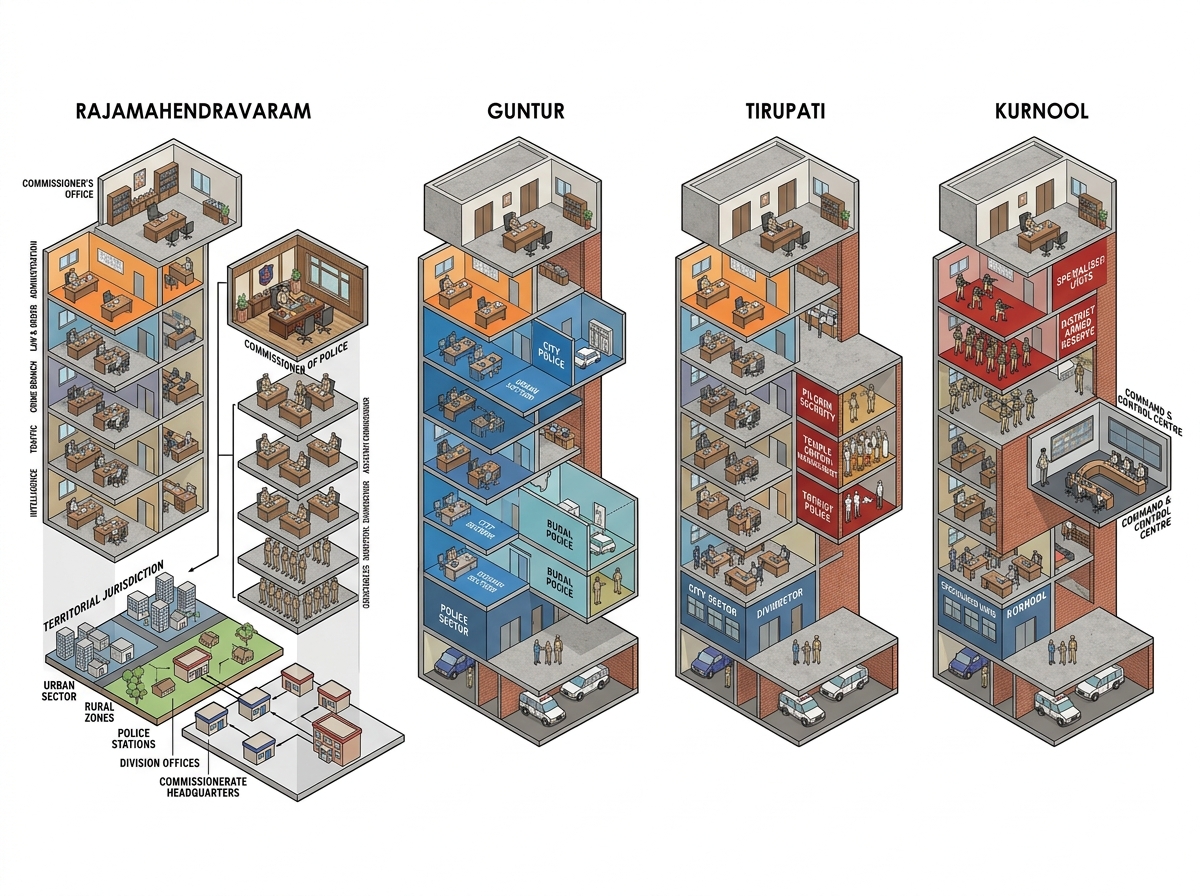
The Andhra Pradesh Cabinet’s decision to establish four new Police Commissionerates in Rajamahendravaram, Guntur, Tirupati, and Kurnool marks a significant reform in the state’s policing architecture. This move, alongside approvals for power sector initiatives, irrigation works, and the formulation of a Social Media Influencers Policy, reflects a comprehensive governance agenda aimed at enhancing administrative efficiency, internal security, and public service delivery. The decision is particularly notable for its implications on the federal structure, as it redefines the territorial jurisdiction of police forces and introduces specialised administrative units.
Background
- The Police Commissionerate system is a model of urban policing adopted in several Indian states, including Maharashtra, Gujarat, and Tamil Nadu, where a Commissioner of Police exercises both executive and judicial magistracy powers under the Code of Criminal Procedure, 1973.
- Andhra Pradesh has historically followed a district-based policing model under the supervision of the District Superintendent of Police, with limited integration of executive magistracy functions within police administration.
- The establishment of new Commissionerates aligns with the state’s broader agenda of urban governance reforms, particularly in rapidly growing cities such as Guntur, Tirupati, and Rajamahendravaram, which face challenges related to population density, law-and-order maintenance, and infrastructure development.
- The decision follows the state’s emphasis on decentralised governance, as evidenced by the creation of new districts and the implementation of flagship irrigation and power projects like the Handri-Neeva Sujala Sravanthi (HNSS) scheme.
- The introduction of a Social Media Influencers (SMI) Policy reflects a contemporary approach to public service dissemination, leveraging digital platforms to enhance transparency and citizen engagement in welfare schemes.
- The power sector proposals, including guarantees for loans and investments in renewable energy projects, underscore the state’s commitment to addressing its energy deficit while transitioning towards sustainable energy sources.
What are Police Commissionerates?
- A Police Commissionerate is a specialised urban policing model where the head of the police force, designated as the Commissioner of Police, holds both police and executive magistracy powers under the Code of Criminal Procedure, 1973, and the respective state police acts.
- This system integrates the dual roles of law enforcement and administrative control, enabling faster decision-making in urban areas with high crime rates and complex administrative demands.
- The Commissioner of Police is typically of the rank of Inspector General of Police (IGP) or Deputy Inspector General (DIG), and exercises powers akin to those of an Executive Magistrate, including the authority to impose Section 144 of the CrPC for maintaining public order.
- Police Commissionerates are divided into territorial zones or divisions, each headed by Deputy Commissioners of Police, to ensure efficient supervision and coordination of policing activities.
- The system is distinct from the traditional district policing model, where the Superintendent of Police reports to the District Magistrate, who is an officer of the Indian Administrative Service (IAS) and holds executive magistracy powers.
- Police Commissionerates are operational in several Indian states, including Maharashtra (Mumbai, Pune, Nagpur), Gujarat (Ahmedabad, Surat), and Tamil Nadu (Chennai), and have been credited with improving response times and coordination in urban policing.
- The establishment of new Commissionerates in Andhra Pradesh involves the creation of multiple territorial zones within each Commissionerate, with designated sub-divisions to address localised policing needs.
- The move also necessitates the formulation of state-specific police service rules, such as the draft Andhra Pradesh State Prosecution Service Rules, 2026, to streamline the legal and administrative framework governing prosecution services.
Key Features
| Feature | Significance |
|---|---|
| Establishment of four new Police Commissionerates | Enhances policing efficiency by decentralising authority to urban centres, improving law-and-order management in high-density regions. |
| Territorial zoning under each Commissionerate | Facilitates focused policing, quicker response times, and better coordination with local administrative units. |
| Supernumerary post of Additional Director (Prosecution Department) | Strengthens the prosecution infrastructure to expedite criminal trials and reduce pendency. |
| Draft Andhra Pradesh State Prosecution Service Rules, 2026 | Provides a formalised framework for recruitment, service conditions, and career progression of prosecutors. |
| Social Media Influencers (SMI) Policy | Leverages digital platforms to disseminate governance information, enhancing transparency and public outreach. |
Why it Matters
Administrative Reforms
- Decentralisation of policing authority to urban centres improves responsiveness and accountability in law enforcement.
- Formalisation of prosecution services through rules and posts enhances judicial efficiency.
- Digital governance initiatives (SMI Policy) align with contemporary public communication strategies.
Infrastructure Development
- Approval of irrigation and canal lining works under HNSS Phase-II and Kuppam Branch Canal enhances water-use efficiency.
- Energy sector allocations (₹3,750 crore in guarantees) support grid stability and renewable energy integration.
Fiscal Governance
- Revised administrative sanctions (₹463.55 crore) for HNSS projects reflect prioritisation of irrigation infrastructure.
- Cancellation of the 2,000-MW pumped hydro storage project at Kommuru signals a shift in energy planning priorities.
Challenges
1. Implementation Bottlenecks in Policing Reforms
- Recruitment and training of officers for new Commissionerates may face delays due to procedural formalities.
- Coordination between municipal bodies and police departments in urban areas requires institutional alignment.
UPSC Link: Police Reforms (Prakash Singh Case)
2. Energy Sector Transition Risks
- Cancellation of the pumped hydro project may impact long-term energy storage capacity planning.
- Dependence on SECI for storage procurement introduces market volatility risks.
UPSC Link: Renewable Energy Integration
3. Irrigation Infrastructure Sustainability
- Canal lining works require post-completion monitoring to prevent seepage and ensure water-use efficiency.
- Climate variability may affect the long-term viability of irrigation projects in semi-arid regions.
UPSC Link: National Mission for Sustainable Agriculture
Challenges — UPSC Perspective
| Issue | Concern |
|---|---|
| Police Commissionerate establishment | Potential delays in officer posting and zone demarcation |
| Prosecution service formalisation | Need for capacity-building in digital case management systems |
| Energy sector guarantees | Fiscal burden on state exchequer due to sovereign guarantees |
| Irrigation project sanctions | Land acquisition and environmental compliance hurdles |
Way Forward
- Constitute a high-level committee to oversee the phased establishment of Police Commissionerates, including officer recruitment and zonal mapping.
- Develop a digital dashboard for real-time monitoring of prosecution case progress under the new rules.
- Conduct a feasibility study for alternative energy storage solutions post-cancellation of the pumped hydro project.
- Implement a third-party audit mechanism for canal lining works to ensure quality and durability.
- Launch a pilot phase of the SMI Policy in select districts to assess outreach effectiveness before statewide rollout.
- Strengthen inter-departmental coordination between police, municipal bodies, and revenue authorities for urban policing.
- Integrate climate resilience metrics into irrigation project designs to mitigate long-term risks.
UPSC Value Addition
Keywords for Mains Answer-Writing
Police Commissionerates · Andhra Pradesh Police Act, 2024 · Urban policing reforms · Police Commissionerate model · Executive Magistrate powers · Police organisation and administration · State police reforms · Zonal policing structure · Police Commissionerate zones · Social Media Influencers (SMI) Policy · Police Prosecution Service Rules · Public order and law enforcement
Concept Flow
Urbanisation and rising crime rates in Andhra Pradesh → Need for decentralised policing → Cabinet approval for Police Commissionerates → Police Commissionerates → Territorial zoning → Improved law-and-order management in urban centres → Formalisation of prosecution services → Draft rules and new posts → Expedited criminal trials → Energy sector priorities → Cancellation of pumped hydro project → Shift towards renewable energy integration → Irrigation infrastructure development → Canal lining works → Enhanced water-use efficiency in agriculture → Digital governance initiatives → SMI Policy → Enhanced public outreach for welfare schemes
Prelims Practice Questions
Q1. Consider the following statements regarding the Police Commissionerate system in India:
1. The Police Commissionerate system is uniformly implemented across all states.
2. A Police Commissionerate is headed by an officer of the rank of Commissioner of Police.
3. The Police Commissionerate system confers executive magistracy powers on the Commissioner.
4. The system is designed to enhance urban policing efficiency.
How many of the above statements are correct?
- Only one
- Only two
- Only three
- All
Answer: Only three — Statements 2, 3, and 4 are correct. Statement 1 is incorrect as the Police Commissionerate system is not uniformly implemented across all states; it is adopted selectively based on state legislation and administrative requirements.
Q2. Assertion (A): The establishment of Police Commissionerates in Andhra Pradesh aims to decentralise policing and improve administrative efficiency.
Reason (R): The Police Commissionerate model grants executive magistracy powers to the Commissioner, enabling faster decision-making in urban areas.
Options:
A. Both A and R are true, and R is the correct explanation of A.
B. Both A and R are true, but R is not the correct explanation of A.
C. A is true, but R is false.
D. A is false, but R is true.
Answer: ? — Both the Assertion (A) and Reason (R) are true. The establishment of Police Commissionerates in Andhra Pradesh is indeed aimed at decentralising policing and improving administrative efficiency. The conferment of executive magistracy powers on the Commissioner (R) facilitates faster decision-making, which is a key feature of the model.
Q3. Match the following cities with the number of territorial zones under the newly approved Police Commissionerates in Andhra Pradesh:
Column I (City) | Column II (Number of Territorial Zones)
Rajamahendravaram | 1. Two
Guntur | 2. Three
Tirupati | 3. Four
Kurnool | 4. Five
Answer: ? — Rajamahendravaram Commissionerate has 3 territorial zones, Guntur has 4, Tirupati has 4, and Kurnool has 2 territorial zones.
Mains Practice Question
✍ The establishment of Police Commissionerates in urban centres is often cited as a reform to enhance policing efficiency and accountability. Critically examine the rationale behind this model, its constitutional and legal basis, and the challenges in its implementation. Also, discuss the significance of conferring executive magistracy powers on the Police Commissioner in this context. (15 Marks)
Approach: MODEL-ANSWER SKELETON:
1. **Rationale behind Police Commissionerates** (4 points):
– Urbanisation and rising crime rates necessitate specialised policing structures.
– Decentralisation of policing authority to improve responsiveness and efficiency.
– Integration of law enforcement and executive magistracy functions for faster decision-making.
– Alignment with the recommendations of the Second Administrative Reforms Commission (2005) and the Model Police Act, 2006.
2. **Constitutional and Legal Basis** (3 points):
– Police organisation is a State subject under the Seventh Schedule (List II, Entry 2).
– The Police Act, 1861, is the primary legislation, but states have amended it (e.g., Andhra Pradesh Police Act, 2024).
– The conferment of executive magistracy powers is derived from Section 20 of the Police Act, 1861, and state-specific amendments.
3. **Challenges in Implementation** (4 points):
– Resistance from the civil bureaucracy due to overlapping jurisdictions with district magistrates.
– Potential for over-centralisation of power within the Police Commissionerate.
– Resource constraints, including manpower and infrastructure deficits.
– Ensuring accountability and transparency in the exercise of executive magistracy powers.
4. **Significance of Executive Magistracy Powers** (4 points):
– Enables the Commissioner to issue orders for immediate law and order situations without bureaucratic delays.
– Facilitates coordination between police and civil administration in urban areas.
– Strengthens the Commissioner’s role as both a law enforcement officer and an executive authority.
– Aligns with the principle of ‘minimum government, maximum governance’ by reducing procedural bottlenecks.
Balance of views: Acknowledge the reform’s potential benefits while highlighting implementation challenges and the need for safeguards against abuse of power.
Source: The Hindu
Andhra Pradesh PCS (APPSC) — State PCS Practice
Prelims: Which of the following cities in Andhra Pradesh has been newly declared as a Police Commissionerate as per the recent Cabinet approval?
- Visakhapatnam
- Vijayawada
- Guntur
- Tirupati
Answer: Vijayawada — The Andhra Pradesh Cabinet approved the creation of four new Police Commissionerates, including Vijayawada, in addition to the existing Visakhapatnam Commissionerate.
Mains: Discuss the significance of establishing new Police Commissionerates in Andhra Pradesh, particularly in the context of urban policing, administrative efficiency, and law and order management. Highlight the challenges that may arise in the implementation of this decision.
Generated by AanyaAi for educational purpose.
Related guides on our sites
- Current affairs for upsc 2026
- Best PSIR optional coaching for upsc
- Best PSIR optional teacher for upsc
- Best teacher of PSIR optional for upsc

- महाराष्ट्र में त्योहार जुलूसों पर बॉम्बे हाईकोर्ट का बड़ा फैसला: पटाखे, लेजर और संगीत पर रोक - September 24, 2026
- Bombay HC Bans Firecrackers, Music in Maharashtra Processions: Key UPSC Analysis - September 24, 2026
- तमिलनाडु में महिला कर्मचारियों के लिए सवैतनिक माहवारी अवकाश नीति पर HC का आदेश - September 24, 2026

No Comments