


24 Sep 11th Ayurveda Day celebrated at NIA Jaipur: Key highlights for UPSC
✎ Ayurveda Day, observed on Dhanteras, promotes the integration of Ayurveda—India’s traditional medical system—with modern healthcare through education, research, and public health initiatives led by institutions like the National…
Subject Relevance — Where This Topic Fits
- GS Paper II — Health, Education and Human Resources | GS Paper III — Science and Technology
- Prelims: Ayurveda Day, National Institute of Ayurveda (NIA), Dhanvantari Puja, Preventive healthcare, Ayurvedic health camps
- Essay: The role of traditional knowledge systems in modern healthcare, Integrating holistic health practices with contemporary medical science
Quick Revision: Ayurveda Day, observed on Dhanteras, promotes the integration of Ayurveda—India’s traditional medical system—with modern healthcare through education, research, and public health initiatives led by institutions like the National Institute of Ayurveda (NIA), Jaipur.
Why is this in the news?
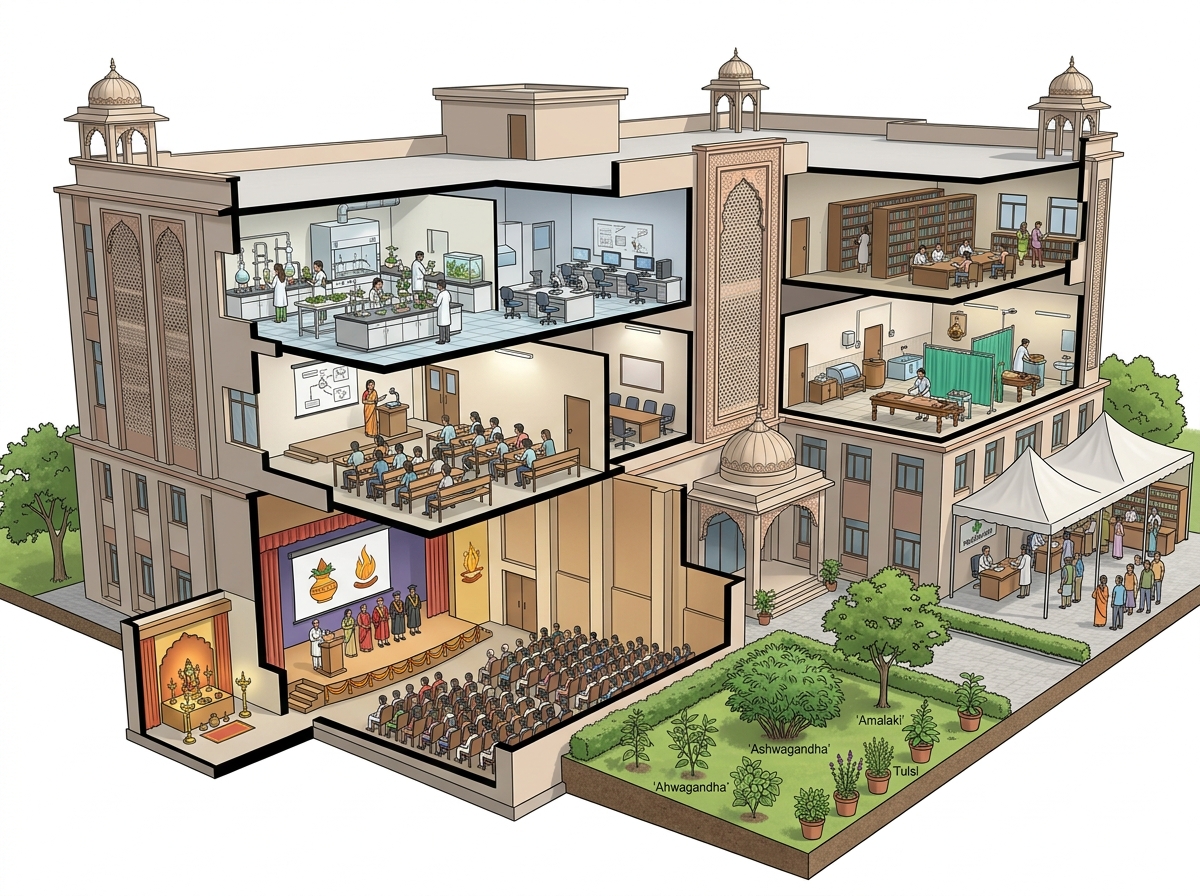
The National Institute of Ayurveda (NIA), Jaipur, a deemed university under the Ministry of Ayush, organised a series of programmes on 23 September 2026 to mark the 11th Ayurveda Day. The event included traditional Dhanvantari Puja, free Ayurvedic health camps, awareness drives, and educational activities, reflecting the government’s emphasis on promoting Ayurveda as a holistic health system and preventive healthcare approach. The initiative underscores the institutionalisation of Ayurveda within India’s healthcare framework and its alignment with contemporary health policy objectives.
Background
- Ayurveda is one of the oldest documented systems of medicine, with its roots tracing back to the Vedic period (circa 1500 BCE–500 BCE); it is recognised as a distinct medical system under the Ministry of Ayush, Government of India.
- The Ministry of Ayush, established in November 2014, is responsible for the development, propagation, and regulation of traditional systems of medicine including Ayurveda, Yoga, Naturopathy, Unani, Siddha, and Homoeopathy in India.
- Ayurveda Day was first observed in 2016 to promote awareness about Ayurveda and its preventive and curative healthcare benefits; it is celebrated annually on Dhanteras, a day associated with Dhanvantari, the Hindu god of medicine.
- The National Institute of Ayurveda (NIA), Jaipur, was established in 1976 as an autonomous body under the Ministry of Ayush and was granted deemed university status in 2002; it serves as a premier institution for Ayurvedic education, research, and clinical practice.
- The integration of traditional medicine systems with modern scientific research is a key policy thrust, as outlined in the National Health Policy 2017 and the National AYUSH Mission, aimed at enhancing healthcare accessibility and affordability.
- Ayurveda’s holistic approach—emphasising diet, lifestyle, and daily routines—aligns with global trends towards preventive healthcare and integrative medicine, particularly in the context of non-communicable diseases and lifestyle disorders.
What is Ayurveda Day and the National Institute of Ayurveda (NIA)?
- Ayurveda Day is an annual observance initiated by the Ministry of Ayush in 2016 to celebrate and promote the principles and practices of Ayurveda, observed on Dhanteras, the day dedicated to Lord Dhanvantari, the divine physician in Hindu mythology.
- The primary objectives of Ayurveda Day include raising public awareness about Ayurveda’s preventive and curative healthcare benefits, promoting research and integration of Ayurvedic knowledge with modern science, and encouraging adoption of Ayurvedic principles in daily life for holistic well-being.
- The National Institute of Ayurveda (NIA), Jaipur, is an autonomous institution under the Ministry of Ayush, functioning as a deemed university since 2002; it offers undergraduate, postgraduate, and doctoral programmes in Ayurveda, including specialisations in Ayurvedic medicine, surgery, and allied disciplines.
- NIA is designated as a Centre of Excellence for Ayurveda by the Ministry of Ayush and serves as a nodal agency for academic, clinical, and research activities in Ayurveda, including the development of standardised Ayurvedic formulations and protocols.
- The institute conducts clinical research to validate Ayurvedic therapies using modern scientific methodologies, including randomised controlled trials, pharmacognosy, and toxicology studies, thereby bridging the gap between traditional knowledge and evidence-based medicine.
- NIA organises outreach programmes such as health camps, workshops, and awareness campaigns to disseminate Ayurvedic knowledge, particularly in rural and underserved areas, aligning with the government’s goal of universal health coverage (UHC) and Ayushman Bharat.
- Ayurveda, as practised at NIA, is based on the principles of the three doshas (Vata, Pitta, Kapha), seven dhatus (body tissues), and three malas (waste products), with treatment modalities including herbal medicines, dietary therapy, panchakarma (detoxification procedures), and lifestyle modifications.
- The institute collaborates with national and international institutions for research, capacity building, and policy advocacy, including the World Health Organization (WHO) and the Council of Scientific and Industrial Research (CSIR), to promote Ayurveda globally.
Key Features
| Feature | Significance |
|---|---|
| National Ayurveda Day observance | Institutionalizes annual public health outreach and reinforces the integration of Ayurveda within India’s healthcare ecosystem. |
| Free Ayurvedic health camps | Provides preventive and promotive healthcare services, particularly to underserved populations, aligning with the Ayushman Bharat framework. |
| Traditional worship of Lord Dhanvantari | Symbolizes the cultural and philosophical foundation of Ayurveda, emphasizing its holistic and preventive ethos. |
| Awareness programmes and workshops | Educates the public on Ayurvedic principles of diet, lifestyle, and daily routine for sustainable health. |
| Scientific advancement of Ayurveda | Demonstrates the institution’s commitment to validating traditional knowledge through modern research methodologies. |
Why it Matters
Public Health
- Promotes preventive healthcare by disseminating Ayurvedic principles of diet, lifestyle, and daily routine.
- Enhances community health security through free Ayurvedic health camps and health education.
- Supports the integration of Ayurveda into mainstream healthcare delivery systems.
Cultural and Philosophical
- Reinforces the cultural heritage of Ayurveda through traditional rituals and public engagement.
- Highlights the holistic life philosophy embedded in Ayurveda, transcending its role as a mere medical system.
Institutional and Academic
- Showcases the role of Ayurvedic institutions in advancing traditional knowledge through scientific research.
- Demonstrates the institutional capacity of Ayurvedic universities in public health outreach and education.
Policy and Governance
- Aligns with national health policies promoting integrative medicine and preventive healthcare.
- Demonstrates the implementation of Ayush Ministry’s initiatives at the grassroots level.
Challenges
1. Standardization and Quality Control
- Ensuring uniformity in Ayurvedic formulations and treatments across institutions and practitioners.
- Addressing concerns regarding the scientific validation and reproducibility of Ayurvedic therapies.
UPSC Link: GS Paper 2: Health – Ayush Systems
2. Public Awareness and Skepticism
- Overcoming misconceptions about Ayurveda as an alternative rather than complementary system.
- Bridging the knowledge gap between traditional practitioners and modern medical professionals.
UPSC Link: GS Paper 2: Health – Preventive Healthcare
3. Research and Evidence Generation
- Developing robust clinical research frameworks to validate Ayurvedic therapies.
- Encouraging collaboration between Ayurvedic institutions and modern medical research bodies.
UPSC Link: GS Paper 3: Science & Technology – Research Ecosystem
4. Accessibility and Affordability
- Ensuring equitable access to Ayurvedic healthcare services, particularly in rural and underserved areas.
- Addressing cost barriers in Ayurvedic treatments and formulations.
UPSC Link: GS Paper 2: Health – Healthcare Delivery
5. Regulatory and Legal Framework
- Strengthening regulatory mechanisms for Ayurvedic education, practice, and drug manufacturing.
- Harmonizing Ayurvedic standards with international health regulations.
UPSC Link: GS Paper 2: Health – Ayush Systems
Challenges — UPSC Perspective
| Issue | Concern |
|---|---|
| Standardization of Ayurvedic formulations | Lack of uniform quality control across practitioners and institutions. |
| Scientific validation of Ayurvedic therapies | Limited clinical evidence and reproducibility in modern scientific terms. |
| Public perception and acceptance | Skepticism towards Ayurveda as a primary healthcare system. |
| Regulatory oversight | Inadequate enforcement of Ayurvedic education and practice standards. |
| Research collaboration | Limited synergy between Ayurvedic and allopathic medical research. |
| Geographical accessibility | Uneven distribution of Ayurvedic healthcare services across regions. |
Way Forward
- Strengthen institutional research capabilities to generate high-quality clinical evidence for Ayurvedic therapies.
- Expand public health campaigns to dispel myths and promote Ayurveda as a complementary healthcare system.
- Develop standardized protocols for Ayurvedic formulations and treatments to ensure quality and safety.
- Enhance collaboration between Ayurvedic institutions, modern medical colleges, and research bodies.
- Increase funding and incentives for Ayurvedic startups and practitioners in rural and underserved areas.
- Integrate Ayurvedic principles into national health programmes like Ayushman Bharat and Poshan Abhiyaan.
- Promote interdisciplinary education to bridge the knowledge gap between traditional and modern medicine.
- Establish a national registry for Ayurvedic practitioners to monitor and regulate the sector effectively.
UPSC Value Addition
Keywords for Mains Answer-Writing
Ayurveda Day · National Institute of Ayurveda (NIA) Jaipur · Ayurveda as holistic lifestyle · Preventive healthcare · Traditional Knowledge Systems · Ministry of AYUSH · Dhanvantari Puja · Free Ayurvedic health camps · Ayurvedic education and research · Integrative medicine
Concept Flow
Observance of National Ayurveda Day → Institutional engagement in public health outreach → Traditional Ayurvedic practices (e.g., worship of Lord Dhanvantari) → Reinforcement of cultural and philosophical foundations → Free Ayurvedic health camps → Direct provision of preventive and promotive healthcare services → Awareness programmes and workshops → Dissemination of Ayurvedic principles of diet and lifestyle → Modern research initiatives → Validation and advancement of traditional Ayurvedic knowledge → Integration into national health policies → Alignment with Ayush Ministry’s objectives → Community health security → Long-term impact on public health outcomes
Prelims Practice Questions
Q1. Consider the following statements regarding Ayurveda Day:
1. Ayurveda Day is celebrated annually on the occasion of Dhanvantari Jayanti.
2. The National Institute of Ayurveda (NIA), Jaipur, is a deemed university under the Ministry of AYUSH.
3. Ayurveda Day was first observed in 2016.
How many of the above statements are correct?
- Only one
- Only two
- All three
- None
Answer: All three — Statement 1 is correct: Ayurveda Day is celebrated on Dhanvantari Jayanti. Statement 2 is correct: NIA, Jaipur, is a deemed university under the Ministry of AYUSH. Statement 3 is incorrect: Ayurveda Day was first observed in 2016, making it the 11th edition in 2026.
Q2. Assertion (A): Ayurveda is recognized as a holistic lifestyle system rather than merely a medical practice.
Reason (R): The National Institute of Ayurveda (NIA), Jaipur, emphasizes preventive healthcare, diet, and daily routines in its outreach programs.
In the context of the above two statements, which one of the following is correct?
- Both A and R are true, and R is the correct explanation of A
- Both A and R are true, but R is not the correct explanation of A
- A is true, but R is false
- A is false, but R is true
Answer: Both A and R are true, but R is not the correct explanation of A — Assertion (A) is true: Ayurveda is framed as a holistic lifestyle system. Reason (R) is also true and directly explains the assertion, as NIA’s programs highlight preventive healthcare, diet, and daily routines as core components of Ayurveda.
Q3. Match the following pairs related to Ayurveda and its institutional framework:
Column I | Column II
———————————-|———————————-
A. National Institute of Ayurveda | 1. Deemed University under Ministry of AYUSH
B. Ministry of AYUSH | 2. Celebrates Ayurveda Day annually
C. Dhanvantari Jayanti | 3. Central nodal agency for AYUSH systems
D. Ayurvedic health camps | 4. Organizes free health awareness programs
Select the correct match:
- A-1, B-3, C-2, D-4
- A-2, B-1, C-3, D-4
- A-3, B-2, C-1, D-4
- A-4, B-3, C-2, D-1
Answer: A-1, B-3, C-2, D-4 — Correct matches: A (National Institute of Ayurveda) is a deemed university under the Ministry of AYUSH (1); B (Ministry of AYUSH) is the central nodal agency for AYUSH systems (3); C (Dhanvantari Jayanti) is the occasion for celebrating Ayurveda Day (2); D (Ayurvedic health camps) are organized to create awareness (4).
Mains Practice Question
✍ Critically examine the role of the Ministry of AYUSH in promoting Ayurveda as a holistic lifestyle system in contemporary India. In your answer, highlight the institutional mechanisms, flagship initiatives, and challenges in integrating traditional knowledge systems with modern healthcare. (15 Marks)
Approach: MODEL-ANSWER SKELETON:
1. **Institutional Framework**: Role of Ministry of AYUSH (established 2014) as the nodal agency for AYUSH systems; National Institute of Ayurveda (NIA), Jaipur, as a deemed university under its aegis.
2. **Flagship Initiatives**:
– **Ayurveda Day**: Annual celebration on Dhanvantari Jayanti (since 2016) to promote awareness.
– **Integrative Medicine**: Initiatives like the National Ayurveda Dietetics Research Institute (NADRI) and collaboration with modern medical institutions for evidence-based research.
– **Health Camps and Outreach**: Free Ayurvedic health camps (as exemplified by NIA, Jaipur) to disseminate preventive healthcare, diet, and lifestyle practices.
3. **Promotion of Holistic Lifestyle**: Emphasis on preventive healthcare, balanced diet, and daily routines (Dinacharya) as core components of Ayurveda.
4. **Challenges**:
– **Standardization**: Lack of uniform protocols for Ayurvedic practices and quality control.
– **Integration**: Skepticism from modern medical fraternity and regulatory hurdles in integrating Ayurveda with allopathy.
– **Research and Evidence**: Need for robust clinical trials to validate Ayurvedic formulations and therapies.
5. **Way Forward**: Strengthening research infrastructure (e.g., CCRAS), enhancing public-private partnerships, and fostering interdisciplinary collaboration.
Balance of views: Acknowledge the potential of Ayurveda in preventive healthcare while critically assessing the systemic challenges in its mainstream adoption.
Source: PIB (Press Information Bureau)
Rajasthan PCS (RPSC / RAS) — State PCS Practice
Prelims: Where was the 11th Ayurveda Day celebrated in Rajasthan in 2023?
- A. Jaipur
- B. Udaipur
- C. Jodhpur
- D. Kota
Answer: A. Jaipur — The 11th Ayurveda Day was celebrated at the National Institute of Ayurveda (NIA), Jaipur, in 2023.
Mains: Discuss the significance of the 11th Ayurveda Day celebration at the National Institute of Ayurveda, Jaipur, and its impact on promoting Ayurveda in Rajasthan. (Word limit: 200)
Generated by AanyaAi for educational purpose.
Related guides on our sites
- How to prepare for GS paper 1 for UPSC CSE mains exam
- Best UPSC coaching for IFOS exam
- Best mentorship programme for upsc
- UPSC+BA degree

- महाराष्ट्र में त्योहार जुलूसों पर बॉम्बे हाईकोर्ट का बड़ा फैसला: पटाखे, लेजर और संगीत पर रोक - September 24, 2026
- Bombay HC Bans Firecrackers, Music in Maharashtra Processions: Key UPSC Analysis - September 24, 2026
- तमिलनाडु में महिला कर्मचारियों के लिए सवैतनिक माहवारी अवकाश नीति पर HC का आदेश - September 24, 2026

No Comments