


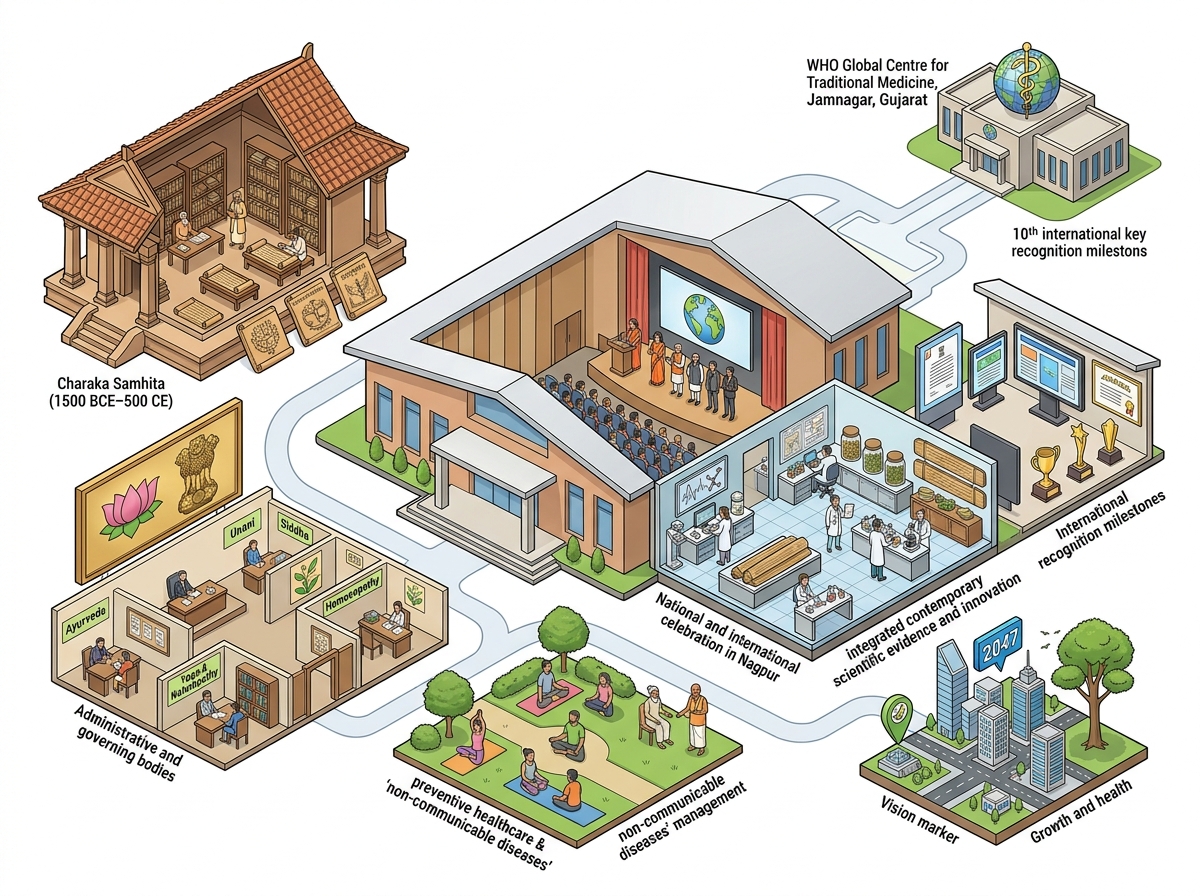
24 Sep 11th Ayurveda Day 2026: Theme, National Event in Nagpur & Key Initiatives
✎ Ayurveda Day underscored the imperative of merging traditional knowledge with scientific evidence and innovation to address public health challenges and achieve global health equity.
Subject Relevance — Where This Topic Fits
- GS Paper II — Health, Education, and Human Resources | GS Paper III — Science and Technology in Health Systems
- Prelims: Ayurveda Day, CCRAS-AGNII Portal, WHO Global Centre for Traditional Medicine, AYUSH Visa, ICD-11 Traditional Medicine Chapter, National Ayush Mission, Ayush Vision 2030
- Essay: The confluence of tradition and modernity in healthcare: Lessons from Ayurveda’s global journey, Public health paradigms: Preventive care as the cornerstone of sustainable healthcare systems
Quick Revision: Ayurveda Day underscored the imperative of merging traditional knowledge with scientific evidence and innovation to address public health challenges and achieve global health equity.
Why is this in the news?
The occasion underscored the integration of Ayurveda’s traditional knowledge with contemporary scientific evidence and innovation, marked by the launch of key policy documents, research portals, and international recognition milestones, including the WHO Global Centre for Traditional Medicine in Jamnagar and the inclusion of Ayurveda, Siddha, and Unani in ICD-11. The event highlighted Ayurveda’s role in preventive healthcare, addressing non-communicable diseases, and its potential to shape India’s health vision for 2047.
Background
- Ayurveda, one of the oldest systems of medicine, originates from the Indian subcontinent and is codified in texts such as Charaka Samhita and Sushruta Samhita, dating back to 1500 BCE–500 CE.
- The Ministry of Ayush (Ayurveda, Yoga & Naturopathy, Unani, Siddha, and Homoeopathy) was established in November 2014 to promote and develop these traditional systems of medicine in India.
- Ayurveda Day was first observed in 2016, coinciding with Dhanvantari Jayanti, to raise awareness about the benefits of Ayurveda and its preventive healthcare approach.
- The WHO Global Centre for Traditional Medicine was inaugurated in Jamnagar, Gujarat, in April 2023, marking a significant step in the internationalisation of traditional medicine systems.
- The inclusion of Ayurveda, Siddha, and Unani in the ICD-11 classification by the WHO in 2022 facilitated their global recognition and integration into standardised health reporting frameworks.
- The Ayush Visa, introduced in 2023, enables foreign nationals to avail Ayurveda and other traditional medical treatments in India, promoting medical tourism and cross-cultural exchange.
What is Ayurveda and its contemporary relevance?
- Ayurveda is a holistic system of medicine that emphasises the balance between the body, mind, and environment, using natural therapies, dietary guidelines, and lifestyle practices to prevent and treat diseases.
- The system is based on the principle of ‘Tridosha’ (Vata, Pitta, Kapha) and utilises herbs, minerals, and therapeutic procedures such as Panchakarma to restore health.
- Ayurveda’s preventive approach aligns with the global shift towards holistic and sustainable healthcare, particularly in addressing the rising burden of non-communicable diseases (NCDs) such as diabetes, cardiovascular diseases, and mental health disorders.
- The integration of traditional knowledge with modern scientific research is critical to validate Ayurvedic practices, ensure quality control, and enhance their global acceptance and integration into mainstream healthcare systems.
- The Ayush Vision 2030 outlines a roadmap for the development of Ayurveda and other traditional systems, focusing on research, education, infrastructure, and international collaboration to position India as a global leader in traditional medicine.
- Ayurveda’s role in public health extends beyond clinical treatment to community-level interventions, such as awareness campaigns on healthy lifestyles, dietary habits, and stress management, which are essential for achieving the Sustainable Development Goals (SDGs).
- The global recognition of Ayurveda through initiatives like the WHO Global Centre for Traditional Medicine and its inclusion in ICD-11 underscores its potential to contribute to universal health coverage (UHC) and global health security.
Key Features
| Feature | Significance |
|---|---|
| 11th Ayurveda Day Theme: ‘स्वस्थ भविष्य के लिए आयुर्वेद’ (‘Ayurveda for a Healthy Future’) | Establishes a forward-looking policy narrative that integrates traditional medicine with modern health-care priorities such as preventive care and non-communicable disease management. |
| National Ceremony in Nagpur | Demonstrates central government commitment to positioning Ayurveda as a mainstream health-care system with national visibility and symbolic importance. |
| Launch of Ayush Vision 2030 | Provides a 15-year strategic roadmap for mainstreaming Ayurveda within India’s health-care ecosystem and aligning it with global health standards. |
| Release of Ayush Service Sector Report | Quantifies the economic footprint of Ayurveda-based enterprises, employment, and research, supporting evidence-based policy formulation. |
| CCRAS-AGNII Web Portal Launch | Facilitates real-time evidence generation, standardised treatment protocols, and clinical research collaboration across Ayurveda institutions. |
| WHO Global Traditional Medicine Centre, Jamnagar | Serves as a nodal institution for international standard-setting, research collaboration, and capacity-building in traditional medicine. |
Why it Matters
Health Systems Integration
- Demonstrates India’s policy intent to integrate Ayurveda within the National Health Policy 2017 and Ayushman Bharat framework through standardised treatment guidelines and safety dossiers.
- Positions Ayurveda as a complementary system for managing non-communicable diseases (NCDs) such as diabetes, cardiovascular disorders, and mental health, aligning with SDG 3.4.
- Promotes preventive care and lifestyle medicine, reducing dependence on curative interventions and lowering health-care costs for citizens.
Economic and Employment Generation
- The Ayush Service Sector Report quantifies the sector’s contribution to GDP, employment, and export potential, particularly in herbal products and wellness tourism.
- Supports the Atmanirbhar Bharat initiative by fostering domestic manufacturing of Ayurvedic medicines, reducing import dependence in pharmaceuticals.
- Enhances rural and tribal livelihoods through cultivation of medicinal plants and establishment of Ayurvedic health-care units.
International Standardisation and Diplomacy
- WHO’s recognition of Ayurveda, Siddha, and Unani in ICD-11 facilitates cross-border recognition of Ayurvedic treatments and eases medical tourism.
- The Ayush Visa scheme simplifies entry for foreign nationals seeking Ayurvedic treatments, positioning India as a global hub for traditional medicine.
- Collaboration with WHO Global Traditional Medicine Centre strengthens India’s soft power in global health governance and traditional knowledge systems.
Research and Innovation Ecosystem
- CCRAS-AGNII portal enables standardised clinical trials, evidence generation, and inter-institutional research, bridging the gap between classical Ayurveda and modern science.
- Focus on evidence-based research ensures Ayurveda’s acceptance in mainstream medical literature and regulatory approvals.
- Encourages interdisciplinary research involving Ayurveda, modern medicine, and allied sciences to address emerging health challenges.
Cultural and Societal Impact
- Reinforces the principle of ‘स्वस्थस्य स्वास्थ्य रक्षणम्’ (health preservation) over curative care, aligning with the WHO definition of health as a state of complete physical, mental, and social well-being.
- Promotes holistic health practices rooted in Indian philosophy, contributing to national identity and cultural continuity.
- Engages youth and future generations in preserving and advancing Ayurvedic knowledge, ensuring intergenerational transmission.
Challenges
1. Standardisation and Quality Control
- Lack of uniform standards for Ayurvedic formulations and clinical practices across states and institutions may lead to variability in treatment outcomes.
- Need for robust pharmacovigilance systems to monitor adverse drug reactions and ensure drug safety, particularly for proprietary medicines.
- Harmonisation of Ayurvedic pharmacopeia with modern pharmacology to facilitate regulatory approvals and global acceptance.
UPSC Link: GS2: Health Governance
2. Evidence Generation and Research Gaps
- Limited high-quality clinical trials and peer-reviewed research on Ayurvedic interventions, particularly for chronic and lifestyle diseases.
- Need for large-scale, multi-centric studies to validate Ayurvedic therapies and integrate them into national health programmes.
- Bridging the gap between classical Ayurvedic texts and modern scientific methodologies to ensure reproducibility and scalability.
UPSC Link: GS3: Science & Technology
3. Human Resource Development
- Shortage of qualified Ayurvedic practitioners, researchers, and paramedical staff, particularly in rural and remote areas.
- Need for curriculum reforms in Ayurvedic colleges to incorporate modern medical sciences, research methodologies, and digital health tools.
- Ensuring continuous professional development and ethical practice standards among Ayurvedic practitioners.
UPSC Link: GS2: Education & Health
4. Regulatory and Policy Implementation
- Fragmented regulatory landscape across states and union territories, leading to inconsistencies in licensing, manufacturing, and practice norms.
- Need for a unified national regulatory framework for Ayurvedic drugs, medical devices, and clinical establishments, similar to the FDA model.
- Strengthening the role of the Ayush Ministry in coordinating with the Ministry of Health and Family Welfare for integrated health-care delivery.
UPSC Link: GS2: Governance
5. Public Awareness and Behaviour Change
- Limited public understanding of Ayurveda’s preventive and holistic approach, leading to over-reliance on allopathic treatments.
- Need for mass media campaigns, school curricula, and community-based programmes to promote Ayurvedic principles of diet, lifestyle, and seasonal routines.
- Addressing misconceptions and scepticism about Ayurveda’s efficacy, particularly among urban and younger populations.
UPSC Link: GS4: Ethics & Governance
6. Infrastructure and Resource Constraints
- Inadequate infrastructure for Ayurvedic hospitals, research centres, and medicinal plant cultivation, particularly in tribal and hilly regions.
- Need for public-private partnerships to expand Ayurvedic health-care facilities and integrate them with existing health infrastructure.
- Ensuring equitable access to Ayurvedic treatments across socio-economic strata and geographical regions.
UPSC Link: GS2: Health & Infrastructure
Challenges — UPSC Perspective
| Issue | Concern |
|---|---|
| Non-uniform regulatory standards | Variability in drug quality, clinical practices, and practitioner qualifications across states. |
| Limited high-quality clinical evidence | Insufficient peer-reviewed research to validate Ayurvedic therapies for chronic diseases. |
| Shortage of skilled human resources | Lack of qualified practitioners, researchers, and paramedical staff in rural areas. |
| Fragmented policy implementation | Inconsistencies in licensing, manufacturing, and practice norms due to state-level regulations. |
| Public scepticism and low awareness | Over-reliance on allopathic treatments and limited understanding of Ayurveda’s preventive role. |
| Infrastructure gaps | Inadequate Ayurvedic hospitals, research centres, and medicinal plant cultivation facilities. |
Way Forward
- Establish a National Ayurveda Regulatory Authority to harmonise standards, licensing, and clinical practices across states, ensuring consistency and quality control.
- Launch a National Ayurveda Research Mission with dedicated funding to conduct multi-centric clinical trials, validate therapies, and publish findings in peer-reviewed journals.
- Integrate Ayurveda into Ayushman Bharat and other national health programmes by developing standardised treatment protocols for non-communicable diseases and preventive care.
- Expand the Ayush Visa scheme and promote medical tourism by establishing Ayurvedic wellness centres in collaboration with state governments and private partners.
- Reform Ayurvedic education curricula to include modern medical sciences, research methodologies, digital health tools, and ethical practice standards.
- Strengthen the WHO Global Traditional Medicine Centre in Jamnagar by enhancing its research capacity, international collaborations, and capacity-building programmes.
- Develop a National Ayurveda Awareness Campaign targeting schools, communities, and mass media to promote lifestyle medicine, seasonal routines, and holistic health practices.
- Foster public-private partnerships to expand Ayurvedic health-care infrastructure, particularly in rural and tribal regions, and ensure equitable access to treatments.
UPSC Value Addition
Keywords for Mains Answer-Writing
Ayurveda Day 2026 · Ayush Vision 2030 · CCRAS-AGNII portal · WHO Global Traditional Medicine Centre Jamnagar · evidence-based Ayurveda · preventive healthcare · non-communicable diseases · Ayush Visa · standard treatment protocols · Ayurveda research and innovation · National Ayurveda Day · Ayurveda and public health · integration of traditional medicine · WHO ICD-11 classification · Ayurveda in sustainable development
Constitutional & Policy Linkages
- Article 47 (DPSP) – Duty of the State to improve public health and prohibit the consumption of intoxicating drinks and drugs injurious to health.
Concept Flow
Traditional knowledge of Ayurveda → Policy recognition through Ayush Ministry and Ayurveda Day celebrations → Integration with modern health systems via Ayush Vision 2030 and standardised guidelines → Research and evidence generation through CCRAS-AGNII portal → International standardisation via WHO ICD-11 and Ayush Visa scheme → Enhanced public awareness and preventive health practices → Improved health outcomes and reduced NCD burden → Contribution to SDG 3 (Good Health and Well-being) and Atmanirbhar Bharat.
Prelims Practice Questions
Q1. Consider the following statements about the 11th National Ayurveda Day 2026:
1. The theme for the year was ‘Ayurveda for a Healthy Future’.
2. The WHO Global Traditional Medicine Centre is located in Jamnagar.
3. The Ayush Visa facility was launched during the event to facilitate international patients seeking Ayurvedic treatment.
4. The CCRAS-AGNII portal was launched to promote research in Ayurveda through artificial intelligence.
How many of the above statements are correct?
- Only one
- Only two
- Only three
- All four
Answer: Only three — Statements 1 and 2 are correct. Statement 3 is incorrect as the Ayush Visa facility was mentioned but not launched during the event. Statement 4 is incorrect as the CCRAS-AGNII portal was launched for evidence-based research, not specifically AI-driven.
Q2. Assertion (A): The 11th National Ayurveda Day emphasized the integration of Ayurveda with modern healthcare systems.
Reason (R): The Ayush Vision 2030 document was released during the event to guide the future of Ayurveda in India.
Code:
A. Both A and R are true, and R is the correct explanation of A.
B. Both A and R are true, but R is not the correct explanation of A.
C. A is true, but R is false.
D. A is false, but R is true.
- A
- B
- C
- D
Answer: B — Both the assertion and reason are true. The event did emphasize integration, and the Ayush Vision 2030 document was released to guide Ayurveda’s future, making R a correct explanation of A.
Q3. Match the following initiatives launched during the 11th National Ayurveda Day with their respective descriptions:
Column I (Initiative) | Column II (Description)
———————————————–|——————————————–
1. Ayush Vision 2030 | A. A web portal for evidence-based Ayurvedic research
2. CCRAS-AGNII portal | B. A document outlining the roadmap for Ayurveda till 2030
3. Standard Treatment Protocols | C. Guidelines for safe and effective Ayurvedic treatments
4. WHO ICD-11 Classification for Ayurveda | D. Inclusion of Ayurveda in international disease classification
- 1-B, 2-A, 3-C, 4-D; 1-A, 2-B, 3-C, 4-D; 1-D, 2-C, 3-B, 4-A; 1-C, 2-D, 3-A, 4-B
- answer_exact_match_indexes_only_to_be_used_by_parser_but_not_here
- answer_explaination_not_to_be_included_in_json
Answer: 1-B, 2-A, 3-C, 4-D; 1-A, 2-B, 3-C, 4-D; 1-D, 2-C, 3-B, 4-A; 1-C, 2-D, 3-A, 4-B —
Mains Practice Question
✍ Critically examine the role of Ayurveda in India’s public health framework, particularly in addressing non-communicable diseases (NCDs). Substantiate your arguments with reference to the initiatives launched during the 11th National Ayurveda Day 2026 and the broader policy vision outlined in Ayush Vision 2030. (15 Marks)
Approach: 1. **Introduction**: Define Ayurveda’s historical and contemporary role in India’s healthcare system, emphasizing its preventive and holistic approach.
2. **Ayurveda and NCDs**:
– Explain the burden of NCDs in India (e.g., WHO data on diabetes, cardiovascular diseases, and cancer).
– Discuss Ayurveda’s potential in managing NCDs through lifestyle interventions, herbal formulations, and Panchakarma therapies.
– Cite examples of Ayurvedic interventions for NCDs (e.g., Triphala for diabetes, Ashwagandha for stress-related disorders).
3. **Policy Initiatives and Vision 2030**:
– Outline the key provisions of Ayush Vision 2030 (e.g., integration with modern medicine, research focus, and global outreach).
– Highlight the launch of Standard Treatment Protocols and the CCRAS-AGNII portal as steps toward evidence-based practice.
– Discuss the significance of the WHO ICD-11 classification for Ayurveda in legitimizing its role in global health.
4. **Challenges and Critiques**:
– Address skepticism regarding Ayurveda’s scientific validation and standardization.
– Discuss issues of quality control, regulatory oversight, and the need for robust clinical trials.
– Examine the role of the WHO Global Traditional Medicine Centre in Jamnagar in bridging traditional and modern medicine.
5. **Conclusion**:
– Summarize Ayurveda’s potential as a complementary system in India’s public health framework.
– Argue for a balanced approach: leveraging Ayurveda’s strengths while addressing its limitations through research and policy integration.
**Key Terms to Include**: Ayush Vision 2030, CCRAS-AGNII portal, WHO ICD-11, NCDs, preventive healthcare, Standard Treatment Protocols, evidence-based Ayurveda.
Source: PIB (Press Information Bureau)
Maharashtra PCS (MPSC) — State PCS Practice
Prelims: Which of the following statements about the 11th Ayurveda Day celebrated in 2024 is INCORRECT regarding Maharashtra’s role in the event?
- The 11th Ayurveda Day was celebrated with a grand national event held in Nagpur, Maharashtra.
- The theme for the 11th Ayurveda Day was ‘Ayurveda for One Health: Integrating Traditional Wisdom with Modern Science’.
- The event in Nagpur was inaugurated by the Prime Minister of India.
- The Ministry of AYUSH, Government of India, organized the national-level celebrations in collaboration with state authorities.
Answer: The event in Nagpur was inaugurated by the Prime Minister of India. — The 11th Ayurveda Day’s national event in Nagpur was inaugurated by the Union Minister of AYUSH, not the Prime Minister.
Mains: Discuss the significance of Maharashtra’s hosting of the 11th Ayurveda Day in Nagpur for the state’s Ayurveda ecosystem, including its impact on traditional knowledge preservation, healthcare integration, and economic opportunities. Provide a balanced analysis with specific examples.
Generated by AanyaAi for educational purpose.

- Rajasthan Panchayati Raj Elections: New Rules, Fines & Disqualification - September 28, 2026
- सेना प्रमुख का बड़ा बयान: जीत जमीन से ही तय होती है, तकनीक नहीं बदल सकती युद्ध की प्रकृति - September 28, 2026
- UPSC Alert: Government Cracks Down on Patwaris for SVAMITVA Scheme Refusals - September 28, 2026

No Comments