


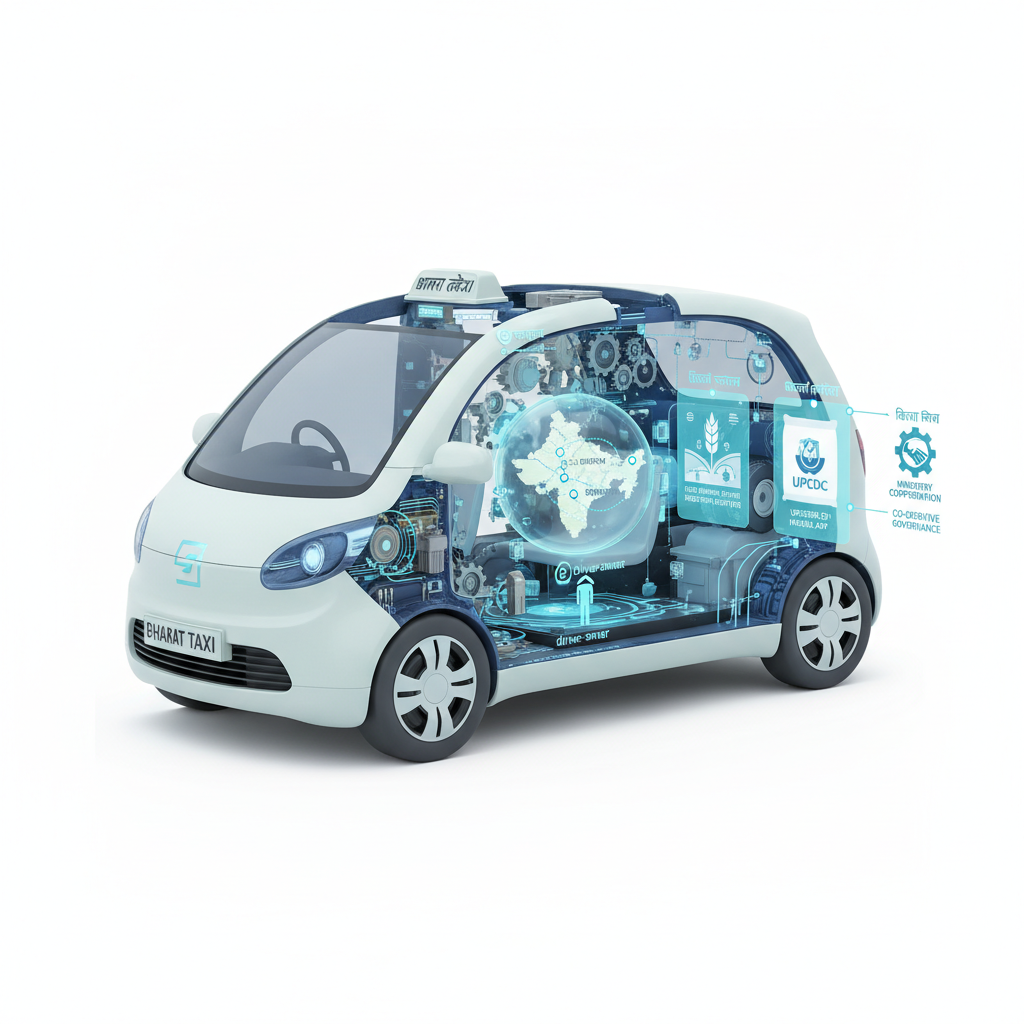
24 Sep UPSC Alert: ‘भारत टैक्सी’ Service Launch in 5 UP Cities – Key Facts
✎ ‘भारत टैक्सी’ exemplifies the integration of cooperative governance with digital public infrastructure to democratise urban mobility, empowering drivers as owner-operators while ensuring transparency and scalability.
Subject Relevance — Where This Topic Fits
- GS Paper II — Governance, Transparency and Accountability | GS Paper III — Mobilization of Resources, Technology Missions, Start-up Ecosystems
- Prelims: Cooperative Societies Act, 1912 (amended), Digital Public Infrastructure (DPI), PACS (Primary Agricultural Credit Societies), Mobility-as-a-Service (MaaS), Driver-Owner Model
- Essay: Cooperatives as instruments of socio-economic transformation, Role of technology in democratising access to public services
Quick Revision: ‘भारत टैक्सी’ exemplifies the integration of cooperative governance with digital public infrastructure to democratise urban mobility, empowering drivers as owner-operators while ensuring transparency and scalability.
Why is this in the news?
The launch of ‘भारत टैक्सी’—a cooperative-driven mobility service—across five major cities in Uttar Pradesh marks a significant expansion of cooperative enterprises into the urban transport sector. This initiative, aligned with the ‘सहकार से समृद्धि’ vision, integrates cooperative governance with digital public infrastructure to empower drivers as owner-operators while enhancing urban mobility. The event also featured the rollout of three digital platforms—‘मुख्यमंत्री कृषक समृद्धि योजना’ portal, ‘उर्वरक सेतु’ mobile app, and UPCDC mobile app—demonstrating the state’s commitment to cooperative and agricultural modernization.
Background
- The Government of India established an independent Ministry of Cooperation in July 2021 to modernise the cooperative sector, aligning it with contemporary economic needs and technological advancements.
- Cooperative societies in India operate under the Cooperative Societies Act, 1912 (as amended by state legislatures), with over 8.5 lakh societies and 32 crore members nationwide.
- Primary Agricultural Credit Societies (PACS) have historically focused on agricultural credit and inputs but are now being diversified into sectors such as dairy, sugar, and now urban mobility.
- The ‘सहकार से समृद्धि’ vision, articulated by the Prime Minister, aims to expand cooperative enterprises beyond traditional domains into areas like exports, health services, and mobility.
- Uttar Pradesh has emerged as a leader in cooperative expansion, with approximately 54 lakh new cooperative members added in recent years, serving as a model for other states.
- Digital transformation of cooperatives is a key policy thrust, with the computerisation of 80,000 PACS at an estimated cost of ₹3,000 crore to enhance transparency and service delivery.
What is ‘भारत टैक्सी’ and how does it function?
- ‘भारत टैक्सी’ is a mobility service launched under the cooperative framework, where drivers are owner-operators and members of cooperative societies, adhering to the ‘Driver is the Owner’ principle.
- The service operates on a cooperative governance model, ensuring democratic control, profit-sharing, and collective decision-making among driver-members.
- Initially launched in five major cities of Uttar Pradesh—Lucknow, Gorakhpur, Varanasi, Kanpur, and Prayagraj—it aims to scale across urban centres to provide affordable, reliable, and safe taxi services.
- The platform leverages digital public infrastructure, including mobile applications and GPS-based tracking, to ensure transparency, real-time ride monitoring, and fare regulation.
- Within six months of operation, the service has connected over 10 lakh drivers (referred to as ‘सारथी’) and facilitated approximately 20,000 rides daily, with over ₹100 crore credited to driver accounts.
- Strategic partnerships with institutions like the Airports Authority of India, Lucknow Metro Rail, and Lucknow Police enhance service integration, ensuring seamless last-mile connectivity and safety protocols.
- The initiative aligns with the broader policy goal of integrating cooperatives into non-traditional sectors, such as urban mobility, to promote inclusive entrepreneurship and reduce dependency on unorganised transport services.
- The model exemplifies the ‘Platform Cooperativism’ approach, where digital platforms are owned and governed by the workers (drivers) themselves, contrasting with gig-economy models dominated by private aggregators.
Key Features
| Feature | Significance |
|---|---|
| ‘Driver is the Owner’ model | Ensures ownership and decision-making authority for drivers, aligning incentives with service quality and sustainability. |
| Multi-city launch (Lucknow, Gorakhpur, Varanasi, Kanpur, Prayagraj) | Expands mobility solutions across key urban centres, promoting inclusive access to transportation. |
| MoUs with Airport Authority, Lucknow Metro Rail, and Lucknow Police | Facilitates integrated urban mobility, seamless last-mile connectivity, and enhanced passenger safety. |
| Integration with ‘Uttar Pradesh Cooperative Database Centre (UPCDC)’ mobile app | Enables real-time data tracking, transparency, and governance of cooperative-driven initiatives. |
| Launch of ‘Urvak Setu’ mobile app | Supports farmers by providing timely access to fertiliser-related information and services. |
Why it Matters
Economic Integration
- Expands the cooperative sector into mobility, diversifying income sources for driver-owners and reducing dependency on traditional livelihoods.
- Promotes formalisation of the gig economy through structured cooperative frameworks, ensuring social security and fair remuneration.
- Enhances local economic activity by retaining revenue within cooperative structures rather than external aggregators.
Governance and Transparency
- Leverages digital platforms (UPCDC, Urvak Setu) to streamline cooperative governance, reducing leakages and improving service delivery.
- Facilitates data-driven policymaking by aggregating cooperative performance metrics across sectors.
- Strengthens accountability through real-time tracking of financial transactions and service metrics.
Urban Mobility and Infrastructure
- Addresses last-mile connectivity gaps in tier-2 and tier-3 cities, complementing public transport systems.
- Promotes multi-modal integration, reducing congestion and environmental impact through shared mobility solutions.
- Enhances passenger safety via partnerships with police and metro authorities.
Cooperative Sector Modernisation
- Demonstrates the scalability of cooperative models beyond agriculture, aligning with the ‘Sahkar Se Samriddhi’ vision.
- Highlights the role of technology in transforming traditional cooperatives into agile, competitive entities.
- Serves as a replicable model for other states to adopt cooperative-driven solutions in emerging sectors.
Social Impact
- Empowers marginalised driver communities by providing ownership and financial independence.
- Supports gender-inclusive mobility by enabling women drivers to join the cooperative framework.
- Contributes to rural-urban integration by connecting hinterlands to urban economic hubs.
Challenges
1. Regulatory and Compliance Hurdles
- Ensuring adherence to state-specific transport regulations while maintaining cooperative autonomy.
- Balancing cooperative governance with statutory compliance for driver-owners.
- Addressing potential conflicts between cooperative policies and municipal/local government priorities.
UPSC Link: GS-II: Cooperative Societies Act, 1912
2. Technology Adoption and Digital Divide
- Overcoming resistance to digital tools among driver-owners, particularly in rural areas.
- Ensuring equitable access to smartphones and internet connectivity for seamless app usage.
- Preventing cybersecurity risks in data-driven cooperative operations.
UPSC Link: GS-III: Digital Divide and Inclusion
3. Financial Sustainability
- Managing initial capital investments for fleet acquisition and maintenance.
- Ensuring fair revenue-sharing models that sustain driver-owners without compromising service affordability.
- Mitigating financial risks during low-demand periods or economic downturns.
UPSC Link: GS-III: Financial Inclusion and Cooperative Finance
4. Competition and Market Penetration
- Competing with established ride-hailing platforms that dominate urban mobility markets.
- Building trust among passengers accustomed to app-based aggregators over cooperative models.
- Scaling operations efficiently to match demand in high-density urban corridors.
UPSC Link: GS-III: Competition Policy and Market Dynamics
5. Human Resource Management
- Training driver-owners in customer service, safety protocols, and digital literacy.
- Addressing attrition and ensuring long-term commitment to the cooperative.
- Managing disputes among members over service allocation, pricing, or governance.
UPSC Link: GS-IV: Ethical Governance and Stakeholder Management
Challenges — UPSC Perspective
| Issue | Concern |
|---|---|
| Regulatory alignment | Ensuring cooperative model compliance with state transport laws and municipal regulations. |
| Digital literacy | Low adoption of UPCDC/Urvak Setu apps among driver-owners due to lack of technical skills. |
| Revenue sustainability | Balancing driver earnings with passenger affordability in a competitive market. |
| Fleet maintenance | High upfront costs for vehicle acquisition and ongoing repair infrastructure. |
| Passenger trust | Convincing urban commuters to prefer cooperative-driven taxis over established platforms. |
| Data privacy | Securing sensitive passenger and driver data shared via cooperative databases. |
Government Initiatives — Must-Memorise for Prelims
- Main Scheme: ‘Bharat Taxi’ (Cooperative-driven mobility initiative)
- Supporting Scheme: ‘Uttar Pradesh Cooperative Database Centre (UPCDC)’ mobile app
- Supporting Scheme: ‘Urvak Setu’ mobile app (fertiliser-related services for farmers)
- Supporting Scheme: ‘Mukhyamantri Krishak Samriddhi Yojana’ portal (agricultural welfare)
Way Forward
- Conduct capacity-building workshops for driver-owners on digital tools, customer service, and safety protocols.
- Expand multi-modal partnerships (e.g., with railways, bus operators) to enhance inter-city connectivity.
- Develop a tiered pricing model to ensure affordability for low-income commuters while sustaining driver earnings.
- Establish a grievance redressal mechanism under the cooperative framework for dispute resolution.
- Pilot blockchain-based transaction tracking to enhance transparency in revenue sharing and expense management.
- Collaborate with academic institutions to research cooperative models in emerging sectors (e.g., logistics, e-commerce).
- Launch gender-inclusive driver training programs to increase women’s participation in the cooperative.
- Integrate AI-driven demand forecasting to optimise fleet deployment and reduce idle capacity.
UPSC Value Addition
Keywords for Mains Answer-Writing
Cooperative federalism · Public-Private Partnership (PPP) in mobility · Driver-Owner cooperative model · Digital public infrastructure for cooperatives · Primary Agricultural Credit Societies (PACS) computerisation · Ministry of Cooperation initiatives · Uttar Pradesh cooperative sector reforms · Mobility as a cooperative sector · Union Budget 2021-22 cooperative focus · Sahakar se Samriddhi Vision · Cooperative governance model · Digital transformation in cooperatives · Agricultural credit cooperatives · Multimodal transport integration · Cooperative entrepreneurship in services
Constitutional & Policy Linkages
- Article 19(1)(g): Freedom to practise any profession, occupation, trade, or business (cooperative enterprises).
Concept Flow
Vision: ‘Sahkar Se Samriddhi’ (Cooperative-led prosperity) → → Policy Framework: Establishment of independent Cooperative Ministry (2021) → → Institutional Innovation: Expansion of cooperatives into non-traditional sectors (mobility) → → Operational Model: ‘Driver is the Owner’ principle under cooperative governance → → Digital Integration: UPCDC/UrvaK Setu apps for transparency and service delivery → → Multi-Stakeholder Collaboration: MoUs with Airport Authority, Metro Rail, Police → → Outcome: Enhanced urban mobility, economic empowerment of drivers, and cooperative sector modernisation.
Prelims Practice Questions
Q1. Consider the following statements regarding the ‘Sahakar se Samriddhi’ Vision of the Government of India:
1. It was launched in 2021 with the establishment of an independent Ministry of Cooperation.
2. The Vision aims to integrate cooperatives into sectors beyond traditional agriculture, such as mobility and digital services.
3. The Ministry of Cooperation has launched over 200 new initiatives under this Vision in the last five years.
How many of the above statements are correct?
- Only one
- Only two
- All three
- None
Answer: All three — Statements 1 and 2 are correct. Statement 3 is incorrect as the Ministry has launched 160+ initiatives, not over 200.
Q2. Assertion (A): The ‘Driver is the Owner’ model in ‘Bharat Taxi’ service aligns with the principles of cooperative governance.
Reason (R): In this model, drivers are not employees but owners of their services, sharing profits and decision-making power with the cooperative society.
Code:
- Both A and R are true, and R is the correct explanation of A
- Both A and R are true, but R is not the correct explanation of A
- A is true but R is false
- A is false but R is true
Answer: Both A and R are true, and R is the correct explanation of A — Both A and R are true, and R correctly explains A. The cooperative model empowers drivers as owners, aligning with cooperative governance principles.
Q3. Match the following initiatives launched by the Ministry of Cooperation with their respective objectives:
Column I (Initiative) | Column II (Objective)
—————————————————|—————————————————
A. Computerisation of PACS | 1. Enhancing cooperative governance through digital records
B. UPCDC Mobile App | 2. Facilitating cooperative membership and services
C. Fertiliser Setu Mobile App | 3. Streamlining fertiliser distribution and subsidies
D. Bharat Taxi Service | 4. Promoting mobility as a cooperative sector
Select the correct match:
- A-1, B-2, C-3, D-4
- A-2, B-1, C-4, D-3
- A-3, B-4, C-1, D-2
- A-4, B-3, C-2, D-1
Answer: A-1, B-2, C-3, D-4 — A-1: Computerisation of PACS aims to digitise records for better governance. B-2: UPCDC Mobile App facilitates cooperative membership and services. C-3: Fertiliser Setu App streamlines fertiliser distribution. D-4: Bharat Taxi promotes mobility as a cooperative sector.
Mains Practice Question
✍ Critically examine the role of cooperatives in transforming India’s mobility sector, with particular reference to the ‘Bharat Taxi’ initiative. How does this model align with the broader ‘Sahakar se Samriddhi’ Vision of the Government of India? Also, analyse the potential challenges in scaling such cooperative models in the mobility sector. (15 Marks)
Approach: MODEL-ANSWER SKELETON:
1. **Introduction (2 Marks)**
– Define cooperatives and their role in India’s economy (Article 19(1)(c), 9th Schedule).
– Contextualise the ‘Sahakar se Samriddhi’ Vision (2021) and its focus on diversifying cooperative sectors beyond agriculture.
– Mention the launch of ‘Bharat Taxi’ under this Vision.
2. **Bharat Taxi Initiative: Features and Alignment (4 Marks)**
– Explain the ‘Driver is the Owner’ model: drivers as cooperative members, profit-sharing, and decision-making.
– Link to cooperative principles (voluntary membership, democratic control, economic participation).
– Highlight the integration with digital public infrastructure (UPCDC Mobile App, partnerships with AAI, LMRC, and police).
– Data points: 6 months, 10+ lakh drivers, 20,000 daily rides, ₹100 crore+ credited to drivers’ accounts.
3. **Broader Vision: Cooperatives in Non-Agricultural Sectors (3 Marks)**
– Discuss the expansion of cooperatives into sectors like health, exports, storage, and now mobility.
– Reference the Ministry of Cooperation’s 160+ initiatives and their aim to modernise cooperatives.
– Cite UP’s cooperative reforms: 54 lakh new members, PACS computerisation (₹3,000 crore, 80,000 PACS).
4. **Challenges in Scaling Cooperative Mobility Models (4 Marks)**
– **Regulatory Hurdles**: Licensing, fare regulation, and competition with private aggregators (e.g., Uber, Ola).
– **Operational Challenges**: Driver training, vehicle maintenance, and digital literacy among drivers.
– **Financial Sustainability**: Initial capital investment, profit-sharing models, and viability in low-density routes.
– **Public Perception**: Trust in cooperative models vs. established private players; branding and service quality.
5. **Way Forward (2 Marks)**
– Policy interventions: Subsidies for cooperative mobility, tax incentives, and skill development programs.
– Technological integration: AI-driven route optimisation, real-time monitoring, and digital payment systems.
– Multi-stakeholder partnerships: Collaboration with state governments, local bodies, and private sector for last-mile connectivity.
**Balanced View Required**: Acknowledge successes (empowerment of drivers, digital integration) while critiquing limitations (scalability, regulatory gaps).
Source: PIB (Press Information Bureau)
Uttar Pradesh PCS (UPPSC) — State PCS Practice
Prelims: Which of the following cities in Uttar Pradesh is NOT among the initial cities where the ‘Bharat Taxi’ service was launched?
- A. Lucknow
- B. Gorakhpur
- C. Agra
- D. Varanasi
Answer: C. Agra — The ‘Bharat Taxi’ service was launched in Lucknow, Gorakhpur, Varanasi, Kanpur, and Prayagraj, but not in Agra.
Mains: Discuss the significance of the ‘Bharat Taxi’ service for urban mobility and economic connectivity in Uttar Pradesh, with a focus on its impact on tier-II cities like Gorakhpur and Varanasi. How can this initiative align with the state’s ‘One District, One Product’ (ODOP) scheme to boost local economies?
Generated by AanyaAi for educational purpose.
Related guides on our sites
- Current affairs for upsc 2026
- How to prepare for GS paper 1 for UPSC CSE mains exam
- Best UPSC coaching for IFOS exam
- Best mentorship programme for upsc

- NAMASTE Scheme: Enhancing Sanitation Workers’ Livelihoods & Safety - November 14, 2026
- एमएसएमई का विशेष अभियान 6.0: स्वच्छता और लंबित मामलों का निपटारा - November 14, 2026
- Sea Vigil-26: Coastal Defence Drills Off Visakhapatnam - November 14, 2026

No Comments