


24 Sep Arunachal Cabinet Forms Panel for Siang Mega Dam Survey: Key Facts for UPSC
✎ The Siang Upper Multipurpose Project (SUMP) is a proposed 11,000 MW hydropower initiative in Arunachal Pradesh, declared a national project in 2008, aimed at enhancing India’s energy and water security amid China’s upstream…
Subject Relevance — Where This Topic Fits
- GS Paper II — International Relations (Transboundary Rivers and Water Security) | GS Paper III — Energy (Hydropower Projects and Energy Security) | GS Paper III — Environment and Ecology (Environmental Impact Assessment and Sustainable Development)
- Prelims: Siang Upper Multipurpose Project (SUMP), Yarlung Tsangpo-Brahmaputra River System, Hydropower potential in North-East India, National Projects (Hydropower), Environmental Impact Assessment (EIA) 2006, Pre-feasibility report, Arunachal Pradesh State Cabinet, Brahmaputra River Basin, Transboundary water governance, Sustainable hydropower development
- Essay: Sustainable development versus environmental conservation: Balancing energy needs and ecological integrity, The role of federalism in managing transboundary river basins: A case study of the Brahmaputra
Quick Revision: The Siang Upper Multipurpose Project (SUMP) is a proposed 11,000 MW hydropower initiative in Arunachal Pradesh, declared a national project in 2008, aimed at enhancing India’s energy and water security amid China’s upstream hydropower expansion on the Yarlung Tsangpo.
Why is this in the news?
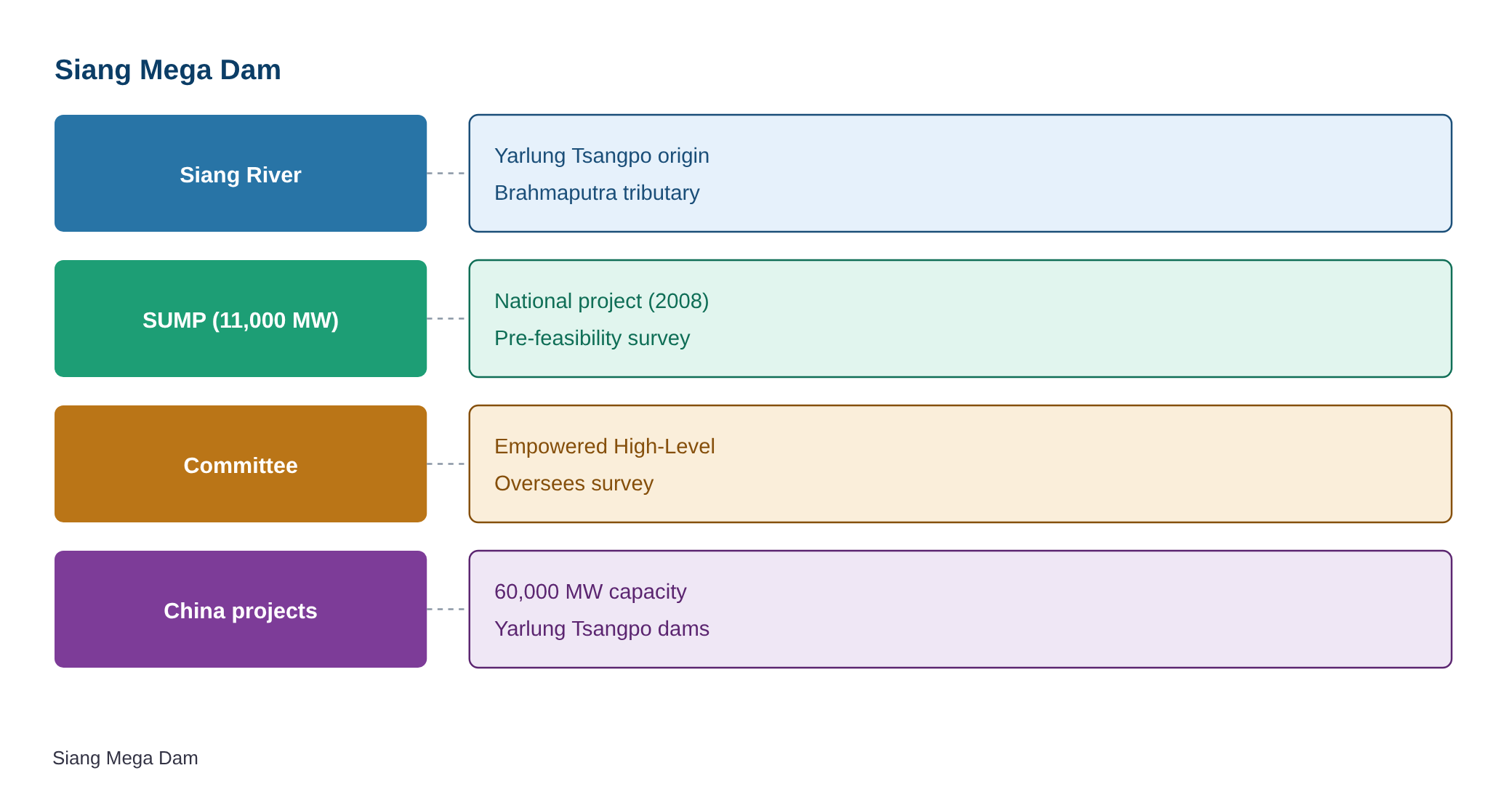
The Arunachal Pradesh State Cabinet has constituted an Empowered High-Level Committee to oversee the pre-feasibility survey for the Siang Upper Multipurpose Project (SUMP), a proposed 11,000 MW hydropower initiative on the Siang River. This development follows local protests against the survey, highlighting tensions between developmental imperatives and community concerns. The project, declared a national project in 2008, is framed as critical for India’s energy and water security amid China’s upstream hydropower expansion on the Yarlung Tsangpo, underscoring broader geopolitical and governance dimensions.
Background
- The Siang River, originating in Tibet as the Yarlung Tsangpo, flows into Arunachal Pradesh and merges with the Dibang and Lohit rivers to form the Brahmaputra, a lifeline for millions in India and Bangladesh.
- China has been constructing multiple hydropower projects on the Yarlung Tsangpo, with a cumulative capacity exceeding 60,000 MW, raising concerns in India about downstream water flow, sedimentation, and ecological impacts.
- The Siang Upper Multipurpose Project (SUMP) was declared a national project by the Government of India in 2008, prioritising its development for strategic, economic, and energy security reasons.
- Arunachal Pradesh, with significant hydropower potential (~50,000 MW), has been a focal point for large-scale hydroelectric projects, though many face opposition due to environmental and social concerns.
- The Brahmaputra River Basin is a shared resource, governed by limited bilateral mechanisms between India and China, necessitating proactive domestic water resource management.
- Local communities in Siang and Upper Siang districts have raised objections to the pre-feasibility survey, citing misinformation, displacement risks, and ecological degradation.
What is the Siang Upper Multipurpose Project (SUMP)?
- The SUMP is a proposed 11,000 MW (or more) multipurpose hydropower project on the Siang River in Arunachal Pradesh, designed for electricity generation, flood mitigation, and water resource management.
- The project is classified as a ‘national project’ under the Government of India’s National Hydroelectric Power Corporation (NHPC) initiative, signifying its strategic importance for energy and water security.
- The project aims to harness the hydropower potential of the Siang River, which is part of the Brahmaputra Basin, a critical transboundary river system.
- Key objectives include generating clean energy, reducing flood risks in the Siang-Brahmaputra basin, creating employment opportunities, and fostering socio-economic development in the region.
- The project involves three proposed dam sites: two in Siang district and one in Upper Siang district, with the potential to significantly alter river flow dynamics and sediment transport.
- Environmental safeguards and social impact assessments are mandated under the Environmental Impact Assessment (EIA) Notification, 2006, and the Forest (Conservation) Act, 1980, to address ecological and community concerns.
- The project is framed as a countermeasure to China’s upstream hydropower development on the Yarlung Tsangpo, which has raised geopolitical and hydrological concerns in India.
- Public consultations and stakeholder engagement are integral to the pre-feasibility and feasibility study phases, as per the EIA Notification, 2006, to ensure transparency and address local grievances.
Key Features
| Feature | Significance |
|---|---|
| Siang Upper Multipurpose Project (SUMP) | A proposed 11,000 MW hydroelectric project on the Siang River, designated as a national project by the Union government in 2008, aimed at enhancing energy and water security for India. |
| Empowered High-Level Committee | A state-level committee constituted to guide and coordinate the pre-feasibility survey for SUMP, ensuring transparency and adherence to regulatory frameworks. |
| National Project Status (2008) | Conferred by the Union government to prioritize SUMP due to its strategic importance in countering China’s Yarlung Tsangpo hydropower projects and ensuring regional energy dominance. |
| Pre-feasibility Survey | The initial phase of assessing technical, environmental, and socio-economic viability of SUMP, critical for subsequent clearances and project implementation. |
| Community Engagement Initiatives | State-led outreach programs, including school exhibitions, to educate local stakeholders on river management, hydropower sustainability, and project benefits. |
UPSC Value Addition
Keywords for Mains Answer-Writing
Siang Upper Multipurpose Project (SUMP) · Arunachal Pradesh State Cabinet · pre-feasibility report survey · National Project status · Siang-Brahmaputra basin · hydroelectric potential · environmental and social impact assessment · water-energy nexus · transboundary river governance · consent of affected communities · strategic infrastructure · environmental governance in India
Prelims Practice Questions
Q1. Consider the following statements regarding the Siang Upper Multipurpose Project (SUMP):
1. The SUMP has been declared a National Project by the Union Government.
2. The project aims to generate an estimated 11,000 MW of hydroelectricity.
3. The project is located entirely within Arunachal Pradesh and does not involve any transboundary considerations.
How many of the above statements are correct?
- Only one
- Only two
- All three
- None
Answer: Only two — Statement 1 is correct: SUMP was declared a National Project in 2008. Statement 2 is correct: The project is estimated to generate 11,000 MW of electricity. Statement 3 is incorrect: The Siang River is a transboundary river, flowing from Tibet (China) into Arunachal Pradesh as the Siang, before joining the Brahmaputra in Assam.
Q2. Assertion (A): The Siang Upper Multipurpose Project (SUMP) is envisaged to strengthen water and energy security in India.
Reason (R): The project is expected to mitigate floods in the Siang-Brahmaputra basin and generate significant hydroelectric power.
- Both A and R are true, and R is the correct explanation of A
- Both A and R are true, but R is not the correct explanation of A
- A is true, but R is false
- A is false, but R is true
Answer: Both A and R are true, and R is the correct explanation of A — Both the Assertion (A) and Reason (R) are true. The SUMP is designed to enhance water and energy security by generating hydroelectric power and mitigating floods in the Siang-Brahmaputra basin. However, R explains A but is not the sole reason for the assertion.
Q3. Match the following pairs related to river governance in India:
Column I (River Projects)
A. Siang Upper Multipurpose Project (SUMP)
B. Sardar Sarovar Project
C. Tehri Hydroelectric Project
D. Nathpa Jhakri Project
Column II (State/Union Territory)
1. Gujarat
2. Arunachal Pradesh
3. Uttarakhand
4. Himachal Pradesh
- A-2, B-1, C-3, D-4; A-1, B-2, C-3, D-4; A-3, B-1, C-2, D-4; A-4, B-3, C-1, D-2
- answer_array_indexes_to_match_pairings_only_for_internal_use
Answer: A-2, B-1, C-3, D-4; A-1, B-2, C-3, D-4; A-3, B-1, C-2, D-4; A-4, B-3, C-1, D-2 — The correct matching is: A-2 (SUMP is in Arunachal Pradesh), B-1 (Sardar Sarovar Project is in Gujarat), C-3 (Tehri Hydroelectric Project is in Uttarakhand), and D-4 (Nathpa Jhakri Project is in Himachal Pradesh).
Mains Practice Question
✍ The Arunachal Pradesh State Cabinet has approved the constitution of an Empowered High-Level Committee to guide and coordinate the pre-feasibility report survey for the Siang Upper Multipurpose Project (SUMP). Critically examine the significance of the SUMP in the context of India’s water-energy nexus, while also addressing the concerns raised by local communities regarding its implementation. (15 Marks)
Approach: MODEL-ANSWER SKELETON:
1. **Introduction (2 Marks)**
– Define the water-energy nexus and its importance for India’s sustainable development.
– Briefly introduce the SUMP: its location (Siang River in Arunachal Pradesh), declared National Project status (2008), and estimated capacity (11,000 MW).
2. **Strategic Significance of SUMP (4 Marks)**
– **Energy Security**: SUMP’s role in augmenting India’s hydroelectric capacity to meet growing energy demands and reduce dependence on fossil fuels.
– **Water Security**: Potential to mitigate floods in the Siang-Brahmaputra basin, addressing recurring flood risks in Assam and downstream states.
– **Transboundary Governance**: Highlight the river’s origin in Tibet (China) as the Yarlung Tsangpo and its flow into India as the Siang, underscoring the need for cooperative river governance.
– **Economic Development**: Employment generation, long-term socio-economic upliftment in the Siang region, and alignment with the ‘Act East Policy’.
3. **Environmental and Social Concerns (4 Marks)**
– **Ecological Impact**: Risks to biodiversity, riverine ecosystems, and sediment flow disruption in the Brahmaputra basin.
– **Displacement and Livelihoods**: Concerns of local communities (Siang and Upper Siang districts) regarding land acquisition, resettlement, and loss of livelihoods.
– **Transparency and Consent**: Emphasise the need for a transparent pre-feasibility survey, addressing misinformation, and ensuring meaningful engagement with project-affected families.
– **Legal Framework**: Reference the Environmental Impact Assessment (EIA) Notification, 2006, and the requirement for public consultations under the Right to Fair Compensation and Transparency in Land Acquisition, Rehabilitation and Resettlement (RFCTLARR) Act, 2013.
4. **Balancing Development and Sustainability (3 Marks)**
– **Sustainable Hydropower**: Highlight the role of modern technologies (e.g., run-of-the-river projects) in minimising ecological disruption.
– **Alternative Energy Sources**: Discuss the complementarity of hydropower with solar, wind, and other renewable energy sources to diversify India’s energy mix.
– **Institutional Mechanisms**: Role of the Empowered High-Level Committee in ensuring compliance with environmental and social safeguards.
5. **Conclusion (2 Marks)**
– Reiterate the need for a balanced approach that leverages SUMP’s strategic benefits while addressing environmental and social concerns through robust governance, transparency, and community participation.
– Conclude with a forward-looking statement on India’s commitment to sustainable infrastructure development in the Himalayan region.
Source: The Hindu
Generated by AanyaAi for educational purpose.
Related guides on our sites
- Current affairs for upsc 2026
- Best PSIR optional coaching for upsc
- Best economics optional coaching for upsc
- Best PSIR optional teacher for upsc

- Arunachal Cabinet Forms Panel for Siang Mega Dam Survey: Key Facts for UPSC - September 24, 2026
- सुप्रीम कोर्ट का ‘अंपायर’ वाला फैसला: चुनाव आयोग मामले में न्यायमूर्ति दत्ता की भूमिका - September 24, 2026
- Supreme Court’s Cricket Analogy in EC Case: What UPSC Aspirants Must Know - September 24, 2026

No Comments