


24 Sep UP’s Groundbreaking Leopard Sterilization Plan to Curb Human-Wildlife Conflict
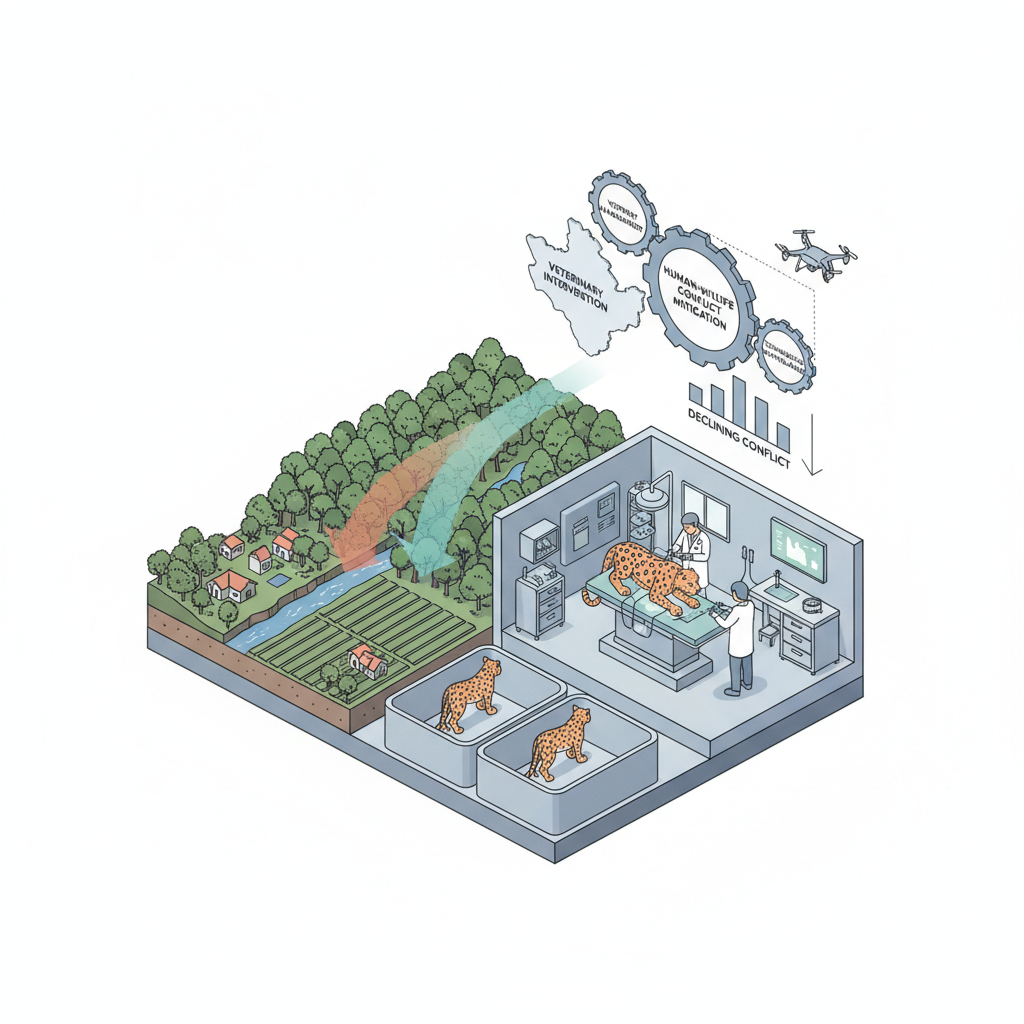
✎ Leopard sterilisation in Uttar Pradesh’s Bijnor district is a pilot project under the state’s ₹601 crore master plan to mitigate human-wildlife conflict, combining veterinary intervention, habitat management, and technological…
Subject Relevance — Where This Topic Fits
- GS Paper III — Environment, Biodiversity and Climate Change | GS Paper III — Animal Husbandry
- Prelims: Human-Wildlife Conflict, Leopard (Panthera pardus), Sterilisation of wild animals, Project Tiger, National Wildlife Action Plan, Wildlife Protection Act, 1972, Forest Rights Act, 2006, Command and Control Centre, Thermal Night Vision Cameras, Chain-link fencing
- Essay: Human-Wildlife Coexistence: Balancing Conservation and Development, Ethical Dimensions of Wildlife Management
Quick Revision: Leopard sterilisation in Uttar Pradesh’s Bijnor district is a pilot project under the state’s ₹601 crore master plan to mitigate human-wildlife conflict, combining veterinary intervention, habitat management, and technological surveillance while adhering to the Wildlife Protection Act, 1972.
Why is this in the news?
The Uttar Pradesh Forest Department has initiated a pilot project for the sterilisation of leopards in Bijnor district to address escalating human-wildlife conflict. This marks the first such initiative in the state and follows a structured master plan costing ₹601 crore, aimed at mitigating conflicts through veterinary intervention, habitat management, and technological surveillance. The project aligns with broader conservation strategies while addressing demographic and land-use pressures in human-dominated landscapes.
Background
- Human-wildlife conflict in Uttar Pradesh has intensified due to expanding agricultural frontiers, shrinking forest habitats, and increasing human settlements, particularly in the Terai and Shivalik regions.
- Leopards (Panthera pardus) are highly adaptable predators, often venturing into human settlements in search of prey, leading to retaliatory killings and ecological disruptions.
- Uttar Pradesh’s Terai landscape, including districts like Bijnor, Pilibhit, and Lakhimpur Kheri, hosts a significant population of leopards, with Bijnor alone reporting an estimated 444 individuals.
- The Wildlife Protection Act, 1972, provides the legal framework for wildlife conservation, including measures for human-wildlife conflict mitigation and habitat management.
- Maharashtra’s Junnar region has previously implemented leopard sterilisation as a pilot project, demonstrating the feasibility of such interventions in reducing conflict.
- The National Wildlife Action Plan (2017–2031) emphasises the need for integrated approaches to mitigate human-wildlife conflicts, including habitat restoration and community-based conservation.
What is Leopard Sterilisation and Its Role in Human-Wildlife Conflict Mitigation?
- Leopard sterilisation involves surgical procedures (ovariohysterectomy in females and castration in males) to render individuals reproductively inactive, thereby controlling population growth in conflict-prone areas.
- The pilot project in Bijnor will target a subset of the leopard population, with an estimated 75% sterilisation coverage over five years (15% annually) to stabilise numbers at 755 individuals, down from the projected 1,336 without intervention.
- Sterilisation is not a standalone solution but part of a broader master plan that includes habitat management, technological surveillance, and community engagement to reduce human-wildlife encounters.
- The project will utilise camera traps, thermal night vision systems, and chain-link fencing to monitor leopard movements and restrict their entry into human settlements.
- A dedicated wildlife veterinary hospital (₹2.73 crore) will be established in Bijnor, equipped with advanced surgical facilities, anaesthesia machines, and post-operative care units to ensure the welfare of captured leopards.
- Post-sterilisation, leopards will be released into designated forest reserves after a mandatory recovery period in isolation wards to monitor their health and behaviour.
- The initiative adheres to ethical wildlife management principles, ensuring minimal stress to animals and compliance with the Wildlife Protection Act, 1972.
- Success metrics will include reduced human-leopard encounters, lower livestock predation, and improved community tolerance towards wildlife, evaluated through periodic audits and data analysis.
Key Features
| Feature | Significance |
|---|---|
| Sterilisation of leopards (bhadhiya karan) | First-of-its-kind initiative in Uttar Pradesh to control leopard population and mitigate human-wildlife conflict through non-lethal means. |
| Pilot project in Bijnor district | Serves as a testbed for the state-wide plan, allowing assessment of feasibility, costs, and outcomes before scaling up. |
| Dedicated wildlife veterinary hospital (₹2.73 crore) | Provides surgical infrastructure, post-operative care, and emergency medical facilities for leopards, addressing existing gaps in veterinary capacity. |
| Chain-link fencing (310 km) with thermal night-vision cameras | Physical and technological barriers to reduce leopard incursions into human settlements while enabling monitoring. |
| Camera-trap identification and capture | Uses modern wildlife monitoring tools to locate and humanely capture problem leopards for sterilisation. |
Why it Matters
Ecological Balance
- Prevents unchecked population growth of leopards in human-dominated landscapes, reducing ecological pressure on prey species and habitat degradation.
- Maintains natural predator-prey dynamics in reserved forest areas by relocating sterilised leopards back to their habitats.
Human-Wildlife Conflict Mitigation
- Reduces livestock predation and human casualties, thereby lowering retaliatory killings of leopards by local communities.
- Promotes coexistence by addressing root causes of conflict through population control rather than lethal measures.
Administrative and Institutional Capacity Building
- Strengthens veterinary and wildlife management infrastructure in Uttar Pradesh, addressing chronic shortages of trained personnel and equipment.
- Demonstrates proactive governance in wildlife conservation, setting a precedent for other states facing similar challenges.
Technological Integration
- Leverages modern tools such as thermal cameras, GPS tracking, and camera traps to enhance monitoring and data-driven decision-making.
- Establishes a command-and-control centre for real-time surveillance and response to human-wildlife interface incidents.
Challenges
1. Human Resource Shortages in Forest Department
- Only 50% of sanctioned posts (163 out of 326) are filled in Bijnor, impairing routine operations, monitoring, and emergency response.
- Chronic understaffing delays implementation of conservation plans and increases operational risks during sterilisation procedures.
UPSC Link: Forest Policy 1988
2. Infrastructure Gaps in Wildlife Healthcare
- Absence of emergency medical equipment in existing veterinary facilities necessitates investment in specialised infrastructure.
- Post-operative care requires sterile environments and advanced monitoring, which are currently unavailable in the region.
UPSC Link: Wildlife Protection Act 1972
3. Public Perception and Community Resistance
- Local communities may oppose sterilisation efforts due to misconceptions about leopard behaviour or perceived ineffectiveness.
- Lack of awareness campaigns risks undermining trust in wildlife management initiatives.
UPSC Link: Environmental Psychology
4. Scalability and Funding Constraints
- Pilot project cost (₹601 crore master plan) requires sustained budgetary support, which may face fiscal constraints.
- Expansion to other districts depends on successful outcomes in Bijnor, creating a dependency on initial results.
UPSC Link: Public Finance
5. Ethical and Animal Welfare Concerns
- Sterilisation procedures must adhere to veterinary ethics, ensuring minimal stress and maximum survival rates for leopards.
- Post-release monitoring is essential to assess long-term impacts on leopard health and behaviour.
UPSC Link: Animal Welfare Board of India
Challenges — UPSC Perspective
| Issue | Concern |
|---|---|
| Staff vacancies (50% posts unfilled) | Impairs operational efficiency and delays project execution. |
| Lack of emergency medical equipment | Risks complications during sterilisation surgeries and post-operative care. |
| Community misconceptions | May lead to resistance or non-cooperation with wildlife management efforts. |
| High initial investment (₹601 crore) | Requires long-term fiscal commitment and risk of budgetary shortfalls. |
| Ethical considerations in animal handling | Demands adherence to veterinary standards and welfare protocols. |
Way Forward
- Conduct baseline surveys to map leopard distribution, habitat use, and conflict hotspots in Bijnor and adjacent districts.
- Strengthen forest department staffing through recruitment drives and capacity-building programmes for veterinary and field operations.
- Implement community awareness campaigns to educate locals on the benefits of sterilisation and coexistence strategies.
- Develop a phased rollout plan for district-wise expansion, contingent on pilot project outcomes and resource availability.
- Establish a dedicated command-and-control centre for real-time monitoring of leopard movements and conflict incidents.
- Integrate the initiative with existing wildlife conservation schemes, such as Project Tiger and Wildlife Habitat Development.
- Publish periodic progress reports to ensure transparency and accountability in fund utilisation and outcomes.
UPSC Value Addition
Keywords for Mains Answer-Writing
Human-Wildlife Conflict Mitigation · Leopard Sterilisation Pilot Project · Uttar Pradesh Forest Department Master Plan · Wildlife Veterinary Infrastructure · Chain-link Fencing and Thermal Cameras for Wildlife Management · Wildlife Conservation (Amendment) Act 2022 · Project Tiger and Wildlife Protection · Human-Wildlife Conflict Resolution Strategies · Forest Rights Act 2006 and Wildlife Habitat · Wildlife Corridors and Habitat Fragmentation · Thermal Night Vision Cameras in Wildlife Monitoring · Wildlife Veterinary Units in India · Ruhilkhhand Region Leopard Population · Wildlife Crime Control Bureau (WCCB) · National Wildlife Action Plan (2017-2031) · Forest Conservation Act 1980 · Wildlife (Protection) Act 1972 · Human-Wildlife Conflict and Livelihoods in Rural India
Constitutional & Policy Linkages
- Article 48A (DPSP) — Protection and improvement of environment and wildlife
Concept Flow
Expanding human settlements into leopard habitats → Increased human-wildlife encounters → Retaliatory killings and ecological imbalance → Need for non-lethal population control → Identification of problem leopards via camera traps → Humane capture and transport to veterinary facility → Sterilisation surgery under anaesthesia → Post-operative care and recovery → Release of sterilised leopards into reserved forests → Monitoring via GPS collars and thermal cameras → Assessment of population stabilisation and conflict reduction → Data-driven policy adjustments → Scaling up to district and state levels → Integration with broader wildlife conservation frameworks
Prelims Practice Questions
Q1. Consider the following statements regarding the Wildlife (Protection) Act, 1972:
1. The Act provides for the establishment of wildlife sanctuaries and national parks.
2. The Act empowers the Central Government to declare any area as a protected area.
3. The Act mandates the sterilisation of wild animals as a method for population control.
4. The Act establishes the Wildlife Crime Control Bureau (WCCB) to combat wildlife crime.
How many of the above statements are correct?
- Only one
- Only two
- Only three
- All four
Answer: Only three — Statements 1, 2, and 4 are correct as per Sections 18, 38, and 38Z of the Wildlife (Protection) Act, 1972. Statement 3 is incorrect as the Act does not mandate sterilisation; it is a management tool decided by state authorities under the Act.
Q2. Assertion (A): The Wildlife (Protection) Act, 1972, empowers state governments to regulate and manage wildlife populations within their jurisdictions.
Reason (R): The Act delegates powers to state governments under Section 62 for framing rules and regulations for wildlife conservation and management.
Options:
A. Both A and R are true, and R is the correct explanation of A.
B. Both A and R are true, but R is not the correct explanation of A.
C. A is true, but R is false.
D. A is false, but R is true.
Answer: ? — Assertion (A) is true as the Wildlife (Protection) Act, 1972, empowers state governments to manage wildlife under their jurisdiction (Section 62). Reason (R) is also true and correctly explains (A) as it details the legal basis for state-level regulation.
Q3. Match the following pairs related to wildlife conservation in India:
Column I (Initiative/Programme) Column II (Year of Launch)
A. Project Tiger 1. 1973
B. Wildlife Crime Control Bureau (WCCB) 2. 2007
C. National Wildlife Action Plan 3. 2017-2031
D. Wildlife (Protection) Act Amendment 4. 2022
Options:
A. A-1, B-2, C-3, D-4
B. A-2, B-1, C-4, D-3
C. A-3, B-2, C-1, D-4
D. A-4, B-3, C-2, D-1
Answer: ? — Project Tiger was launched in 1973 (A-1). WCCB was established in 2007 (B-2). The National Wildlife Action Plan covers 2017-2031 (C-3). The Wildlife (Protection) Act was amended in 2022 (D-4).
Mains Practice Question
✍ Critically examine the efficacy of population control measures such as sterilisation in mitigating human-wildlife conflict, with particular reference to the pilot project on leopard sterilisation in Uttar Pradesh. Also, analyse the legal and institutional framework governing wildlife conservation in India and assess whether the current approach adequately addresses the root causes of human-wildlife conflict. (15 Marks)
Approach: MODEL-ANSWER SKELETON:
1. **Introduction (2 Marks)**
– Define human-wildlife conflict (HWC) and its socio-economic impacts in rural India.
– Contextualise the pilot project in Bijnor, Uttar Pradesh, as a response to rising leopard populations and encroachment into human habitats.
– State the directive: examine efficacy, legal framework, and root causes.
2. **Population Control Measures: Sterilisation as a Tool (4 Marks)**
– **Mechanism**: Explain the biological and ecological rationale behind sterilisation (e.g., reducing reproductive rates, stabilising populations).
– **Efficacy**: Discuss the potential benefits (e.g., gradual population stabilisation, reduced aggression) and limitations (e.g., ethical concerns, temporary solution, ecological imbalances).
– **Comparative Analysis**: Cite global examples (e.g., tiger sterilisation in Maharashtra’s Melghat Tiger Reserve) and their outcomes.
– **Critique**: Highlight that sterilisation alone does not address habitat fragmentation, food scarcity, or human encroachment.
3. **Legal and Institutional Framework (4 Marks)**
– **Wildlife (Protection) Act, 1972**: Key provisions (Sections 2, 38, 62) empowering state governments to manage wildlife and protected areas.
– **Wildlife (Protection) Act Amendment, 2022**: Introduction of community participation, stricter penalties, and habitat conservation measures.
– **National Wildlife Action Plan (2017-2031)**: Emphasis on habitat restoration, corridors, and community-based conservation.
– **Forest Rights Act, 2006**: Balancing tribal rights with wildlife conservation (e.g., Scheduled Tribes and Other Traditional Forest Dwellers (Recognition of Forest Rights) Act).
4. **Root Causes of Human-Wildlife Conflict (3 Marks)**
– **Habitat Fragmentation**: Urbanisation, agricultural expansion, and infrastructure projects (e.g., highways, dams) encroaching into wildlife habitats.
– **Food Scarcity**: Depletion of prey base due to overhunting or habitat degradation.
– **Human Encroachment**: Expansion of human settlements into forest fringes (e.g., Bijnor’s growing population and shrinking forest cover).
– **Climate Change**: Altering ecosystems and forcing wildlife into human-dominated areas.
5. **Holistic Approach: Beyond Sterilisation (2 Marks)**
– **Habitat Management**: Restoring corridors, afforestation, and creating buffer zones.
– **Community Engagement**: Involving local communities in conservation (e.g., eco-development committees, compensation schemes for livestock loss).
– **Technology**: Use of thermal cameras, chain-link fencing, and early warning systems (as proposed in Uttar Pradesh’s master plan).
– **Policy Integration**: Linking wildlife conservation with rural livelihoods (e.g., eco-tourism, alternative livelihoods).
6. **Conclusion (1 Mark)**
– Summarise that sterilisation is a short-term measure and must be complemented by long-term habitat restoration and community-based solutions.
– Emphasise the need for a multi-stakeholder approach involving forest departments, local communities, and policymakers.
Source: amarujala.com
Generated by AanyaAi for educational purpose.
Related guides on our sites
- Current affairs for upsc 2026
- How to prepare for GS paper 1 for UPSC CSE mains exam
- Best UPSC coaching for IFOS exam
- Best geography optional coaching

- UP’s Groundbreaking Leopard Sterilization Plan to Curb Human-Wildlife Conflict - September 24, 2026
- महाराष्ट्र में त्योहार जुलूसों पर बॉम्बे हाईकोर्ट का बड़ा फैसला: पटाखे, लेजर और संगीत पर रोक - September 24, 2026
- Bombay HC Bans Firecrackers, Music in Maharashtra Processions: Key UPSC Analysis - September 24, 2026

No Comments