


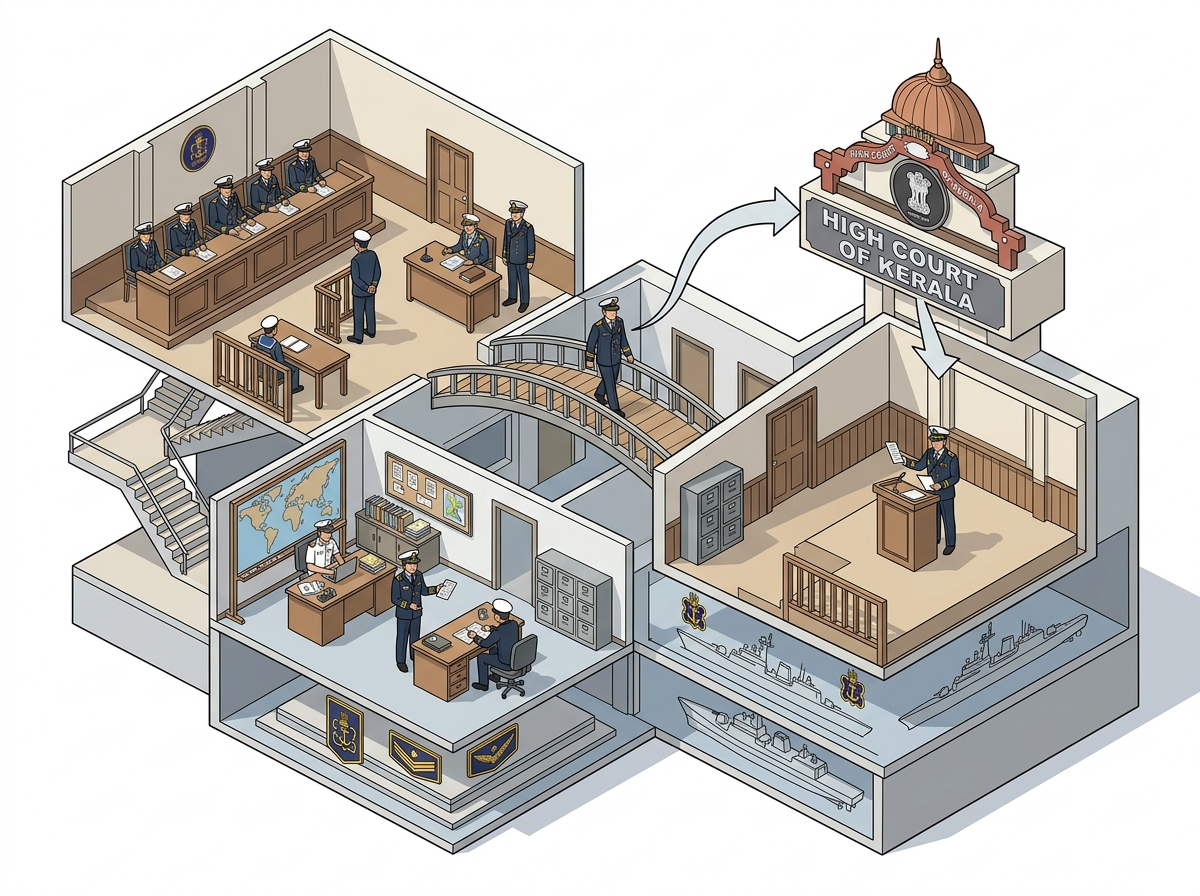
24 Sep Kerala HC upholds Navy rule: IO can be prosecutor in court-martial cases
✎ In court-martial proceedings under naval regulations, the appointment of an investigating officer as prosecutor is constitutionally valid and does not inherently violate the accused’s right to a fair trial, as military law…
Subject Relevance — Where This Topic Fits
- GS Paper II — Polity and Governance (Constitutional Provisions, Fundamental Rights, Judicial Review) | GS Paper III — Security (Armed Forces, Court-Martial, Disciplinary Proceedings)
- Prelims: Court-martial, Navy Act 1957, Navy (Discipline and Miscellaneous Provisions) Regulations 1965, Fundamental Right to Fair Trial (Article 21), Armed Forces Tribunal, Judicial Review of Military Laws
- Essay: Judicial Review and Military Justice: Balancing Discipline and Fundamental Rights, The Role of Courts in Safeguarding Constitutional Rights in Specialized Legal Regimes
Quick Revision: In court-martial proceedings under naval regulations, the appointment of an investigating officer as prosecutor is constitutionally valid and does not inherently violate the accused’s right to a fair trial, as military law permits such flexibility under Article 33 of the Constitution.
Why is this in the news?
The Kerala High Court, in a Division Bench judgment delivered on 24 September 2026, upheld the constitutional validity of appointing an investigating officer as a prosecutor in court-martial proceedings under the Navy (Discipline and Miscellaneous Provisions) Regulations, 1965, affirming that such an arrangement does not inherently violate the accused’s fundamental right to a fair trial. The judgment clarifies the interplay between military discipline and constitutional safeguards, particularly in the context of court-martial trials governed by the Navy Act, 1957, and the Code of Criminal Procedure, 1973.
Background
- The Navy Act, 1957, and the Navy (Discipline and Miscellaneous Provisions) Regulations, 1965, govern disciplinary proceedings in the Indian Navy, including court-martial trials.
- Court-martial proceedings are summary trials conducted under military law, distinct from civilian criminal trials, and are governed by special provisions that may restrict certain fundamental rights of military personnel.
- The Constitution of India, under Article 33, empowers Parliament to restrict or modify the application of fundamental rights to persons subject to military law, including naval personnel.
- The Code of Criminal Procedure, 1973, applies to court-martial proceedings only to the extent permitted by military regulations, creating a dual legal framework for such trials.
- The Armed Forces Tribunal, established under the Armed Forces Tribunal Act, 2007, has jurisdiction over disputes and complaints related to service matters, including court-martial trials.
- The petitioner, a naval personnel with 31 years of service, challenged the appointment of the investigating officer as prosecutor, alleging denial of a fair trial and restricted access to documents.
What are court-martial proceedings and the role of prosecutors under naval regulations?
- Court-martial is a military judicial proceeding conducted to try members of the armed forces for offences under military law, distinct from civilian criminal courts.
- The Navy Act, 1957, and the Navy (Discipline and Miscellaneous Provisions) Regulations, 1965, provide the legal framework for court-martial trials, including the appointment of prosecutors and investigating officers.
- Under naval regulations, the investigating officer is responsible for gathering evidence, filing the chargesheet, and submitting the case for trial, while the prosecutor presents the case before the court-martial.
- The Kerala High Court held that the investigating officer’s appointment as prosecutor does not violate the accused’s fundamental right to a fair trial, as military law permits such flexibility in prosecutorial roles.
- The court observed that the investigating officer’s familiarity with the facts of the case may enhance the efficiency of prosecution, provided that the accused is not prejudiced in their defence.
- The judgment underscored that the restrictions on fundamental rights under Article 33 of the Constitution are permissible in the interest of discipline and efficiency in the armed forces.
- The court-martial process is governed by principles of natural justice, including the right to be heard, access to documents, and the opportunity to cross-examine witnesses.
- The Armed Forces Tribunal serves as an appellate authority for court-martial convictions, ensuring that military justice remains subject to judicial oversight.
Key Features
| Feature | Significance |
|---|---|
| Appointment of investigating officer as prosecutor in court-martial proceedings | Ensures procedural efficiency by leveraging the investigating officer’s familiarity with case facts, thereby streamlining the trial process in military justice systems. |
| Constitutional validity of Navy regulations under Article 33 | Affirms the principle that fundamental rights of armed forces personnel may be restricted under specific statutory frameworks to maintain discipline and operational integrity. |
| Role of Armed Forces Tribunal (AFT) | Highlights the AFT’s jurisdiction to assess procedural fairness in military trials, ensuring checks and balances within the armed forces’ judicial system. |
| Right to fair trial under Article 21 | Reinforces that despite restrictions, the accused retains safeguards to ensure a fair trial, including the ability to examine witnesses and access documents. |
| Judicial review of military regulations | Demonstrates the judiciary’s role in interpreting military laws while balancing constitutional protections and institutional autonomy. |
Why it Matters
Judicial and Constitutional Significance
- The judgment reaffirms the constitutional framework under Article 33, which permits the Parliament to restrict fundamental rights of armed forces personnel in the interest of discipline and efficiency.
- It clarifies the interplay between military justice and constitutional rights, ensuring that restrictions do not undermine the core principles of fairness and due process.
- The ruling underscores the judiciary’s role in interpreting military regulations without encroaching upon the executive’s domain in matters of discipline and internal governance.
Institutional Significance
- The Armed Forces Tribunal (AFT) is positioned as a critical institution for addressing grievances within the military justice system, ensuring accountability and procedural fairness.
- The judgment highlights the need for specialized tribunals to handle military cases, given the unique nature of military law and discipline.
- It reinforces the autonomy of the armed forces in managing internal disciplinary matters while maintaining judicial oversight.
Procedural and Operational Significance
- The appointment of an investigating officer as prosecutor in court-martial cases is justified on grounds of efficiency, as the officer possesses firsthand knowledge of the case.
- The ruling ensures that such appointments do not inherently violate the accused’s right to a fair trial, provided adequate safeguards are in place.
- It sets a precedent for balancing operational exigencies with legal protections in military justice systems.
Challenges
1. Potential Conflict of Interest
- The primary concern is whether the dual role of an investigating officer as prosecutor could compromise impartiality, despite the officer’s familiarity with the case.
- The accused may face challenges in ensuring a fair trial if the prosecutor is also a key witness, potentially influencing the proceedings.
- The judgment does not fully address the psychological impact on the accused, who may perceive the process as biased.
UPSC Link: GS-II: Judiciary and Tribunals
2. Access to Justice and Procedural Fairness
- The accused’s ability to access material documents and effectively present their defense may be compromised if the prosecutor is also the investigating officer.
- The ruling places a greater burden on the Armed Forces Tribunal to scrutinize such cases to ensure procedural fairness.
- There is a risk that the accused may not receive the same level of legal representation as in civilian courts.
UPSC Link: GS-II: Fundamental Rights
3. Judicial Review vs. Military Autonomy
- The judgment raises questions about the extent of judicial review over military regulations, balancing constitutional rights with institutional autonomy.
- There is a need to ensure that judicial interventions do not undermine the operational efficiency of the armed forces.
- The Armed Forces Tribunal must strike a delicate balance between upholding fairness and respecting military discipline.
UPSC Link: GS-II: Separation of Powers
Challenges — UPSC Perspective
| Issue | Concern |
|---|---|
| Conflict of Interest | Risk of bias in proceedings due to the prosecutor’s dual role as investigating officer. |
| Procedural Fairness | Ensuring the accused has adequate access to documents and opportunities to defend their case. |
| Judicial Review vs. Military Autonomy | Balancing constitutional rights with the need for military discipline and efficiency. |
| Role of Armed Forces Tribunal | Effectiveness of the tribunal in ensuring fairness in military justice cases. |
| Perception of Bias | Potential psychological impact on the accused, who may view the process as inherently unfair. |
Way Forward
- The Armed Forces Tribunal should issue detailed guidelines to ensure procedural fairness in cases where the investigating officer is appointed as prosecutor.
- The Navy should consider implementing additional safeguards, such as independent review mechanisms, to mitigate conflicts of interest.
- Judicial training programs should include modules on military justice systems to enhance understanding of the unique challenges faced by armed forces personnel.
- The government should explore the possibility of amending the Navy (Discipline and Miscellaneous Provisions) Regulations, 1965, to explicitly address the concerns raised by the judgment.
- Civil society organizations and legal aid bodies should be encouraged to provide support to military personnel undergoing court-martial proceedings.
- Research institutions should conduct studies on the effectiveness of military justice systems in balancing discipline and fundamental rights.
- The judiciary should continue to monitor the implementation of this judgment to ensure that it does not lead to unintended consequences.
UPSC Value Addition
Keywords for Mains Answer-Writing
Court-martial · Fundamental Rights of Armed Forces Personnel · Navy Act, 1957 · Navy (Discipline and Miscellaneous Provisions) Regulations, 1965 · Right to Fair Trial (Article 21) · Armed Forces Tribunal · Judicial Review of Military Justice · Constitutional Validity of Military Regulations · Prosecutorial and Investigative Roles in Court-Martial · Judicial Interpretation of Fundamental Rights in Armed Forces
Constitutional & Policy Linkages
- Article 33: Restriction of Fundamental Rights in Armed Forces
- Article 21: Right to Fair Trial
- Article 14: Equality Before Law
Concept Flow
Court-martial proceedings under the Navy Act, 1957 → Appointment of investigating officer as prosecutor under Navy Regulations, 1965 → Challenge to the appointment on grounds of violation of Article 21 → Judicial review of the regulation under Article 33 → Judgment upholding the regulation while emphasizing safeguards for fair trial → Role of Armed Forces Tribunal in assessing procedural fairness → Implementation of the judgment and potential reforms in military justice
Prelims Practice Questions
Q1. Consider the following statements regarding the right to a fair trial in the context of court-martial proceedings:
1. The Kerala High Court has held that an investigating officer can also be appointed as a prosecutor in a court-martial case without violating the accused’s fundamental right to a fair trial.
2. The Navy (Discipline and Miscellaneous Provisions) Regulations, 1965, explicitly prohibit the appointment of an investigating officer as a prosecutor in court-martial cases.
3. The Armed Forces Tribunal is empowered to adjudicate on the fairness of court-martial proceedings.
How many of the above statements are correct?
- Only one
- Only two
- All three
- None
Answer: Only two — Statement 1 is correct as per the Kerala High Court’s ruling. Statement 2 is incorrect as the regulations do not prohibit such an appointment. Statement 3 is correct as the Armed Forces Tribunal is tasked with reviewing court-martial proceedings.
Q2. Assertion (A): The Navy Act, 1957, empowers the Central Government to modify the fundamental rights of naval personnel.
Reason (R): The Kerala High Court has held that the appointment of an investigating officer as a prosecutor in a court-martial does not violate the accused’s right to a fair trial.
Options:
A. Both A and R are true, and R is the correct explanation of A.
B. Both A and R are true, but R is not the correct explanation of A.
C. A is true, but R is false.
D. A is false, but R is true.
Answer: ? — Assertion (A) is true as the Navy Act, 1957, allows for modifications to fundamental rights for naval personnel. Reason (R) is also true, but it does not explain the assertion, as the ruling pertains to procedural fairness rather than the modification of rights.
Q3. Match the following provisions/regulations with their respective contexts:
Column I
1. Navy Act, 1957
2. Navy (Discipline and Miscellaneous Provisions) Regulations, 1965
3. Article 21 of the Constitution of India
4. Armed Forces Tribunal Act, 2007
Column II
A. Governs the appointment of prosecutors in court-martial cases
B. Provides for the modification of fundamental rights for naval personnel
C. Ensures the right to a fair trial
D. Adjudicates disputes arising from court-martial proceedings
- 1-B, 2-A, 3-C, 4-D; 1-A, 2-B, 3-C, 4-D; 1-D, 2-C, 3-B, 4-A; 1-B, 2-D, 3-A, 4-C
- answer_expected_pairing_index_for_correct_match_1_B_2_A_3_C_4_D
Answer: 1-B, 2-A, 3-C, 4-D; 1-A, 2-B, 3-C, 4-D; 1-D, 2-C, 3-B, 4-A; 1-B, 2-D, 3-A, 4-C — The correct match is: 1-B (Navy Act, 1957 governs modifications to fundamental rights), 2-A (Navy Regulations govern prosecutor appointments), 3-C (Article 21 ensures right to fair trial), 4-D (Armed Forces Tribunal adjudicates disputes).
Mains Practice Question
✍ Examine the constitutional and statutory framework governing the right to a fair trial for armed forces personnel in India. In this context, critically analyse the Kerala High Court’s recent judgment on the appointment of an investigating officer as a prosecutor in a court-martial case. Also, discuss the implications of such judicial interpretations on the balance between military discipline and fundamental rights. (15 Marks)
Approach: MODEL-ANSWER SKELETON:
1. Constitutional Framework:
– Article 21 (Right to Life and Personal Liberty) and its judicial interpretation (Maneka Gandhi v. Union of India, 1978; Selvi v. State of Karnataka, 2010).
– Fundamental Rights of Armed Forces Personnel: Article 33 (Parliament’s power to restrict fundamental rights of armed forces personnel).
– Doctrine of ‘Restricted Fundamental Rights’ (Kesavananda Bharati v. State of Kerala, 1973; Explanation to Article 33).
2. Statutory Framework:
– Navy Act, 1957: Sections 129-136 (Court-martial procedure).
– Navy (Discipline and Miscellaneous Provisions) Regulations, 1965: Regulation governing prosecutor appointments.
– Armed Forces Tribunal Act, 2007: Role in adjudicating disputes arising from court-martial proceedings.
3. Kerala High Court’s Judgment (Kerala HC, 2026):
– Key observations: Combined analysis of Constitution, CrPC, Navy Act, and Regulations.
– Rationale: Investigating officer’s familiarity with facts; no violation of Article 21.
– Distinction from civilian trials: Military exigencies and discipline.
4. Critical Analysis:
– Arguments for the Judgment:
* Military discipline necessitates flexibility in prosecutorial roles.
* Investigating officer’s dual role ensures efficiency and coherence in prosecution.
– Arguments against the Judgment:
* Potential conflict of interest: Investigating officer as prosecutor may compromise impartiality.
* Risk of procedural unfairness: Accused’s right to a free and fair trial may be compromised.
– Judicial Precedents: Compare with Supreme Court rulings on military justice (e.g., Union of India v. Major General Shri Kant Sharma, 2012).
5. Implications:
– Balance between military discipline and fundamental rights.
– Need for safeguards: Transparency, independent review, and appellate mechanisms.
– Role of Armed Forces Tribunal in ensuring procedural fairness.
6. Conclusion:
– The judgment reinforces the principle of restricted fundamental rights for armed forces personnel while underscoring the need for procedural safeguards. The balance must be struck between military exigencies and the accused’s right to a fair trial.
Source: The Hindu
Kerala PCS (Kerala PSC (KAS)) — State PCS Practice
Prelims: According to a recent judgment by the Kerala High Court, which of the following is permissible under Navy regulations in court-martial cases?
- The investigating officer can also be appointed as the prosecutor
- The prosecutor must be a separate individual from the investigating officer
- Court-martial proceedings require mandatory judicial review
- The investigating officer cannot be involved in any stage of court-martial
Answer: The investigating officer can also be appointed as the prosecutor — The Kerala High Court ruled that the investigating officer can also be appointed as the prosecutor in court-martial cases as per Navy regulations.
Mains: Discuss the significance of the Kerala High Court’s judgment on the appointment of the investigating officer as the prosecutor in court-martial cases under Navy regulations. Examine the implications for judicial independence and the efficiency of military justice delivery in Kerala.
Generated by AanyaAi for educational purpose.

- दिव्यांगजन विभाग का विशेष अभियान 6.0 : लंबित मामलों से मुक्ति और स्वच्छ कार्यालयों की ओर - September 24, 2026
- DEPwD Launches Special Campaign 6.0 for Swachh Governance & Pending Cases - September 24, 2026
- यूएनजीए81 में भारत: यूनिवर्सल हेल्थ कवरेज और हेपेटाइटिस उन्मूलन की उपलब्धियां - September 24, 2026

No Comments