


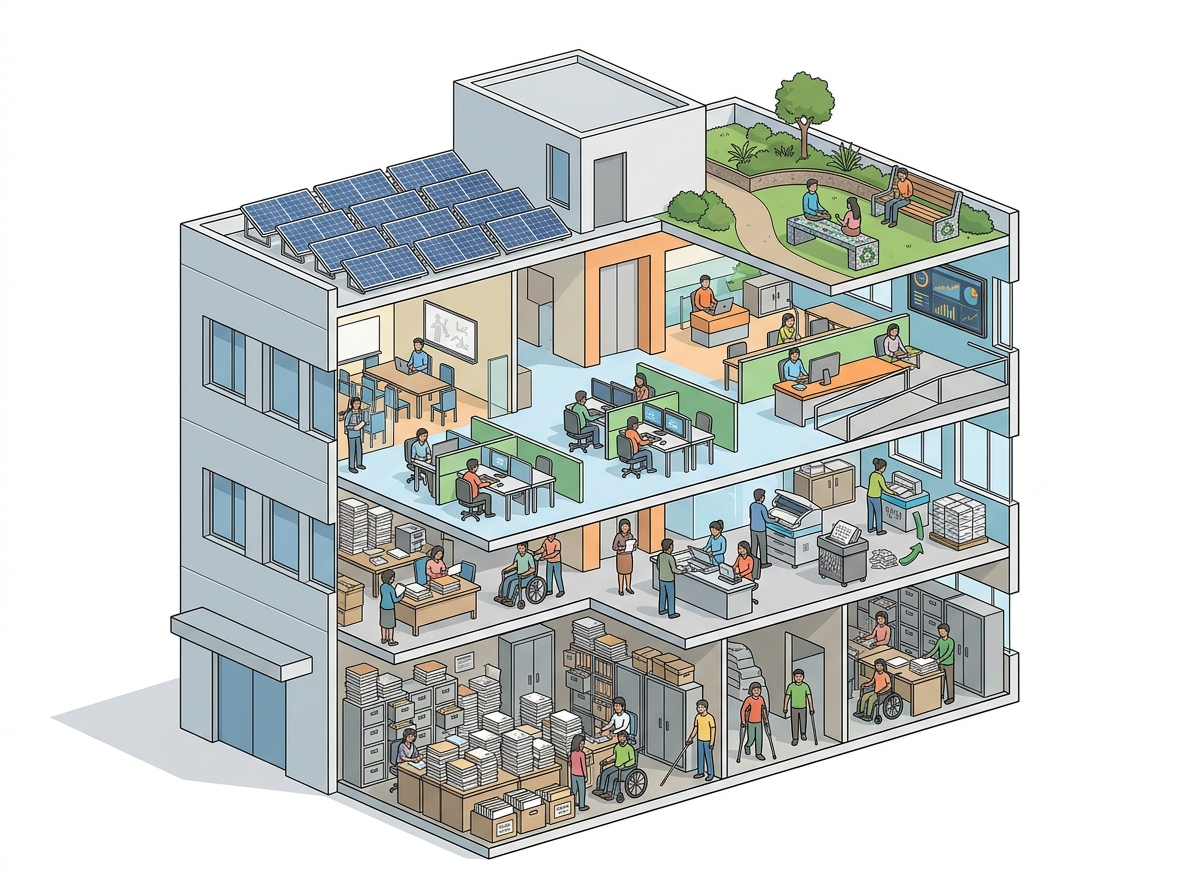
24 Sep DEPwD Launches Special Campaign 6.0 for Swachh Governance & Pending Cases
✎ Special Campaign 6.0 (October 2026) aims to institutionalise cleanliness, reduce pendency, and convert waste into resources in government offices, building on the success of Special Campaign 5.0.
Subject Relevance — Where This Topic Fits
- GS Paper II — Governance, Transparency and Accountability | GS Paper III — Administrative Reforms and E-Governance
- Prelims: Special Campaign 6.0, DARPG, DEPwD, E-waste management, Digitisation of records, Swachhata Abhiyan, Government e-marketplace (GeM), Sustainable Development Goal 12
- Essay: Governance reforms and their impact on public service delivery, Sustainable resource utilisation in administrative systems
Quick Revision: Special Campaign 6.0 (October 2026) aims to institutionalise cleanliness, reduce pendency, and convert waste into resources in government offices, building on the success of Special Campaign 5.0.
Why is this in the news?
The Department of Empowerment of Persons with Disabilities (DEPwD) has initiated Special Campaign 6.0 (2–31 October 2026) under the aegis of the Department of Administrative Reforms and Public Grievances (DARPG) to institutionalise cleanliness, expedite pendency clearance, and convert waste into productive resources. This follows the successful implementation of Special Campaign 5.0 in October 2025, which yielded measurable outcomes in digitisation, space optimisation, and revenue generation.
Background
- The Department of Administrative Reforms and Public Grievances (DARPG) launched Special Campaigns as a time-bound, mission-mode initiative to reduce pendency, improve record management, and enhance efficiency in government offices.
- Special Campaign 5.0 (2–31 October 2025) was implemented across all central ministries/departments, including DEPwD, with a focus on digitisation, space reutilisation, and sustainable waste management.
- DEPwD, under the Ministry of Social Justice and Empowerment, is mandated to implement policies for the empowerment of persons with disabilities, including accessibility, skill development, and inclusive governance.
- Government records, including physical files and digital documents, constitute a significant administrative resource that requires systematic management to prevent duplication, loss, and inefficiency.
- E-waste, generated from obsolete electronic devices in government offices, poses environmental and health risks, necessitating responsible disposal and recycling mechanisms.
- The Right to Information Act, 2005, and the National e-Governance Plan (NeGP) underscore the importance of transparency, digitisation, and efficient record-keeping in public administration.
What is Special Campaign 6.0?
- Special Campaign 6.0 is a two-phase initiative (16–30 September 2026: preparation; 2–31 October 2026: implementation) launched by DARPG to institutionalise cleanliness, reduce pendency, and optimise resource utilisation in government offices.
- The campaign targets three core objectives: expediting the disposal of pending matters, digitising records, and ensuring sustainable waste management, including e-waste.
- DEPwD has designated nodal officers at the headquarters and subordinate offices to coordinate the campaign, aligning with DARPG’s prescribed benchmarks for pendency clearance and cleanliness.
- Key focus areas include the digitisation of physical files, removal of redundant records, reutilisation of freed office space, and the establishment of systematic e-waste collection and disposal mechanisms.
- The campaign builds on the outcomes of Special Campaign 5.0, where DEPwD digitised 11,972 files, freed 15,588 sq. ft. of office space, and conducted 64 cleanliness drives across offices.
- Post-campaign, DEPwD continues monthly activities to sustain cleanliness and pendency reduction, as mandated by DARPG’s guidelines, reflecting a shift from episodic to continuous governance improvement.
- The campaign aligns with the broader national agenda of ‘Minimum Government, Maximum Governance’ and supports Sustainable Development Goal 12 (Responsible Consumption and Production).
- Institutional mechanisms such as the Special Campaign Dashboard (SCDPM) are used to track progress, ensuring transparency and accountability in implementation.
Key Features
| Feature | Significance |
|---|---|
| Special Campaign 6.0 (2–31 Oct 2026) | A focused governance initiative by DEPwD under DARPG’s framework to institutionalise cleanliness and reduce pendency in government offices. |
| Digitalisation of Records | Converts physical files into searchable electronic formats, reducing storage costs and improving retrieval efficiency. |
| E-waste Management | Ensures responsible disposal of electronic waste through segregation, collection, and recycling protocols. |
| Space Reclamation | Liberates office space by removing redundant files and obsolete materials, enabling productive reallocation. |
| Revenue Generation | Monetises redundant assets (e.g., sale of scrap) to augment departmental resources. |
Why it Matters
Governance Efficiency
- Demonstrates the Union Government’s commitment to reducing bureaucratic inertia by converting pendency into productivity.
- Institutionalises cleanliness and record management as continuous processes, not one-off drives.
- Enhances transparency and accountability through real-time tracking on the Special Campaign 6.0 Portal (SCDPM).
Resource Optimisation
- Maximises utilisation of physical and financial resources by reallocating freed office space and generating revenue from scrap.
- Promotes circular economy principles through systematic e-waste recycling and material recovery.
- Reduces long-term storage costs by digitising archival records.
Digital Public Infrastructure
- Accelerates the transition to e-governance by prioritising digital record-keeping and workflow automation.
- Supports the Digital India initiative by reducing reliance on paper-based processes.
Inclusivity & Accessibility
- Aligns with the Rights of Persons with Disabilities Act, 2016, by creating barrier-free and efficient work environments.
- Ensures compliance with accessibility standards in digitised records and office layouts.
Challenges
1. Resistance to Cultural Change
- Bureaucratic inertia may impede adoption of digital workflows and new cleanliness protocols.
- Training gaps in staff for handling e-waste and digital tools could slow implementation.
UPSC Link: GS2: Governance
2. Technical Infrastructure Gaps
- Inadequate IT infrastructure in sub-ordinate offices may hinder seamless digitisation.
- Cybersecurity risks associated with storing sensitive records digitally.
UPSC Link: GS3: Science & Tech
3. Logistical Constraints in E-waste Management
- Limited certified e-waste recycling facilities in remote areas may delay disposal.
- High costs of compliant e-waste collection and transportation.
UPSC Link: GS3: Environment
4. Monitoring & Sustainability
- Ensuring post-campaign adherence to cleanliness and pendency norms without external oversight.
- Risk of relapse into pre-campaign practices due to lack of institutionalised incentives.
UPSC Link: GS4: Ethics
Challenges — UPSC Perspective
| Issue | Concern |
|---|---|
| Digital Divide | Uneven access to IT tools across DEPwD’s sub-ordinate offices may create implementation disparities. |
| Data Privacy | Risk of unauthorised access or leakage of sensitive disability-related records in digital repositories. |
| Cost of Compliance | Financial burden of procuring certified e-waste recycling partners and digitisation software. |
| Inter-departmental Coordination | Need for seamless collaboration between DEPwD, DARPG, and state agencies for e-waste logistics. |
| Public Perception | Citizens may perceive digitisation as a reduction in physical record accessibility, affecting trust. |
Way Forward
- Establish a dedicated Digital Records Cell within DEPwD to oversee ongoing digitisation and maintenance.
- Conduct quarterly audits of office spaces to identify and remove redundant physical files proactively.
- Partner with certified e-waste recyclers under the E-Waste (Management) Rules, 2022, for compliant disposal.
- Integrate AI-driven workflow automation tools to reduce pendency in routine administrative tasks.
- Launch capacity-building programmes for staff on digital record-keeping, e-waste handling, and cleanliness protocols.
- Develop a public dashboard on the SCDPM portal to display real-time progress and citizen feedback.
- Institutionalise incentives (e.g., performance-linked bonuses) for offices achieving cleanliness and pendency reduction targets.
- Collaborate with the Department of Administrative Reforms to replicate successful models across other ministries.
UPSC Value Addition
Keywords for Mains Answer-Writing
Special Campaign 6.0 · Department of Empowerment of Persons with Disabilities (DEPwD) · Administrative Reforms and Public Grievances (DARPG) · Digitalisation of records · E-waste management · Institutionalising cleanliness · Pending cases disposal · Sustainable governance · Swachhata Abhiyan · Government efficiency · Resource optimisation · Sustainable Development Goals (SDGs) · Good Governance Index · Digital India Mission · Waste-to-wealth conversion
Constitutional & Policy Linkages
- [‘Article 38’, ‘Directive Principles of State Policy on welfare’]
- [‘Article 41’, ‘Right to work and public assistance’]
- [‘Article 46’, ‘Promotion of educational and economic interests of weaker sections’]
Concept Flow
Pendency in government offices → Inefficient resource utilisation and delayed service delivery → Special Campaign 6.0 initiative → Focused drive to digitise records and manage e-waste → Digitalisation and space reclamation → Conversion of redundant assets into productive resources → Institutionalisation of cleanliness protocols → Embedding sustainability in daily governance → Revenue generation from scrap and freed space → Augmenting departmental resources → Continuous monitoring via SCDPM portal → Ensuring accountability and transparency
Prelims Practice Questions
Q1. Consider the following statements regarding Special Campaign 6.0 launched by the Department of Empowerment of Persons with Disabilities (DEPwD):
1. The campaign is being conducted under the aegis of the Administrative Reforms and Public Grievances (DARPG).
2. The campaign includes the digitisation of records and responsible disposal of e-waste.
3. The campaign is limited to the DEPwD headquarters and does not extend to subordinate offices.
4. The campaign aims to convert pending files into productive assets and waste into resources.
How many of the above statements are correct?
- Only one
- Only two
- Only three
- All four
Answer: Only three — Statements 1, 2, and 4 are correct as per the PIB release. Statement 3 is incorrect because the campaign extends to all subordinate and affiliated offices, PSUs, and autonomous bodies under DEPwD.
Q2. Assertion (A): The Department of Empowerment of Persons with Disabilities (DEPwD) is mandated to institutionalise cleanliness and reduce pending cases under Special Campaign 6.0.
Reason (R): The campaign is part of a broader initiative by the DARPG to promote sustainable governance and resource optimisation across government offices.
In the context of the above two statements, which of the following is correct?
- Both A and R are true, and R is the correct explanation of A.
- Both A and R are true, but R is NOT the correct explanation of A.
- A is true, but R is false.
- A is false, but R is true.
Answer: Both A and R are true, but R is NOT the correct explanation of A. — Both the assertion and reason are true, and the reason correctly explains the assertion. DEPwD’s campaign is indeed part of DARPG’s broader initiative for sustainable governance and resource optimisation.
Q3. Match the following initiatives under Special Campaign 6.0 with their respective objectives:
Column I (Initiative)
A. Digitisation of records
B. Disposal of e-waste
C. Reduction of pending cases
D. Institutionalising cleanliness
Column II (Objective)
1. To free up physical space and improve record retrieval
2. To ensure environmentally responsible handling of electronic waste
3. To enhance administrative efficiency and accountability
4. To create a culture of cleanliness and hygiene in government offices
Select the correct match:
- A-1, B-2, C-3, D-4
- A-2, B-1, C-3, D-4
- A-1, B-3, C-2, D-4
- A-4, B-2, C-3, D-1
Answer: A-1, B-2, C-3, D-4 — The correct matches are: A (Digitisation of records) with 1 (free up physical space and improve record retrieval), B (Disposal of e-waste) with 2 (environmentally responsible handling), C (Reduction of pending cases) with 3 (enhance administrative efficiency), and D (Institutionalising cleanliness) with 4 (create a culture of cleanliness and hygiene).
Mains Practice Question
✍ The Department of Empowerment of Persons with Disabilities (DEPwD) has initiated Special Campaign 6.0 to institutionalise cleanliness, dispose of pending cases, and optimise resources in government offices. In this context, critically examine the significance of such campaigns for promoting sustainable governance and resource efficiency in public administration. Also, analyse the challenges in sustaining the momentum post-campaign and suggest measures to ensure long-term institutionalisation of these practices. (15 Marks)
Approach: MODEL-ANSWER SKELETON:
1. **Introduction (2 Marks)**
– Define Special Campaign 6.0 and its objectives as outlined by DEPwD and DARPG.
– Contextualise within the broader framework of Good Governance Index (GGI) and Sustainable Development Goals (SDGs), particularly SDG 12 (Responsible Consumption and Production) and SDG 16 (Peace, Justice, and Strong Institutions).
2. **Significance of Campaigns like Special Campaign 6.0 (5 Marks)**
– **Administrative Efficiency**: Reduction of pending cases and digitisation of records to enhance transparency and accountability (cite Article 41 of the Constitution on duty of the State to ensure efficiency in administration).
– **Resource Optimisation**: Conversion of waste (e.g., e-waste) into resources, aligning with the principles of circular economy and waste-to-wealth conversion (reference to Swachh Bharat Mission 2.0 and Digital India Mission).
– **Institutionalising Cleanliness**: Creation of a culture of hygiene and cleanliness in government offices, reducing operational costs and improving employee morale.
– **Environmental Sustainability**: Responsible disposal of e-waste to mitigate environmental degradation (reference to E-Waste (Management) Rules, 2022).
– **Public Trust**: Enhancing citizen trust in government institutions through visible improvements in governance.
3. **Challenges in Sustaining Momentum (4 Marks)**
– **Bureaucratic Inertia**: Resistance to change within government departments due to entrenched practices and lack of incentives for innovation.
– **Resource Constraints**: Limited financial and human resources for continuous monitoring and implementation post-campaign.
– **Lack of Accountability Mechanisms**: Absence of robust frameworks to track progress and enforce compliance after the campaign period.
– **Digital Divide**: Uneven adoption of digital tools across regions and departments, particularly in rural or remote offices.
– **Short-term Focus**: Tendency to treat such campaigns as one-off events rather than continuous improvement processes.
4. **Measures for Long-term Institutionalisation (4 Marks)**
– **Institutional Reforms**: Strengthening the role of DARPG in monitoring and evaluating progress through dedicated portals (e.g., Special Campaign Dashboard for Progress Monitoring – SCDPM).
– **Capacity Building**: Training and capacity-building programs for officials to adopt digital tools and sustainable practices.
– **Incentivisation**: Linking performance appraisals and promotions to adherence to cleanliness and efficiency standards.
– **Public Participation**: Involving citizens in monitoring and reporting lapses in cleanliness or pending cases through grievance redressal mechanisms (reference to CPGRAMS – Centralised Public Grievance Redress and Monitoring System).
– **Legislative Backing**: Enacting laws or rules to mandate periodic cleanliness drives and record digitisation (e.g., amendments to the Right to Information Act, 2005, to include digital records).
– **Technology Integration**: Leveraging AI and data analytics to identify pending cases and prioritise their disposal (reference to the use of e-office solutions).
5. **Conclusion (2 Marks)**
– Reiterate the importance of such campaigns in fostering a culture of efficiency, sustainability, and transparency in governance.
– Emphasise the need for a paradigm shift from ad-hoc initiatives to systemic, institutionalised reforms for lasting impact.
Source: PIB (Press Information Bureau)
Generated by AanyaAi for educational purpose.
Related guides on our sites
- Best PSIR optional coaching for upsc
- Best sociology optional coaching for upsc
- Which is best sociology optional coaching for upsc
- Best PSIR optional teacher for upsc

- सुप्रीम कोर्ट ने चुनाव आयोग से पूछा: टीएमसी नाम-चिह्न विवाद का फैसला कब तक? - September 24, 2026
- दिव्यांगजन विभाग का विशेष अभियान 6.0 : लंबित मामलों से मुक्ति और स्वच्छ कार्यालयों की ओर - September 24, 2026
- DEPwD Launches Special Campaign 6.0 for Swachh Governance & Pending Cases - September 24, 2026

No Comments