


24 Sep Supreme Court Grants Centre Time on Three-Language Policy for Class 6 Students
✎ The three-language formula, as envisaged in the Kothari Commission and NEP 2020, seeks to balance linguistic diversity and national integration but requires constitutional and pedagogical safeguards to ensure equitable…
Subject Relevance — Where This Topic Fits
- GS Paper II — Constitutional and Legal Framework | GS Paper II — Functions and Responsibilities of the Union and the States | GS Paper III — Education, Human Resource Development
- Prelims: Three-language formula, Article 29 and 30 of the Constitution, National Education Policy 2020, Right to Education Act 2009, Union List Entry 66, State List Entry 11, CBSE examination reforms
- Essay: Language policy and national integration, Balancing uniformity and diversity in education
Quick Revision: The three-language formula, as envisaged in the Kothari Commission and NEP 2020, seeks to balance linguistic diversity and national integration but requires constitutional and pedagogical safeguards to ensure equitable implementation.
Why is this in the news?
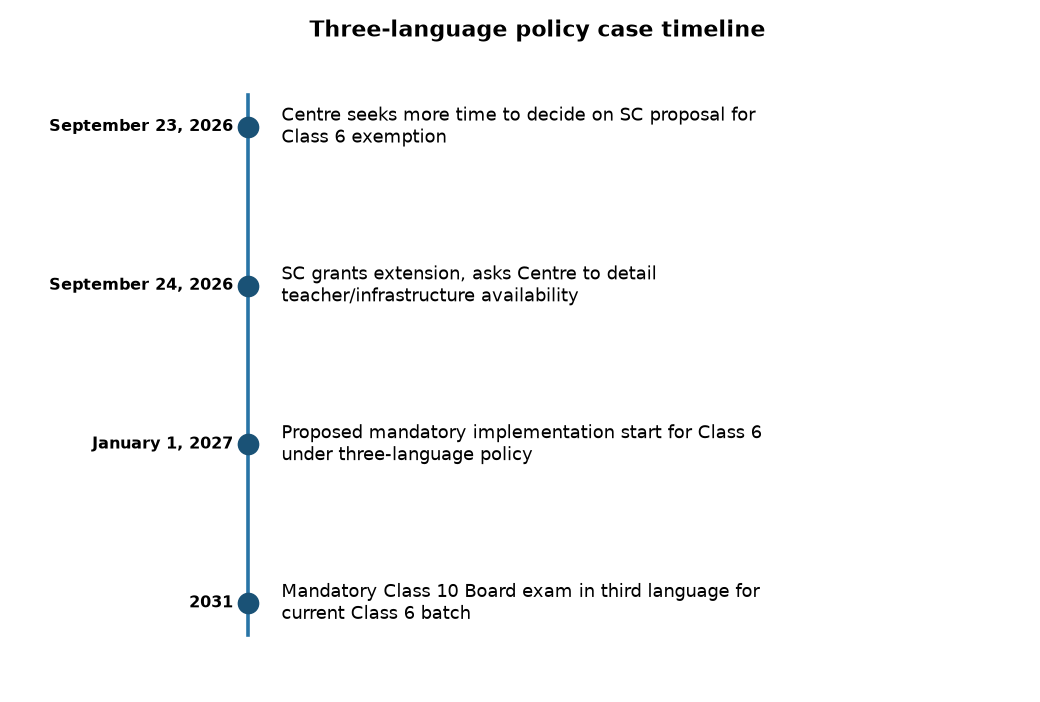
The Supreme Court, in a hearing on the implementation of the three-language formula, granted the Union Government additional time to deliberate on a proposal to exempt the current batch of Class 6 students from the mandatory third-language requirement. The Bench, led by the Chief Justice of India, emphasised the need to ensure pedagogical feasibility and student convenience while balancing constitutional mandates and educational equity.
Background
- The three-language formula was first recommended by the Kothari Commission (1964–66) to promote multilingual competence and national integration, balancing Hindi-speaking and non-Hindi-speaking states.
- The formula was formally endorsed by the National Policy on Education (NPE) 1968 and reiterated in subsequent policies, including the National Education Policy (NEP) 2020.
- The Right of Children to Free and Compulsory Education (RTE) Act, 2009, mandates free and compulsory education for children aged 6–14 but does not explicitly prescribe the three-language formula.
- The Supreme Court’s intervention stems from petitions challenging the abrupt imposition of the policy on the current Class 6 cohort, raising concerns over feasibility, teacher availability, and student preparedness.
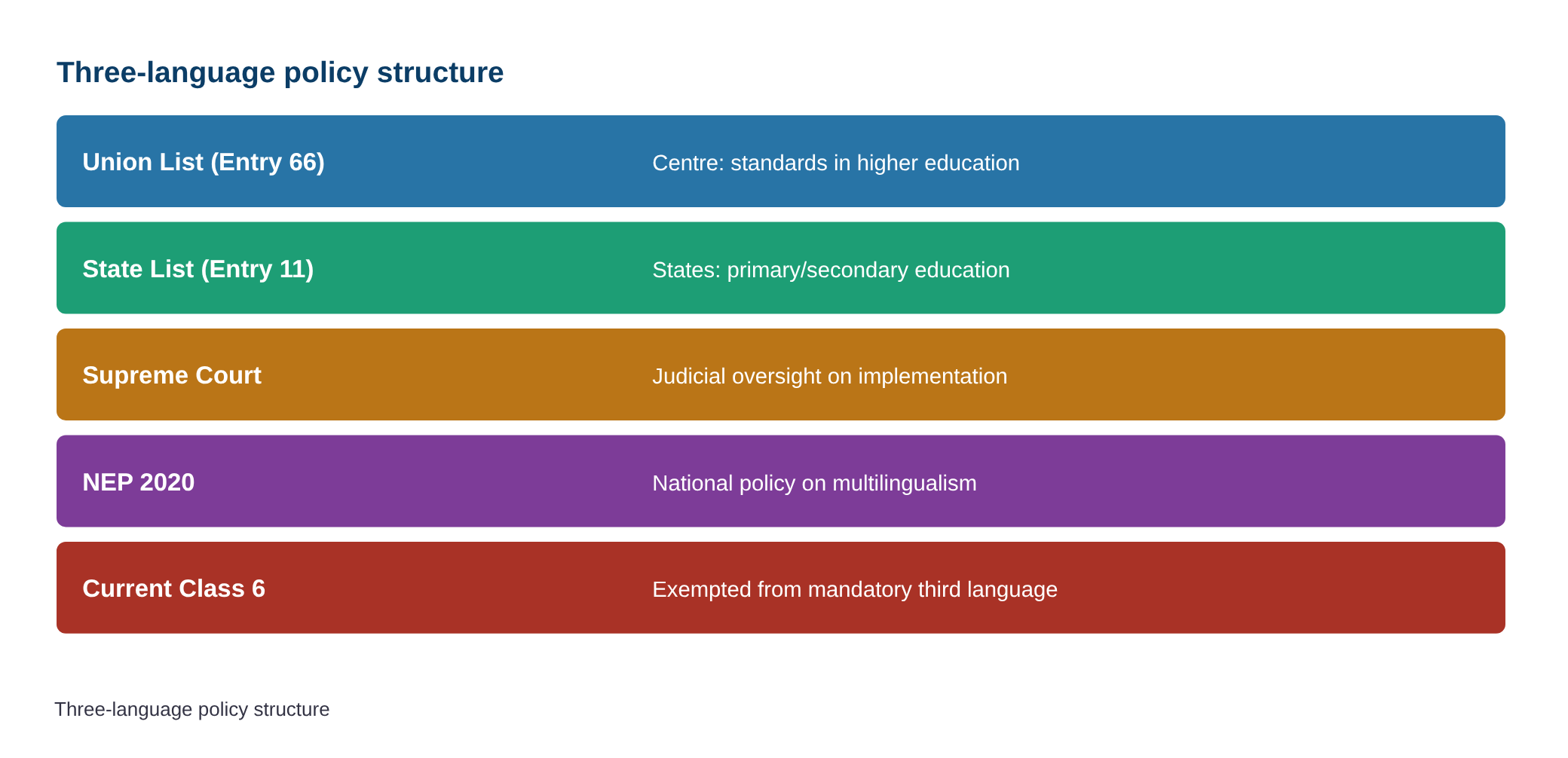
- The Constitution of India allocates education to both the Union and State Lists, with Entry 66 of the Union List empowering the Centre to coordinate and determine standards in higher education, while Entry 11 of the State List vests primary and secondary education with states.
What is the Three-Language Formula?
- The three-language formula is an educational policy designed to promote multilingualism, national integration, and cultural exchange by mandating the study of three languages in schools.
- The formula typically includes: (1) the mother tongue or regional language, (2) Hindi (for non-Hindi-speaking states) or another modern Indian language, and (3) English or a foreign language.
- It was first formally recommended by the Kothari Commission (1964–66) and later incorporated into the National Policy on Education (NPE) 1968 and the National Education Policy (NEP) 2020.
- The NEP 2020 recommends flexibility in implementation, allowing states to adapt the formula based on local linguistic contexts while ensuring exposure to at least two Indian languages.
- The formula is implemented through CBSE and state board curricula, with variations in subject combinations across regions to respect linguistic diversity.
- The policy aims to foster linguistic competence, cultural understanding, and economic mobility while addressing the challenges of a multilingual society.
- Implementation challenges include teacher shortages, lack of infrastructure, and resistance from stakeholders due to perceived academic burden or cultural insensitivity.
- Judicial oversight, as seen in the current case, ensures that policy implementation adheres to constitutional principles, procedural fairness, and pedagogical feasibility.
Key Features
| Feature | Significance |
|---|---|
| Three-language policy (NEP 2020) | Aims to promote multilingualism and cognitive flexibility in school education by mandating study of three languages, including one Indian language, one English, and one modern Indian or foreign language. |
| Gradual implementation (Class 6 from 2027) | Provides a phased transition to avoid disruption in the academic year, allowing schools and students time to adapt to the new linguistic demands. |
| Supreme Court’s judicial oversight | Ensures constitutional compliance and practical feasibility of the policy, balancing educational objectives with student welfare. |
| Teacher and infrastructure readiness | Critical for successful implementation, as the policy requires trained educators and adequate resources to teach multiple languages effectively. |
| Incentives for third-language adoption | Proposed to encourage student engagement and reduce resistance to learning an additional language, aligning with pedagogical goals. |
Why it Matters
Educational Policy
- Advances the National Education Policy 2020’s vision of multilingual competence, fostering cultural inclusivity and global competitiveness among students.
- Aligns with global best practices in language education, where proficiency in multiple languages enhances cognitive and analytical skills.
- Promotes national integration by encouraging study of diverse Indian languages, reinforcing constitutional values of unity in diversity.
Judicial-Legislative Interface
- Demonstrates the role of the judiciary in ensuring that policy implementation is grounded in constitutional principles and practical feasibility.
- Highlights the collaborative approach between the executive and judiciary to balance educational reforms with student welfare.
- Sets a precedent for judicial oversight in large-scale educational reforms, ensuring accountability and transparency.
Administrative Preparedness
- Underscores the need for robust administrative planning, including teacher training, curriculum design, and resource allocation, to implement the policy effectively.
- Emphasizes the importance of inter-departmental coordination between the Ministry of Education, state governments, and educational institutions.
Challenges
1. Implementation Readiness
- Inadequate teacher training in multilingual pedagogy may hinder effective instruction and student comprehension.
- Variations in state-level education policies and infrastructure could lead to uneven implementation across regions.
- Resistance from students, parents, or local communities due to perceived academic burden or cultural preferences.
UPSC Link: GS2-Education
2. Resource Allocation
- Shortage of qualified language teachers, particularly in rural and under-resourced schools, may delay policy rollout.
- Limited availability of teaching materials, textbooks, and digital resources in multiple languages, especially for less commonly taught languages.
UPSC Link: GS2-Education
3. Student Welfare and Equity
- Risk of disproportionate impact on students from socio-economically disadvantaged backgrounds, who may face greater challenges in adapting to the new policy.
- Need for inclusive incentives to ensure all students, regardless of linguistic background, can benefit from the policy without undue hardship.
UPSC Link: GS2-Social Justice
4. Policy Coherence
- Potential conflicts with existing state-level language policies, which may prioritize regional languages over the NEP 2020’s three-language formula.
- Ensuring consistency between the policy’s objectives and the assessment mechanisms, such as board examinations in the third language.
UPSC Link: GS2-Federalism
5. Stakeholder Engagement
- Lack of widespread awareness and consensus among educators, parents, and students about the benefits and operational aspects of the policy.
- Need for continuous feedback mechanisms to address concerns and adapt the policy based on ground-level challenges.
UPSC Link: GS2-Public Participation
Challenges — UPSC Perspective
| Issue | Concern |
|---|---|
| Teacher Training | Insufficient number of educators proficient in multilingual teaching methodologies. |
| Curriculum Design | Lack of standardized textbooks and digital resources in multiple languages. |
| Regional Disparities | Uneven implementation across states due to varying educational infrastructure. |
| Student Adaptability | Potential resistance from students accustomed to traditional monolingual education systems. |
| Assessment Mechanisms | Challenges in designing fair and comprehensive evaluation methods for the third language. |
| Parental Concerns | Skepticism or opposition from parents regarding the academic burden on students. |
Way Forward
- Conduct a nationwide audit of language teachers and infrastructure to identify gaps and prioritize resource allocation.
- Develop standardized, multilingual teaching materials and digital resources in collaboration with state education boards.
- Launch targeted teacher training programs focused on multilingual pedagogy and inclusive classroom strategies.
- Establish regional language resource centers to support less commonly taught languages and ensure equitable access.
- Create incentive mechanisms, such as scholarships or recognition programs, to encourage student engagement with the third language.
- Strengthen inter-state coordination to harmonize implementation and address regional disparities in policy execution.
- Introduce phased pilot programs in select districts to test and refine the policy before nationwide rollout.
- Enhance public awareness campaigns to educate stakeholders about the policy’s objectives and benefits.
UPSC Value Addition
Keywords for Mains Answer-Writing
Three-language formula · National Education Policy 2020 · Right to Education Act 2009 · Article 29 and 30 of the Constitution · Union and State List in Education · Supreme Court of India · Judicial review of educational policies · Bilingualism and multilingualism in education · Curriculum implementation challenges · Teacher availability and infrastructure in schools · Constitutional provisions on minority educational rights · Federalism in education policy · Pedagogical flexibility in school education
Constitutional & Policy Linkages
- Article 29(1) – Cultural and Educational Rights of Minorities
- Article 350A – Facilities for Instruction in Mother-Tongue at Primary Stage
Concept Flow
NEP 2020 introduces three-language policy to promote multilingualism and cognitive development. → Supreme Court proposes phased implementation, exempting current Class 6 students to avoid disruption. → Union Government seeks additional time to assess readiness and propose incentives for third-language adoption. → Judiciary emphasizes practical feasibility, including teacher training and infrastructure, before full implementation. → Policy rollout hinges on administrative preparedness, stakeholder engagement, and resource allocation. → Successful implementation requires continuous monitoring, feedback, and adaptation to address challenges.
Prelims Practice Questions
Q1. Consider the following statements regarding the Three-language formula in India’s education policy:
1. The Three-language formula was first recommended by the Kothari Commission (1964-66).
2. The formula mandates that students must study Hindi, English, and a modern Indian language.
3. The National Education Policy 2020 recommends the continuation of the Three-language formula with flexibility.
4. The Right to Education Act 2009 legally enforces the Three-language formula in all states.
How many of the above statements are correct?
- Only one
- Only two
- Only three
- All four
Answer: Only three — Statements 1 and 3 are correct. Statement 2 is incorrect as the formula does not mandate Hindi; it allows for a modern Indian language other than the state language. Statement 4 is incorrect as the RTE Act does not legally enforce the Three-language formula.
Q2. Assertion (A): The Supreme Court of India has the power to direct the implementation of educational policies under its jurisdiction.
Reason (R): The Constitution of India empowers the Supreme Court to issue directions for the enforcement of fundamental rights, including those related to education.
Options:
A. Both A and R are true, and R is the correct explanation of A.
B. Both A and R are true, but R is not the correct explanation of A.
C. A is true, but R is false.
D. A is false, but R is true.
Answer: ? — Both A and R are true, and R correctly explains A. The Supreme Court can issue directions for the enforcement of fundamental rights, including those related to education, as per Articles 32 and 226 of the Constitution.
Q3. Match the following committees with their respective recommendations on language policy in education:
Column I (Committee) Column II (Recommendation)
A. Kothari Commission (1964-66) 1. Recommended a flexible Three-language formula with mother tongue as the medium of instruction.
B. National Education Policy 2020 2. Advocated for the promotion of Hindi as a link language alongside English and a regional language.
C. Radhakrishnan Commission (1948-49) 3. Suggested a uniform Three-language formula for all states, with Hindi as one of the languages.
D. D.S. Kothari Committee (1961) 4. Proposed the study of three languages, including English, Hindi, and a modern Indian language.
Options:
A. A-4, B-1, C-2, D-3
B. A-3, B-1, C-2, D-4
C. A-2, B-3, C-1, D-4
D. A-1, B-4, C-3, D-2
Answer: ? — Correct matching: A-4 (Kothari Commission recommended a Three-language formula including English, Hindi, and a modern Indian language), B-1 (NEP 2020 recommends a flexible Three-language formula with mother tongue as the medium), C-2 (Radhakrishnan Commission advocated for Hindi as a link language), D-3 (D.S. Kothari Committee suggested a uniform Three-language formula).
Mains Practice Question
✍ Critically examine the constitutional and pedagogical challenges in the implementation of the Three-language formula in India’s school education system. Also, assess the role of the judiciary in ensuring its effective enforcement. (15 Marks)
Approach: MODEL-ANSWER SKELETON:
1. **Constitutional Framework and Federalism** (4 points):
– Distribution of subjects under the Seventh Schedule (Union List: education policy coordination; State List: implementation of school education).
– Article 29 and 30: Rights of minorities to establish and administer educational institutions; implications for language choice.
– Article 350A: Facilities for instruction in mother-tongue at the primary stage.
– Federal tensions: State autonomy vs. Centre’s role in ensuring uniformity in policy implementation.
2. **Pedagogical and Practical Challenges** (5 points):
– Teacher availability and infrastructure constraints in implementing a Three-language formula, especially in rural areas.
– Linguistic diversity: Choosing the third language (e.g., Hindi vs. English vs. regional languages) and its impact on learning outcomes.
– Curriculum overload and cognitive load on students, particularly in early grades.
– Resistance from states (e.g., Tamil Nadu) due to linguistic identity politics.
– Data from recent studies or reports (e.g., NEP 2020’s emphasis on flexibility) to highlight implementation gaps.
3. **Judicial Role and Recent Developments** (4 points):
– Supreme Court’s jurisdiction under Articles 32 and 226 to enforce fundamental rights related to education.
– Recent cases (e.g., 2026 Supreme Court hearing on exempting Class 6 students from the Three-language policy) and the Court’s observations on feasibility.
– Balancing judicial activism with executive and legislative domains in policy implementation.
– The Court’s suggestion for incentives to encourage students to embrace the third language, highlighting its role in policy refinement.
4. **Conclusion** (2 points):
– Need for a balanced approach that respects federalism, linguistic diversity, and pedagogical feasibility.
– Recommendations: Flexibility in implementation, capacity-building for teachers, and phased rollout with incentives.
Source: The Hindu
Generated by AanyaAi for educational purpose.
Related guides on our sites
- Best PSIR optional coaching for upsc
- Best PSIR optional teacher for upsc
- Best teacher of PSIR optional for upsc
- Best PSIR optional coaching in delhi for UPSC

- Supreme Court Grants Centre Time on Three-Language Policy for Class 6 Students - September 24, 2026
- सुप्रीम कोर्ट ने बीसीआई के कानून शिक्षा विनियमन अधिकार पर उठाए सवाल - September 24, 2026
- Supreme Court Questions BCI’s Power Over Legal Education Regulation - September 24, 2026

No Comments