


24 Sep Swachhata Hi Seva 2026: Textile Ministry’s Nationwide Cleanliness & Green Initiatives
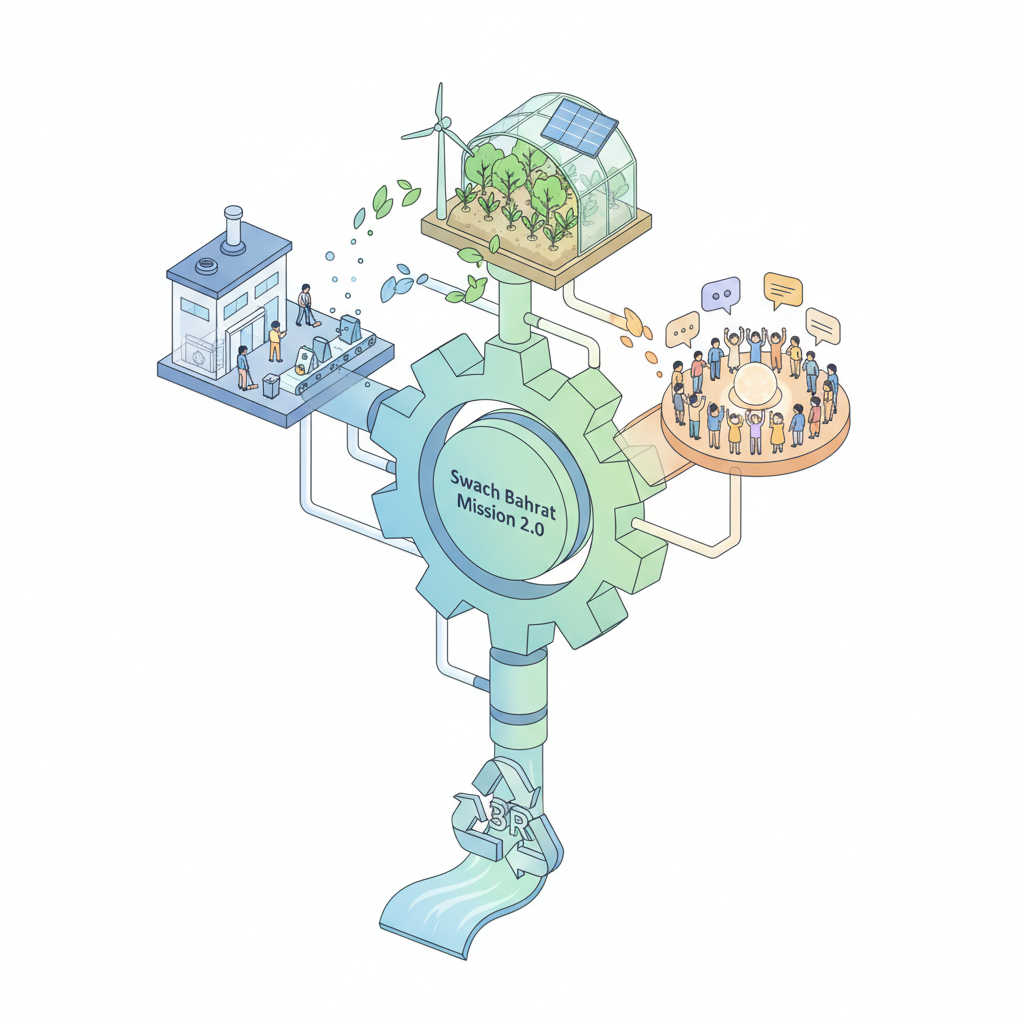
✎ Swachhata Hi Seva 2026 integrates institutional cleanliness, 3R principles, and community participation to advance the Swachh Bharat Mission 2.0 goals of sanitation, sustainability, and behavioural change.
Subject Relevance — Where This Topic Fits
- GS Paper II — Governance, Transparency and Accountability | GS Paper III — Environment and Sustainable Development | GS Paper IV — Ethics in Governance and Corporate Social Responsibility
- Prelims: Swachh Bharat Mission 2.0, 3R Principles (Reduce, Reuse, Recycle), Solid Waste Management Rules 2016, Plastic Waste Management Rules 2022, National Mission for Clean Ganga (NMCG), Extended Producer Responsibility (EPR) under Plastic Waste Management Rules
- Essay: Sustainability and Corporate Social Responsibility: The Role of Institutions in Public Welfare, From Awareness to Action: The Power of Community Participation in Nation-Building
Quick Revision: Swachhata Hi Seva 2026 integrates institutional cleanliness, 3R principles, and community participation to advance the Swachh Bharat Mission 2.0 goals of sanitation, sustainability, and behavioural change.
Why is this in the news?
The Ministry of Textiles has launched a comprehensive nationwide campaign under the ‘Swachhata Hi Seva 2026’ initiative, involving large-scale cleanliness drives, green initiatives, and community engagement across multiple textile sector institutions. The campaign underscores the integration of cleanliness, sustainability, and participatory governance within the textile value chain, aligning with broader national missions for sanitation and environmental stewardship.
Background
- Swachhata Hi Seva (SHS) is an annual nationwide cleanliness campaign launched by the Government of India in 2017, operationalised under the aegis of the Swachh Bharat Mission 2.0, to foster mass participation in sanitation and environmental conservation.
- The campaign is structured around the 3R principles—Reduce, Reuse, and Recycle—aimed at minimising waste generation and promoting circular economy practices within institutions and communities.
- The textile sector, encompassing cotton, jute, handloom, and fashion industries, is a significant contributor to employment and GDP, making its engagement in cleanliness and sustainability initiatives critical for national development goals.
- The Ministry of Textiles has historically promoted eco-friendly practices in the sector, including the adoption of organic cotton, jute-based biodegradable products, and sustainable fashion initiatives.
- Institutional cleanliness drives under SHS are designed to complement the Solid Waste Management Rules, 2016, and Plastic Waste Management Rules, 2022, by ensuring compliance and fostering behavioural change among stakeholders.
- The campaign’s participatory model aligns with the constitutional directive under Article 48A (Directive Principles of State Policy) to protect and improve the environment and safeguard forests and wildlife.
What is Swachhata Hi Seva 2026?
- Swachhata Hi Seva 2026 is a year-long mass movement under the Swachh Bharat Mission 2.0, focusing on cleanliness, hygiene, and environmental sustainability through institutional and community-led initiatives.
- The campaign is coordinated by the Ministry of Textiles in collaboration with subordinate offices, autonomous bodies, and sectoral institutions such as the National Jute Board (NJB), Cotton Corporation of India (CCI), and National Institute of Fashion Technology (NIFT).
- Key activities include ‘Clean Desk and Clean Campus’ drives, waste segregation and recycling initiatives (e.g., ‘Kabaad se Jugaad’), tree plantation drives (e.g., ‘Ek Ped Maa Ke Naam’), and public awareness campaigns on responsible waste management.
- The ‘3R Principles’ are central to the campaign’s waste management strategy, aiming to reduce waste generation, promote reuse of materials, and enhance recycling of scrap and by-products within textile institutions.
- Institutional cleanliness drives are not merely symbolic but involve measurable outcomes such as waste audits, segregation at source, and partnerships with local authorities (e.g., New Town Kolkata Development Authority) for waste collection and disposal.
- The campaign emphasises ‘Swachhata Jan Bhagidari’ (public participation), encouraging employees, students, and local communities to adopt sustainable practices and maintain clean public and private spaces.
- The textile sector’s participation in SHS 2026 is aligned with national priorities under the circular economy framework, contributing to the reduction of carbon footprint and promotion of green jobs.
- The initiative also serves as a model for other sectors to emulate, demonstrating how institutional cleanliness can be institutionalised through structured campaigns, training, and community engagement.
Key Features
| Feature | Significance |
|---|---|
| Swachhata Hi Seva 2026 Campaign | A nation-wide mass movement for sanitation, hygiene, and waste management, integrating community participation across sectors. |
| Clean Desk & Clean Campus Initiative | Promotes organisational discipline, reduces clutter, and fosters a culture of cleanliness in office environments. |
| Kabad se Jugaad (3R Principles) | Encourages waste reduction, reuse, and recycling, aligning with circular economy principles and generating revenue from scrap. |
| Tree Plantation Drive (‘Ek Ped Maa Ke Naam’) | Enhances environmental sustainability, carbon sequestration, and public awareness of afforestation. |
| Swachhata Jan Bhagidari (Textile Donation Drive) | Strengthens community engagement by mobilising resources for social welfare while promoting reuse of materials. |
Why it Matters
Governance & Institutional Behaviour
- Demonstrates proactive governance through inter-departmental coordination (e.g., NITD, NITI Aayog, state authorities) for large-scale sanitation drives.
- Institutionalises behavioural change by embedding cleanliness as a core organisational value across textile sector entities.
- Enhances public trust in government initiatives by showcasing tangible, grassroots-level impact through measurable participation.
Environmental Sustainability
- Advances India’s commitments under the Swachh Bharat Mission 2.0 and the National Clean Air Programme through sector-specific action.
- Promotes circular economy principles via systematic waste segregation, recycling, and revenue generation from scrap materials.
- Contributes to climate resilience by integrating tree plantation and green campus initiatives within institutional frameworks.
Social & Community Engagement
- Fosters a culture of collective responsibility by involving employees, students, and local communities in sanitation activities.
- Bridges formal and informal sectors through partnerships with municipal authorities and community groups for waste management.
- Reinforces the principle of ‘Jan Bhagidari’ (people’s participation) in public service delivery, aligning with SDG 11 (Sustainable Cities and Communities).
Operational Efficiency & Revenue Generation
- Optimises resource utilisation by identifying and repurposing scrap materials, reducing operational waste and costs.
- Creates secondary revenue streams through the sale or reuse of recyclable scrap, enhancing financial sustainability.
- Improves workplace productivity and morale by maintaining clean, organised, and hygienic environments.
Challenges
1. Sustaining Long-Term Behavioural Change
- Risk of short-term enthusiasm without institutional mechanisms to maintain momentum post-campaign.
- Need for continuous reinforcement through training, incentives, and periodic audits to prevent relapse into pre-campaign practices.
UPSC Link: GS2: Role of Civil Society in Governance
2. Resource Constraints in Waste Management
- Limited infrastructure for segregation, processing, and disposal of waste in certain regions, particularly for textile and jute scrap.
- Dependence on informal sector for waste collection and recycling, which may lack standardisation and safety protocols.
UPSC Link: GS3: Solid Waste Management Rules, 2016
3. Cross-Sectoral Coordination Gaps
- Fragmented implementation across textile sector entities due to varying capacities and priorities.
- Need for stronger inter-ministerial collaboration (e.g., Ministry of Textiles, Ministry of Environment, Urban Local Bodies) to align efforts.
UPSC Link: GS2: Inter-State Relations and Cooperative Federalism
4. Public Awareness and Participation Divide
- Urban-centric focus may exclude rural and peri-urban areas, where sanitation infrastructure and awareness are weaker.
- Socio-economic barriers may limit participation in donation drives or tree plantation activities.
UPSC Link: GS1: Social Empowerment and Inclusive Growth
5. Monitoring and Evaluation Mechanisms
- Lack of standardised metrics to measure the impact of sanitation drives on health, environment, and institutional behaviour.
- Need for robust data systems to track progress, identify bottlenecks, and ensure accountability.
UPSC Link: GS4: Ethics in Governance
Challenges — UPSC Perspective
| Issue | Concern |
|---|---|
| Infrastructure Gaps | Inadequate facilities for waste segregation, recycling, and disposal in certain regions. |
| Behavioural Relapse | Risk of reverting to pre-campaign practices due to lack of reinforcement mechanisms. |
| Resource Allocation | Limited financial and human resources for scaling up initiatives across all textile sector entities. |
| Awareness Disparities | Uneven public participation due to socio-economic and regional differences. |
| Monitoring Deficits | Absence of standardised tools to assess the long-term impact of sanitation drives. |
Government Initiatives — Must-Memorise for Prelims
- Swachh Bharat Mission 2.0
Way Forward
- Establish a dedicated monitoring cell within the Ministry of Textiles to track progress, conduct audits, and publish quarterly reports on sanitation drives.
- Integrate behavioural change modules into employee training programs, with mandatory refresher courses on waste segregation and recycling.
- Partner with NGOs and private sector entities to enhance waste management infrastructure, particularly in areas lacking formal recycling facilities.
- Launch a nationwide awareness campaign leveraging digital platforms (e.g., social media, mobile apps) to sustain public interest and participation.
- Develop a standardised framework for measuring the impact of sanitation initiatives on health outcomes, environmental parameters, and institutional behaviour.
- Expand the ‘Kabad se Jugaad’ initiative to include skill development programs for informal sector workers, ensuring safe and dignified employment.
- Strengthen inter-ministerial coordination through regular review meetings and joint task forces to align sanitation efforts across sectors.
- Introduce incentive mechanisms (e.g., tax rebates, recognition awards) for textile sector entities demonstrating exemplary performance in cleanliness and sustainability.
UPSC Value Addition
Keywords for Mains Answer-Writing
Swachhata Hi Seva 2026 · Ministry of Textiles · waste management hierarchy (3R) · community participation in sanitation · corporate social responsibility in public sector undertakings · solid waste management rules 2016 · Green initiatives in government offices · circular economy in public administration · behavioural change for cleanliness · institutional cleanliness drives · public-private partnership in sanitation · solid waste management in urban areas
Concept Flow
Initiation of Swachhata Hi Seva 2026 campaign → Mobilisation of textile sector entities (NIFT, NJB, CCI, etc.) for mass sanitation drives. → Implementation of Clean Desk & Clean Campus initiatives → Institutionalisation of cleanliness as a core organisational value. → Execution of 3R principles (Kabad se Jugaad) → Promotion of circular economy and revenue generation from scrap materials. → Tree Plantation Drive (‘Ek Ped Maa Ke Naam’) → Enhancement of environmental sustainability and carbon sequestration. → Swachhata Jan Bhagidari (Textile Donation Drive) → Strengthening community engagement and social welfare. → Monitoring and Evaluation → Assessment of impact on health, environment, and institutional behaviour. → Sustainability Measures → Reinforcement through training, incentives, and policy integration.
Prelims Practice Questions
Q1. Consider the following statements regarding the 3R principles in waste management:
1. The 3R principles—Reduce, Reuse, Recycle—are explicitly mandated under the Solid Waste Management Rules, 2016.
2. The ‘Reduce’ principle prioritises minimising waste generation at the source.
3. The ‘Reuse’ principle encourages the use of discarded materials for new purposes without altering their form.
4. The ‘Recycle’ principle involves converting waste into raw material for new products, which may require significant energy input.
How many of the above statements are correct?
- Only one
- Only two
- Only three
- All
Answer: All — Statements 1, 2, and 3 are correct. Statement 4 is incorrect because recycling may or may not require significant energy input, depending on the material and process.
Q2. Assertion (A): The ‘Swachhata Hi Seva’ campaign is a government initiative aimed at promoting cleanliness and sanitation through community participation.
Reason (R): The campaign aligns with the objectives of the Swachh Bharat Mission 2.0, which seeks to sustain open defecation-free status and improve solid waste management in urban areas.
Options:
A. Both A and R are true, and R is the correct explanation of A.
B. Both A and R are true, but R is not the correct explanation of A.
C. A is true, but R is false.
D. A is false, but R is true.
- A
- B
- C
- D
Answer: B — Both A and R are true, and R correctly explains A as ‘Swachhata Hi Seva’ is designed to complement Swachh Bharat Mission 2.0 by fostering community-driven cleanliness.
Q3. Match the following initiatives with their respective organisations:
Column I (Initiative) | Column II (Organisation)
———————————————–|———————————————–
1. ‘Kabaad se Jugaad’ | A. National Jute Board (NJB)
2. Tree plantation under ‘Ek Ped Maa Ke Naam’ | B. Indian Cotton Corporation Limited (ICC)
3. Cleanliness drive in showrooms | C. Textiles Committee, Mumbai
4. Cleanliness oath in campuses | D. National Institute of Fashion Technology (NIFT)
Options:
A. 1-B, 2-A, 3-C, 4-D
B. 1-B, 2-D, 3-C, 4-A
C. 1-C, 2-A, 3-B, 4-D
D. 1-A, 2-B, 3-D, 4-C
- A
- B
- C
- D
Answer: B — 1-B (ICC), 2-A (NJB), 3-C (Textiles Committee), 4-D (NIFT). The initiatives are correctly matched with their respective organisations.
Mains Practice Question
✍ The Ministry of Textiles has launched ‘Swachhata Hi Seva 2026’ as a nationwide campaign to promote cleanliness, green initiatives, and community participation in sanitation. Critically examine the significance of such institutional cleanliness drives in achieving the objectives of the Solid Waste Management Rules, 2016. Also, analyse the role of public sector undertakings in fostering a culture of sustainability and behavioural change among employees and communities. (15 Marks)
Approach: MODEL-ANSWER SKELETON:
1. **Introduction (2 marks)**
– Define ‘Swachhata Hi Seva 2026’ and its alignment with government initiatives like Swachh Bharat Mission 2.0.
– State the objectives of the Solid Waste Management Rules, 2016 (e.g., source segregation, waste minimisation, and safe disposal).
2. **Significance of Institutional Cleanliness Drives (5 marks)**
– **Behavioural Change**: Discuss how institutional cleanliness drives (e.g., ‘Clean Desk, Clean Campus’ at ICC) foster a culture of cleanliness and responsibility among employees and communities.
– **Compliance with SWM Rules**: Explain how such drives promote source segregation, 3R principles (Reduce, Reuse, Recycle), and proper waste disposal, as mandated under SWM Rules 2016.
– **Public Awareness**: Highlight the role of these drives in raising awareness about waste management and environmental sustainability.
– **Circular Economy**: Discuss how initiatives like ‘Kabaad se Jugaad’ contribute to the circular economy by encouraging recycling and revenue generation from scrap materials.
3. **Role of Public Sector Undertakings (PSUs) (5 marks)**
– **Leadership by Example**: PSUs like the National Jute Board (NJB) and Textiles Committee demonstrate leadership in cleanliness and sustainability, setting benchmarks for other organisations.
– **Community Engagement**: Discuss how PSUs engage with local communities (e.g., NJB’s cleanliness drive in New Town Kolkata with NKDA support) to promote collective responsibility.
– **Corporate Social Responsibility (CSR)**: Explain how PSUs integrate CSR into their operations, aligning with Sustainable Development Goals (SDGs) 11 (Sustainable Cities) and 12 (Responsible Consumption).
– **Innovation and Scalability**: Highlight how initiatives like tree plantation (‘Ek Ped Maa Ke Naam’) and cleanliness oaths in campuses (NIFT) scale up sustainability practices.
4. **Challenges and Way Forward (3 marks)**
– **Sustainability**: Discuss challenges in sustaining behavioural change and institutionalising cleanliness practices beyond campaign periods.
– **Resource Allocation**: Address the need for adequate resources, training, and monitoring mechanisms to ensure long-term impact.
– **Policy Integration**: Suggest integrating such drives with existing policies like the National Clean Air Programme (NCAP) and Urban Local Body (ULB) waste management plans.
5. **Conclusion (2 marks)**
– Summarise the role of institutional cleanliness drives and PSUs in achieving the objectives of SWM Rules 2016.
– Emphasise the need for continued collaboration between government, PSUs, and communities to build a sustainable and clean environment.
Source: PIB (Press Information Bureau)
Generated by AanyaAi for educational purpose.
Related guides on our sites
- Best PSIR optional coaching for upsc
- Best PSIR optional teacher for upsc
- Best teacher of PSIR optional for upsc
- Best PSIR optional coaching in delhi for UPSC

- वस्त्र मंत्रालय ने शुरू किया ‘स्वच्छता ही सेवा 2026’ अभियान: जाने प्रमुख पहल - September 24, 2026
- Swachhata Hi Seva 2026: Textile Ministry’s Nationwide Cleanliness & Green Initiatives - September 24, 2026
- आरबीआई ने क्लेम एक्सिवा फाइनेंस पर लगाया 2.70 लाख रुपये का जुर्माना - September 24, 2026

No Comments