


25 Sep UPSC Alert: New Daily Night Train Between Kanpur & Delhi Approved
✎ The Kanpur Central–Anand Vihar Terminal daily night mail service (Train Nos. 14153/14154) provides an 8-hour overnight travel option between Kanpur and Delhi, stopping at 8 key intermediate stations, thereby enhancing regional…
Subject Relevance — Where This Topic Fits
- GS Paper III — Infrastructure: Railways and Logistics
- Prelims: Railway Budget, Dedicated Freight Corridors, Semi-High Speed Rail, Vande Bharat Express, Garib Rath Express, Railway Electrification, Dedicated Passenger Corridors, Indian Railways Organisation for Alternative Fuels (IROAF), National Rail Plan 2030, Railway Safety Fund, Kanpur Central, Anand Vihar Terminal, Dedicated Freight Corridor (DFC), Eastern Dedicated Freight Corridor (EDFC), Western Dedicated Freight Corridor (WDFC)
Quick Revision: The Kanpur Central–Anand Vihar Terminal daily night mail service (Train Nos. 14153/14154) provides an 8-hour overnight travel option between Kanpur and Delhi, stopping at 8 key intermediate stations, thereby enhancing regional connectivity and passenger convenience.
Why is this in the news?
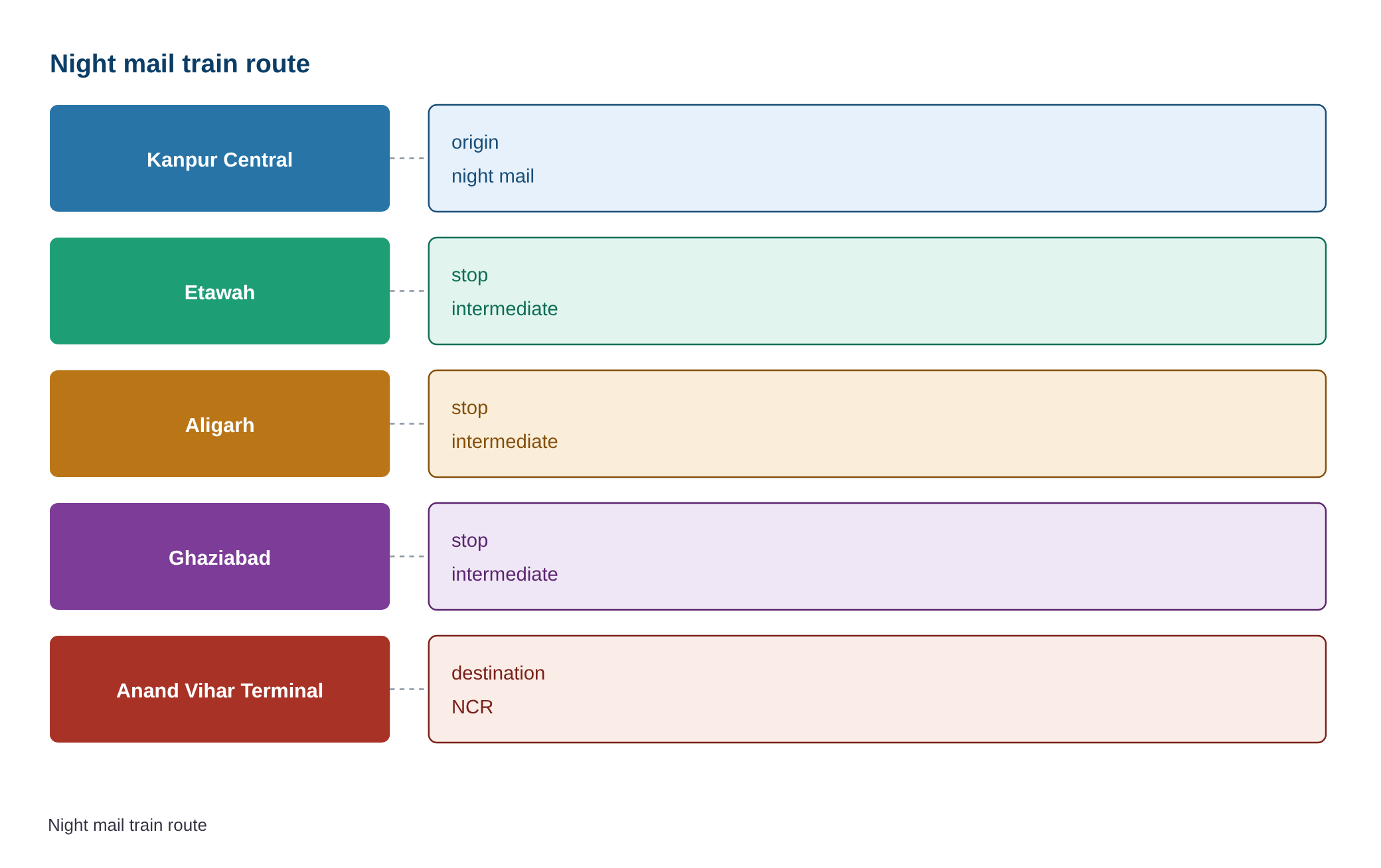
The Ministry of Railways, through a press release dated 24 September 2026, announced the approval of a new daily night mail service between Kanpur Central and Anand Vihar Terminal. This initiative is aimed at improving passenger connectivity between Kanpur and the National Capital Region (NCR), particularly by providing a convenient overnight rail travel option with stops at key intermediate stations such as Etawah, Aligarh, and Ghaziabad. The introduction of this service underscores the Indian Railways’ ongoing efforts to enhance passenger amenities and regional connectivity through strategic rail linkages.
Background
- The Indian Railways operates one of the world’s largest rail networks, playing a pivotal role in India’s transportation and logistics infrastructure.
- The Kanpur–Delhi rail corridor is a critical link connecting Uttar Pradesh’s industrial and commercial hubs with the national capital, facilitating both passenger and freight movement.
- Night mail services have historically been a staple of Indian Railways, offering cost-effective and time-efficient travel options for passengers, particularly for long-distance journeys.
- The National Rail Plan 2030 emphasizes the augmentation of passenger services and the development of high-density corridors to improve mobility and reduce congestion on existing routes.
What is the Kanpur Central–Anand Vihar Terminal Daily Night Mail Service?
- The service comprises two trains: Train Number 14153 (Kanpur Central–Anand Vihar Terminal Mail) and Train Number 14154 (Anand Vihar Terminal–Kanpur Central Mail), operating daily in both directions.
- Train 14153 departs Kanpur Central at 20:40 hours and arrives at Anand Vihar Terminal at 04:50 hours the next morning, covering a distance of 428 kilometres in 8 hours and 10 minutes.
- Train 14154 departs Anand Vihar Terminal at 23:25 hours and arrives at Kanpur Central at 07:25 hours the following day, covering the same distance in 8 hours.
- The route includes eight intermediate stations: Phaphund, Etawah, Tundla, Hathras, Aligarh, Khurja, Dadri, and Ghaziabad, enhancing connectivity for passengers in these regions.
- This initiative aligns with the Indian Railways’ objective to provide affordable, reliable, and time-efficient overnight travel options, particularly for business and commuter traffic between Uttar Pradesh and the NCR.
- The introduction of this service reflects the Railways’ commitment to expanding and diversifying passenger offerings on high-traffic corridors, complementing existing express and superfast services.
- The operational timings are designed to cater to late-evening departures and early-morning arrivals, aligning with the travel preferences of commuters and reducing the need for overnight stays in transit cities.
Key Features
| Feature | Significance |
|---|---|
| Train Numbers 14153/14154 | Designated identifiers for the new daily mail service between Kanpur Central and Anand Vihar Terminal, ensuring systematic scheduling and operational clarity. |
| Operational Timings | Overnight service (20:40–04:50 hrs forward; 23:25–07:25 hrs return) optimises utilisation of rolling stock and aligns with passenger demand for night-time travel. |
| Route Coverage | Connects eight key stations (Fafund, Etawah, Tundla, Hathras, Aligarh, Khurja, Dadri, Ghaziabad) en route, enhancing regional integration. |
| Distance and Duration | 428 km journey completed in 8 hours 10 minutes each way, providing a competitive alternative to road transport. |
| Service Classification | Designated as a ‘Mail’ train, implying priority scheduling and higher standards of punctuality and passenger amenities. |
Why it Matters
Economic Integration
- Facilitates bidirectional movement of labour, goods, and services between Kanpur (a major industrial hub) and the National Capital Region, enhancing economic linkages.
- Supports micro, small, and medium enterprises in the intermediate districts (Etawah, Aligarh, Ghaziabad) by improving accessibility to markets in Delhi-NCR and Uttar Pradesh.
- Reduces logistical costs for industries reliant on overnight freight movement, particularly in the leather, textile, and agro-processing sectors.
Regional Connectivity
- Strengthens the eastern arm of the Golden Quadrilateral’s feeder network, complementing existing trunk routes like the Delhi–Kanpur main line.
- Provides last-mile connectivity to tier-2 cities (Aligarh, Hathras, Khurja) that lack direct high-speed rail links to major metros.
- Enhances social mobility by enabling daily commuters, students, and healthcare seekers to travel between Kanpur Division and NCR without resorting to air or private transport.
Modal Shift and Sustainability
- Encourages a shift from road to rail for long-distance travel, reducing carbon emissions and road congestion on the Delhi–Agra–Kanpur corridor.
- Aligns with India’s National Rail Plan (2030) objective of increasing rail share in passenger transport from ~1% to 4–5%.
- Supports the Ministry of Railways’ ‘One Station One Product’ initiative by linking producers in intermediate districts to NCR markets.
Operational Efficiency
- Leverages existing infrastructure (double-line sections, electrified tracks) between Kanpur and Ghaziabad, minimising capital expenditure.
- Night-time operation allows daytime utilisation of rolling stock for other services, improving asset turnover.
- Standardised timings and stoppages enhance predictability, reducing waiting times at junctions and improving overall network fluidity.
Challenges
1. Rolling Stock Availability
- Limited availability of LHB coaches and electric locomotives may constrain the introduction of additional services on this corridor.
- High utilisation of existing rakes for premium trains (e.g., Rajdhani, Shatabdi) could delay commissioning of new mail services.
UPSC Link: IRS (Indian Railways Standard) rolling stock norms
2. Track Capacity Constraints
- The Delhi–Ghaziabad–Kanpur section is one of the busiest freight corridors, with heavy traffic of goods trains competing for slots.
- Electrification and doubling projects are ongoing but face right-of-way and land acquisition delays, limiting throughput.
UPSC Link: Railway line capacity utilisation
3. Passenger Amenities at Intermediate Stations
- Many intermediate stations (Fafund, Tundla, Dadri) lack adequate platform length, lighting, or passenger amenities, affecting boarding comfort.
- Absence of integrated multi-modal hubs hampers seamless last-mile connectivity to buses, auto-rickshaws, and metro services.
UPSC Link: IRS (Indian Railways Standard) station development
4. Punctuality and Safety Risks
- Night operations increase exposure to fog, wildlife crossings, and trespassing risks, particularly in rural stretches near Etawah and Aligarh.
- Higher speeds on mixed-traffic routes elevate collision risks with slower freight trains or road vehicles at unmanned level crossings.
UPSC Link: Railway Safety (Amendment) Act, 2023
5. Revenue Sustainability
- Mail services typically operate at lower fares, requiring cross-subsidisation from freight or premium services to remain viable.
- Competition from low-cost airlines and private bus operators may pressure occupancy rates, especially during off-peak seasons.
UPSC Link: Railway Finance (2021) Report
Challenges — UPSC Perspective
| Issue | Concern |
|---|---|
| Station Infrastructure | Inadequate platform length, lack of escalators/elevators, and poor lighting at intermediate stops hinder passenger convenience. |
| Freight-Passenger Conflict | High freight traffic on the Delhi–Kanpur corridor limits passenger train scheduling windows, increasing delays. |
| Safety Protocols | Night operations require enhanced visibility systems, anti-collision devices, and stricter patrolling to mitigate trespassing risks. |
| Last-Mile Connectivity | Absence of integrated transport hubs at intermediate stations forces passengers to rely on informal transport, increasing costs. |
| Demand Fluctuations | Seasonal variations in travel demand (festivals, examinations) may lead to overcrowding or underutilisation, affecting revenue. |
| Regulatory Compliance | Adherence to Railway Board norms on coach maintenance, axle load limits, and brake testing adds operational overheads. |
Way Forward
- Conduct a corridor capacity audit to identify bottlenecks and prioritise doubling/electrification projects on the Delhi–Ghaziabad–Kanpur stretch.
- Upgrade intermediate stations (Fafund, Tundla, Dadri) under the ‘Amrit Bharat Station Scheme’ to include longer platforms, escalators, and digital signage.
- Introduce dynamic pricing for mail services to balance occupancy and revenue, with discounts for off-peak travel and group bookings.
- Deploy AI-based predictive maintenance for rolling stock and tracks to reduce unscheduled delays and improve punctuality metrics.
- Establish multi-modal integration hubs at key junctions (Aligarh, Ghaziabad) linking rail with metro, buses, and auto-rickshaws.
- Expand Wi-Fi and infotainment systems in coaches to enhance passenger experience and justify premium pricing for mail services.
- Collaborate with state governments to eliminate unmanned level crossings and install automatic signalling systems in high-density zones.
- Launch targeted marketing campaigns in intermediate districts to promote the new service, leveraging local influencers and community networks.
UPSC Value Addition
Keywords for Mains Answer-Writing
Passenger rail connectivity · Kanpur-Delhi rail corridor · Night train services · Railway passenger amenities · Regional rail transport · Uttar Pradesh-Delhi connectivity · Railway line capacity augmentation · Passenger train scheduling · Railway station accessibility · Transport infrastructure policy
Concept Flow
Expansion of rail connectivity → Increased economic integration between Kanpur Division and NCR → Enhanced labour mobility and industrial output. → Introduction of overnight mail service → Modal shift from road to rail → Reduction in carbon emissions and road congestion. → Operationalisation of new train → Utilisation of existing electrified double-line corridor → Improved asset turnover and network efficiency. → Upgradation of intermediate stations → Enhanced passenger amenities → Higher ridership and revenue sustainability. → Implementation of safety protocols → Mitigation of night-time operational risks → Improved punctuality and passenger confidence. → Dynamic pricing and marketing → Optimised occupancy and revenue → Long-term financial viability of the service.
Prelims Practice Questions
Q1. Consider the following statements about the newly approved Kanpur Central–Anand Vihar Terminal daily mail service:
1. The train will operate as Train Number 14153/14154.
2. It will cover a distance of 428 km in both directions.
3. The train will halt at eight intermediate stations including Fafund, Etawah, and Aligarh.
4. The journey time from Kanpur Central to Anand Vihar Terminal is 8 hours 10 minutes.
How many of the above statements are correct?
- Only one
- Only two
- Only three
- All
Answer: All — Statements 1, 2, and 3 are correct. Statement 4 is incorrect as the journey time is 8 hours 10 minutes from Kanpur Central to Anand Vihar Terminal, but the return journey time is 8 hours.
Q2. Assertion (A): The newly approved Kanpur Central–Anand Vihar Terminal daily mail service is designed to improve night-time passenger connectivity between Uttar Pradesh and the National Capital Region.
Reason (R): The service operates as a night train with scheduled departures after 20:00 hours and arrivals before 05:00 hours the next day.
Codes:
(A) Both A and R are true and R is the correct explanation of A.
(B) Both A and R are true but R is NOT the correct explanation of A.
(C) A is true but R is false.
(D) A is false but R is true.
- A
- B
- C
- D
Answer: A — Both Assertion (A) and Reason (R) are true. The night-time operation (departure after 20:00 and arrival before 05:00) directly explains why the service is designed to improve night-time passenger connectivity.
Q3. Match the following railway stations with their respective states:
Column I (Station) | Column II (State)
——————-|——————
1. Kanpur Central | A. Uttar Pradesh
2. Anand Vihar Terminal | B. Delhi
3. Etawah | C. Madhya Pradesh
4. Aligarh | D. Uttar Pradesh
Options:
(A) 1-A, 2-B, 3-D, 4-D
(B) 1-A, 2-B, 3-C, 4-D
(C) 1-B, 2-A, 3-D, 4-C
(D) 1-D, 2-B, 3-A, 4-C
- A
- B
- C
- D
Answer: A — Kanpur Central (1) and Etawah (3) are in Uttar Pradesh, Anand Vihar Terminal (2) is in Delhi, and Aligarh (4) is in Uttar Pradesh. Thus, the correct match is 1-A, 2-B, 3-D, 4-D.
Mains Practice Question
✍ The expansion of passenger rail connectivity through the introduction of night-time mail services represents a strategic intervention in regional transport infrastructure. Critically examine the significance of such initiatives for economic integration and social equity in the context of the Kanpur Central–Anand Vihar Terminal daily mail service. (15 Marks)
Approach: MODEL-ANSWER SKELETON:
1. **Economic Integration**:
– Facilitates movement of goods and labour between Uttar Pradesh and Delhi-NCR, reducing transit time and costs.
– Supports supply chains for industries in Kanpur (e.g., leather, textiles) and the National Capital Region.
– Aligns with the Sagarmala Programme and Bharatmala Pariyojana objectives of multi-modal connectivity.
2. **Social Equity**:
– Provides affordable overnight travel options for low-income groups, students, and migrant workers.
– Enhances accessibility for rural and semi-urban populations in Uttar Pradesh to employment and educational hubs in Delhi-NCR.
– Reduces dependence on air and road transport, lowering travel expenses.
3. **Policy and Institutional Dimensions**:
– Reflects the Railway Ministry’s focus on passenger amenities under the ‘Mission Raftaar’ and ‘One Station One Product’ initiatives.
– Complements the ‘Gati Shakti National Master Plan’ by integrating rail with other transport modes.
4. **Challenges and Limitations**:
– Potential overcrowding and safety concerns in night-time trains.
– Need for last-mile connectivity from stations to final destinations.
– Ensuring equitable distribution of benefits across all socio-economic strata.
5. **Comparative Perspective**:
– Contrast with other regional rail projects (e.g., Vande Bharat Express, Tejas Express) in terms of speed, cost, and coverage.
6. **Way Forward**:
– Expand such services to other critical corridors (e.g., Lucknow–Delhi, Allahabad–Delhi).
– Integrate with state and local transport systems for seamless connectivity.
– Monitor ridership and economic impact to assess long-term viability.
Source: PIB (Press Information Bureau)
Uttar Pradesh PCS (UPPSC) — State PCS Practice
Prelims: Which of the following is a key objective of the newly approved daily train service between Kanpur Central and Anand Vihar Terminal in Uttar Pradesh?
- A. To enhance connectivity between industrial hubs in western and eastern Uttar Pradesh
- B. To reduce the travel time between Delhi and Mumbai via Uttar Pradesh
- C. To promote religious tourism in Varanasi and Prayagraj
- D. To facilitate international trade through dedicated freight corridors
Answer: A. To enhance connectivity between industrial hubs in western and eastern Uttar Pradesh — The new daily train service aims to strengthen economic and industrial linkages between western Uttar Pradesh (Anand Vihar Terminal) and eastern Uttar Pradesh (Kanpur Central), boosting trade and commuter mobility.
Mains: Discuss the potential socio-economic impacts of the newly approved daily train service between Kanpur Central and Anand Vihar Terminal on Uttar Pradesh’s industrial corridors and urban development. (200 words)
Generated by AanyaAi for educational purpose.
Related guides on our sites
- Current affairs for upsc 2026
- Best PSIR optional coaching in delhi for UPSC
- How to prepare for GS paper 1 for UPSC CSE mains exam
- Best UPSC coaching for IFOS exam

- NAMASTE Scheme: Enhancing Sanitation Workers’ Livelihoods & Safety - November 14, 2026
- एमएसएमई का विशेष अभियान 6.0: स्वच्छता और लंबित मामलों का निपटारा - November 14, 2026
- Sea Vigil-26: Coastal Defence Drills Off Visakhapatnam - November 14, 2026

No Comments