


25 Sep UPSC Alert: India’s Red Line Before US Foreign Secretary Rubio’s Visit
✎ India’s ‘red lines’ in the India-US strategic dialogue are rooted in its commitment to energy security, strategic autonomy, and the rejection of coercive trade measures, ensuring that national interests remain paramount in…
Subject Relevance — Where This Topic Fits
- GS Paper II — International Relations: India-US bilateral relations, energy security, strategic autonomy, and foreign policy decision-making | GS Paper III — Economy: Tariffs, trade disputes, energy imports, and economic sovereignty
- Prelims: Indo-Pacific Strategy, Hydrocarbon imports, Tariff barriers, Strategic autonomy, Quadrilateral Security Dialogue (Quad), Energy security, Foreign policy instruments
- Essay: The paradox of strategic autonomy in a multipolar world, Energy security: Balancing sovereignty and global interdependence
Quick Revision: India’s ‘red lines’ in the India-US strategic dialogue are rooted in its commitment to energy security, strategic autonomy, and the rejection of coercive trade measures, ensuring that national interests remain paramount in foreign policy decisions.
Why is this in the news?
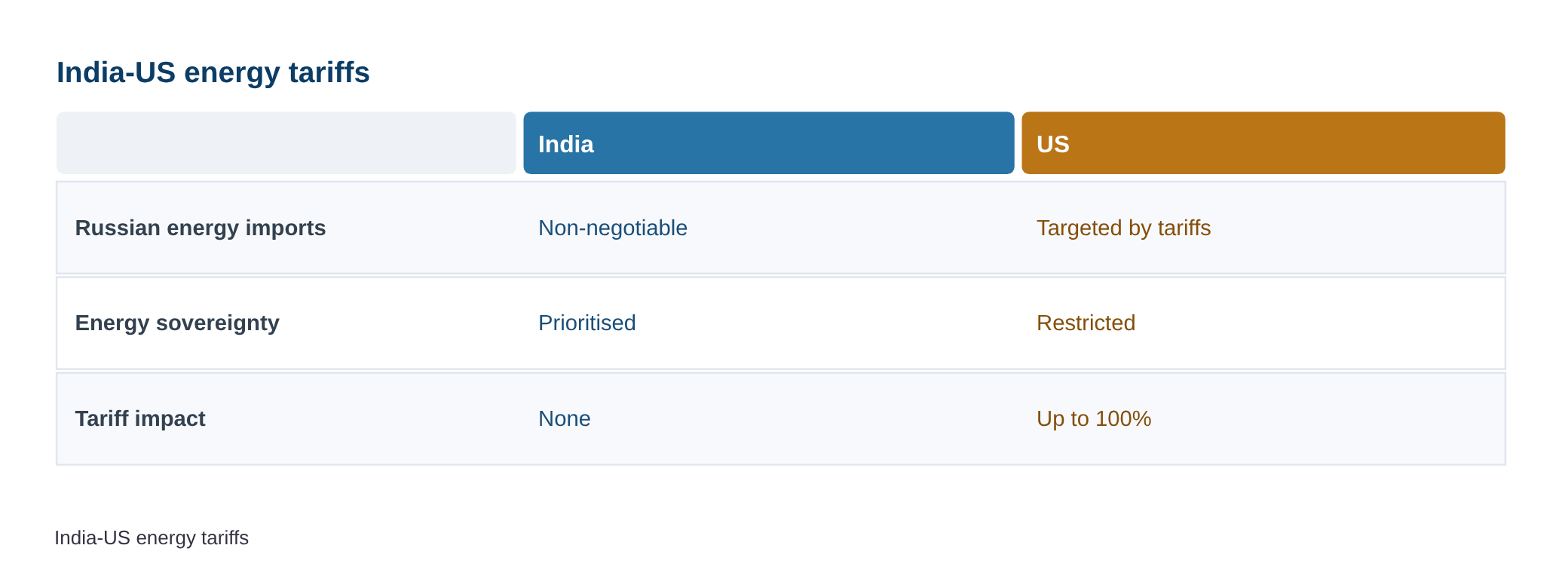
Reports indicate that India has drawn ‘red lines’—non-negotiable positions—regarding its energy imports from Russia, despite US pressures to reduce such purchases. This development underscores the complexities of India’s foreign policy in balancing its strategic partnerships with the US while safeguarding its economic and energy sovereignty.
Background
- India’s energy security strategy has historically relied on diversified import sources, including Russia, to ensure affordability and supply stability, particularly given the volatility in global oil markets.
- The United States, under its recent legislation, has imposed stringent tariffs—up to 100%—on countries importing Russian energy, aiming to curtail Russia’s revenue streams amid the ongoing geopolitical conflict.
- India’s participation in the Quad (Quadrilateral Security Dialogue) and its deepening military cooperation with the US, including joint exercises like the ‘Yudh Abhyas’, reflect a strategic convergence in the Indo-Pacific region.
- The US-India relationship has evolved into a ‘comprehensive global strategic partnership’, encompassing defence, technology, and trade, but it remains subject to divergent national interests.
- India’s foreign policy doctrine of ‘strategic autonomy’ emphasizes the primacy of national interest in decision-making, particularly in areas such as energy procurement and trade.
- Recent geopolitical shifts, including the Russia-Ukraine conflict and US-China tensions, have intensified the need for India to navigate its foreign policy with precision to avoid over-dependence on any single power.
What are India’s ‘Red Lines’ in the India-US Strategic Dialogue?
- **Energy Security as a Non-Negotiable Priority**: India’s red lines are anchored in its constitutional and policy commitment to ensuring energy security for its 1.4 billion citizens. This includes maintaining access to affordable and reliable energy sources, irrespective of external pressures.
- **Rejection of Coercive Trade Measures**: India has historically opposed unilateral tariffs or sanctions imposed by external powers that disrupt its energy procurement strategies, viewing such measures as infringements on its economic sovereignty.
- **Strategic Autonomy in Foreign Policy**: The concept of strategic autonomy—enshrined in India’s foreign policy doctrine—requires that India reserves the right to pursue its national interests without external imposition, particularly in areas like defence and energy.
- **Diversification of Energy Sources**: India’s energy import strategy prioritizes diversification to mitigate risks associated with supply disruptions, price volatility, or geopolitical pressures. This includes continued engagement with Russia, despite US objections.
- **Multilateralism and Rule-Based Order**: India advocates for a rules-based international order where decisions are made through multilateral forums rather than unilateral diktats, reinforcing its stance against coercive trade practices.
- **Balancing Strategic Partnerships**: While India values its strategic partnership with the US, it seeks to ensure that this relationship does not compromise its autonomy in critical policy domains, such as energy and defence procurement.
- **Domestic Political Consensus**: India’s red lines enjoy broad political and public support, reflecting a national consensus on the need to prioritize domestic priorities over external pressures.
- **Diplomatic Leverage**: By drawing red lines, India aims to signal to the US that while it values the partnership, it will not yield to demands that undermine its core national interests.
Key Features
| Feature | Significance |
|---|---|
| US Foreign Secretary’s visit | Signals strategic engagement between India and the US, with potential implications for bilateral trade, defence cooperation, and geopolitical alignment in the Indo-Pacific region. |
| India’s ‘red lines’ on energy security | Demonstrates India’s firm stance on maintaining energy autonomy, particularly regarding imports from Russia, despite external pressures. |
| US tariff legislation on Russian energy imports | Highlights the extraterritorial reach of US laws and their potential impact on India’s energy procurement strategies. |
| India-US military exercises | Underscores the deepening defence partnership, reflecting shared strategic interests in countering regional security challenges. |
| Energy security as a national priority | Reinforces India’s commitment to affordable and accessible energy sources, aligning with domestic economic and strategic imperatives. |
Why it Matters
Strategic Relations
- The visit underscores the evolving India-US strategic partnership, particularly in the context of the Indo-Pacific and regional security dynamics.
- Military exercises and defence cooperation serve as tangible evidence of mutual trust and shared strategic objectives.
- The visit may influence the trajectory of the Quadrilateral Security Dialogue (Quad) and broader multilateral engagements in the region.
Energy Security
- India’s refusal to compromise on energy imports from Russia highlights its prioritisation of energy security and affordability.
- The US tariff legislation poses a direct challenge to India’s energy procurement flexibility, testing the resilience of bilateral relations.
- The episode reflects the broader geopolitical tensions between energy security imperatives and external regulatory pressures.
Economic Diplomacy
- The visit is likely to feature negotiations on trade, tariffs, and economic cooperation, with potential implications for India’s export competitiveness.
- The US tariff law exemplifies the extraterritorial application of domestic legislation, raising questions about its compatibility with international trade norms.
- Energy and trade negotiations may set precedents for future economic engagements between the two nations.
Geopolitical Positioning
- India’s stance on energy imports underscores its policy of strategic autonomy, balancing relations with multiple global powers.
- The visit may influence India’s role in global energy markets and its approach to sanctions regimes imposed by other nations.
- The episode highlights the complexities of navigating relations with major powers while safeguarding national interests.
Challenges
1. Extraterritorial Application of US Tariff Laws
- The US tariff legislation on Russian energy imports may compel India to reconsider its energy procurement strategies, potentially increasing costs.
- Such laws challenge the principle of sovereign autonomy in foreign policy decisions, particularly in energy and trade matters.
- India may need to explore alternative energy sources or negotiate exemptions to mitigate the impact of these tariffs.
UPSC Link: GS II: Bilateral Relations
2. Balancing Strategic Autonomy and Alliances
- India’s refusal to compromise on energy security highlights its commitment to strategic autonomy, even in the face of external pressures.
- However, this stance may strain relations with the US, a key strategic partner, and necessitate careful diplomatic navigation.
- India must balance its alliances with major powers while safeguarding its national interests and sovereignty.
UPSC Link: GS II: Foreign Policy
3. Ensuring Energy Affordability and Security
- India’s energy security is contingent on affordable and accessible sources, which may be threatened by external pressures such as US tariffs.
- The country must diversify its energy mix and invest in domestic production to reduce reliance on imports.
- Diplomatic efforts to secure exemptions or alternative arrangements will be critical to maintaining energy stability.
UPSC Link: GS III: Energy Security
4. Navigating Multilateral Sanctions Regimes
- India’s energy imports from Russia place it in a position where it must navigate sanctions regimes imposed by other nations.
- This requires a nuanced approach to diplomacy, balancing compliance with international norms and safeguarding national interests.
- The episode underscores the challenges of adhering to multilateral frameworks while pursuing independent foreign policy objectives.
UPSC Link: GS II: International Organisations
5. Managing Public Perception and Domestic Expectations
- India’s firm stance on energy security resonates with domestic expectations of sovereignty and self-reliance.
- However, prolonged negotiations or concessions may lead to public scrutiny or political backlash.
- The government must manage expectations while ensuring that its diplomatic efforts yield tangible benefits for the nation.
UPSC Link: GS II: Governance
Challenges — UPSC Perspective
| Issue | Concern |
|---|---|
| US tariff legislation on Russian energy imports | Potential increase in energy costs and disruption of procurement strategies |
| Strategic autonomy vs. alliance obligations | Risk of strained relations with key partners while maintaining sovereignty |
| Energy affordability and security | Threat to domestic economic stability and national security |
| Extraterritorial application of foreign laws | Challenge to sovereign decision-making in trade and energy policies |
| Public and political expectations | Need to balance domestic sentiment with diplomatic pragmatism |
Way Forward
- Conduct a comprehensive review of India’s energy procurement strategies to identify alternative sources and reduce reliance on imports from high-tariff regions.
- Engage in bilateral negotiations with the US to seek exemptions or mitigations under the tariff legislation, highlighting India’s strategic importance in the Indo-Pacific.
- Accelerate domestic energy production, including renewable sources, to enhance energy security and reduce vulnerability to external pressures.
- Strengthen diplomatic channels with Russia to explore long-term energy agreements that align with India’s affordability and security priorities.
- Develop contingency plans for energy supply disruptions, including strategic reserves and diversified procurement routes.
- Enhance public communication to explain the government’s stance on energy security and the rationale behind its diplomatic negotiations.
- Collaborate with like-minded nations to advocate for reforms in the global energy market that prioritise affordability and accessibility for developing economies.
UPSC Value Addition
Keywords for Mains Answer-Writing
India-United States strategic partnership · energy security · diplomatic red lines · tariff diplomacy · Hindustan Strategic Petroleum Reserves Limited (HSPRL) · Hind-Pasific region · geopolitical autonomy · United States Tariff Act 2026 · India-Russia energy relations · strategic autonomy in foreign policy
Concept Flow
US imposes extraterritorial tariff legislation targeting Russian energy imports → India’s energy security is challenged by potential cost increases and procurement disruptions → India asserts ‘red lines’ on energy autonomy, refusing to compromise on affordability → US Foreign Secretary’s visit becomes a platform for bilateral negotiations on trade and strategic cooperation → India balances strategic autonomy with alliance obligations, navigating geopolitical complexities → Outcome of negotiations influences India’s energy security, economic stability, and strategic partnerships
Prelims Practice Questions
Q1. Consider the following statements regarding the United States Tariff Act 2026:
1. The Act imposes a 100% tariff on countries importing Russian energy products.
2. The Act is aimed at reducing India’s reliance on Russian crude oil imports.
3. The Act includes provisions for exemptions based on strategic partnerships with the United States.
How many of the above statements are correct?
- Only one
- Only two
- All
- None
Answer: Only two — Statement 1 and 2 are correct as per the Act’s provisions. Statement 3 is incorrect as the Act does not mention exemptions based on strategic partnerships.
Q2. Assertion (A): India has drawn a ‘red line’ in its diplomatic negotiations with the United States, refusing to compromise on energy security.
Reason (R): India’s energy needs are met primarily through imports from Russia, and the United States’ tariff policies threaten this supply chain.
Options:
A. Both A and R are true, and R is the correct explanation of A.
B. Both A and R are true, but R is not the correct explanation of A.
C. A is true, but R is false.
D. A is false, but R is true.
- A
- B
- C
- D
Answer: A — Both A and R are true. However, R is not the sole reason for India’s red line; energy security is a broader concern that includes affordability and accessibility in the global market.
Q3. Match the following columns regarding India’s strategic partnerships:
Column I (Country) | Column II (Key Area of Partnership)
——————-|——————————-
A. United States | 1. Nuclear energy cooperation
B. Russia | 2. Defence and military exercises
C. France | 3. Strategic petroleum reserves
D. Saudi Arabia | 4. Civil nuclear cooperation
Options:
A. A-2, B-4, C-1, D-3
B. A-2, B-1, C-4, D-3
C. A-3, B-2, C-4, D-1
D. A-4, B-3, C-1, D-2
- A
- B
- C
- D
Answer: A — The correct matches are: A (United States) – 2 (Defence and military exercises), B (Russia) – 4 (Civil nuclear cooperation), C (France) – 1 (Nuclear energy cooperation), D (Saudi Arabia) – 3 (Strategic petroleum reserves).
Mains Practice Question
✍ Critically examine India’s approach to maintaining strategic autonomy in its foreign policy, particularly in the context of its energy security concerns vis-à-vis the United States. Also, analyse the implications of such an approach for India’s global standing and domestic policy priorities. (15 Marks)
Approach: MODEL-ANSWER SKELETON:
1. **Introduction (2 marks)**: Define strategic autonomy in the context of India’s foreign policy, citing the core principle of non-alignment and its evolution into ‘multi-alignment’. Reference the recent geopolitical tensions involving the United States and Russia.
2. **Energy Security as a Red Line (3 marks)**:
– Explain India’s energy dependency on Russian crude oil (approx. 30-40% of imports) and the rationale behind its refusal to compromise on energy security.
– Highlight the role of Hindustan Strategic Petroleum Reserves Limited (HSPRL) in ensuring supply chain resilience.
– Reference the United States Tariff Act 2026 and its impact on India’s energy import strategy.
3. **Diplomatic Negotiations and Red Lines (3 marks)**:
– Discuss the concept of ‘red lines’ in diplomacy, drawing parallels with India’s stance on issues like Article 370 or CAA.
– Analyse the recent diplomatic standoff between India and the United States, focusing on the refusal to accept unilateral tariff impositions.
– Reference the recent statements by the External Affairs Minister on India’s energy security being ‘non-negotiable’.
4. **Implications for Global Standing (3 marks)**:
– Evaluate the impact of India’s stance on its global image as a ‘rule-abiding’ yet ‘assertive’ middle power.
– Discuss the potential for India to emerge as a leader among Global South nations by resisting coercive diplomacy.
– Reference India’s role in forums like BRICS, G20, and the Quad to illustrate its diplomatic leverage.
5. **Domestic Policy Priorities (2 marks)**:
– Explain how India’s energy security concerns influence domestic policies, such as the push for renewable energy (e.g., National Hydrogen Mission) and strategic petroleum reserves.
– Discuss the economic implications of maintaining energy security, including inflation control and industrial growth.
6. **Conclusion (2 marks)**:
– Summarise the balance between strategic autonomy and global partnerships.
– Offer a balanced view: India’s approach strengthens its sovereignty but may strain alliances; however, it aligns with its long-term vision of a multipolar world order.
Source: amarujala.com
Generated by AanyaAi for educational purpose.
Related guides on our sites
- Current affairs for upsc 2026
- Best PSIR optional coaching for upsc
- Best Law optional coaching for upsc
- Best PSIR optional teacher for upsc

- PM Modi Praises Youth-Led Nasha Mukt Yuva Abhiyan Momentum - September 27, 2026
- राजनाथ सिंह का बड़ा बयान: भारत किसी की ज़मीन कब्ज़ा नहीं करेगा, लेकिन सुरक्षा पर होगा कठोर - September 27, 2026
- Exercise Tarang Shakti 2026: India’s Mega Multi-Nation Air Power Showcase - September 27, 2026

No Comments