


25 Sep J&K Panchayat Polls Delayed: OBC Quota Decision Pending Since 2025
✎ The conduct of panchayat elections in Jammu & Kashmir is contingent upon the implementation of OBC reservation, as mandated under the Panchayati Raj Act, 1993, and the 73rd Constitutional Amendment Act, 1992,
Subject Relevance — Where This Topic Fits
- GS Paper II — Constitutional and Statutory Bodies | GS Paper II — Functions and Responsibilities of the Union and the States | GS Paper III — Decentralised Governance and Local Self-Government
- Prelims: Panchayati Raj Act, 1993, 73rd and 74th Constitutional Amendments, Union Territory of Jammu & Kashmir, State Election Commission (SEC), Other Backward Classes (OBC) Reservation, Delimitation of Constituencies, District Development Councils (DDCs), Block Development Councils (BDCs), Panchayati Raj Institutions (PRIs), Constitutional Provisions for Local Governance
- Essay: The Role of Local Governance in Strengthening Democracy: A Case Study of Jammu & Kashmir, Federalism and Decentralisation: Challenges in Union Territories
Quick Revision: The conduct of panchayat elections in Jammu & Kashmir is contingent upon the implementation of OBC reservation, as mandated under the Panchayati Raj Act, 1993, and the 73rd Constitutional Amendment Act, 1992,
Why is this in the news?
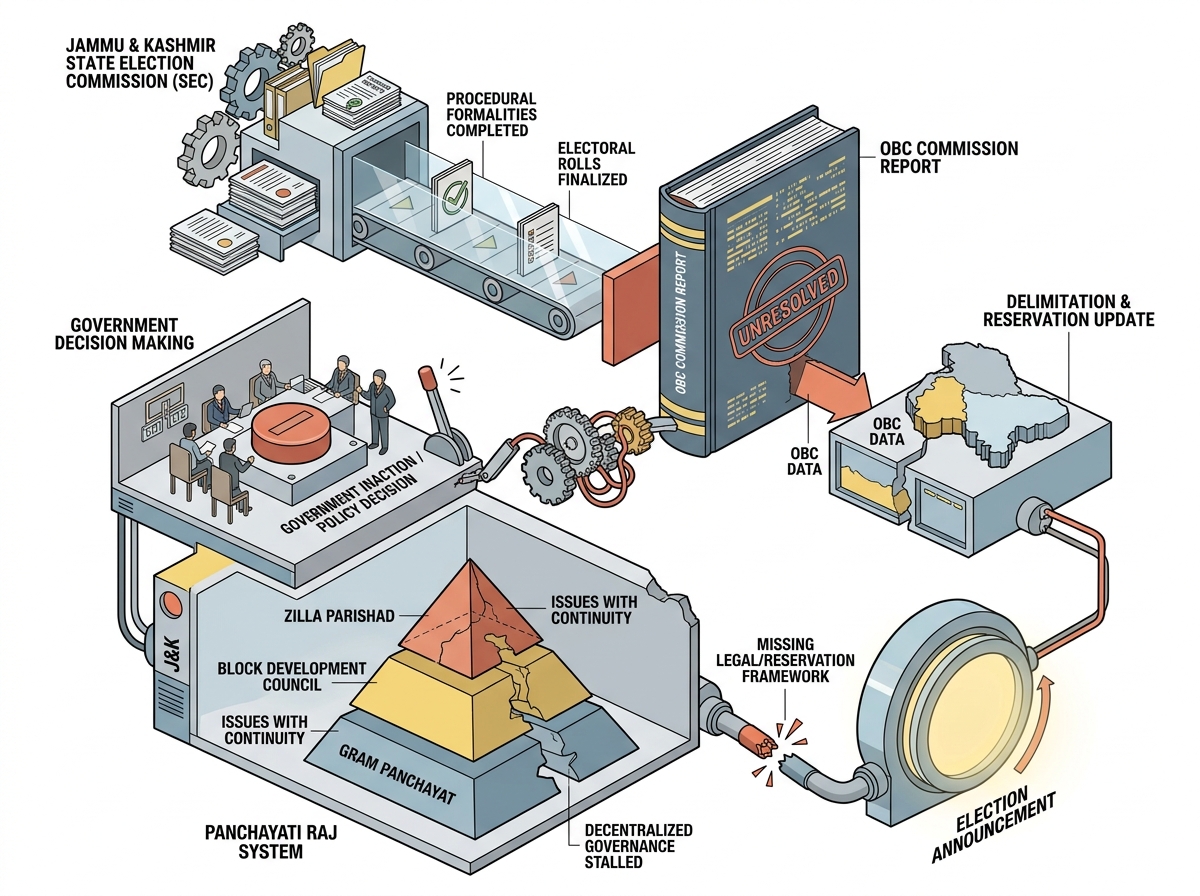
The State Election Commission (SEC) has completed all procedural formalities, but the government’s inaction on the OBC Commission’s report has stalled the electoral process, raising concerns about the continuity of decentralised governance in the region.
Background
- The Panchayati Raj system in India is a three-tier structure of local self-government, established under the 73rd Constitutional Amendment Act, 1992, and operationalised through the Panchayati Raj Act, 1993. This system aims to decentralise governance, empower rural communities, and ensure participatory democracy at the grassroots level.
- Jammu & Kashmir, prior to its conversion into a Union Territory in 2019, had its own Panchayati Raj Act, which did not provide for reservation of seats for Other Backward Classes (OBCs). However, post-reorganisation, the provisions of the Constitution (73rd Amendment) Act, 1992, and the Panchayati Raj Act, 1993, became applicable to the Union Territory, necessitating compliance with OBC reservation norms.
- The terms of the erstwhile Panchayats and Block Development Councils (BDCs) in J&K concluded on January 9, 2024. Before that, the municipalities completed their term in October-November 2023. The term of District Development Councils (DDCs) is set to conclude in November 2025.
- The Jammu & Kashmir government constituted a three-member OBC Commission in 2022, led by a former High Court judge, to recommend the quantum of OBC reservation in PRIs. The Commission submitted its report in February 2025, but the government is yet to take a decision on its implementation, citing the need for further deliberation.
- The State Election Commission (SEC) has repeatedly informed the government that all procedural formalities for conducting panchayat elections have been completed. The SEC has urged the government to provide a timeline for holding the elections, but the administration has adopted a non-committal stance, citing the need to finalise OBC reservation and delimitation processes.
What are Panchayati Raj Institutions (PRIs) and their Role in Local Governance?
- Panchayati Raj Institutions (PRIs) are statutory local self-government bodies established under the 73rd Constitutional Amendment Act, 1992, and the Panchayati Raj Act, 1993, to ensure decentralised governance in rural India. They function as a three-tier system comprising Gram Panchayats (village level), Panchayat Samitis (block level), and Zila Parishads (district level).
- The primary objective of PRIs is to empower rural communities by devolving powers, responsibilities, and resources to local institutions, thereby promoting participatory democracy and inclusive development. They are entrusted with functions such as planning for economic development, social justice, and poverty alleviation, as well as the implementation of schemes like MGNREGA, PMGSY, and Swachh Bharat Mission.
- PRIs are mandated to reserve seats for women (not less than one-third), Scheduled Castes (SCs), Scheduled Tribes (STs), and Other Backward Classes (OBCs) in proportion to their population. This reservation policy aims to ensure social equity and representation of marginalised sections in local governance.
- The State Election Commission (SEC) is a constitutional body responsible for conducting elections to PRIs and urban local bodies. It operates independently of the executive to ensure free and fair elections. The SEC’s role includes delimitation of constituencies, preparation of electoral rolls, and supervision of the electoral process.
- The 73rd Constitutional Amendment Act, 1992, introduced Part IX to the Constitution, which provides a uniform framework for the establishment and functioning of PRIs across India. It mandates the reservation of seats for women and marginalised communities, devolution of powers to PRIs, and regular conduct of elections.
- The Panchayati Raj Act, 1993, is the enabling legislation that operationalises the provisions of the 73rd Amendment. It outlines the structure, functions, and powers of PRIs, as well as the process for conducting elections, delimitation, and reservation of seats.
- The absence of elected PRIs disrupts the continuity of local governance, leading to a vacuum in service delivery, planning, and implementation of welfare schemes at the grassroots level. It also undermines the principles of democratic decentralisation and participatory development enshrined in the Constitution.
- The implementation of OBC reservation in PRIs is a critical step towards ensuring social justice and equitable representation in local governance. The delay in finalising these reservations in Jammu & Kashmir reflects broader challenges in aligning local governance structures with constitutional provisions.
Key Features
| Feature | Significance |
|---|---|
| Absence of elected local bodies in J&K | J&K has been functioning without any elected panchayats, Block Development Councils (BDCs), or District Development Councils (DDCs) since January 2024, January-November 2023, and February 2026 respectively, disrupting grassroots governance and democratic decentralisation. |
| Pending OBC reservation decision | The J&K government has not yet decided on the OBC reservation quota for panchayats, which is mandatory under the Panchayati Raj Act (2019) and the 73rd Constitutional Amendment, delaying the electoral process. |
| Role of the State Election Commission (SEC) | The SEC has completed all procedural formalities for conducting panchayat elections but awaits a formal directive from the government to announce poll dates, highlighting the institutional interdependence in electoral processes. |
| OBC Commission’s report submission | A three-member OBC Commission, led by a former High Court judge, submitted its report on OBC reservation in February 2025, but the government has not yet acted on its recommendations. |
| Government’s non-committal stance | The J&K government’s repeated use of the phrase ‘at an appropriate time’ mirrors the ambiguity in policy communication, raising concerns about the prioritisation of local body elections in the UT’s governance agenda. |
Why it Matters
Governance and Democratic Decentralisation
- The absence of elected local bodies in J&K since 2024 undermines the constitutional principle of democratic decentralisation enshrined in the 73rd Constitutional Amendment Act, 1992, which mandates regular elections to panchayats.
- Local self-governance institutions are critical for grassroots development, service delivery, and participatory democracy, particularly in conflict-affected regions like J&K.
- The delay in holding panchayat elections exacerbates administrative vacuums, leading to reliance on bureaucratic structures and potential erosion of local accountability.
Legal and Institutional Compliance
- The Panchayati Raj Act, 2019, as applicable to Union Territories, requires OBC reservation in proportion to their population in panchayat constituencies, aligning with the 73rd Amendment’s provisions.
- The SEC’s role is constrained by the government’s delay in finalising OBC reservation, as electoral processes cannot commence without statutory compliance.
- The pending OBC Commission report highlights the procedural gaps in translating expert recommendations into policy action, reflecting institutional inefficiencies.
Social Equity and Inclusion
- OBC reservation in panchayats is intended to ensure equitable representation of socially and educationally backward classes, a key objective of the 73rd Amendment.
- The delay in implementing OBC reservation may perpetuate historical underrepresentation of marginalised communities in local governance, contrary to the spirit of inclusive development.
Challenges
1. Procedural Delays in Policy Implementation
- The government’s inaction on the OBC Commission’s report, submitted in February 2025, has stalled the delimitation and reservation process, delaying panchayat elections.
- The SEC’s inability to proceed without government directives underscores the administrative bottlenecks in inter-institutional coordination.
UPSC Link: Constitutional Amendments and Governance
2. Legal and Constitutional Non-Compliance
- Failure to hold panchayat elections violates the 73rd Constitutional Amendment’s mandate for regular elections to local bodies, raising concerns about constitutional governance.
- The absence of OBC reservation in panchayats contravenes the Panchayati Raj Act, 2019, and the principles of social justice enshrined in the Constitution.
UPSC Link: 73rd Constitutional Amendment Act
3. Administrative Vacuum and Governance Gaps
- The prolonged absence of elected local bodies in J&K has created a governance vacuum, with bureaucratic structures filling the void, potentially leading to inefficiencies and reduced accountability.
- The delay in holding elections may erode public trust in democratic institutions and exacerbate perceptions of governance neglect in the UT.
UPSC Link: Local Self-Governance
4. Ambiguity in Policy Communication
- The government’s repeated use of ‘at an appropriate time’ lacks clarity on timelines, raising questions about the prioritisation of local body elections in the UT’s policy agenda.
- Such ambiguity in communication can lead to misinterpretations and undermine public confidence in the electoral process.
UPSC Link: Governance and Policy Communication
5. Institutional Coordination Challenges
- The SEC’s dependence on government directives for poll scheduling highlights the need for stronger institutional mechanisms to ensure timely and coordinated electoral processes.
- Delays in inter-institutional decision-making can disrupt the electoral calendar and undermine the credibility of local governance institutions.
UPSC Link: Institutional Interdependence
Challenges — UPSC Perspective
| Issue | Concern |
|---|---|
| Pending OBC reservation decision | Delays in implementing OBC quota in panchayats violate constitutional and statutory provisions, stalling electoral processes. |
| Absence of elected local bodies | Prolonged vacancy in panchayats, BDCs, and DDCs disrupts grassroots governance and democratic decentralisation. |
| Government’s non-committal stance | Ambiguity in policy communication undermines public trust and institutional credibility. |
| SEC’s procedural constraints | The SEC cannot proceed without government directives, highlighting administrative bottlenecks in electoral processes. |
| OBC Commission report inaction | Failure to act on the OBC Commission’s recommendations perpetuates social inequities in local governance. |
| Constitutional non-compliance | The delay in holding panchayat elections violates the 73rd Constitutional Amendment’s mandate for regular elections. |
Way Forward
- The J&K government must expedite the decision on OBC reservation in panchayats by placing the OBC Commission’s report before the Cabinet for consideration without further delay.
- The government should collaborate with the State Election Commission to finalise a concrete timeline for panchayat elections, ensuring transparency and public accountability.
- The delimitation and reservation of panchayat constituencies should be completed promptly to comply with the Panchayati Raj Act, 2019, and the 73rd Constitutional Amendment.
- Institutional mechanisms for inter-departmental coordination must be strengthened to prevent procedural delays in electoral processes.
- Public awareness campaigns should be conducted to educate stakeholders about the importance of local self-governance and the need for timely elections.
- The SEC should proactively engage with the government to ensure that all requisite preparations for panchayat elections are completed in a time-bound manner.
- The government should address the administrative vacuum in local governance by ensuring interim mechanisms for service delivery and community engagement.
UPSC Value Addition
Keywords for Mains Answer-Writing
Panchayati Raj Institutions (PRIs) · 73rd Constitutional Amendment Act, 1992 · Other Backward Classes (OBC) reservation · State Election Commission (SEC) · Jammu and Kashmir Reorganisation Act, 2019 · Delimitation of constituencies · Local self-government · Constitutional provisions for local governance · Grassroots democracy · Decentralisation of power · Reservation policies in local bodies · Union Territory governance · Panchayati Raj Act · OBC Commission · Elections to rural local bodies
Constitutional & Policy Linkages
- {‘Article’: ‘Article 243B’, ‘note’: ‘Mandates elections to panchayats’}
- {‘Article’: ‘Article 243D’, ‘note’: ‘Provides for reservation in panchayats’}
- {‘Article’: ‘Article 243M’, ‘note’: ‘Excludes certain areas from panchayat jurisdiction’}
- {‘Article’: ’73rd Constitutional Amendment Act’, ‘note’: ‘Establishes three-tier panchayat system’}
Concept Flow
Absence of elected local bodies in J&K since 2024 → Prolonged governance vacuum → Reliance on bureaucratic structures → Erosion of democratic decentralisation → 73rd Constitutional Amendment mandates regular panchayat elections → J&K Panchayati Raj Act, 2019, requires OBC reservation → OBC Commission submits report in February 2025 → Government inaction on report → Delay in delimitation and reservation → SEC completes procedural formalities → Awaits government directive for poll dates → Government’s non-committal stance → Ambiguity in policy communication → Constitutional non-compliance (73rd Amendment) → Legal and institutional gaps → Challenges in inter-institutional coordination → Stalled electoral process → Social inequity in local governance → Marginalised communities underrepresented → Delay in OBC reservation exacerbates exclusion → Contradicts principles of inclusive development
Prelims Practice Questions
Q1. Consider the following statements regarding the Panchayati Raj system in India:
1. The 73rd Constitutional Amendment Act, 1992 mandates reservation for women in Panchayati Raj Institutions (PRIs).
2. The State Election Commission (SEC) is responsible for delimiting constituencies for PRIs.
3. The term of Panchayats in Jammu and Kashmir was last extended in 2024.
How many of the above statements are correct?
- Only one
- Only two
- All three
- None
Answer: All three — Statement 1 is correct as the 73rd Amendment mandates at least one-third reservation for women in PRIs. Statement 2 is incorrect as the delimitation of constituencies for PRIs is typically done by the State government in consultation with the SEC, not solely by the SEC. Statement 3 is correct as the term of Panchayats in J&K concluded in January 2024.
Q2. Assertion (A): The Jammu and Kashmir Reorganisation Act, 2019 extended the applicability of OBC reservation policies to the Union Territory of Jammu and Kashmir.
Reason (R): The 73rd Constitutional Amendment Act, 1992 does not explicitly provide for OBC reservation in Panchayati Raj Institutions.
- Both A and R are true, and R is the correct explanation of A
- Both A and R are true, but R is not the correct explanation of A
- A is true, but R is false
- A is false, but R is true
Answer: Both A and R are true, but R is not the correct explanation of A — Assertion (A) is true as the J&K Reorganisation Act, 2019 brought J&K under the ambit of central laws, including those related to OBC reservation. Reason (R) is true as the 73rd Amendment does not explicitly mandate OBC reservation, leaving it to the discretion of the State. However, R is not the correct explanation of A, as the extension of OBC reservation in J&K is due to the Reorganisation Act, not the 73rd Amendment.
Q3. Match the following pairs related to local governance in India:
Column I
A. 73rd Constitutional Amendment Act, 1992
B. State Election Commission
C. Delimitation of constituencies
D. OBC reservation in PRIs
Column II
1. Conducts elections to PRIs
2. Mandates reservation for women
3. Determines boundaries of Panchayat constituencies
4. Applies to J&K post-2019
Select the correct match:
- A-2, B-1, C-3, D-4; A-1, B-2, C-3, D-4; A-4, B-3, C-2, D-1; A-2, B-4, C-1, D-3
- answer_string_matchings_list_indexes_to_correct_matching_pair_array_indexes_in_json_but_here_we_return_correct_matching_pair_array_indexes_as_0_based_indexes_so_0_1_2_3
- answer_string_matchings_list_indexes_to_correct_matching_pair_array_indexes_in_json_but_here_we_return_correct_matching_pair_array_indexes_as_0_based_indexes_so_0_1_2_3
- answer_string_matchings_list_indexes_to_correct_matching_pair_array_indexes_in_json_but_here_we_return_correct_matching_pair_array_indexes_as_0_based_indexes_so_0_1_2_3
Answer: ? — A. The 73rd Amendment mandates reservation for women in PRIs (Statement 2). B. The State Election Commission conducts elections to PRIs (Statement 1). C. Delimitation of constituencies for PRIs is determined by the State government (Statement 3). D. OBC reservation policies apply to J&K post the Jammu and Kashmir Reorganisation Act, 2019 (Statement 4).
Mains Practice Question
✍ The absence of elected Panchayati Raj Institutions (PRIs) in Jammu and Kashmir for over two years underscores a critical governance deficit in local self-government. Critically examine the constitutional and statutory provisions governing the establishment, functioning, and elections of PRIs in India. Also, analyse the implications of prolonged vacancies in these institutions for grassroots democracy and decentralisation of power. (15 Marks)
Approach: MODEL-ANSWER SKELETON:
1. **Constitutional Framework (3 Marks)**
– 73rd Constitutional Amendment Act, 1992: Mandates establishment of PRIs as a three-tier system (Gram Panchayat, Panchayat Samiti, Zila Parishad).
– Article 243 to 243-O: Provisions for composition, reservation (women, SCs, STs, OBCs), powers, and finances.
– Article 243-M: Exemptions for certain areas (e.g., scheduled areas under Fifth Schedule).
2. **Statutory Provisions (3 Marks)**
– State-specific Panchayati Raj Acts: J&K had its own Act, now superseded by central laws post-2019.
– Role of State Election Commission (SEC): Conducts elections to PRIs (Article 243-K).
– Delimitation and reservation: State government’s role in delimiting constituencies and implementing OBC reservation post-2019.
3. **Governance Deficit in J&K (4 Marks)**
– Prolonged vacancy: Term of PRIs concluded in January 2024; no elections held due to pending OBC reservation decision.
– Impact on decentralisation: Erosion of local self-government, reduced citizen participation, and weakened accountability.
– Constitutional obligation: Article 243-O requires regular elections; prolonged vacancies violate democratic principles.
4. **Implications for Grassroots Democracy (3 Marks)**
– Reduced local representation: Marginalised groups (OBCs, women) lose voice in decision-making.
– Administrative vacuum: Absence of elected bodies leads to bureaucratic control, reducing transparency.
– Erosion of trust: Prolonged delays undermine public confidence in democratic institutions.
5. **Way Forward (2 Marks)**
– Expeditious decision on OBC reservation: Cabinet approval, delimitation, and notification of elections.
– Strengthening SEC: Ensure autonomy and timely conduct of elections.
– Awareness campaigns: Educate stakeholders on the importance of PRIs for inclusive governance.
Source: The Indian Express
Generated by AanyaAi for educational purpose.
Related guides on our sites
- Current affairs for upsc 2026
- Best PSIR optional coaching for upsc
- Best PSIR optional teacher for upsc
- Best teacher of PSIR optional for upsc

- PM Modi Praises Youth-Led Nasha Mukt Yuva Abhiyan Momentum - September 27, 2026
- राजनाथ सिंह का बड़ा बयान: भारत किसी की ज़मीन कब्ज़ा नहीं करेगा, लेकिन सुरक्षा पर होगा कठोर - September 27, 2026
- Exercise Tarang Shakti 2026: India’s Mega Multi-Nation Air Power Showcase - September 27, 2026

No Comments