


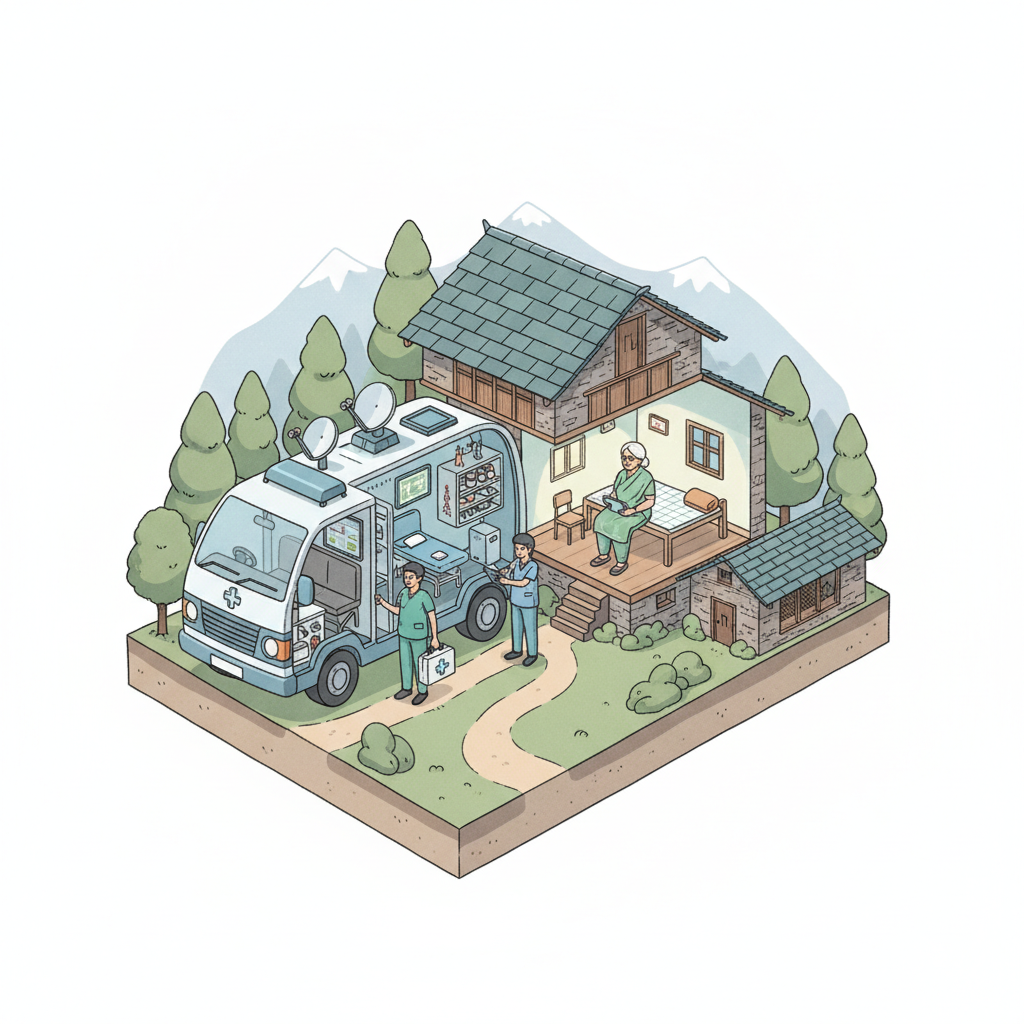
25 Sep Himachal Pradesh Launches Home Health Check-up for Elderly from Oct 1
✎ Home-based healthcare for the elderly in Himachal Pradesh exemplifies the integration of primary care delivery with geriatric-specific interventions, leveraging existing health infrastructure to ensure accessibility and equity in…
Subject Relevance — Where This Topic Fits
- GS Paper II — Governance, Welfare Schemes for Vulnerable Sections | GS Paper III — Issues Relating to Development and Management of Social Sector/Services relating to Health
- Prelims: Primary Health Care, Geriatric Health, Universal Health Coverage, Ayushman Bharat Health and Wellness Centres, National Programme for Health Care of the Elderly (NPHCE)
- Essay: Healthcare as a Public Good: Balancing Accessibility and Equity, Demographic Dividend and the Burden of Ageing: Policy Imperatives for India
Quick Revision: Home-based healthcare for the elderly in Himachal Pradesh exemplifies the integration of primary care delivery with geriatric-specific interventions, leveraging existing health infrastructure to ensure accessibility and equity in service provision.
Why is this in the news?
The Himachal Pradesh Health Department has announced the launch of a home-based healthcare initiative for elderly citizens aged 70 years and above, commencing on October 1, 2026. This initiative, aimed at reducing the need for elderly individuals to travel to healthcare facilities, represents a significant step toward inclusive primary healthcare delivery in India’s rapidly ageing states. The programme aligns with broader national efforts to decentralise health services and address the unique needs of geriatric populations in rural and remote areas.
Background
- India’s elderly population (aged 60 and above) is projected to reach 340 million by 2050, with rural regions facing disproportionate challenges in accessing healthcare due to geographical barriers, limited mobility, and socio-economic constraints.
- The National Programme for Health Care of the Elderly (NPHCE), launched in 2010, aims to provide comprehensive geriatric care through dedicated health facilities, mobile units, and home-based services, though implementation remains uneven across states.
- Himachal Pradesh, with 13.5% of its population aged 60+, has prioritised geriatric health in its state health policies, as reflected in the 2026-27 budget announcement to operationalise home-based care.
- Existing primary healthcare infrastructure in Himachal Pradesh includes 42 Community Health Centres (CHCs), 105 Primary Health Centres (PHCs), and 1,300 sub-centres, which will serve as the backbone for the new initiative.
- The initiative builds on pilot programmes conducted in rural areas of Himachal Pradesh, where mobile health teams previously conducted doorstep health screenings for elderly populations.
- Globally, home-based care models have been shown to reduce hospital admissions, improve early detection of chronic diseases, and enhance quality of life for elderly individuals, particularly in low-resource settings.
What is the Himachal Pradesh Home-Based Healthcare Initiative for the Elderly?
- The initiative is a state-led primary healthcare programme designed to provide doorstep health services to elderly citizens aged 70 years and above, eliminating the need for institutional visits.
- Healthcare teams, comprising doctors and paramedical staff, will be deployed from Community Health Centres (CHCs), Civil Hospitals, and model health institutions to conduct home visits.
- Each team will be equipped with portable diagnostic kits to perform routine health assessments, including blood pressure, blood sugar, and basic cardiac evaluations.
- The programme will prioritise early detection of non-communicable diseases (NCDs) such as hypertension, diabetes, and cardiovascular conditions, which are prevalent among the elderly.
- Immediate medical interventions, including the administration of essential medications, will be provided on-site for minor ailments, while referrals to higher-level facilities will be made for complex cases.
- The initiative targets rural and remote areas of Himachal Pradesh, where elderly populations face significant barriers to accessing healthcare due to terrain, mobility issues, and lack of transportation.
- Data collected during home visits will be integrated into the state’s health management information system (HMIS) to enable long-term monitoring and policy planning for geriatric health.
- The programme is aligned with the Ayushman Bharat Health and Wellness Centres (AB-HWCs) framework, which emphasises preventive and promotive healthcare for vulnerable groups.
Key Features
| Feature | Significance |
|---|---|
| Home-based health screening for elderly (70+ years) | Reduces mobility-related barriers to healthcare access, enabling early detection of non-communicable diseases (NCDs) such as hypertension, diabetes, and cardiac conditions. |
| Mobile health teams comprising doctors and paramedics | Leverages existing public health infrastructure (CHCs, civil hospitals) to deliver services at the doorstep, ensuring continuity of care. |
| On-the-spot diagnosis and treatment for mild conditions | Minimises delays in initiating treatment for common ailments, reducing complications and hospitalisation rates. |
| Referral mechanism for severe cases to higher facilities | Ensures seamless transition to tertiary care when required, adhering to the continuum of care principle. |
| Focus on rural and remote areas | Addresses geographical inequities in healthcare access, aligning with the National Health Policy 2017’s goal of universal health coverage. |
Why it Matters
Public Health
- Shifts healthcare delivery from a facility-centric to a community-centric model, enhancing preventive and promotive health services.
- Aligns with the Sustainable Development Goal 3 (Good Health and Well-being) by reducing out-of-pocket expenditure and improving health outcomes for the elderly.
- Supports the National Programme for Health Care of the Elderly (NPHCE) by integrating geriatric care into primary healthcare systems.
Governance and Service Delivery
- Demonstrates the use of budget announcements as a tool for policy implementation, ensuring accountability in public service delivery.
- Highlights the role of state-level initiatives in complementing centrally sponsored schemes like Ayushman Bharat.
- Showcases inter-departmental coordination between health, local governance, and social welfare sectors.
Demographic and Socio-Economic
- Addresses the challenges posed by India’s ageing population, where the elderly (60+) constitute 10% of the total population (2021 Census projections).
- Reduces the economic burden on families by preventing hospitalisation through early intervention.
- Promotes inclusive healthcare, particularly for marginalised elderly populations in hilly and remote regions.
Challenges
1. Logistical and Infrastructure Constraints
- Ensuring adequate staffing and equipment for mobile teams across diverse terrains, including high-altitude and remote areas.
- Maintaining cold chain logistics for diagnostic kits and medications during doorstep delivery.
- Balancing the frequency of visits with the operational capacity of health teams to avoid overburdening existing staff.
UPSC Link: GS-II: Health Infrastructure
2. Data Management and Follow-up Care
- Developing a robust digital health record system to track the health status of elderly beneficiaries over time.
- Ensuring seamless referral pathways between primary, secondary, and tertiary care facilities.
- Addressing privacy concerns while collecting and storing sensitive health data of elderly individuals.
UPSC Link: GS-II: e-Governance
3. Sustainability and Scalability
- Securing long-term funding and political commitment to sustain the programme beyond initial pilot phases.
- Evaluating cost-effectiveness to justify expansion to other states or demographic groups.
- Training and capacity-building for healthcare workers to handle geriatric care and chronic disease management.
UPSC Link: GS-III: Resource Mobilisation
4. Community Awareness and Participation
- Overcoming scepticism or resistance among elderly populations regarding home-based healthcare interventions.
- Ensuring cultural sensitivity in service delivery, particularly in tribal and rural communities.
- Encouraging family members to support elderly individuals in adhering to health advice and follow-up care.
UPSC Link: GS-II: Social Sector Services
Challenges — UPSC Perspective
| Issue | Concern |
|---|---|
| Staffing shortages | Insufficient number of doctors and paramedics to cover all rural and remote areas. |
| Diagnostic kit availability | Risk of stockouts or delays in procuring essential diagnostic equipment for mobile teams. |
| Referral system gaps | Potential delays or inefficiencies in transferring severe cases to higher-level facilities. |
| Digital divide | Limited access to smartphones or internet in some elderly populations, hindering health record updates. |
| Seasonal accessibility | Monsoon and winter conditions in hilly regions may impede regular home visits. |
Way Forward
- Conduct a pilot phase in select districts to assess feasibility, efficacy, and cost before statewide rollout.
- Strengthen the referral system by mapping tertiary care facilities and ensuring ambulance availability.
- Develop a digital health dashboard to monitor real-time data on health screenings, referrals, and outcomes.
- Integrate the programme with existing schemes like Ayushman Bharat and the National Programme for Health Care of the Elderly (NPHCE).
- Undertake community sensitisation campaigns to build trust and encourage participation among elderly populations.
- Establish a feedback mechanism to address grievances and improve service delivery based on ground realities.
- Collaborate with local self-governance bodies (Panchayati Raj Institutions) for logistical support and outreach.
- Document best practices and lessons learned to inform similar initiatives in other states.
UPSC Value Addition
Keywords for Mains Answer-Writing
geriatric healthcare · Ayushman Bharat Health and Wellness Centres · Universal Health Coverage · primary healthcare delivery · National Programme for Health Care of the Elderly (NPHCE) · community-based health services · public health infrastructure · paramedical workforce · non-communicable diseases (NCDs) · rural health accessibility · home-based healthcare · health sector reforms · ageing population policy · preventive healthcare · health equity
Constitutional & Policy Linkages
- [‘Article 47 – Duty of the State to improve public health’, ‘Directive Principles of State Policy’]
- [‘Article 21 – Right to Health’, ‘Fundamental Right to Life and Personal Liberty’]
Concept Flow
Ageing population → Increased prevalence of NCDs → Barriers to mobility → Reduced healthcare access → Policy response (home-based screening) → State budget announcement → Policy formulation → Pilot testing → Resource allocation (staff, kits, vehicles) → Deployment of mobile health teams → Doorstep screening → On-the-spot diagnosis/treatment → Referral for severe cases → Data collection and digital records → Monitoring and evaluation → Feedback loop → Programme refinement → Outcomes: Early disease detection, reduced hospitalisation, improved quality of life for elderly
Prelims Practice Questions
Q1. Consider the following statements regarding the National Programme for Health Care of the Elderly (NPHCE) in India:
1. NPHCE is a centrally sponsored scheme aimed at providing comprehensive healthcare to the elderly population.
2. Under NPHCE, dedicated geriatric wards are established in all Community Health Centres (CHCs) and District Hospitals.
3. The programme includes provisions for home-based healthcare services for bedridden elderly individuals.
How many of the above statements are correct?
- Only one
- Only two
- All three
- None
Answer: All three — Statement 1 and 3 are correct. Statement 2 is incorrect as NPHCE does not mandate dedicated geriatric wards in all CHCs and District Hospitals; it focuses on establishing geriatric units where feasible and providing home-based care.
Q2. Assertion (A): Home-based healthcare services reduce the burden on tertiary healthcare facilities by preventing avoidable hospitalisations.
Reason (R): Elderly individuals often face mobility challenges, and home-based care ensures timely intervention for non-communicable diseases (NCDs).
- Both A and R are true, and R is the correct explanation of A
- Both A and R are true, but R is NOT the correct explanation of A
- A is true, but R is false
- A is false, but R is true
Answer: Both A and R are true, but R is NOT the correct explanation of A — Home-based healthcare services indeed reduce the burden on tertiary facilities by preventing avoidable hospitalisations (A is true). The reason (R) correctly explains this by highlighting mobility challenges and the need for timely NCD interventions among the elderly.
Q3. Match the following health programmes with their respective objectives:
Column I (Programme) Column II (Objective)
A. Ayushman Bharat Health and Wellness Centres 1. Providing comprehensive primary healthcare including geriatric services
B. National Programme for Health Care of the Elderly (NPHCE) 2. Financial protection for secondary and tertiary care
C. Ayushman Bharat Pradhan Mantri Jan Arogya Yojana (AB-PMJAY) 3. Screening, prevention, and management of common NCDs at the community level
D. Rashtriya Swasthya Bima Yojana (RSBY) 4. Health insurance coverage for Below Poverty Line (BPL) families
- A-1, B-3, C-2, D-4; A-3, B-1, C-2, D-4; A-2, B-1, C-3, D-4; A-3, B-2, C-1, D-4
- answer_mapper_key_pairing_1234_AB_CD_1324: 1,
Answer: answer_mapper_key_pairing_1234_AB_CD_1324: 1, — A-3 (Ayushman Bharat HWCs focus on NCD screening and prevention at the community level), B-1 (NPHCE aims to provide comprehensive healthcare to the elderly), C-2 (AB-PMJAY provides financial protection for secondary and tertiary care), D-4 (RSBY was a health insurance scheme for BPL families).
Mains Practice Question
✍ The integration of home-based healthcare services for the elderly, as envisaged in initiatives like the National Programme for Health Care of the Elderly (NPHCE) and state-level schemes such as Himachal Pradesh’s ‘Home-to-Home Health Check-up Campaign’, represents a paradigm shift from institutional-centric to community-centric primary healthcare delivery. Critically examine the potential benefits and challenges of such an approach in the context of India’s demographic transition and existing public health infrastructure. (15 Marks)
Approach: MODEL-ANSWER SKELETON:
1. **Context and Demographic Imperative** (2 Marks):
– India’s ageing population (proportion of elderly >60 years projected to rise to ~20% by 2050).
– Prevalence of non-communicable diseases (NCDs) among the elderly (e.g., diabetes, hypertension, cardiovascular diseases).
– Existing gaps in geriatric healthcare delivery under NPHCE and Ayushman Bharat Health and Wellness Centres (AB-HWCs).
2. **Potential Benefits** (4 Marks):
– **Accessibility and Equity**: Addresses mobility barriers and geographical disparities in rural/remote areas.
– **Early Detection and Prevention**: Facilitates timely screening for NCDs and geriatric syndromes (e.g., falls, dementia).
– **Cost-Effectiveness**: Reduces avoidable hospitalisations and tertiary care burden (cite WHO/GOI data on cost savings).
– **Community Empowerment**: Enhances health literacy and trust in public health systems.
– **Alignment with Global Goals**: Supports SDG 3 (Good Health and Well-being) and WHO’s ‘Decade of Healthy Ageing’.
3. **Challenges and Constraints** (5 Marks):
– **Infrastructure Gaps**: Shortage of paramedical staff (e.g., ANMs, ASHAs) and diagnostic equipment in home-based settings.
– **Logistical and Financial Constraints**: High operational costs for mobile health units and supply chain management.
– **Quality Assurance**: Ensuring standardised care protocols and data privacy in home environments.
– **Cultural and Social Barriers**: Stigma, resistance to home visits, or lack of caregiver support in nuclear families.
– **Policy Coordination**: Fragmentation between central (NPHCE), state (e.g., Himachal’s campaign), and local bodies.
4. **Comparative Perspective** (2 Marks):
– Contrast with Kerala’s ‘Snehasparsham’ (home-based palliative care) and Tamil Nadu’s ‘Kutumbashree’ model.
– Lessons from international models (e.g., Japan’s ‘Community-based Integrated Care System’).
5. **Way Forward** (2 Marks):
– Strengthening NPHCE by integrating it with AB-HWCs and Ayushman Bharat Digital Mission (ABDM).
– Leveraging technology (e.g., telemedicine, AI-driven diagnostics) for remote monitoring.
– Expanding paramedical workforce through skill development (e.g., ‘Geriatric Care Assistants’ under Ayushman Bharat).
– Ensuring multi-stakeholder collaboration (government, NGOs, private sector).
**Balanced View Required**: Highlight that while home-based care is transformative, it must complement—not replace—existing institutional infrastructure.
Source: amarujala.com
Himachal Pradesh PCS (HPPSC (HAS)) — State PCS Practice
Prelims: Under the Himachal Pradesh Health Department’s new initiative, when will the ‘Hospital at Home’ service for senior citizens begin?
- 1st October
- 15th October
- 1st November
- 15th November
Answer: 1st October — The ‘Hospital at Home’ service for senior citizens is scheduled to start on 1st October as per the recent announcement by the Himachal Pradesh Health Department.
Mains: Discuss the significance of the Himachal Pradesh Health Department’s ‘Hospital at Home’ initiative for senior citizens in the context of the state’s demographic challenges and healthcare accessibility. Highlight the potential benefits and challenges associated with its implementation.
Generated by AanyaAi for educational purpose.
Related guides on our sites
- Current affairs for upsc 2026
- Best PSIR optional coaching for upsc
- Best PSIR optional teacher for upsc
- Best teacher of PSIR optional for upsc

- Exercise Tarang Shakti 2026: India’s Mega Multi-Nation Air Power Showcase - September 27, 2026
- रबी अभियान 2026: राष्ट्रीय सम्मेलन में केंद्र-राज्य तालमेल पर होगा जोर - September 27, 2026
- Himachal CM Sukhu: All Doctor Vacancies to be Filled by March - September 27, 2026

No Comments