


25 Sep Barbados PM Mottley at UN: Urges Action on Global Crises & AI Governance
✎ Global governance reforms are imperative to bridge the gap between knowledge and action, ensuring that international institutions like the UN reflect contemporary geopolitical realities, address climate finance gaps, and govern…
Subject Relevance — Where This Topic Fits
- GS Paper II — International Relations: International Institutions (UN, Security Council Reform), Global Governance, Multilateralism | GS Paper II — International Relations: Regional Organisations (CARICOM, LAC) | GS Paper III — Economy: Climate Finance, Debt Sustainability, Global Financial Architecture | GS Paper III — Science & Technology: Governance of Emerging Technologies (AI), Ethical Frameworks
- Prelims: United Nations General Assembly, United Nations Security Council, Veto Power in UNSC, Small Island Developing States (SIDS), Climate Finance, Artificial Intelligence Governance, Haiti Crisis, Cuba Embargo, Guyana-Venezuela Territorial Dispute, CARICOM
- Essay: The efficacy of multilateral institutions in addressing global challenges: A case study of the United Nations, Technology as a double-edged sword: Balancing innovation with equity in global governance
Quick Revision: Global governance reforms are imperative to bridge the gap between knowledge and action, ensuring that international institutions like the UN reflect contemporary geopolitical realities, address climate finance gaps, and govern emerging technologies such as AI in an inclusive and equitable manner.
Why is this in the news?
The address by Prime Minister Mia Amor Mottley of Barbados at the 81st session of the United Nations General Assembly underscores the urgent need for systemic reforms in global governance to address contemporary challenges such as climate change, artificial intelligence governance, and geopolitical instability. Her remarks highlight the disconnect between global knowledge and action, the inadequacies of existing international institutions, and the necessity for inclusive, equitable, and effective multilateral frameworks to navigate the complexities of the 21st century.
Background
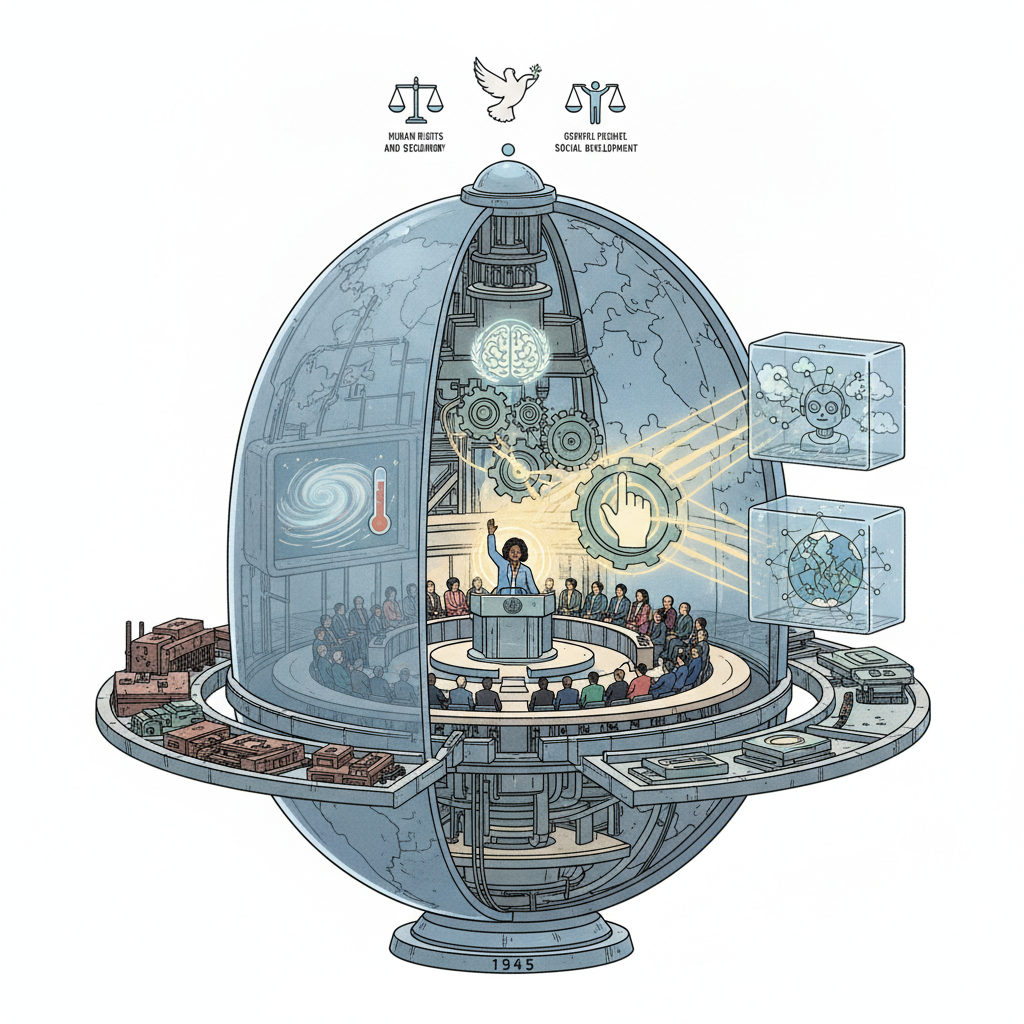
- The United Nations, established in 1945, remains the world’s largest intergovernmental organisation, tasked with maintaining international peace and security, promoting human rights, and fostering social and economic development.
- The UN Security Council, with its five permanent members (P5) holding veto power, has been criticised for its lack of representativeness, particularly in reflecting the geopolitical realities of the post-Cold War era and the rise of new global powers.
- Small Island Developing States (SIDS), including Barbados, are disproportionately affected by climate change, despite contributing minimally to global greenhouse gas emissions, highlighting the inequities in global climate governance.
- The global financial architecture, including institutions like the IMF and World Bank, has been criticised for failing to address the debt vulnerabilities of developing nations, particularly in the context of climate-induced economic shocks.
- Artificial Intelligence (AI) has emerged as a transformative technology with applications across sectors, but its governance remains fragmented, with concerns over bias, surveillance, and unequal access to its benefits.
- The Caribbean region faces persistent challenges, including political instability in Haiti, economic pressures on Cuba due to unilateral coercive measures, and territorial disputes such as the Guyana-Venezuela controversy.
Key Dimensions of Global Governance Reforms as Highlighted by PM Mottley
- **Institutional Reform and Representation**: The UN Security Council’s structure, particularly the veto power of the P5, has been criticised for its lack of responsiveness to contemporary geopolitical realities. Calls for reform include expanding permanent membership to reflect current power dynamics and ensuring equitable representation for regions such as Africa and Small Island Developing States (SIDS).
- **Veto Restrictions in Mass Atrocities**: Barbados’ support for the Franco-Mexican initiative to restrict the use of veto in situations involving mass atrocities underscores the need for accountability in the Security Council’s decision-making process, particularly in preventing genocide, war crimes, and crimes against humanity.
- **Climate Finance and Debt Sustainability**: Climate-vulnerable countries, particularly SIDS, require substantial financial resources to adapt to climate change. Current climate finance flows (approximately $90 billion annually) fall short of the estimated $490 billion needed annually by 2030, necessitating reforms in global financial mechanisms to ensure debt sustainability and affordable financing.
- **Governance of Artificial Intelligence**: AI presents opportunities for advancements in healthcare, disaster prediction, and public services but also risks such as algorithmic bias, surveillance, and misinformation. Governance frameworks must be inclusive, transparent, and globally negotiated to prevent the reproduction of existing power hierarchies.
- **Conflict Prevention and Peacekeeping**: The UN’s role in conflict prevention and mediation requires adequate resourcing and political will to act before crises escalate. Strengthening peacekeeping operations and investing in early warning systems are critical to reducing reliance on reactive military interventions.
- **Regional Stability in the Caribbean**: The Caribbean faces multifaceted challenges, including political instability in Haiti, economic pressures on Cuba due to unilateral measures, and territorial disputes. Multilateral support for regional security and political renewal is essential to address these issues.
- **Equitable Access to Technology**: The governance of emerging technologies like AI must ensure that benefits are distributed equitably across nations, avoiding a scenario where technologically advanced countries and corporations dominate access and control.
- **Multilateralism and Shared Responsibility**: PM Mottley’s emphasis on a ‘crisis of responsibility’ highlights the need for countries to collectively address global challenges through reformed multilateral institutions, rather than pursuing narrow national interests.
Key Features
| Feature | Significance |
|---|---|
| Call for actionable knowledge conversion | Emphasizes the gap between global knowledge and implementation, urging systemic reforms in governance and institutional accountability. |
| UN Security Council reform | Highlights underrepresentation of Africa and Small Island Developing States (SIDS), advocating for equitable power distribution and veto restrictions in mass atrocity situations. |
| AI governance framework | Proposes multilateral rules for AI to prevent discrimination, surveillance overreach, and misinformation, ensuring equitable access and ethical deployment. |
| Climate finance mobilization | Urges scaling up climate adaptation funding from $90 billion to $490 billion annually by 2030 to address vulnerabilities of SIDS and developing nations. |
| Haiti and Caribbean stability | Calls for international support to address security and political crises in Haiti while opposing unilateral coercive measures against Cuba. |
Why it Matters
Global Governance and Institutional Reforms
- Underscores the need for multilateral institutions to adapt to contemporary geopolitical realities, particularly the underrepresentation of Africa and SIDS in decision-making bodies like the UN Security Council.
- Advocates for veto restrictions in cases of mass atrocities to prevent abuse of power and enhance the UN’s credibility in conflict prevention.
- Stresses the importance of collective responsibility in addressing global challenges, moving beyond selective reforms to systemic accountability.
Technological Governance and Ethical AI
- Highlights the dual-use nature of AI, where its benefits in healthcare, disaster prediction, and public services must be balanced against risks of discrimination, surveillance, and misinformation.
- Proposes a rules-based global framework for AI governance, ensuring that all nations, especially developing ones, have a voice in shaping these rules to prevent new forms of technological colonialism.
- Emphasizes the need for transparency and accountability in AI deployment to avoid exacerbating existing inequalities.
Climate Justice and Financial Architecture
- Draws attention to the disproportionate burden of climate change on vulnerable nations, particularly SIDS, which face existential threats despite contributing minimally to global emissions.
- Calls for a paradigm shift in climate finance, integrating debt sustainability, resilience-building, and affordable financing to ensure long-term viability for climate-vulnerable countries.
- Critiques the current inadequacy of climate finance flows ($90 billion vs. required $490 billion annually by 2030) as a failure of global solidarity.
Regional Stability and Multilateral Cooperation
- Addresses the crises in Haiti, emphasizing the need for coordinated international support to restore security, governance, and political renewal.
- Reaffirms opposition to unilateral coercive measures (e.g., embargoes) against Cuba, framing such actions as counterproductive to regional stability and dialogue.
- Supports a peaceful resolution to the Guyana-Venezuela territorial dispute, underscoring the role of diplomacy and international law in preventing conflicts.
Challenges
1. Institutional Reform Paralysis
- The UN Security Council’s inability to reflect contemporary geopolitical realities, particularly the absence of permanent African representation and limited voice for SIDS.
- Selective reforms that fail to address underlying power imbalances, undermining trust in multilateral institutions.
- The veto power’s misuse in situations of mass atrocities, leading to inaction and eroding the UN’s legitimacy.
UPSC Link: GS-II: Important International Institutions
2. AI Governance and Ethical Dilemmas
- Risk of AI exacerbating global inequalities by concentrating power in technologically advanced nations and corporations.
- Potential for AI-driven surveillance and misinformation to destabilize societies and undermine democratic processes.
- Lack of a unified global framework to govern AI, leading to fragmented and inconsistent regulatory approaches.
UPSC Link: GS-III: Science and Technology
3. Climate Finance Deficit
- Insufficient climate finance flows to meet the needs of vulnerable nations, with a gap of approximately $400 billion annually by 2030.
- Debt sustainability concerns for developing nations, which may prioritize repayments over climate adaptation investments.
- Inadequate integration of climate resilience, debt management, and affordable financing in global climate policies.
UPSC Link: GS-III: Environment and Climate Change
4. Regional Security Instability
- Prolonged political and security crises in Haiti, exacerbated by weak governance, gang violence, and lack of international coordination.
- Unilateral coercive measures (e.g., embargoes) against Cuba, which hinder regional cooperation and dialogue.
- Territorial disputes (e.g., Guyana-Venezuela) posing risks to regional stability and economic development.
UPSC Link: GS-II: Regional and Global Groupings
Challenges — UPSC Perspective
| Issue | Concern |
|---|---|
| UN Security Council reform | Lack of representation for Africa and SIDS, veto abuse in mass atrocity situations. |
| AI governance | Risk of discrimination, surveillance, and misinformation; absence of global regulatory framework. |
| Climate finance | Inadequate funding ($90B vs. $490B required annually by 2030); debt sustainability concerns. |
| Haiti’s security crisis | Gang violence, weak governance, and lack of international coordination. |
| Unilateral coercive measures | Counterproductive to regional stability and dialogue, as seen in Cuba’s case. |
Way Forward
- Strengthen multilateral institutions by expanding permanent representation for Africa and SIDS in the UN Security Council.
- Advocate for a global framework on AI governance, ensuring equitable participation of all nations in rule-making.
- Mobilize climate finance through innovative mechanisms (e.g., green bonds, debt-for-climate swaps) to bridge the $400 billion annual gap.
- Enhance international support for Haiti through coordinated peacekeeping, governance reforms, and socio-economic development programs.
- Promote dialogue and diplomatic solutions in territorial disputes (e.g., Guyana-Venezuela) to prevent escalation.
- Establish a UN-led mechanism for veto restraint in cases of mass atrocities to prevent abuse of power.
- Develop ethical guidelines for AI deployment, focusing on transparency, accountability, and bias mitigation.
UPSC Value Addition
Keywords for Mains Answer-Writing
United Nations reform · Security Council restructuring · AI governance · climate finance · Small Island Developing States (SIDS) · veto power in UNSC · mass atrocities prevention · international institutional accountability · global commons · multilateralism · technology and inequality · debt sustainability for climate-vulnerable nations
Constitutional & Policy Linkages
- Article 253 (Legislation for giving effect to international agreements): Enables India’s participation in global governance frameworks.
Concept Flow
Global knowledge and capacity exist but fail to translate into action due to institutional inertia and selective reforms. → Institutional paralysis (e.g., UN Security Council) and power imbalances (e.g., veto abuse) undermine trust and accountability. → Technological advancements (e.g., AI) present opportunities but also risks of inequality and ethical dilemmas without governance. → Climate change disproportionately affects vulnerable nations, exacerbating debt and financial instability. → Regional instability (e.g., Haiti, Cuba, Guyana-Venezuela) threatens global peace and requires multilateral cooperation. → Reforms in governance, finance, and technology are interlinked and must be addressed holistically to restore trust and stability.
Prelims Practice Questions
Q1. Consider the following statements regarding the United Nations Security Council (UNSC):
1. The UNSC currently has five permanent members with veto power.
2. The Franco-Mexican initiative seeks to restrict the use of the veto in situations involving mass atrocities.
3. Small Island Developing States (SIDS) are permanently represented in the UNSC.
4. The UNSC has been reformed to include a permanent seat for Africa.
How many of the above statements are correct?
- Only one
- Only two
- Only three
- All
Answer: Only two — Statement 1 is correct (P5 members: China, France, Russia, UK, USA). Statement 2 is correct (the initiative was proposed by France and Mexico in 2015). Statement 3 is incorrect (SIDS lack assured representation). Statement 4 is incorrect (Africa does not have a permanent seat).
Q2. Assertion (A): The veto power of permanent members in the UNSC has been a subject of repeated reform debates.
Reason (R): The veto power is often used to block action on issues like mass atrocities, limiting the UNSC’s effectiveness.
Options:
A. Both A and R are true, and R is the correct explanation of A.
B. Both A and R are true, but R is not the correct explanation of A.
C. A is true, but R is false.
D. A is false, but R is true.
Answer: ? — A is true (veto power is a long-standing reform debate). R is true and directly explains why A is true (veto use blocks action on critical issues).
Q3. Match the following initiatives/policies with their respective objectives:
Column I (Initiative/Policy)
1. Paris Agreement
2. Sendai Framework for Disaster Risk Reduction
3. UN Framework Convention on Climate Change (UNFCCC)
4. Agenda 2030 for Sustainable Development
Column II (Objective)
A. Global climate action and mitigation
B. Disaster risk reduction and resilience building
C. Comprehensive sustainable development agenda
D. International treaty on climate change adopted in 1992
Options:
A. 1-A, 2-B, 3-D, 4-C
B. 1-B, 2-A, 3-C, 4-D
C. 1-C, 2-D, 3-A, 4-B
D. 1-D, 2-C, 3-B, 4-A
Answer: ? — 1-A (Paris Agreement aims for climate action), 2-B (Sendai Framework focuses on disaster risk reduction), 3-D (UNFCCC is the 1992 treaty), 4-C (Agenda 2030 is the SDG framework).
Mains Practice Question
✍ The assertion that ‘knowledge must be converted into action’ is central to contemporary debates on global governance. Critically examine this proposition in the context of (i) the reform of international institutions, and (ii) the governance of emerging technologies like artificial intelligence. (15 Marks)
Approach: MODEL-ANSWER SKELETON:
1. **Introduction (2 marks)**
– Define ‘knowledge’ as the collective understanding of global challenges (e.g., climate change, AI risks) and ‘action’ as policy implementation.
– Reference Barbados PM Mottley’s UNGA 2026 speech as contemporary context.
2. **Reform of International Institutions (5 marks)**
– **UNSC Reform**: Discuss the need for restructuring to reflect contemporary power dynamics (e.g., absence of permanent African seat, SIDS representation). Cite the Franco-Mexican veto initiative on mass atrocities.
– **Institutional Accountability**: Highlight the ‘crisis of responsibility’—how selective reform (e.g., ignoring veto misuse) undermines trust. Reference the UN’s resource constraints in peacekeeping and conflict prevention.
– **Balance of Views**: Contrast the view that reform is necessary for legitimacy (e.g., IBSA, G4 proposals) with arguments for incrementalism (e.g., P5 resistance to dilution of veto power).
3. **Governance of Emerging Technologies (5 marks)**
– **AI Governance**: Argue that AI’s dual-use nature (e.g., healthcare vs. surveillance, misinformation) requires global rules. Reference Barbados PM’s call for inclusive governance, not corporate/tech-advanced country dominance.
– **Frameworks**: Discuss existing mechanisms (e.g., UNESCO Recommendation on AI Ethics, OECD AI Principles) and their limitations in ensuring equitable access and mitigating bias.
– **Balance of Views**: Present the libertarian view (self-regulation by tech firms) vs. the multilateral governance approach (e.g., UN-led treaties).
4. **Conclusion (3 marks)**
– Synthesize: Knowledge without action leads to ‘crisis of responsibility’; action without inclusive governance risks exacerbating inequality and conflict.
– Policy Recommendations: Strengthen UNSC reform (e.g., African permanent seat), adopt binding AI governance frameworks, and mobilize climate finance (e.g., Barbados’ $490B annual target).
– Final Position: The proposition is valid but requires institutional and normative shifts to bridge the ‘knowing-doing gap’.
Source: news.un.org
Generated by AanyaAi for educational purpose.
Related guides on our sites
- Best PSIR optional coaching for upsc
- Best PSIR optional teacher for upsc
- Best teacher of PSIR optional for upsc
- Best PSIR optional coaching in delhi for UPSC

- PM Modi Praises Youth-Led Nasha Mukt Yuva Abhiyan Momentum - September 27, 2026
- राजनाथ सिंह का बड़ा बयान: भारत किसी की ज़मीन कब्ज़ा नहीं करेगा, लेकिन सुरक्षा पर होगा कठोर - September 27, 2026
- Exercise Tarang Shakti 2026: India’s Mega Multi-Nation Air Power Showcase - September 27, 2026

No Comments