


25 Sep India-Africa WASH Collaboration: Key Takeaways for UPSC & State PCS 2026
✎ India’s WASH sector reforms—Jal Jeevan Mission, Swachh Bharat Mission-Gramin, and decentralised governance—offer scalable models for Africa to achieve SDG 6 through knowledge exchange and collaborative governance.
Subject Relevance — Where This Topic Fits
- GS Paper II — International Relations (India-Africa cooperation) | GS Paper III — Environment and Disaster Management (Water and Sanitation)
- Prelims: Swachh Bharat Mission-Gramin, Jal Jeevan Mission, SDG 6, WASH (Water, Sanitation and Hygiene), Field Testing Kits (FTKs), Village Water and Sanitation Committees, Gram Panchayats, Decentralised Governance
- Essay: Sustainable Development Goals: A Global Imperative, South-South Cooperation in Public Health and Sanitation
Quick Revision: India’s WASH sector reforms—Jal Jeevan Mission, Swachh Bharat Mission-Gramin, and decentralised governance—offer scalable models for Africa to achieve SDG 6 through knowledge exchange and collaborative governance.
Why is this in the news?
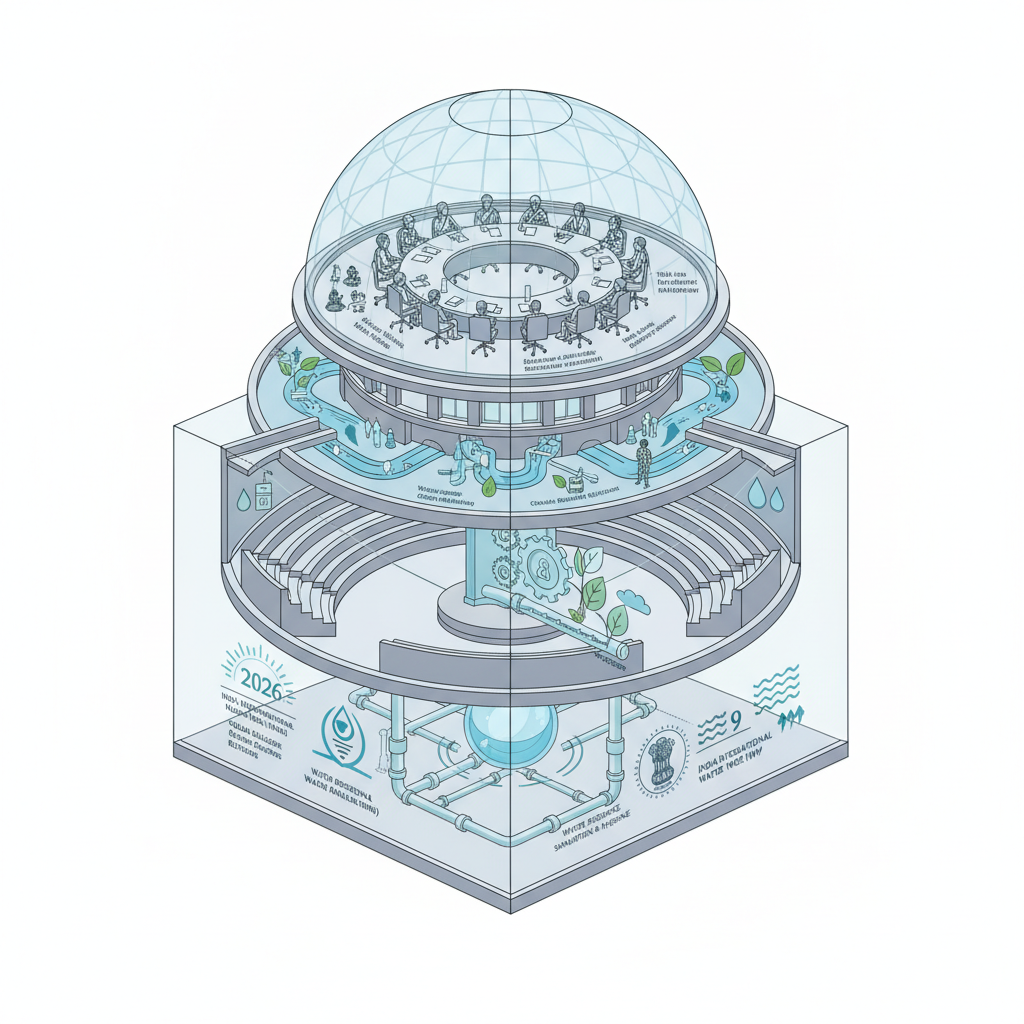
The Second India International WASH Conference, held under the 9th India International Water Week (IIWW) 2026, featured a high-level India-Africa Roundtable on Water, Sanitation, and Hygiene (WASH). This platform brought together 22 African nations, Indian officials, and development partners to deliberate on shared challenges and explore collaborative opportunities in water and sanitation governance, with a focus on knowledge exchange, capacity building, and climate-resilient solutions.
Background
- The India International Water Week (IIWW) is a biennial event organised by the Ministry of Jal Shakti to foster global dialogue on water resource management, sanitation, and hygiene.
- India’s WASH sector reforms have gained international recognition, particularly through flagship programmes like the Jal Jeevan Mission (JJM) and Swachh Bharat Mission-Gramin (SBM-G).
- The United Nations Sustainable Development Goal 6 (SDG 6) aims for universal access to safe water, sanitation, and hygiene, with targets aligned to India’s domestic priorities.
- Africa faces significant WASH deficits, with over 300 million people lacking access to basic drinking water and 700 million lacking safely managed sanitation, necessitating collaborative solutions.
- India’s experience in decentralised governance, community-led sanitation, and digital monitoring of water quality has been cited as a model for replication in African contexts.
- The India-Africa Roundtable is part of India’s broader engagement with Africa under the framework of South-South Cooperation, emphasising shared learning and mutual capacity building.
What is the India-Africa WASH Roundtable?
- A high-level dialogue platform established under the Second India International WASH Conference, held during the 9th India International Water Week (IIWW) 2026 in New Delhi.
- The roundtable convened 22 African countries, Indian officials, development partners, and international organisations to discuss WASH challenges and collaborative opportunities.
- Thematic focus areas included knowledge exchange, capacity building, digital innovations, community-based service delivery, and climate-resilient WASH solutions.
- The event underscored India’s role as a knowledge provider in WASH governance, drawing from the successes of programmes like the Jal Jeevan Mission and Swachh Bharat Mission-Gramin.
- Key discussions revolved around decentralised governance models, women’s participation in water management, and the use of Field Testing Kits (FTKs) for water quality monitoring.
- The roundtable aimed to strengthen South-South cooperation by facilitating mutual learning between India and African nations to accelerate progress toward SDG 6.
- Emphasis was placed on leveraging digital systems for accountability, service delivery, and operational efficiency in WASH programmes.
- The event also highlighted the importance of political commitment, local institutional partnerships, and community ownership in ensuring sustainable WASH outcomes.
Key Features
| Feature | Significance |
|---|---|
| India-Africa Roundtable on WASH (Water, Sanitation and Hygiene) | A high-level platform for knowledge exchange, capacity building, and collaborative exploration of solutions to shared challenges in water, sanitation, and hygiene between India and African nations. |
| Decentralised Governance Model (Panchayati Raj Institutions & Village Water & Sanitation Committees) | Demonstrates the critical role of local institutions in planning, implementing, monitoring, and sustaining rural water and sanitation services. |
| Field Testing Kits for Water Quality Monitoring | Empowers over 24 lakh women to actively participate in local water governance, ensuring community-led monitoring and accountability. |
| Community-Led Behavioural Change (Swachh Bharat Mission-Gramin) | Transformed sanitation into a nationwide social movement through grassroots participation, local leadership, and cultural integration. |
| Digital Systems for Service Delivery (e.g., JJM’s IMIS) | Facilitates transparent, interoperable, and accountable monitoring of water and sanitation services, enhancing operational efficiency. |
Why it Matters
Diplomatic and Global Governance
- Strengthens South-South cooperation under SDG 6 (Clean Water and Sanitation) by fostering mutual learning and joint innovation between India and African nations.
- Demonstrates India’s role as a knowledge partner in global water governance, leveraging its domestic successes to support international capacity-building.
- Enhances India’s soft power in Africa through technical assistance, training, and collaborative projects in WASH infrastructure and governance.
Sustainable Development Goals (SDG 6)
- Contributes to SDG 6.1 (universal and equitable access to safe and affordable drinking water) and SDG 6.2 (access to adequate and equitable sanitation and hygiene) through scalable models of community engagement and infrastructure development.
- Aligns with SDG 6.b (participation of local communities in improving water and sanitation management) by institutionalising decentralised governance structures.
- Supports SDG 5 (Gender Equality) by training women as frontline workers in water quality monitoring and sanitation management.
Institutional and Governance Innovation
- Showcases India’s decentralised governance model as a replicable framework for rural service delivery, emphasising local ownership and accountability.
- Highlights the integration of digital tools (e.g., IMIS under JJM) for real-time monitoring, reducing leakages, and ensuring service reliability.
- Demonstrates the efficacy of political commitment coupled with multi-stakeholder partnerships in achieving large-scale public health outcomes.
Challenges
1. Climate Vulnerability and Resilience in WASH
- Increasing frequency of extreme weather events (droughts, floods) disrupts water supply and sanitation infrastructure, necessitating climate-resilient design and adaptive governance.
- Groundwater depletion and contamination (e.g., arsenic, fluoride) pose persistent challenges, requiring integrated water resource management and community awareness.
- Rising temperatures exacerbate waterborne diseases, demanding proactive surveillance and community-led hygiene practices.
UPSC Link: GS3: Disaster Management, Climate Change
2. Behavioural and Cultural Barriers
- Deep-rooted social norms (e.g., open defecation in certain regions) hinder the adoption of sanitation practices, requiring sustained behaviour change campaigns.
- Lack of awareness about waterborne diseases and hygiene practices limits community participation in maintenance and monitoring of WASH facilities.
- Gender disparities in access to water and sanitation services persist, particularly in rural and marginalised communities.
UPSC Link: GS1: Social Issues, GS2: Governance
3. Infrastructure and Financial Sustainability
- High capital expenditure for piped water supply and sanitation systems in remote areas, coupled with low revenue generation from rural users, strains fiscal sustainability.
- Maintenance and operational costs often exceed initial projections, leading to underutilisation or premature failure of systems.
- Limited availability of skilled local technicians for repair and upkeep of WASH infrastructure.
UPSC Link: GS3: Infrastructure, GS3: Resource Mobilisation
4. Data Gaps and Monitoring Challenges
- Incomplete or outdated data on water quality, coverage, and service levels hampers evidence-based policymaking and targeted interventions.
- Lack of standardised metrics for assessing WASH outcomes across regions and countries complicates cross-learning and benchmarking.
- Digital divide in rural areas limits the effectiveness of real-time monitoring systems and community engagement platforms.
UPSC Link: GS2: Governance, GS3: Technology
Challenges — UPSC Perspective
| Issue | Concern |
|---|---|
| Climate Change Impact | Increased frequency of extreme weather events disrupts water and sanitation infrastructure. |
| Groundwater Depletion | Over-extraction and contamination threaten long-term water security. |
| Behavioural Resistance | Cultural practices and low awareness impede adoption of sanitation and hygiene practices. |
| Financial Constraints | High capital and operational costs challenge sustainable service delivery in rural areas. |
| Institutional Fragmentation | Coordination gaps between central, state, and local bodies affect programme implementation. |
| Technological Gaps | Limited access to digital tools and skilled personnel hinders monitoring and maintenance. |
Government Initiatives — Must-Memorise for Prelims
- Jal Jeevan Mission (JJM)
- Swachh Bharat Mission-Gramin (SBM-G)
Way Forward
- Strengthen bilateral and multilateral partnerships with African nations to co-develop context-specific WASH solutions, leveraging India’s operational expertise.
- Scale up community-led monitoring systems (e.g., women’s SHGs) for real-time data collection on water quality and service delivery gaps.
- Integrate climate resilience into WASH infrastructure design, including flood-resistant designs, rainwater harvesting, and groundwater recharge systems.
- Expand digital governance tools (e.g., IMIS under JJM) to enhance transparency, accountability, and interoperability across jurisdictions.
- Promote South-South knowledge exchange through joint workshops, training programmes, and technology transfer initiatives.
- Address financial sustainability by exploring public-private partnerships (PPPs) and outcome-based financing models for rural WASH projects.
- Enhance capacity building at the grassroots level through targeted training for local technicians, women leaders, and panchayat members.
- Develop standardised metrics and data-sharing protocols to facilitate cross-country learning and benchmarking of WASH outcomes.
UPSC Value Addition
Keywords for Mains Answer-Writing
Sustainable Development Goal 6 · India-Africa cooperation in Water, Sanitation and Hygiene (WASH) · Jal Jeevan Mission (JJM) · Swachh Bharat Mission-Gramin (SBM-G) · Community-based water governance · Decentralised governance of water and sanitation · Climate-resilient WASH solutions · Digital innovation in water service delivery · Field Testing Kits (FTKs) for water quality monitoring · Capacity building in water and sanitation · India International Water Week (IIWW) · Panchayati Raj Institutions in water governance
Concept Flow
Decentralised Governance (Panchayati Raj) → Localised Planning & Implementation → Community Participation (SHGs, VWSCs) → Behavioural Change (SBM-G) → Sustainable Service Delivery (JJM) → Political Commitment (National Missions) → Public Investment → Infrastructure Development → Digital Monitoring (IMIS) → Accountability & Transparency → Shared Challenges (Water Scarcity, Sanitation Gaps) → South-South Cooperation → Knowledge Exchange → Joint Innovation → Global SDG 6 Targets → Climate Vulnerability → Resilient Infrastructure → Adaptive Governance → Community Awareness → Long-term Sustainability → Women’s Empowerment (Field Testing Kits) → Local Water Governance → Gender-Inclusive Policies → Enhanced Service Delivery
Prelims Practice Questions
Q1. Consider the following statements regarding the Jal Jeevan Mission (JJM):
1. JJM was launched on 15 August 2019 with the objective of providing functional household tap water connection to every rural household in India.
2. The mission is implemented under the Ministry of Jal Shakti.
3. JJM mandates 100% community participation in the planning and execution of water supply schemes.
4. The mission includes a provision for the use of Field Testing Kits (FTKs) for water quality monitoring by trained local women.
How many of the above statements are correct?
- Only one
- Only two
- Only three
- All
Answer: All — Statements 1, 2, and 4 are correct. Statement 3 is incorrect as JJM emphasizes community participation but does not mandate 100% community participation in planning and execution.
Q2. Assertion (A): The Swachh Bharat Mission-Gramin (SBM-G) transformed sanitation into a nationwide mass movement through behavior change and local leadership.
Reason (R): SBM-G was implemented under the Ministry of Drinking Water and Sanitation (now merged into the Ministry of Jal Shakti) with a focus on decentralized governance and community involvement.
In the context of the above two statements, which one of the following is correct?
- Both A and R are true and R is the correct explanation of A
- Both A and R are true but R is NOT the correct explanation of A
- A is true but R is false
- A is false but R is true
Answer: Both A and R are true but R is NOT the correct explanation of A — Both the Assertion and Reason are true. The Reason correctly explains how decentralized governance and community involvement under SBM-G enabled behavior change and local leadership, transforming sanitation into a mass movement.
Q3. Match the following initiatives with their respective ministries/departments:
Column I (Initiative) | Column II (Ministry/Department)
— | —
A. Jal Jeevan Mission | 1. Ministry of Housing and Urban Affairs
B. Swachh Bharat Mission-Urban | 2. Ministry of Jal Shakti
C. National Rural Drinking Water Programme | 3. Ministry of Rural Development
D. Swachh Bharat Mission-Gramin | 4. Ministry of Drinking Water and Sanitation (now part of Ministry of Jal Shakti)
Select the correct match:
- A-2, B-1, C-4, D-3
- A-2, B-1, C-3, D-4
- A-1, B-2, C-4, D-3
- A-4, B-1, C-2, D-3
Answer: A-2, B-1, C-3, D-4 — A-2 (Jal Jeevan Mission is under Ministry of Jal Shakti), B-1 (Swachh Bharat Mission-Urban is under Ministry of Housing and Urban Affairs), C-4 (National Rural Drinking Water Programme was under Ministry of Drinking Water and Sanitation, now part of Ministry of Jal Shakti), D-3 (Swachh Bharat Mission-Gramin is under Ministry of Rural Development).
Mains Practice Question
✍ The India-Africa Roundtable on Water, Sanitation and Hygiene (WASH) held during the 9th India International Water Week (IIWW) 2026 underscores the global significance of collaborative governance in achieving Sustainable Development Goal (SDG) 6. Critically examine the role of community-based governance and digital innovation in ensuring sustainable and equitable WASH service delivery in India. Substantiate your answer with reference to the Jal Jeevan Mission (JJM) and Swachh Bharat Mission-Gramin (SBM-G). (15 Marks)
Approach: MODEL-ANSWER SKELETON:
1. **Introduction (2 marks)**
– Define SDG 6 and its targets (universal access to safe water, sanitation, hygiene, and water quality improvement).
– Briefly introduce the India-Africa WASH Roundtable and its focus on knowledge exchange, capacity building, and climate-resilient solutions.
2. **Community-based governance in WASH (5 marks)**
– **Role of Panchayati Raj Institutions (PRIs)**: Highlight the constitutional provisions (73rd Amendment Act, 1992) and their role in decentralized water governance. Cite the example of Village Water and Sanitation Committees (VWSCs) under JJM and SBM-G.
– **Community participation and ownership**: Explain how JJM and SBM-G fostered behavior change, local leadership, and social audits (e.g., Swachhagrahis in SBM-G).
– **Empowerment of women**: Reference the training of over 24 lakh women in using Field Testing Kits (FTKs) for water quality monitoring under JJM.
– **Challenges**: Discuss issues like low awareness, caste-based exclusion, and weak institutional capacity in rural areas.
3. **Digital innovation in WASH service delivery (4 marks)**
– **JJM’s digital platforms**: Mention the use of the ‘Jal Jeevan Mission Dashboard’ for real-time monitoring, grievance redressal, and transparency.
– **Geospatial mapping and IoT**: Explain how digital tools (e.g., GIS, remote sensing) are used for water source mapping and leak detection.
– **Benefits**: Highlight improved accountability, reduced leakages, and enhanced service delivery.
– **Limitations**: Discuss digital divide, lack of last-mile connectivity, and data privacy concerns.
4. **Comparative perspective with Africa (2 marks)**
– Contrast India’s community-based and digital approaches with Africa’s challenges (e.g., rapid urbanization, limited institutional capacity, climate vulnerability).
– Emphasize the potential for mutual learning in climate-resilient WASH solutions and community governance models.
5. **Conclusion (2 marks)**
– Summarize the critical role of community-based governance and digital innovation in achieving SDG 6.
– Stress the need for continued international collaboration (e.g., India-Africa WASH Roundtable) to address global WASH challenges.
Source: PIB (Press Information Bureau)
Generated by AanyaAi for educational purpose.
Related guides on our sites
- Current affairs for upsc 2026
- Best sociology optional coaching for upsc
- Which is best sociology optional coaching for upsc
- Best teacher of sociology optional for upsc

- भारत-अफ्रीका जल एवं स्वच्छता सहयोग: आईआईडब्ल्यूडब्ल्यू 2026 में गोलमेज सम्मेलन - September 25, 2026
- India-Africa WASH Collaboration: Key Takeaways for UPSC & State PCS 2026 - September 25, 2026
- यूपीएससी/पीसीएस परीक्षा दृष्टि: जलवायु लचीलापन और जल वित्त पोषण पर भारत-नीदरलैंड्स सहयोग - September 25, 2026

No Comments