


25 Sep India-Australia BIT & CECA: Boosting Trade & Investment Ties for UPSC 2026
✎ A Bilateral Investment Treaty (BIT) provides legal protection and stability for cross-border investments, reducing risks and encouraging capital flows between signatory countries.
Subject Relevance — Where This Topic Fits
- GS Paper II — International Relations (Bilateral and Regional Groupings) | GS Paper III — Economy (Foreign Trade, Investment, and Economic Cooperation)
- Prelims: Bilateral Investment Treaty (BIT), Comprehensive Economic Cooperation Agreement (CECA), Economic Cooperation and Trade Agreement (ECTA), critical minerals, Indo-Pacific Economic Framework (IPEF), Foreign Direct Investment (FDI), double taxation avoidance agreement (DTAA)
- Essay: The role of economic diplomacy in shaping India’s strategic partnerships in the Indo-Pacific, Balancing economic growth with sustainable resource management: The case of critical minerals
Quick Revision: A Bilateral Investment Treaty (BIT) provides legal protection and stability for cross-border investments, reducing risks and encouraging capital flows between signatory countries.
Why is this in the news?
The announcement by India’s Commerce and Industry Minister, Piyush Goyal, at the ICAI’s Oceania International Conference 2026 in Australia, highlights the ongoing negotiations between India and Australia to finalise a Bilateral Investment Treaty (BIT) and expand their existing Economic Cooperation and Trade Agreement (ECTA) into a Comprehensive Economic Cooperation Agreement (CECA). This development underscores the strategic importance of economic ties between the two nations, particularly in sectors such as critical minerals, education, and renewable energy technologies, as part of broader efforts to deepen bilateral economic integration.
Background
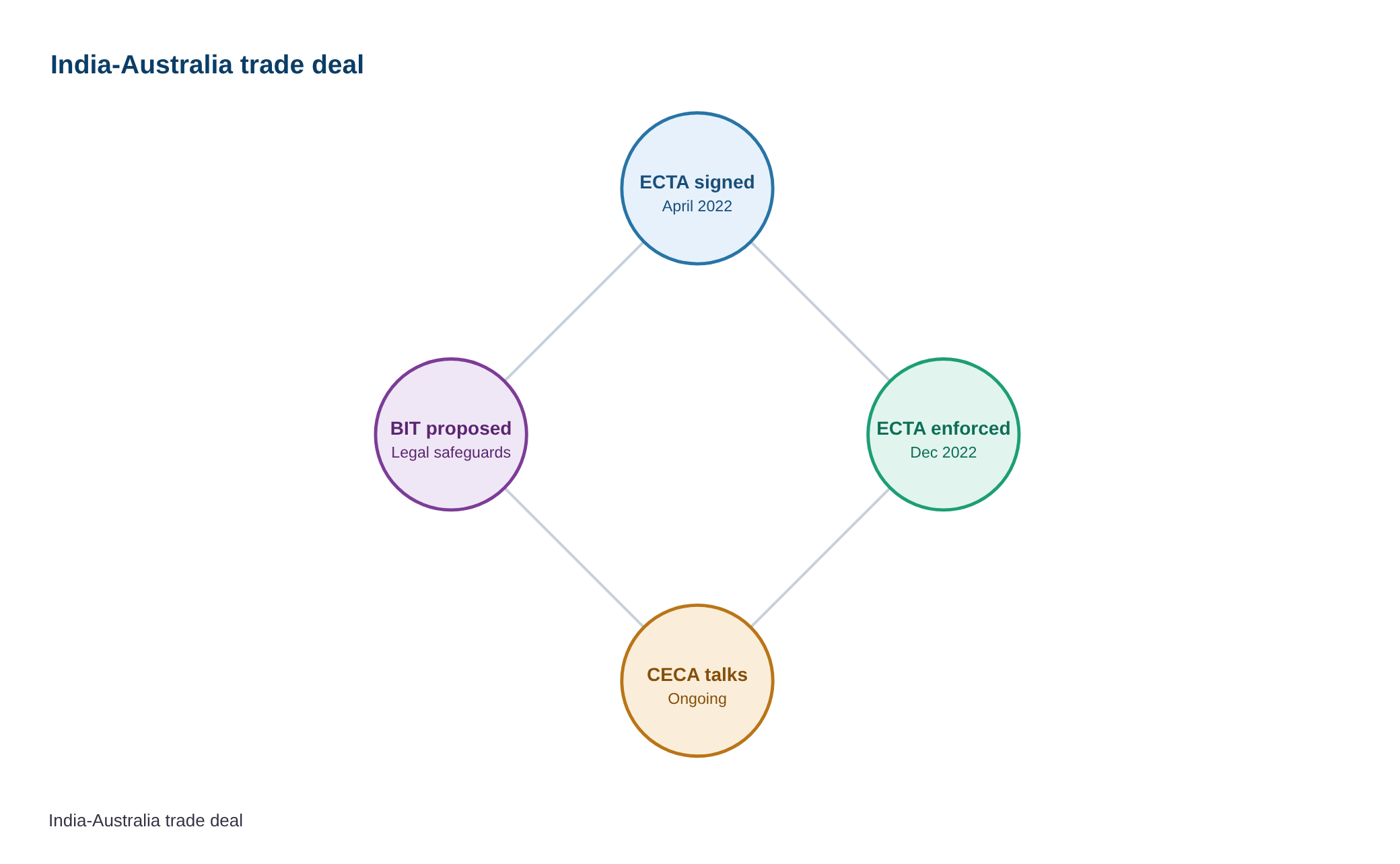
- India and Australia signed the Economic Cooperation and Trade Agreement (ECTA) in April 2022, which entered into force on December 29, 2022, aiming to boost bilateral trade by reducing tariffs on over 6,000 goods and enhancing market access for services.
- The ECTA was a precursor to broader economic engagement, with negotiations for a more comprehensive agreement, the Comprehensive Economic Cooperation Agreement (CECA), already underway to further liberalise trade and investment flows.
- Australia is a significant supplier of critical minerals such as lithium, cobalt, and rare earth elements, which are essential for India’s manufacturing and clean energy transition goals.
- India’s manufacturing and processing ambitions, particularly in sectors like electronics, automotive, and renewable energy, align with Australia’s resource endowments, creating complementarities for deeper economic cooperation.
- The proposed Bilateral Investment Treaty (BIT) aims to provide legal protection and stability for investments between the two countries, reducing risks for businesses and encouraging cross-border capital flows.
- Both countries have been engaged in addressing cross-border taxation challenges, particularly for service providers such as IT companies, to reduce compliance burdens and enhance business ease of doing business.
What is a Bilateral Investment Treaty (BIT)?
- A Bilateral Investment Treaty (BIT) is a legally binding agreement between two sovereign states that establishes the terms and conditions for investments made by investors of one country in the territory of the other.
- BITs typically include provisions for fair and equitable treatment, protection against expropriation, guarantees for repatriation of profits, and mechanisms for dispute resolution, including investor-state arbitration.
- The primary objective of a BIT is to promote and protect foreign direct investment (FDI) by providing a stable and predictable legal framework, thereby reducing investment risks and encouraging capital flows.
- BITs are negotiated under the framework of international investment law and are often aligned with the principles enshrined in the United Nations Conference on Trade and Development (UNCTAD) Investment Policy Framework for Sustainable Development.
- India has signed BITs with over 85 countries, though many of these treaties have been renegotiated or terminated in recent years to align with the country’s evolving investment policy and dispute resolution preferences.
- The proposed India-Australia BIT is expected to build on the existing ECTA and CECA negotiations, ensuring that investment protections are integrated with trade liberalisation measures.
- BITs also often include provisions for cooperation in areas such as capacity building, technical assistance, and the promotion of sustainable investment practices.
- The treaty is expected to enhance investor confidence by providing clear legal safeguards, thereby fostering long-term economic partnerships between the two nations.
Key Features
| Feature | Significance |
|---|---|
| Bilateral Investment Treaty (BIT) | Provides legal protection and dispute resolution mechanisms for cross-border investments, thereby enhancing investor confidence and facilitating two-way capital flows between India and Australia. |
| Comprehensive Economic Cooperation Agreement (CECA) | Expands the existing Economic Cooperation and Trade Agreement (ECTA) to cover a wider range of economic activities, including trade in goods, services, and investment, fostering deeper economic integration. |
| Critical Minerals Collaboration | Leverages Australia’s abundant critical mineral resources and India’s manufacturing and processing capabilities to strengthen supply chain resilience in strategic sectors such as clean energy and technology. |
| Mutual Recognition of Professional Qualifications | Proposes deeper mutual recognition agreements between professional bodies like ICAI, CA ANZ, and CPA Australia to facilitate seamless mobility of skilled professionals, particularly in accounting and finance. |
| Cross-Border Taxation Framework | Addresses double taxation and compliance burdens for service providers, particularly IT companies, by aligning tax policies and reducing regulatory friction for businesses operating across both jurisdictions. |
Why it Matters
Economic Significance
- Enhances bilateral trade and investment flows by reducing regulatory barriers and providing legal safeguards for investors, thereby contributing to economic growth in both nations.
- Strengthens supply chain resilience in critical sectors such as renewable energy, technology, and manufacturing through collaboration on critical minerals and processing capabilities.
- Facilitates knowledge-sharing and skill development by promoting educational exchanges and dual-degree programs, fostering a more skilled workforce in both countries.
Strategic Significance
- Deepens economic ties between India and Australia, positioning both nations as key partners in the Indo-Pacific region amid shifting global trade dynamics.
- Supports India’s ‘Atmanirbhar Bharat’ initiative by securing access to critical inputs and advanced technologies, while Australia benefits from India’s growing market and manufacturing base.
- Promotes regional stability by fostering interdependence in strategic sectors, reducing vulnerabilities to geopolitical disruptions.
Institutional Significance
- Demonstrates the role of professional bodies (e.g., ICAI, CA ANZ) in facilitating economic cooperation by standardizing qualifications and reducing barriers to professional mobility.
- Highlights the importance of multilateral forums (e.g., ICAI’s Oceania International Conference) in fostering dialogue and collaboration between nations on economic and regulatory issues.
Challenges
1. Negotiation Complexity in BIT/CECA
- Balancing investor protection with regulatory sovereignty to ensure that domestic policy space is not unduly constrained by treaty obligations.
- Addressing non-tariff barriers, such as technical standards and sanitary/phytosanitary measures, which can impede trade in goods and services.
- Harmonizing tax policies to prevent double taxation while ensuring compliance with domestic fiscal laws and international obligations.
UPSC Link: GS-III: Bilateral Investment Treaties
2. Supply Chain Vulnerabilities in Critical Minerals
- Ensuring a stable and diversified supply of critical minerals to meet the demands of emerging technologies such as electric vehicles and renewable energy infrastructure.
- Overcoming logistical and infrastructural challenges in mining, processing, and transportation, particularly in remote or underdeveloped regions.
UPSC Link: GS-III: Critical Mineral Security
3. Regulatory and Compliance Burdens
- Streamlining cross-border taxation and compliance procedures to reduce the administrative burden on businesses, particularly IT and professional services firms.
- Aligning regulatory frameworks for professional qualifications to facilitate mutual recognition without compromising standards of competence and ethics.
UPSC Link: GS-III: Regulatory Frameworks in Trade
Challenges — UPSC Perspective
| Issue | Concern |
|---|---|
| Investor-State Dispute Settlement (ISDS) | Risk of frivolous or politically motivated claims against governments, leading to regulatory chill and potential erosion of policy autonomy. |
| Dual-Taxation Avoidance | Complexity in determining tax residency and jurisdictional claims, leading to compliance costs and legal disputes for multinational enterprises. |
| Critical Mineral Supply Chain | Dependence on a limited number of suppliers and processing facilities, exposing vulnerabilities to geopolitical or logistical disruptions. |
| Professional Qualification Recognition | Differences in educational and licensing standards between India and Australia may hinder seamless mobility of professionals. |
| Non-Tariff Barriers | Technical regulations, standards, and certification requirements that may act as hidden barriers to trade in goods and services. |
Way Forward
- Conclude negotiations on the BIT and CECA expeditiously to provide legal certainty and boost investor confidence in both markets.
- Establish joint task forces to address non-tariff barriers and harmonize technical standards in sectors such as renewable energy and IT services.
- Develop a roadmap for critical mineral collaboration, including joint ventures, R&D initiatives, and infrastructure development in mining and processing.
- Strengthen mutual recognition agreements between professional bodies to facilitate the mobility of accountants, engineers, and other skilled professionals.
- Create a bilateral platform for regular consultations between tax authorities to resolve cross-border taxation disputes and align compliance frameworks.
- Promote educational exchanges and dual-degree programs to foster long-term human capital development and cultural ties between the two nations.
- Enhance cooperation in renewable energy technologies, leveraging Australia’s solar/wind potential and India’s manufacturing capabilities to meet climate goals.
UPSC Value Addition
Keywords for Mains Answer-Writing
Bilateral Investment Treaty (BIT) · Comprehensive Economic Cooperation Agreement (CECA) · Economic Cooperation and Trade Agreement (ECTA) · Foreign Direct Investment (FDI) · Investor-State Dispute Settlement (ISDS) · Critical Minerals Security · Cross-border taxation · Mutual Recognition Agreements (MRAs) · India-Australia economic relations · Trade and Investment Facilitation
Concept Flow
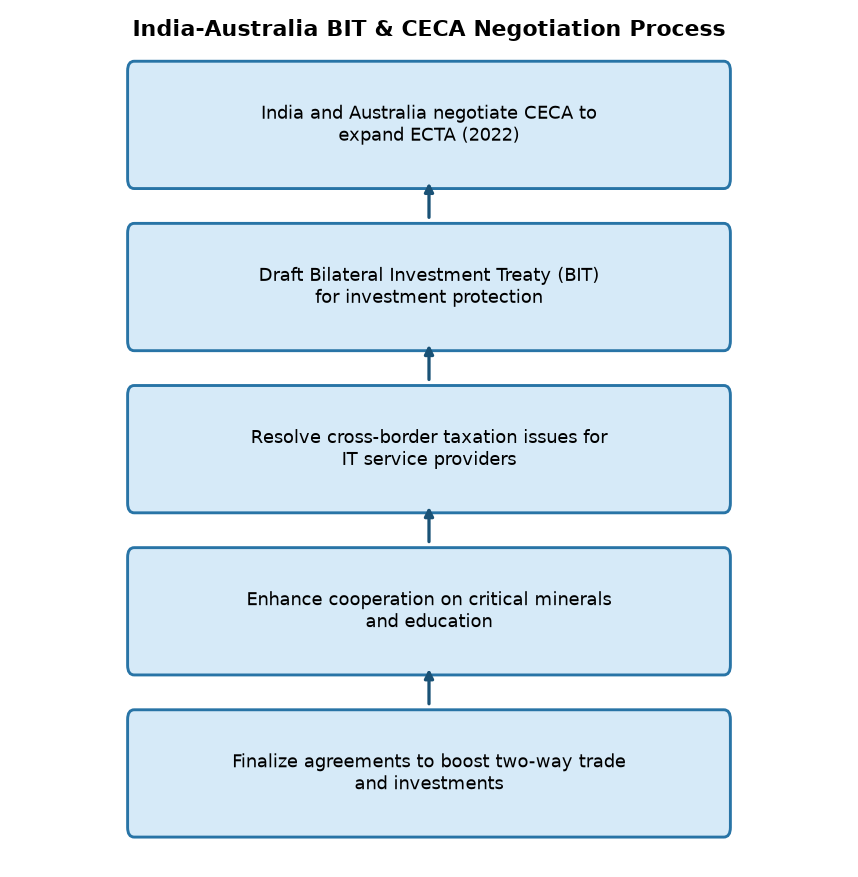
India and Australia initiate negotiations on a Bilateral Investment Treaty (BIT) and Comprehensive Economic Cooperation Agreement (CECA) to deepen economic ties. → Existing Economic Cooperation and Trade Agreement (ECTA) serves as a foundation, but its scope is expanded to cover investment, services, and regulatory alignment. → BIT provides legal protections for investors, while CECA reduces non-tariff barriers and harmonizes standards, facilitating smoother trade and investment flows. → Collaboration on critical minerals and renewable energy technologies strengthens supply chain resilience and supports strategic autonomy in key sectors. → Mutual recognition of professional qualifications and tax policy alignment reduce compliance burdens and enhance business ease of doing business. → Institutional frameworks, such as professional bodies and joint task forces, ensure sustained cooperation and address emerging challenges in implementation.
Prelims Practice Questions
Q1. Consider the following statements regarding the Bilateral Investment Treaty (BIT) between India and Australia:
1. BITs provide protection to investments in other countries.
2. BITs typically include provisions for Investor-State Dispute Settlement (ISDS).
3. India and Australia have already signed a BIT in 2022.
4. BITs aim to promote two-way investments between signatory countries.
How many of the above statements are correct?
- Only one
- Only two
- Only three
- All
Answer: All — Statements 1, 2, and 4 are correct as BITs are designed to protect investments, often include ISDS mechanisms, and aim to promote cross-border investments. Statement 3 is incorrect because the BIT is under negotiation, not yet signed.
Q2. Which of the following is NOT a feature typically associated with a Comprehensive Economic Cooperation Agreement (CECA)?
- Tariff reduction on goods
- Services trade liberalisation
- Investment protection provisions
- Criminalisation of tax evasion
Answer: Criminalisation of tax evasion — A CECA primarily focuses on trade in goods and services, investment facilitation, and economic cooperation. Criminalisation of tax evasion is not a standard feature of such agreements.
Q3. Assertion (A): The Economic Cooperation and Trade Agreement (ECTA) between India and Australia, signed in 2022, includes provisions for mutual recognition of professional qualifications.
Reason (R): Mutual Recognition Agreements (MRAs) are often incorporated into trade agreements to facilitate the movement of professionals across borders.
- Both A and R are true, and R is the correct explanation of A.
- Both A and R are true, but R is not the correct explanation of A.
- A is true, but R is false.
- A is false, but R is true.
Answer: Both A and R are true, but R is not the correct explanation of A. — The ECTA between India and Australia includes provisions for mutual recognition of professional qualifications, and MRAs are indeed incorporated into trade agreements to ease professional mobility.
Mains Practice Question
✍ Critically examine the significance of a Bilateral Investment Treaty (BIT) and a Comprehensive Economic Cooperation Agreement (CECA) in strengthening India-Australia economic ties. (15 Marks)
Approach: MODEL-ANSWER SKELETON:
1. **Introduction (2 marks)**: Define BIT and CECA, and briefly state their objectives in the context of India-Australia relations.
2. **BIT: Objectives and Provisions (4 marks)**:
– Protection of investments (expropriation, fair treatment, national treatment).
– Investor-State Dispute Settlement (ISDS) mechanism.
– Promotion of two-way FDI flows.
– Relevance to sectors like critical minerals, manufacturing, and services.
3. **CECA: Scope and Benefits (4 marks)**:
– Expansion of ECTA (2022) to include deeper trade liberalisation in goods and services.
– Tariff reduction, non-tariff barrier removal, and regulatory cooperation.
– Facilitation of cross-border taxation issues (e.g., IT services).
– Mutual recognition of professional qualifications (e.g., Chartered Accountants).
4. **Strategic Complementarities (3 marks)**:
– Australia’s critical minerals (lithium, cobalt) for India’s manufacturing and energy transition.
– India’s skilled workforce and manufacturing base for Australia’s service sector.
– Educational and technological collaboration (dual degrees, research partnerships).
5. **Challenges and Criticisms (2 marks)**:
– ISDS controversies (sovereignty concerns, regulatory chill).
– Balancing investor rights with domestic policy space.
– Implementation hurdles (e.g., cross-border taxation disputes).
6. **Conclusion (2 marks)**: Summarise the transformative potential of BIT and CECA for India-Australia economic integration, while acknowledging the need for balanced negotiations.
Source: orissapost.com
Generated by AanyaAi for educational purpose.
Related guides on our sites
- Best PSIR optional coaching for upsc
- Best PSIR optional teacher for upsc
- Best teacher of PSIR optional for upsc
- Best PSIR optional coaching in delhi for UPSC

- NAMASTE Scheme: Enhancing Sanitation Workers’ Livelihoods & Safety - November 14, 2026
- एमएसएमई का विशेष अभियान 6.0: स्वच्छता और लंबित मामलों का निपटारा - November 14, 2026
- Sea Vigil-26: Coastal Defence Drills Off Visakhapatnam - November 14, 2026

No Comments