


25 Sep PLI Schemes Boost India’s Pharma & Medical Device Manufacturing
✎ The PLI schemes for pharmaceuticals and medical devices are performance-linked incentive mechanisms aimed at reducing import dependence, enhancing domestic manufacturing capacity, and fostering technological adoption in critical…
Subject Relevance — Where This Topic Fits
- GS Paper III — Indian Economy: Industrial Policy, Manufacturing, and Investment | GS Paper III — Science and Technology: Pharmaceuticals and Medical Devices | GS Paper III — Government Policies and Interventions for Development in various sectors
- Prelims: Production-Linked Incentive (PLI) Scheme, Active Pharmaceutical Ingredients (API), Bulk Drugs, Medical Devices, Make in India, Atmanirbhar Bharat, Pharmaceutical Policy, Import Substitution
- Essay: Industrialisation and Self-Reliance: The Role of PLI Schemes in India’s Economic Transformation, Balancing Global Competitiveness and Domestic Manufacturing: Lessons from India’s Pharmaceutical Sector
Quick Revision: The PLI schemes for pharmaceuticals and medical devices are performance-linked incentive mechanisms aimed at reducing import dependence, enhancing domestic manufacturing capacity, and fostering technological adoption in critical healthcare sectors.
Why is this in the news?
The Press Information Bureau (PIB) of the Government of India, through the Department of Pharmaceuticals, released a press note on 25 September 2026 highlighting the impact of Production-Linked Incentive (PLI) schemes on strengthening India’s pharmaceutical, active pharmaceutical ingredient (API), and medical device manufacturing sectors. The note underscores the role of these schemes in enhancing domestic manufacturing capacity, reducing import dependence, and fostering technological adoption, thereby aligning with the broader objectives of ‘Make in India’ and ‘Atmanirbhar Bharat’.
Background
- India is a global leader in generic pharmaceuticals, supplying over 50% of the world’s vaccines and 20% of generic medicines, but remains heavily dependent on imports for critical inputs such as Active Pharmaceutical Ingredients (APIs) and key starting materials (KSMs).
- The COVID-19 pandemic exposed vulnerabilities in global supply chains, particularly for essential medicines and medical devices, prompting policymakers to prioritise domestic production and reduce import reliance.
- The Union Budget 2020-21 introduced the Production-Linked Incentive (PLI) scheme as a strategic intervention to boost domestic manufacturing across 13 key sectors, including pharmaceuticals and medical devices.
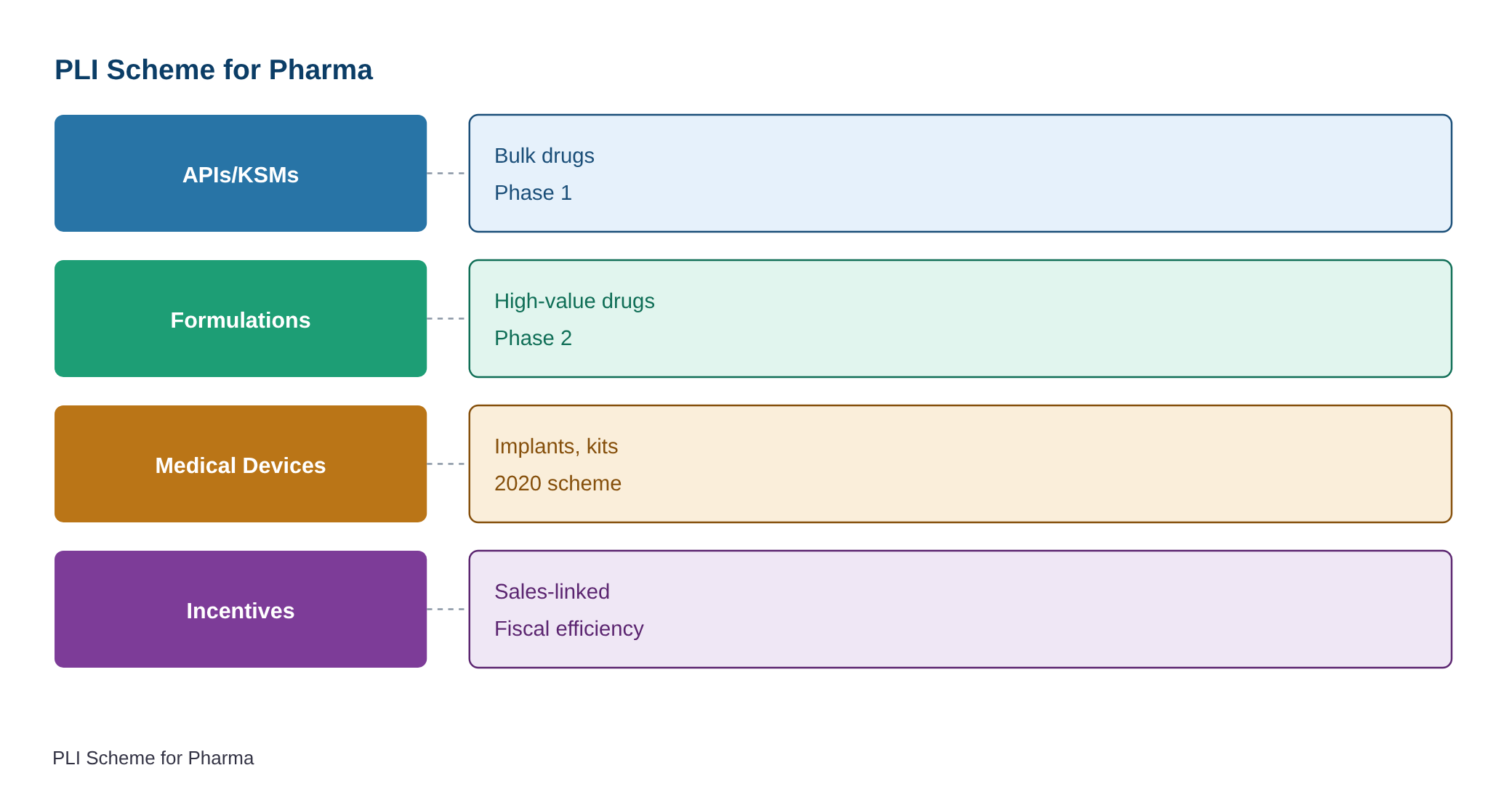
- The PLI scheme for pharmaceuticals was launched in two phases: one targeting bulk drugs (APIs/KSMs/DIs) and another focusing on high-value pharmaceutical formulations and specialised drugs.
- The scheme for medical devices, notified in 2020, aims to enhance domestic manufacturing of high-value medical equipment, including implants, diagnostic kits, and critical care devices.
- The PLI schemes operate on a performance-linked model, where incentives are disbursed based on incremental sales and investment, ensuring fiscal efficiency and accountability.
What are the Production-Linked Incentive (PLI) Schemes for Pharmaceuticals, APIs, and Medical Devices?
- The PLI schemes for pharmaceuticals and medical devices are outcome-based incentive mechanisms designed to catalyse investment, enhance manufacturing capabilities, and reduce import dependence in critical sectors.
- The scheme for bulk drugs (APIs/KSMs/DIs) was approved in 2020 with a financial outlay of ₹6,940 crore to promote the domestic manufacturing of 41 identified critical products, thereby strengthening supply-chain resilience.
- The scheme for pharmaceutical formulations, approved in 2021 with a ₹15,000 crore outlay, targets high-value drugs.
- The PLI scheme for medical devices, notified in 2020, supports the domestic manufacturing of high-value medical equipment such as implants, diagnostic kits, and critical care devices.
- Incentives are disbursed based on incremental sales and investment.
- The Bulk Drugs PLI scheme is designed to attract large investments in greenfield manufacturing projects.
- The Department of Pharmaceuticals, Ministry of Chemicals and Fertilizers, implements the PLI scheme for medical devices.
Key Features
| Feature | Significance |
|---|---|
| Financial Incentives under PLI Schemes | Provides fiscal support to manufacturers to enhance production capacity, reduce import dependency, and stimulate investment in critical pharmaceutical and medical device sectors. |
| Coverage of 41 Bulk Drugs under Bulk Drugs PLI Scheme | Targets key Active Pharmaceutical Ingredients (APIs) and intermediates to strengthen domestic manufacturing and supply chain resilience. |
| Expansion of High-Value Pharmaceutical Products under Pharma PLI Scheme | Encourages production of bio-pharmaceuticals, complex generics, patented drugs, and orphan drugs to diversify India’s pharmaceutical export basket. |
| Medical Devices PLI Scheme | Supports domestic manufacturing of advanced medical equipment to reduce reliance on imports and enhance self-sufficiency in critical healthcare technologies. |
| Employment Generation and Export Boost | Facilitates job creation in manufacturing hubs and increases export earnings through higher domestic production of pharmaceuticals and medical devices. |
Why it Matters
Economic
- Reduces India’s import bill for critical pharmaceutical inputs by 15-20% through domestic production of APIs and intermediates.
- Enhances export competitiveness of Indian pharmaceuticals by shifting focus to high-value, patented, and specialty drugs.
- Attracts foreign direct investment (FDI) in greenfield pharmaceutical and medical device projects, boosting industrial growth.
Strategic
- Strengthens India’s supply chain resilience for essential medicines, reducing vulnerability to global disruptions.
- Promotes self-reliance in strategic healthcare sectors, aligning with the ‘Atmanirbhar Bharat’ and ‘Make in India’ initiatives.
- Supports the production of critical drugs (e.g., penicillin-G, rifampicin) that are essential for public health programs.
Industrial
- Encourages technology adoption and innovation in pharmaceutical manufacturing, including fermentation-based processes.
- Fosters the development of ancillary industries, such as packaging and logistics, through backward linkages.
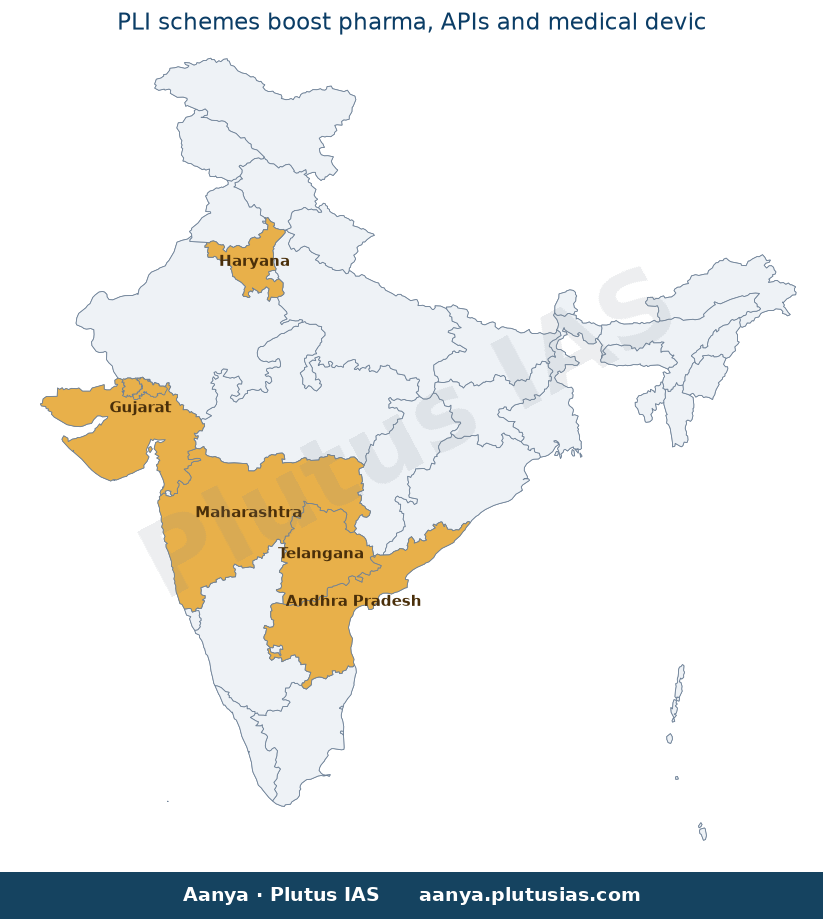
- Promotes clustering of manufacturing units in pharmaceutical hubs (e.g., Visakhapatnam, Gujarat, Maharashtra).
Social
- Creates employment opportunities in tier-2 and tier-3 cities, contributing to balanced regional development.
- Ensures affordable access to essential medicines by reducing dependency on imported raw materials.
- Supports the growth of MSMEs in the pharmaceutical sector, enhancing their participation in global value chains.
Challenges
1. Supply Chain Fragmentation
- Over-reliance on imported intermediates despite PLI schemes, as domestic production of some APIs remains insufficient.
- Logistical bottlenecks in transporting bulk drugs and medical devices from manufacturing hubs to end-users.
- Need for stronger integration between API manufacturers, formulators, and packaging units to optimize supply chains.
UPSC Link: GS3: Industrial Policy
2. Regulatory and Compliance Hurdles
- Stringent regulatory requirements for approval of new drugs and medical devices delay market entry and scaling up.
- Inconsistent implementation of PLI schemes across states due to varying bureaucratic processes and incentives.
- Requirement for global Good Manufacturing Practices (GMP) certification adds to compliance costs for MSMEs.
UPSC Link: GS2: Government Policies
3. Technological Lag in Medical Devices
- Limited domestic capacity for high-end medical devices (e.g., MRI machines, pacemakers) due to lack of R&D investment.
- Dependence on foreign technology transfers for advanced medical equipment manufacturing.
- Need for upskilling workforce in niche areas like robotics-assisted surgery and diagnostic imaging.
UPSC Link: GS3: Science & Technology
4. Market Access and Competition
- Global competition from countries like China and South Korea in bulk drug manufacturing, requiring cost competitiveness.
- Price controls under the National Pharmaceutical Pricing Authority (NPPA) may limit profitability for PLI beneficiaries.
- Export barriers due to stringent quality standards and non-tariff barriers in target markets.
UPSC Link: GS3: Trade & Commerce
5. Sustainability and ESG Concerns
- Environmental impact of pharmaceutical manufacturing, including water pollution and hazardous waste generation.
- Need for adoption of green chemistry practices and circular economy models in API production.
- Compliance with carbon footprint reduction targets under India’s climate commitments.
UPSC Link: GS3: Environment & Sustainability
Challenges — UPSC Perspective
| Issue | Concern |
|---|---|
| API Import Dependency | Despite PLI schemes, domestic production of some critical APIs remains insufficient to meet demand. |
| Regulatory Delays | Approval processes for new drugs and medical devices are time-consuming, delaying market entry. |
| High Compliance Costs | MSMEs face financial strain due to stringent GMP and quality control requirements. |
| Global Competition | China and South Korea dominate bulk drug manufacturing, posing a challenge to Indian exporters. |
| Workforce Skill Gaps | Shortage of trained personnel in advanced pharmaceutical and medical device manufacturing. |
| Logistical Inefficiencies | Transportation and warehousing challenges in distributing bulk drugs and medical devices. |
Government Initiatives — Must-Memorise for Prelims
- Production-Linked Incentive (PLI) Scheme for Bulk Drugs
- Production-Linked Incentive (PLI) Scheme for Pharmaceuticals
- Production-Linked Incentive (PLI) Scheme for Medical Devices
Way Forward
- Strengthen backward integration by incentivizing the production of key intermediates and excipients domestically.
- Accelerate approval processes for new drugs and medical devices through digitalization and single-window clearances.
- Enhance R&D funding for high-end medical devices to reduce reliance on foreign technology transfers.
- Establish dedicated skill development programs in collaboration with industry to address workforce gaps.
- Promote green manufacturing practices in pharmaceutical units to align with ESG goals and reduce environmental impact.
- Expand export promotion initiatives to help PLI beneficiaries access global markets more effectively.
- Improve logistics infrastructure, particularly in pharmaceutical hubs, to reduce supply chain bottlenecks.
- Monitor and evaluate the impact of PLI schemes regularly to identify bottlenecks and adjust incentives as needed.
UPSC Value Addition
Keywords for Mains Answer-Writing
Production Linked Incentive (PLI) Scheme · Pharmaceutical sector · Active Pharmaceutical Ingredients (APIs) · Medical Devices · Bulk Drugs PLI Scheme · Pharmaceuticals PLI Scheme · Medical Devices PLI Scheme · Import substitution · Atmanirbhar Bharat · Make in India · Supply chain resilience · Domestic manufacturing · Pharmaceutical Policy · Healthcare infrastructure · FDI in pharmaceuticals · Technology adoption in manufacturing
Concept Flow
Government identifies strategic sectors (pharmaceuticals, medical devices) for self-reliance under ‘Atmanirbhar Bharat’ and ‘Make in India’. → PLI schemes are introduced with fiscal incentives to attract investment and boost domestic manufacturing. → Manufacturers apply for PLI benefits, focusing on high-value products, APIs, and advanced medical devices. → Investment flows into greenfield projects, enhancing production capacity and supply chain resilience. → Domestic production of critical inputs (APIs, intermediates) reduces import dependency. → Export competitiveness improves as India shifts from bulk drugs to high-value pharmaceuticals and medical devices. → Employment generation and regional development occur in pharmaceutical hubs, contributing to inclusive growth.
Prelims Practice Questions
Q1. Consider the following statements regarding the Production Linked Incentive (PLI) Scheme for Pharmaceuticals and Medical Devices:
1. The PLI Scheme for Bulk Drugs (APIs) was approved in 2020 with a total financial outlay of ₹6,940 crore.
2. The PLI Scheme for Pharmaceuticals was approved in 2021 with a total financial outlay of ₹15,000 crore.
3. The PLI Scheme for Medical Devices was implemented by the Ministry of Health and Family Welfare.
How many of the above statements are correct?
- Only one
- Only two
- Only three
- None
Answer: Only two — Statement 1 and 2 are correct as per the PIB release. Statement 3 is incorrect because the PLI Scheme for Medical Devices is implemented by the Department of Pharmaceuticals, Ministry of Chemicals and Fertilizers, not the Ministry of Health and Family Welfare.
Q2. Assertion (A): The PLI Scheme for Bulk Drugs aims to reduce import dependence on critical Active Pharmaceutical Ingredients (APIs).
Reason (R): The scheme provides financial incentives to promote greenfield manufacturing projects in the pharmaceutical sector.
Options:
A. Both A and R are true, and R is the correct explanation of A.
B. Both A and R are true, but R is not the correct explanation of A.
C. A is true but R is false.
D. A is false but R is true.
Answer: ? — Assertion (A) is true as the PLI Scheme for Bulk Drugs explicitly aims to reduce import dependence on critical APIs. Reason (R) is also true, but it does not directly explain the assertion; the scheme’s primary goal is import substitution, not merely promoting greenfield projects.
Q3. Match the following PLI Schemes with their respective financial outlays:
Column I (Scheme) | Column II (Financial Outlay)
——————————————-|——————————-
A. PLI Scheme for Bulk Drugs (APIs) | 1. ₹15,000 crore
B. PLI Scheme for Pharmaceuticals | 2. ₹6,940 crore
C. PLI Scheme for Medical Devices | 3. ₹5,000 crore
Options:
A. A-2, B-1, C-3
B. A-1, B-2, C-3
C. A-3, B-1, D-2
D. A-2, B-3, C-1
- A
- B
- C
- D
Answer: A — PLI Scheme for Bulk Drugs (APIs) has a financial outlay of ₹6,940 crore (A-2). PLI Scheme for Pharmaceuticals has a financial outlay of ₹15,000 crore (B-1). The financial outlay for the PLI Scheme for Medical Devices is not explicitly mentioned in the given data, but it is not ₹5,000 crore.
Mains Practice Question
✍ The Production Linked Incentive (PLI) Schemes for pharmaceuticals, bulk drugs (APIs), and medical devices represent a strategic shift in India’s industrial policy toward self-reliance and global competitiveness. Critically analyse the objectives, implementation mechanisms, and outcomes of these schemes in the context of India’s pharmaceutical and medical devices sector. Also, examine the challenges faced in achieving the desired outcomes and suggest measures to enhance their effectiveness. (15 Marks)
Approach: MODEL-ANSWER SKELETON:
1. **Introduction (2 Marks)**
– Define the PLI Scheme and its broader context within ‘Atmanirbhar Bharat’ and ‘Make in India’.
– Mention the three specific PLI schemes: Bulk Drugs (APIs), Pharmaceuticals, and Medical Devices.
– State the core objectives: reducing import dependence, enhancing domestic manufacturing, promoting technology adoption, and improving supply chain resilience.
2. **Objectives and Implementation (4 Marks)**
– **Bulk Drugs (APIs) PLI Scheme (2020):** Financial outlay of ₹6,940 crore; focus on 41 identified critical products; aim to reduce import dependence on fermentation-based APIs like Penicillin-G, Rifampicin, and Clavulanic Acid.
– **Pharmaceuticals PLI Scheme (2021):** Financial outlay of ₹15,000 crore; targets high-value pharmaceuticals including biopharmaceuticals, complex generics, patented drugs, and orphan drugs.
– **Medical Devices PLI Scheme:** Implemented by the Department of Pharmaceuticals; aims to boost domestic manufacturing of high-value medical devices.
– Implementation mechanisms: Financial incentives linked to incremental sales and investment; selection of applicants through a transparent process; emphasis on greenfield projects.
3. **Outcomes and Achievements (4 Marks)**
– **Bulk Drugs Scheme:** 48 projects approved; ₹5,210.74 crore invested (exceeding committed ₹4,330 crore); 39 projects operational; domestic production of critical APIs like Penicillin-G and Clavulanic Acid; exports worth ₹560.16 crore; employment generation of 5,127 individuals.
– **Pharmaceuticals Scheme:** 55 applicants selected (including 20 MSMEs); focus on high-value drugs and advanced technologies.
– **Supply Chain Resilience:** Reduced dependence on imports for critical inputs; strengthening of domestic ecosystem (e.g., projects in Visakhapatnam).
– **Global Competitiveness:** Enhanced manufacturing capabilities to meet global standards.
4. **Challenges (3 Marks)**
– **Regulatory and Compliance:** Stringent quality standards and regulatory hurdles for API and medical device manufacturing.
– **Technology Adoption:** High capital costs and technological complexity in adopting advanced manufacturing processes.
– **Market Dynamics:** Competition from established global players and price sensitivity in domestic markets.
– **Supply Chain Bottlenecks:** Dependence on imported raw materials for some APIs and intermediates.
– **MSME Participation:** Limited participation of MSMEs due to high entry barriers and lack of access to finance.
5. **Measures to Enhance Effectiveness (2 Marks)**
– **R&D and Innovation:** Strengthen R&D infrastructure and incentivize innovation in high-value pharmaceuticals and medical devices.
– **Skill Development:** Focus on upskilling the workforce to handle advanced manufacturing technologies.
– **Infrastructure Development:** Invest in common infrastructure facilities (e.g., testing labs, logistics hubs) to reduce costs.
– **Public-Private Partnerships:** Encourage collaborations between industry, academia, and research institutions.
– **Policy Stability:** Ensure long-term policy stability and predictability to attract sustained investments.
– **Export Promotion:** Leverage trade agreements and export promotion councils to enhance market access for domestic manufacturers.
6. **Conclusion (2 Marks)**
– Summarize the significance of PLI schemes in transforming India’s pharmaceutical and medical devices sector.
– Emphasize the need for continuous monitoring, evaluation, and adaptive policy measures to address emerging challenges and sustain growth.
Source: PIB (Press Information Bureau)
Generated by AanyaAi for educational purpose.
Related guides on our sites
- Anthropology VS PSIR
- Best PSIR optional coaching
- Best PSIR optional coaching online
- Best PSIR optional teacher

- PM Modi Praises Youth-Led Nasha Mukt Yuva Abhiyan Momentum - September 27, 2026
- राजनाथ सिंह का बड़ा बयान: भारत किसी की ज़मीन कब्ज़ा नहीं करेगा, लेकिन सुरक्षा पर होगा कठोर - September 27, 2026
- Exercise Tarang Shakti 2026: India’s Mega Multi-Nation Air Power Showcase - September 27, 2026

No Comments