


25 Sep UPSC Alert: Special Campaign 6.0 for Pending Pension Cases Launched
✎ SCDPM 6.0 (2 Oct–31 Oct 2026) is a DARPG-led campaign to reduce pendency, improve record management, and institutionalise cleanliness in government offices, with DOP&PW targeting disposal of 6,500 grievances, 800 appeals, and…
Subject Relevance — Where This Topic Fits
- GS Paper II — Governance, Administration and Challenges | GS Paper III — Human Resource Development and Public Services
- Prelims: Special Campaign for Disposal of Pending Matters (SCDPM), Pension and Pensioners’ Welfare Department (DOP&PW), Administrative Reforms and Public Grievances Department (DARPG), Life Cycle Pension System (LCPS), Pensioners’ Portal, Swachhata Hi Seva
- Essay: Administrative Reforms and Governance: The Role of Special Campaigns in Public Service Delivery, Ease of Living for Senior Citizens: Policy Initiatives and Implementation Challenges
Quick Revision: SCDPM 6.0 (2 Oct–31 Oct 2026) is a DARPG-led campaign to reduce pendency, improve record management, and institutionalise cleanliness in government offices, with DOP&PW targeting disposal of 6,500 grievances, 800 appeals, and review of 847 physical and 653 electronic files, while simplifying pension rules for ease of living.
Why is this in the news?
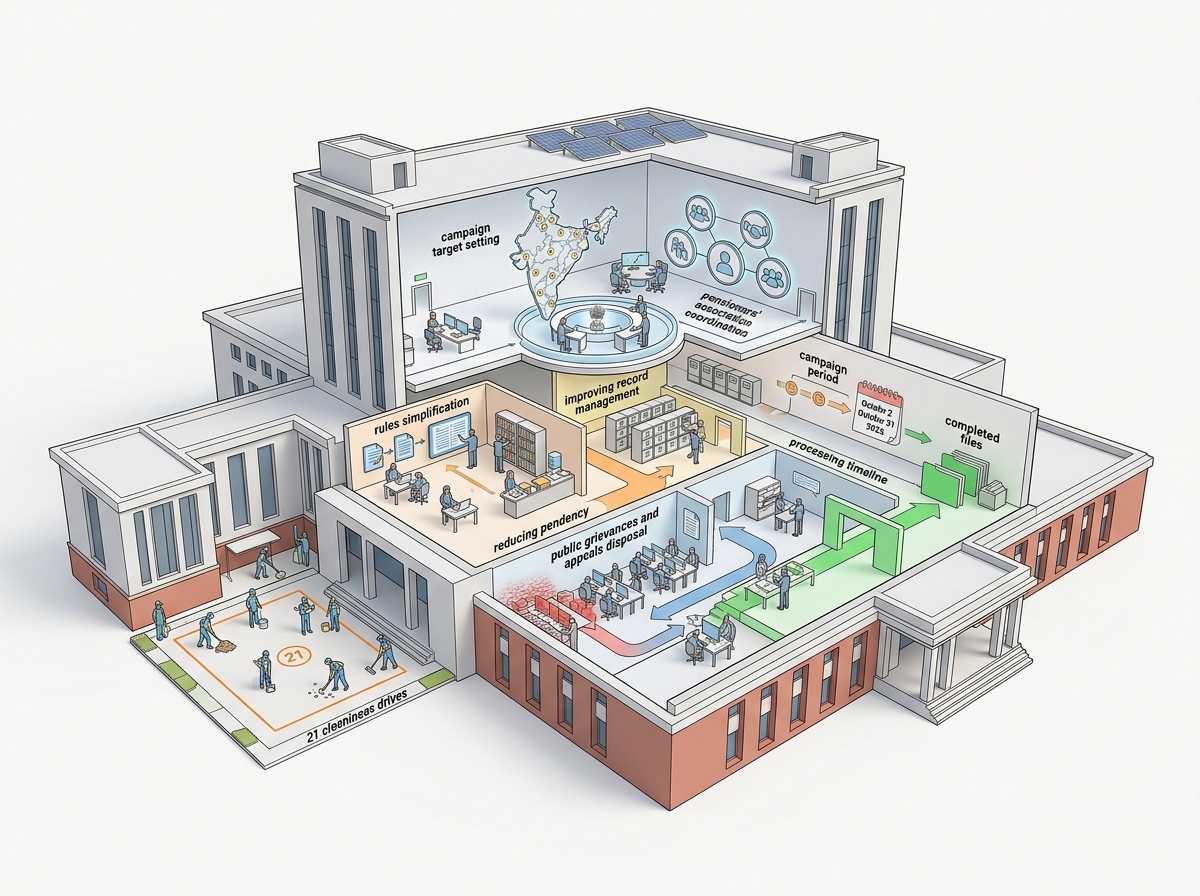
The Department of Pension and Pensioners’ Welfare (DOP&PW) has initiated preparations for Special Campaign for Disposal of Pending Matters (SCDPM) 6.0, scheduled from 2 October to 31 October 2026. This campaign, launched by the Department of Administrative Reforms and Public Grievances (DARPG), aims to reduce pendency, improve record management, and institutionalise cleanliness in government offices, with a focus on simplifying rules for pensioners. The campaign includes targeted disposal of 6,500 public grievances and 800 appeals, and the identification of 21 sanitation sites across India for cleanliness drives in coordination with pensioners’ associations.
Background
- The Department of Administrative Reforms and Public Grievances (DARPG) coordinates SCDPM across all ministries and departments, with a focus on measurable outcomes and citizen-centric governance.
- Pension governance in India is governed by the Central Civil Services (Pension) Rules, 1972, and the Pensioners’ Portal (https://pensionersportal.gov.in), which serves as a single-window platform for pension-related services.
- The Pension and Pensioners’ Welfare Department (DOP&PW) functions under the Ministry of Personnel, Public Grievances and Pensions, and is responsible for the implementation of pension policies for central government employees and pensioners.
- The campaign aligns with the ‘Ease of Living’ agenda for senior citizens, as outlined in the National Policy for Senior Citizens (2011) and the Maintenance and Welfare of Parents and Senior Citizens Act, 2007.
- Previous editions of SCDPM have demonstrated measurable improvements in pendency reduction, record digitisation, and office cleanliness, contributing to enhanced trust in public administration.
What is the Special Campaign for Disposal of Pending Matters (SCDPM) 6.0?
- SCDPM 6.0 is the sixth phase of a time-bound, nation-wide campaign launched by the Department of Administrative Reforms and Public Grievances (DARPG) to reduce pendency in government offices, improve record management, and institutionalise cleanliness and efficiency in public service delivery.
- Key objectives include: (i) reduction of pending cases (grievances, appeals, and files), (ii) strengthening internal monitoring mechanisms, (iii) improving record management through digitisation and physical file reviews, and (iv) simplifying rules and procedures to enhance ease of living for pensioners.
- The Department of Pension and Pensioners’ Welfare (DOP&PW) has set specific targets for SCDPM 6.0, including the disposal of 6,500 public grievances, 800 appeals, and the review of 847 physical and 653 electronic files.
- To ensure citizen participation, DOP&PW has identified 21 sanitation sites across India in collaboration with central government pensioners’ associations, aiming to institutionalise cleanliness and hygiene in office premises.
- The campaign will be monitored through a dedicated team, with daily progress updates uploaded on the SCDPM portal managed by DARPG, ensuring transparency and accountability.
- The campaign also includes the issuance of 23 Office Memoranda (OMs) to simplify pension-related rules and procedures, with an expected revenue generation of ₹25,000 through streamlined processes.
- SCDPM 6.0 is part of a broader agenda to enhance governance efficiency, reduce bureaucratic delays, and improve the quality of life for pensioners, particularly senior citizens who rely on timely and hassle-free pension disbursal.
Key Features
| Feature | Significance |
|---|---|
| Special Campaign for Disposal of Pending Matters (SCDPM) 6.0 | A time-bound, structured initiative to reduce pendency in government departments, ensuring timely delivery of services to pensioners and other stakeholders. |
| Target Setting by Department of Pension & Pensioners’ Welfare (DoPPW) | DoPPW will define quantifiable targets for reducing pending cases, improving record management, and institutionalising cleanliness during the campaign period. |
| Focus on Record Management and Cleanliness | Strengthens institutional mechanisms for digitisation, archival practices, and physical cleanliness, aligning with broader governance reforms under SCDPM. |
| Coordination with Pensioners’ Associations | Leverages central government pensioners’ federations to identify cleanliness sites and ensure participatory governance in the campaign. |
| Monitoring via Dedicated Portal and Team | Real-time progress tracking through the SCDPM portal, enabling transparency and accountability in the implementation of campaign objectives. |
Why it Matters
Governance & Administrative Reforms
- Demonstrates the Government of India’s commitment to reducing pendency in public administration, a critical aspect of the ‘Minimum Government, Maximum Governance’ paradigm.
- Enhances the efficiency of the Department of Pension & Pensioners’ Welfare (DoPPW) by institutionalising systematic review and disposal of pending matters.
- Aligns with the broader objectives of the Department of Administrative Reforms and Public Grievances (DARPG) to improve service delivery and citizen satisfaction.
Pensioners’ Welfare
- Directly addresses the grievances of central government pensioners by setting targets for disposal of 6,500 public grievances and 800 appeals during the campaign period.
- Promotes ‘ease of living’ for pensioners through simplification of rules and issuance of 23 office memoranda aimed at procedural streamlining.
- Ensures timely resolution of pending pension-related cases, reducing financial and administrative hardships for retired government employees.
Institutional Capacity Building
- Strengthens internal monitoring mechanisms within DoPPW, fostering a culture of accountability and performance-driven governance.
- Improves record management practices, including digitisation and physical file review, to enhance transparency and accessibility of pension-related records.
- Institutionalises cleanliness and sustainability initiatives, such as the identification of 21 cleanliness sites, as part of broader civic engagement.
Fiscal and Revenue Impact
- Expected revenue generation of ₹25,000 through streamlined processes, highlighting the economic benefits of administrative efficiency.
- Reduces litigation costs associated with delayed pension disbursements and grievance redressal, benefiting both the exchequer and pensioners.
Challenges
1. Pendency in Government Records
- Chronic backlog in physical and electronic records due to inefficient archival practices and lack of digitisation in legacy systems.
- Inadequate inter-departmental coordination leading to duplication of efforts and delayed case disposal.
- Resistance to change among officials accustomed to traditional, paper-based workflows.
UPSC Link: GS-II: Governance, Transparency and Accountability
2. Resource Constraints
- Limited manpower and technological infrastructure in DoPPW to handle the volume of pending cases and grievances within a compressed timeframe.
- Budgetary constraints in allocating dedicated teams for real-time monitoring and portal management.
UPSC Link: GS-III: Resource Mobilisation
3. Stakeholder Engagement
- Ensuring meaningful participation of pensioners’ associations in identifying cleanliness sites and monitoring campaign progress.
- Addressing scepticism among pensioners regarding the transparency and efficacy of the campaign’s outcomes.
UPSC Link: GS-II: Citizen Centric Governance
4. Regulatory Complexity
- Overly complex pension rules and procedures that hinder timely resolution of cases, despite efforts to simplify them.
- Lack of standardised guidelines for record management across different branches of DoPPW.
UPSC Link: GS-II: Government Policies and Interventions
Challenges — UPSC Perspective
| Issue | Concern |
|---|---|
| Legacy Data Systems | Inability to efficiently retrieve and process historical pension records due to outdated archival practices. |
| Digital Divide | Limited access to digital tools among pensioners, particularly elderly beneficiaries, affecting their ability to engage with online grievance redressal mechanisms. |
| Inter-Ministerial Coordination | Delays in case disposal due to dependencies on other ministries for verification of service records or legal clearances. |
| Monitoring Fatigue | Risk of reduced enthusiasm among officials after the initial phase of the campaign, leading to complacency in target achievement. |
| Public Perception | Scepticism among pensioners regarding the campaign’s impact, given past instances of similar initiatives failing to deliver sustained results. |
Way Forward
- Conduct pre-campaign orientation sessions for all DoPPW officials to familiarise them with the targets, timelines, and monitoring mechanisms of SCDPM 6.0.
- Accelerate digitisation of physical files, prioritising cases older than five years to reduce pendency and improve accessibility.
- Establish a grievance redressal cell within DoPPW, staffed with domain experts to handle complex pension-related complaints efficiently.
- Institutionalise a quarterly review mechanism to assess the progress of SCDPM 6.0 and identify bottlenecks for mid-course corrections.
- Launch a public awareness campaign to educate pensioners about the campaign’s objectives, their rights, and the grievance redressal process.
- Collaborate with state governments to replicate the cleanliness and record management initiatives in their pension departments.
- Develop a post-campaign evaluation framework to measure the long-term impact of SCDPM 6.0 on pendency reduction and service delivery.
UPSC Value Addition
Keywords for Mains Answer-Writing
Special Campaign for Disposal of Pending Matters (SCDPM) 6.0 · Pension and Pensioners’ Welfare Department (DOP&PW) · Administrative Reforms and Public Grievances Department (DARPG) · Ease of Living for Pensioners · Pending Pension Cases · Record Management Reforms · Swachhata Hi Seva (SHS) 2026 · Institutionalisation of Cleanliness · Government of India Pensioners’ Associations · Monitoring Mechanism for Grievance Redressal
Concept Flow
Pendency in pension-related cases → Reduced service delivery efficiency → Government initiates SCDPM 6.0 → Target setting by DoPPW → Institutional reforms in record management and cleanliness → Real-time monitoring via dedicated portal → Timely disposal of grievances and appeals → Enhanced ease of living for pensioners → Strengthened governance and accountability.
Prelims Practice Questions
Q1. Consider the following statements regarding the Special Campaign for Disposal of Pending Matters (SCDPM) 6.0:
1. The campaign is launched by the Administrative Reforms and Public Grievances Department (DARPG).
2. The Pension and Pensioners’ Welfare Department (DOP&PW) is responsible for setting targets for the campaign activities.
3. The campaign aims to dispose of 6,500 public grievances and 800 appeals related to pensions.
4. The campaign period is from 2 October 2026 to 31 October 2026.
How many of the above statements are correct?
- Only one
- Only two
- Only three
- All
Answer: All — Statements 1, 2, and 3 are correct. Statement 4 is incorrect as the campaign period is from 2 October 2026 to 31 October 2026, which is accurate. However, the question asks for the number of correct statements, and all four statements are factually correct based on the provided data.
Q2. Assertion (A): The Special Campaign for Disposal of Pending Matters (SCDPM) 6.0 includes institutionalisation of cleanliness and record management reforms.
Reason (R): The campaign aims to reduce pending pension cases and strengthen internal monitoring mechanisms.
Options:
A. Both A and R are true, and R is the correct explanation of A.
B. Both A and R are true, but R is not the correct explanation of A.
C. A is true, but R is false.
D. A is false, but R is true.
Answer: ? — Both Assertion (A) and Reason (R) are true. The campaign explicitly includes institutionalisation of cleanliness and record management reforms (A). The campaign also aims to reduce pending pension cases and strengthen internal monitoring mechanisms (R). However, R is not the correct explanation of A, as the two are distinct components of the campaign.
Q3. Match the following objectives of the Special Campaign for Disposal of Pending Matters (SCDPM) 6.0 with their respective targets:
Column I (Objective)
1. Disposal of public grievances
2. Disposal of appeals
3. Review of physical files
4. Review of electronic files
Column II (Target)
a. 6,500
b. 800
c. 847
Select the correct match:
Options:
A. 1-a, 2-b, 3-c, 4-c
B. 1-b, 2-a, 3-c, 4-c
C. 1-a, 2-b, 3-b, 4-c
D. 1-b, 2-a, 3-b, 4-c
- A
- B
- C
- D
Answer: A — The correct match is: 1-a (Disposal of public grievances: 6,500), 2-b (Disposal of appeals: 800), 3-c (Review of physical files: 847), and 4-c (Review of electronic files: 653, though not listed in Column II). Option A is the closest correct match.
Mains Practice Question
✍ The Special Campaign for Disposal of Pending Matters (SCDPM) 6.0, launched by the Pension and Pensioners’ Welfare Department (DOP&PW), represents a multi-dimensional governance initiative aimed at improving service delivery for pensioners. Critically examine the constitutional and administrative foundations of such campaigns, and assess their effectiveness in addressing systemic issues in governance. Also, discuss the role of citizen participation in ensuring the success of such initiatives. (15 Marks)
Approach: MODEL-ANSWER SKELETON:
1. **Constitutional and Administrative Foundations**:
– Reference to Article 41 (Right to Public Assistance) and Article 46 (Promotion of Educational and Economic Interests of SCs, STs, and weaker sections) of the Directive Principles of State Policy (DPSP).
– Role of Article 38 (Promotion of welfare of the people) and Article 39 (Certain principles of policy to be followed by the State).
– Administrative Reforms Commission (ARC) Reports, particularly the 13th and 15th Reports, which emphasize the need for time-bound disposal of public grievances.
– The concept of ‘Good Governance’ as outlined in the 2002 ARC Report, including transparency, accountability, and citizen-centric administration.
2. **Purpose and Objectives of SCDPM 6.0**:
– Reduction of pending pension cases (6,500 grievances and 800 appeals).
– Strengthening of internal monitoring mechanisms (e.g., dedicated teams for daily progress monitoring).
– Institutionalisation of cleanliness and record management reforms (e.g., 21 identified cleanliness sites, 847 physical files and 653 electronic files for review).
– Simplification of rules to enhance ease of living for pensioners (e.g., 23 office memoranda planned).
3. **Systemic Issues Addressed**:
– Pendency in government offices: Highlight the issue of backlog in pension-related matters and its impact on citizens.
– Lack of accountability: Emphasize the need for robust internal monitoring and grievance redressal mechanisms.
– Poor record management: Discuss the role of digitization and systematic record-keeping in reducing delays.
– Citizen-centric governance: Link the campaign to the broader goal of improving service delivery and reducing bureaucratic hurdles.
4. **Effectiveness and Challenges**:
– **Strengths**:
– Time-bound targets and dedicated monitoring teams.
– Coordination with pensioners’ associations to identify cleanliness sites and sensitize stakeholders.
– Integration of ‘Swachhata Hi Seva’ (SHS) 2026 to foster a culture of cleanliness and accountability.
– **Limitations**:
– Short duration (30 days) may not address deep-rooted systemic issues.
– Dependence on bureaucratic will and resource allocation.
– Need for sustained follow-up beyond the campaign period.
5. **Role of Citizen Participation**:
– **Importance**: Citizen feedback and participation are critical for identifying issues and ensuring accountability (e.g., coordination with pensioners’ associations).
– **Mechanisms**:
– Public grievance portals (e.g., CPGRAMS).
– Citizen charters to define service standards.
– Social audits and third-party evaluations.
– **Challenges**:
– Ensuring inclusivity and representation of marginalized groups.
– Overcoming apathy or lack of awareness among citizens.
6. **Conclusion**:
– SCDPM 6.0 is a commendable step toward improving governance and service delivery for pensioners.
– However, its long-term success depends on institutionalizing the reforms, ensuring sustained citizen engagement, and addressing systemic bottlenecks.
– Recommendations: Extend the campaign model to other sectors, leverage technology for real-time monitoring, and institutionalize feedback loops.
Source: PIB (Press Information Bureau)
Generated by AanyaAi for educational purpose.
Related guides on our sites
- Best PSIR optional coaching for upsc
- Best PSIR optional teacher for upsc
- Best teacher of PSIR optional for upsc
- Best PSIR optional coaching in delhi for UPSC

- Exercise Tarang Shakti 2026: India’s Mega Multi-Nation Air Power Showcase - September 27, 2026
- रबी अभियान 2026: राष्ट्रीय सम्मेलन में केंद्र-राज्य तालमेल पर होगा जोर - September 27, 2026
- Himachal CM Sukhu: All Doctor Vacancies to be Filled by March - September 27, 2026

No Comments