


26 Sep Madras HC Restrains Media on Veeramani POCSO Case Factual Matrix
✎ In cases involving sexual offences against children under the POCSO Act, 2012, the media is legally prohibited from disclosing the factual matrix of the case, and courts may impose interim injunctions to prevent prejudicial…
Subject Relevance — Where This Topic Fits
- GS Paper II — Polity and Governance: Fundamental Rights, Judicial Review, Media Freedom and Regulation | GS Paper III — Internal Security: Laws related to Sexual Offences, Juvenile Justice, and Institutional Accountability
- Prelims: Protection of Children from Sexual Offences (POCSO) Act, 2012, Media Trial, Judicial Custody, Special Investigation Team (SIT), Right to Privacy, Freedom of Speech and Expression, Juvenile Justice (Care and Protection of Children) Act, 2015, First Information Report (FIR), Interim Injunction, Child Sexual Exploitation and Abuse Material (CSEAM)
- Essay: The delicate balance between freedom of the press and the right to a fair trial in sensitive cases, Ethical journalism in the digital age: Responsibility towards victims and society
Quick Revision: In cases involving sexual offences against children under the POCSO Act, 2012, the media is legally prohibited from disclosing the factual matrix of the case, and courts may impose interim injunctions to prevent prejudicial reporting, as mandated by the Act and reinforced by judicial precedents.
Why is this in the news?
The Madras High Court, on September 25, 2026, issued a landmark order restraining the media from discussing the factual matrix of a child sexual abuse case under the Protection of Children from Sexual Offences (POCSO) Act, 2012, involving R. Veeramani of Gem Granites. This order underscores the constitutional and statutory imperatives governing media conduct in cases involving minors and sexual offences.
Background
- The Protection of Children from Sexual Offences (POCSO) Act, 2012, was enacted to address the heinous nature of crimes against children, providing stringent punishments and procedural safeguards to ensure their protection and welfare.
- The POCSO Act mandates that all offences under it are to be tried in Special Courts and that the identity of the child victim must be protected at all stages of the trial.
- Media trials, particularly in high-profile cases, have raised concerns about prejudicing the judicial process, violating the right to privacy of victims, and compromising the integrity of investigations.
- The Juvenile Justice (Care and Protection of Children) Act, 2015, further reinforces the need for a child-centric approach in legal proceedings involving minors.
- The Madras High Court’s order aligns with the Supreme Court’s jurisprudence on media restraint in cases involving sexual offences, as outlined in *Rajiv Ranjan v. Union of India* (2021) and *Arbaaz Khan v. State of Maharashtra* (2020).
- The order also reflects the judiciary’s recognition of the psychological harm that media sensationalism can inflict on child victims and their families.
Legal and Institutional Framework Governing Media Conduct in POCSO Cases
- The POCSO Act, 2012, is a comprehensive legislation that criminalises sexual offences against children and mandates the establishment of Special Courts for their trial. Section 23 of the Act imposes a prohibition on the disclosure of the identity of the child victim, with stringent penalties for violations.
- The Indian Penal Code (IPC), 1860, under Sections 228A (disclosure of identity of victims of certain offences) and 292 (sale, distribution, or public exhibition of obscene material), provides additional safeguards against the dissemination of sensitive information in such cases.
- The Code of Criminal Procedure (CrPC), 1973, empowers courts to pass orders for the protection of witnesses and victims, including restrictions on media coverage, under Section 309 (powers of the Magistrate) and Section 311 (summoning of material witnesses).
- The Supreme Court, in *Rajiv Ranjan v. Union of India* (2021), held that media houses must exercise restraint in reporting on ongoing investigations to avoid prejudicing the trial and violating the rights of the accused and victims.
- The Press Council of India (PCI) Guidelines on Reporting of Crime Against Women, 2019, and the News Broadcasting Standards Authority (NBSA) Code, 2019, prescribe ethical standards for media reporting on sexual offences, including the prohibition on sensationalism and the disclosure of victim identities.
- The Right to Privacy, as recognised by the Supreme Court in *Puttaswamy v. Union of India* (2017), is a fundamental right that extends to victims of sexual offences, and media reporting that violates this right can be legally challenged.
- The Juvenile Justice (Care and Protection of Children) Act, 2015, mandates that all proceedings involving children must prioritise their best interests, including protection from media intrusion and trauma.
- The Madras High Court’s order in the Veeramani case is a judicial intervention to balance the public’s right to information with the need to protect the rights of victims and the integrity of the investigation.
Key Features
| Feature | Significance |
|---|---|
| Judicial restraint on media reporting | Prevents prejudicial publicity that may compromise the integrity of a POCSO Act investigation and the rights of the accused and victim under Article 21 (Right to Life and Personal Liberty). |
| All-women SIT for investigation | Ensures gender-sensitive handling of child sexual abuse cases, aligning with the POCSO Act’s mandate for child-friendly procedures and protection of victims. |
| Weekly press releases by SIT | Balances public interest in transparency with the need to avoid sensationalism, providing factual updates without disclosing sensitive details. |
| Interim injunction on CSEAM telecast | Protects victims from secondary trauma and prevents the dissemination of exploitative material, adhering to the POCSO Act’s prohibition on child sexual abuse material. |
| Judicial observation on TRP ratings | Highlights the ethical responsibility of media in prioritising justice over commercial metrics, reinforcing societal values of dignity and fairness. |
Why it Matters
Legal and Judicial
- The order underscores the judiciary’s role in safeguarding the rights of the accused and victims in sensitive cases, particularly under the Protection of Children from Sexual Offences (POCSO) Act, 2012.
- It reinforces the principle of fair trial by preventing media-induced bias, which is critical in cases involving vulnerable sections of society.
- The directive to the SIT to issue weekly press releases demonstrates judicial activism in ensuring transparency while maintaining confidentiality in ongoing investigations.
Social and Ethical
- The case exemplifies the societal imperative to protect child rights and prevent secondary victimisation, a core objective of the POCSO Act.
- The media’s ethical responsibility in handling child abuse cases is highlighted, with a call to prioritise justice over sensationalism.
- The order reflects a broader commitment to upholding the dignity of victims and accused alike, in line with constitutional values.
Institutional
- The constitution of an all-women SIT signals institutional sensitivity towards gender-based crimes and aligns with global best practices in handling such cases.
- The judiciary’s proactive stance in directing the SIT to issue press releases sets a precedent for future cases involving child abuse.
Challenges
1. Media Sensationalism and Ethical Dilemmas
- Risk of media trials undermining the presumption of innocence and the right to a fair trial under Article 21.
- Potential for secondary victimisation of the child due to repeated exposure to media narratives.
- Commercial pressures (e.g., TRP ratings) may incentivise sensational reporting, conflicting with ethical journalism standards.
UPSC Link: GS Paper 4: Ethics, Integrity and Aptitude
2. Investigative Challenges in POCSO Cases
- Gathering forensic evidence while ensuring the child’s psychological well-being, as mandated by the POCSO Act.
- Tracking leaks of sensitive material (e.g., CSEAM) to prevent further exploitation of the victim.
- Balancing public demand for transparency with the need to protect the integrity of the investigation.
UPSC Link: GS Paper 2: Governance, Constitution and Polity
3. Institutional Capacity and Gender Sensitivity
- Ensuring all-women SITs are adequately trained and resourced to handle child sexual abuse cases with sensitivity.
- Addressing systemic biases in law enforcement that may affect the investigation and prosecution of such cases.
- Maintaining public trust in institutions while addressing high-profile cases.
UPSC Link: GS Paper 4: Ethics and Governance
4. Legal and Procedural Delays
- Prolonged judicial custody and investigation may lead to delays in justice delivery, affecting the victim’s well-being.
- Need for expeditious disposal of POCSO cases to prevent trauma and ensure timely justice.
UPSC Link: GS Paper 2: Judiciary and Legal System
5. Societal Awareness and Prevention
- Low public awareness about the POCSO Act and child protection mechanisms may hinder reporting and prevention.
- Stigma associated with child sexual abuse cases may deter victims from coming forward.
UPSC Link: GS Paper 1: Social Issues and Governance
Challenges — UPSC Perspective
| Issue | Concern |
|---|---|
| Prejudicial media coverage | Undermines fair trial and victim’s dignity |
| Leakage of CSEAM | Exacerbates victim’s trauma and violates POCSO Act provisions |
| Investigative delays | Compromises timely justice delivery |
| Gender bias in SIT | May affect investigation sensitivity |
| Public pressure for transparency | Risks compromising investigation integrity |
Way Forward
- Strengthen media ethics training for journalists covering sensitive cases, including POCSO Act provisions and child rights.
- Enhance institutional capacity of SITs with regular training on gender sensitivity and child-friendly investigation techniques.
- Implement strict protocols to prevent leaks of sensitive material, including digital forensics and whistleblower protections.
- Promote public awareness campaigns on child rights and the POCSO Act to encourage reporting and reduce stigma.
- Ensure expeditious disposal of POCSO cases through dedicated fast-track courts and trained judicial officers.
- Establish a national-level monitoring mechanism for high-profile child abuse cases to ensure consistency in handling.
- Encourage collaboration between media, judiciary, and civil society to balance transparency and victim protection.
- Develop guidelines for media reporting on child abuse cases, in line with the POCSO Act and international best practices.
UPSC Value Addition
Keywords for Mains Answer-Writing
Protection of Children from Sexual Offences Act, 2012 · Madras High Court · Media ethics and child rights · Special Investigation Team (SIT) · Freedom of speech and expression · Right to privacy of victims · Judicial restraint on media · Child sexual abuse (CSA) · TRP-driven journalism · Press Council of India (PCI) norms · Article 19(1)(a) of the Constitution · Balancing freedom of expression and child welfare · Interim injunctions in media trials · CBI vs SIT probes in criminal cases · Ethical standards in reporting on sexual offences
Constitutional & Policy Linkages
- Article 21 (Right to Life and Personal Liberty) — Protection of accused and victim’s dignity during trial.
- Article 14 (Right to Equality) — Ensuring fair trial and non-discriminatory treatment in POCSO cases.
- Article 19(1)(a) (Freedom of Speech) — Balancing with reasonable restrictions to prevent prejudicial publicity.
Concept Flow
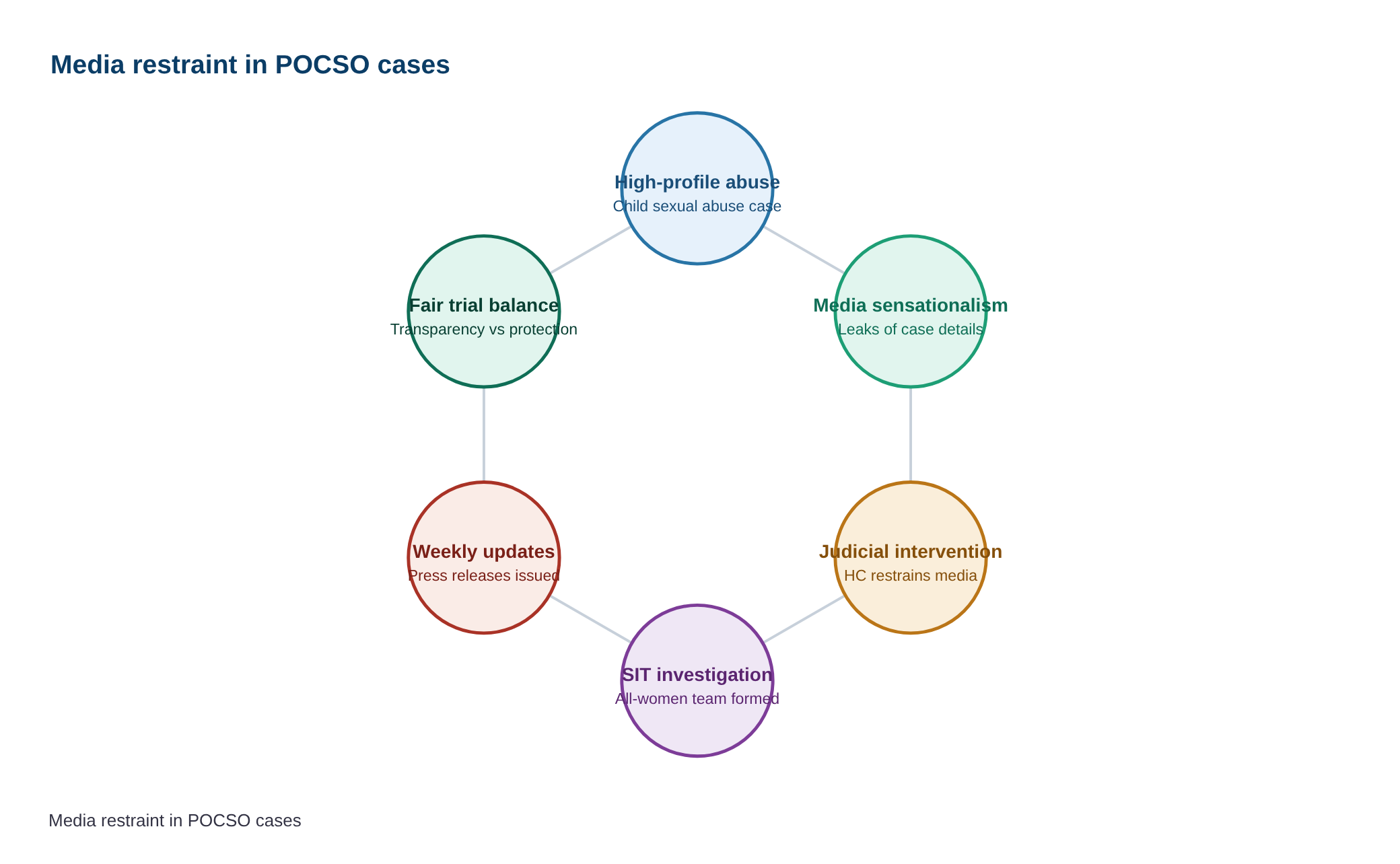
High-profile POCSO case involving child sexual abuse → Media sensationalism and leaks of CSEAM → Judicial intervention to restrain media reporting → Constitution of all-women SIT for investigation → Direction to issue weekly press releases → Balancing transparency and victim protection → Ensuring fair trial and institutional sensitivity → Reinforcing ethical and legal standards in handling child abuse cases.
Prelims Practice Questions
Q1. Consider the following statements regarding the Protection of Children from Sexual Offences (POCSO) Act, 2012:
1. The Act mandates the establishment of Special Courts for the trial of offences under the Act.
2. The Act provides for the appointment of a Special Public Prosecutor for the trial of such offences.
3. The Act prohibits the disclosure of the identity of the child victim in any manner.
4. The Act does not impose any restrictions on the media regarding the reporting of POCSO cases.
How many of the above statements are correct?
- Only one
- Only two
- Only three
- All four
Answer: Only three — Statements 1, 2, and 3 are correct as per Sections 28, 32, and 23(2) of the POCSO Act respectively. Statement 4 is incorrect because the Act and subsequent judicial directives impose strict restrictions on media reporting to protect the child’s identity and dignity.
Q2. Assertion (A): The Madras High Court, in the Veeramani POCSO case, directed the media to refrain from discussing the factual matrix of the case to protect the child’s privacy.
Reason (R): Article 21 of the Constitution guarantees the right to privacy, which includes the right to protection from media intrusion in sensitive cases involving minors.
Options:
A. Both A and R are true, and R is the correct explanation of A.
B. Both A and R are true, but R is not the correct explanation of A.
C. A is true, but R is false.
D. A is false, but R is true.
Answer: ? — Both the Assertion (A) and Reason (R) are true. The Madras High Court’s directive aligns with the constitutional right to privacy under Article 21, which encompasses protection from unwarranted media exposure, especially in cases involving minors. The Reason (R) correctly explains the Assertion (A).
Q3. Match the following provisions of the Protection of Children from Sexual Offences (POCSO) Act, 2012 with their respective descriptions:
Column I (Provisions)
1. Section 23
2. Section 28
3. Section 32
4. Section 44
Column II (Descriptions)
A. Mandates the establishment of Special Courts for trial of offences
B. Prohibits disclosure of the child’s identity in any manner
C. Provides for the appointment of a Special Public Prosecutor
D. Mandates reporting of child sexual abuse cases to the local police or the Child Welfare Committee
Select the correct match:
- 1-B, 2-A, 3-C, 4-D
- 1-A, 2-B, 3-C, 4-D
- 1-D, 2-C, 3-B, 4-A
- 1-C, 2-D, 3-A, 4-B
Answer: 1-B, 2-A, 3-C, 4-D — The correct matching is: 1-B (Section 23 prohibits disclosure of the child’s identity), 2-A (Section 28 mandates Special Courts), 3-C (Section 32 provides for Special Public Prosecutors), and 4-D (Section 44 mandates reporting of child abuse cases).
Mains Practice Question
✍ Critically examine the constitutional and statutory framework governing the balance between freedom of speech and expression under Article 19(1)(a) of the Constitution and the right to privacy of child victims in cases of sexual abuse, with particular reference to the directions issued by the Madras High Court in the Veeramani POCSO case. Also, analyse the role of the media in upholding or undermining child rights in such cases. (15 Marks)
Approach: MODEL-ANSWER SKELETON:
1. **Constitutional Framework**:
– Article 19(1)(a) guarantees freedom of speech and expression, subject to reasonable restrictions under Article 19(2).
– Article 21 guarantees the right to privacy, which has been interpreted by the Supreme Court (e.g., Puttaswamy, 2017) to include protection from unwarranted media intrusion.
2. **Statutory Provisions**:
– POCSO Act, 2012: Sections 23 (protection of identity), 28 (Special Courts), 32 (Special Public Prosecutors), and 44 (mandatory reporting).
– Press Council of India (PCI) Norms: Guidelines on reporting of sexual offences (2019) prohibit disclosure of victim identity and sensationalism.
3. **Judicial Directives**:
– Madras High Court’s order in Veeramani case: Restraint on media discussing factual matrix; weekly SIT press releases; interim injunction on dissemination of CSEAM.
– Judicial reasoning: Emphasis on child welfare over TRP-driven journalism (citing Justice Lakshminarayanan’s observation).
4. **Media Ethics and Child Rights**:
– **Upholding Rights**: Responsible reporting, anonymisation of victims, focus on systemic issues (e.g., child protection mechanisms).
– **Undermining Rights**: Sensationalism, trial-by-media, violation of Section 23 of POCSO Act, and erosion of trust in institutions.
5. **Comparative Analysis**:
– Contrast with international standards (e.g., UK’s Ofcom guidelines, UNICEF’s ethical reporting frameworks).
6. **Conclusion**:
– The balance tilts towards child rights in sensitive cases, but mechanisms for transparent investigation (e.g., SIT press releases) must be strengthened to maintain public trust without compromising privacy.
Key Cases/Committees: Puttaswamy (2017), POCSO Act (2012), PCI Norms (2019), Justice Verma Committee (2013).
Source: The Hindu
Generated by AanyaAi for educational purpose.
Related guides on our sites
- Anthropology VS PSIR
- Best PSIR optional coaching
- Best PSIR optional coaching online
- Best PSIR optional teacher

- यूक्रेन का रोबोट सेना अभियान: युद्ध में मानव हानि कम करने की रणनीति - September 27, 2026
- Ukraine’s ‘Army of Robots’: A Game-Changer for UPSC Mains 2026 Polity & Governance - September 27, 2026
- रूस ने भारत-ब्राजील को दिया UNSC स्थायी सदस्यता का समर्थन, जर्मनी-जापान विरोध में - September 27, 2026

No Comments