


26 Sep Swachhata Hi Seva 2026: Textile Ministry’s Cleanliness Drive & Key Initiatives

✎ Swachhata Hi Seva 2026 is a government-led, multi-stakeholder cleanliness campaign under the Swachh Bharat Mission, operationalised by the Textiles Ministry through agencies like JCI and NJB, focusing on institutional hygiene…
Subject Relevance — Where This Topic Fits
- GS Paper II — Governance, Transparency and Accountability | GS Paper III — Environment and Sustainable Development
- Prelims: Swachh Bharat Mission, Swachhata Hi Seva, Textiles Ministry, Jute Corporation of India (JCI), National Jute Board (NJB), Circular economy, Solid waste management, Public participation in sanitation
- Essay: The Role of Institutions in Public Health: A Case Study of Swachhata Initiatives, Sustainable Development and Community-Led Governance
Quick Revision: Swachhata Hi Seva 2026 is a government-led, multi-stakeholder cleanliness campaign under the Swachh Bharat Mission, operationalised by the Textiles Ministry through agencies like JCI and NJB, focusing on institutional hygiene, public sanitation, and community participation to institutionalise cleanliness as a civic duty.
Why is this in the news?
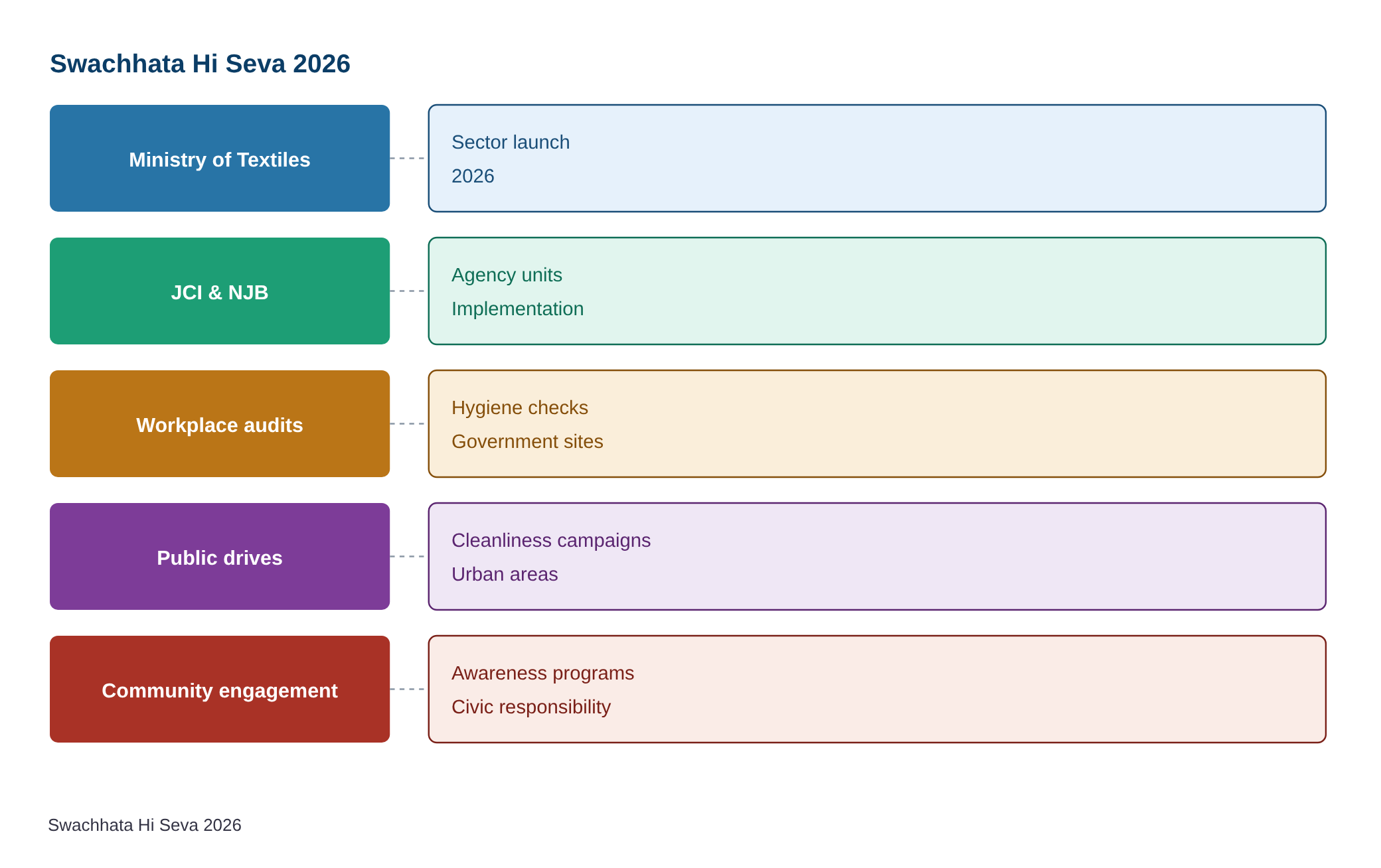
The Ministry of Textiles, through its subordinate organisations such as the Jute Corporation of India (JCI) and the National Jute Board (NJB), has undertaken multi-dimensional cleanliness drives under the ‘Swachhata Hi Seva 2026’ campaign. These initiatives, conducted across multiple states including Assam, West Bengal, and Delhi, combine workplace hygiene audits, public space cleanliness drives, and community engagement programmes to institutionalise sanitation as a shared civic responsibility.
Background
- Swachhata Hi Seva (SHS) is an annual nationwide cleanliness campaign launched by the Government of India, operationalised under the Swachh Bharat Mission (SBM) framework, with the objective of fostering mass participation in sanitation and hygiene.
- The campaign aligns with the constitutional directive under Article 48-A (Directive Principles of State Policy), which enjoins the State to endeavour to protect and improve the environment and safeguard the forests and wildlife of the country.
- The Textiles Ministry, through its agencies like JCI and NJB, has historically engaged in sector-specific sustainability initiatives, including the promotion of jute as an eco-friendly alternative to plastic.
- Public cleanliness drives under SHS are not merely symbolic but are designed to integrate with existing waste management systems, particularly in urban and peri-urban areas.
- The involvement of public institutions such as government colleges, bus stops, and market areas demonstrates a multi-stakeholder approach to sanitation governance.
- These initiatives also reflect the broader policy thrust towards circular economy principles, where waste reduction, reuse, and recycling are embedded in institutional practices.
What is Swachhata Hi Seva 2026?
- The campaign is structured around three pillars: institutional cleanliness, public space sanitation, and community advocacy, ensuring a holistic approach to cleanliness governance.
- Under the Textiles Ministry, organisations such as the Jute Corporation of India (JCI) and the National Jute Board (NJB) have operationalised SHS 2026 through workplace audits, public cleanliness drives, and awareness campaigns.
- Workplace cleanliness initiatives include departmental inspections to assess hygiene standards, waste segregation practices, and the removal of obsolete materials to maintain orderly workspaces.
- Public space cleanliness drives are conducted in collaboration with local authorities, educational institutions, and community groups, targeting areas such as bus stops, markets, and public buildings.
- Community engagement activities, including sports events and awareness programmes, are designed to foster collective responsibility and behavioural change towards sanitation.
- Institutional participation ensures that cleanliness is not treated as a one-time event but as a continuous process embedded in organisational culture and public service delivery.
Key Features
| Feature | Significance |
|---|---|
| Multi-stakeholder participation | Engages employees, public, and local communities in a unified cleanliness drive, fostering shared responsibility for sanitation. |
| Workplace inspection protocol | Ensures adherence to cleanliness standards in government offices, reinforcing institutional accountability. |
| Public space cleanliness drives | Directly addresses visible sanitation deficits in high-footfall areas, improving civic health and environmental aesthetics. |
| Thematic advocacy (Swachh Public Place, Swachh Paathshaala) | Aligns sanitation efforts with national campaigns, amplifying outreach through structured thematic focus. |
| Waste management emphasis | Promotes segregation, disposal, and recycling practices, reducing environmental degradation in jute and allied sectors. |
Why it Matters
Administrative Governance
- Demonstrates the Union Government’s commitment to the ‘Swachh Bharat Mission 2.0’ through sector-specific implementation by the Ministry of Textiles.
- Institutionalises cleanliness as a performance metric for government departments, aligning with the ‘Minimum Government, Maximum Governance’ paradigm.
- Enhances inter-departmental coordination by mandating joint inspections and collective responsibility among senior officials.
Environmental Sustainability
- Advances circular economy principles by integrating waste segregation and recycling in jute processing units and public spaces.
- Contributes to India’s Nationally Determined Contributions (NDCs) under the Paris Agreement by reducing landfill waste and promoting eco-friendly practices.
- Supports the National Clean Air Programme (NCAP) by mitigating particulate pollution from unmanaged waste in urban and semi-urban areas.
Social Behavioural Change
- Leverages community engagement to inculcate long-term sanitation habits, particularly among youth and marginalised groups.
- Uses participatory sports and cultural activities to normalise cleanliness as a social norm, transcending mere regulatory compliance.
- Strengthens public trust in government initiatives by demonstrating visible, on-ground impact in local communities.
Economic Efficiency
- Reduces healthcare expenditure by lowering the incidence of vector-borne diseases linked to poor sanitation.
- Enhances productivity in jute and textile sectors by maintaining hygienic work environments, thereby improving labour welfare.
- Generates cost savings through efficient waste management, reducing municipal expenditure on public cleanliness.
Challenges
1. Behavioural Resistance to Change
- Deep-rooted cultural practices may undermine adherence to sanitation protocols, particularly in informal workspaces.
- Low awareness among marginalised communities regarding the health and economic benefits of cleanliness.
- Need for continuous reinforcement to prevent relapse into pre-intervention habits.
UPSC Link: GS-II: Governance; GS-III: Environment
2. Resource Constraints in Implementation
- Limited availability of funds and manpower for sustained sanitation drives in remote or high-density areas.
- Inadequate infrastructure for waste segregation and recycling in jute processing hubs.
- Delays in procurement of cleaning equipment and consumables due to bureaucratic processes.
UPSC Link: GS-II: Governance; GS-III: Resource Mobilisation
3. Monitoring and Evaluation Gaps
- Lack of standardised metrics to assess the impact of sanitation initiatives on public health and environmental outcomes.
- Insufficient real-time data on waste generation and disposal patterns in textile and jute sectors.
- Need for third-party audits to ensure transparency and accountability in fund utilisation.
UPSC Link: GS-II: Governance; GS-III: Data Governance
4. Inter-Agency Coordination Bottlenecks
- Fragmented implementation across multiple agencies (e.g., JCI, NJB, state governments) leading to duplication or gaps.
- Differences in operational priorities between central ministries and local bodies.
- Bureaucratic inertia in aligning sectoral policies with national sanitation goals.
UPSC Link: GS-II: Governance; GS-II: Federalism
5. Sustainability Post-Campaign
- Risk of discontinuation of initiatives after the ‘Swachhata Hi Seva 2026’ campaign concludes.
- Absence of local ownership mechanisms to ensure continuity of cleanliness practices.
- Need for integration with existing municipal and state-level sanitation programmes.
UPSC Link: GS-II: Governance; GS-III: Sustainable Development
Challenges — UPSC Perspective
| Issue | Concern |
|---|---|
| Cultural apathy towards cleanliness | Low prioritisation of sanitation in daily routines, especially in informal sectors. |
| Inadequate waste management infrastructure | Absence of segregation systems and recycling facilities in jute processing units. |
| Limited public participation | Reluctance of communities to engage in cleanliness drives due to lack of awareness or incentives. |
| Funding shortfalls | Dependence on ad-hoc allocations rather than dedicated budgetary provisions for sanitation. |
| Regulatory enforcement gaps | Weak penalties for non-compliance with cleanliness standards in government offices. |
| Data deficit on waste generation | Lack of granular data on waste streams in textile and jute sectors for targeted interventions. |
Government Initiatives — Must-Memorise for Prelims
- Swachh Bharat Mission 2.0 (Urban and Rural)
- Swachhata Hi Seva 2026 (Ministry of Textiles initiative)
- National Clean Air Programme (NCAP)
- National Jute Policy 2022
Way Forward
- Institutionalise quarterly cleanliness audits in all textile ministry offices with public disclosure of findings.
- Launch a digital dashboard to track real-time progress of sanitation drives, waste management, and community participation across JCI and NJB units.
- Integrate sanitation education into school curricula under the ‘Swachh Paathshaala’ initiative, with mandatory community projects.
- Establish a fund-matching mechanism where central allocations are supplemented by state and private sector contributions for waste management infrastructure.
- Conduct capacity-building workshops for municipal authorities and gram panchayats on low-cost, scalable cleanliness solutions tailored to local contexts.
- Develop a ‘Green Jute’ certification for processing units that meet prescribed sanitation and waste management standards, incentivising compliance.
- Partner with NGOs and corporate CSR arms to adopt high-impact public spaces for sustained cleanliness maintenance.
- Introduce a reward system (e.g., ‘Swachhata Puraskar’) for districts and units demonstrating exemplary sanitation practices.
UPSC Value Addition
Keywords for Mains Answer-Writing
Swachhata Hi Seva 2026 · Ministry of Textiles · Swachh Bharat Mission · Institutional cleanliness · Public participation · Jute Corporation of India · National Jute Board · Circular economy · Waste management · Community engagement · Sustainable environment · Government cleanliness audits · Public-private partnership
Constitutional & Policy Linkages
- Article 48A (Directive Principles of State Policy – environmental protection and improvement)
- Article 51A(g) (Fundamental Duty – to protect and improve the natural environment)
Concept Flow
Ministry of Textiles launches ‘Swachhata Hi Seva 2026’ campaign → → Sector-specific implementation by JCI and NJB units → → Workplace inspections and public space cleanliness drives → → Community participation through sports, advocacy, and school programmes → → Improved waste management and environmental sustainability → → Long-term behavioural change and institutional accountability → → Alignment with national sanitation goals (SBM 2.0, NCAP) and sustainable development
Prelims Practice Questions
Q1. Consider the following statements regarding the ‘Swachhata Hi Seva 2026’ campaign:
1. It is an initiative under the Swachh Bharat Mission.
2. The Ministry of Textiles is actively involved in organizing cleanliness drives.
3. The campaign exclusively targets urban areas for cleanliness activities.
4. Public participation is a key component of the campaign.
How many of the above statements are correct?
- Only one
- Only two
- Only three
- All
Answer: All — Statements 1, 2, and 4 are correct. Statement 3 is incorrect as the campaign includes rural and public areas as well.
Q2. Assertion (A): The Jute Corporation of India (JCI) has launched cleanliness drives under ‘Swachhata Hi Seva 2026’ in collaboration with local communities.
Reason (R): The campaign aims to promote public participation in waste management and environmental sustainability.
Options:
A. Both A and R are true, and R is the correct explanation of A.
B. Both A and R are true, but R is not the correct explanation of A.
C. A is true, but R is false.
D. A is false, but R is true.
- A
- B
- C
- D
Answer: A — Both A and R are true, and R correctly explains A as the campaign explicitly involves public participation in cleanliness drives.
Q3. Match the following initiatives with their respective organizations under the ‘Swachhata Hi Seva 2026’ campaign:
Column I (Initiative) | Column II (Organization)
———————|————————
1. Swachhata drives in public spaces | A. National Jute Board
2. Cleanliness audits in offices | B. Ministry of Textiles
3. Jute sector cleanliness promotion | C. Jute Corporation of India
Options:
A. 1-A, 2-B, 3-C
B. 1-C, 2-B, 3-A
C. 1-B, 2-C, 3-A
D. 1-A, 2-C, 3-B
- A
- B
- C
- D
Answer: B — 1-C (JCI organized public space cleanliness drives), 2-B (Ministry of Textiles conducted office audits), 3-A (National Jute Board promoted cleanliness in jute units).
Mains Practice Question
✍ The ‘Swachhata Hi Seva 2026’ campaign, led by the Ministry of Textiles, exemplifies the integration of institutional cleanliness with public participation in waste management. Critically analyse the significance of such campaigns in achieving the objectives of the Swachh Bharat Mission 2.0. Also, discuss the role of public-private partnerships in ensuring the sustainability of these initiatives. (15 Marks)
Approach: MODEL-ANSWER SKELETON:
1. Introduction (2 marks):
– Define ‘Swachhata Hi Seva 2026’ and its alignment with Swachh Bharat Mission 2.0.
– State the dual objectives: institutional cleanliness and public participation.
2. Significance of such campaigns (6 marks):
– Institutional cleanliness: Ensures compliance with statutory provisions (e.g., Section 24 of the Environment Protection Act, 1986; Solid Waste Management Rules, 2016).
– Public participation: Fosters civic responsibility (refer to Article 51A(g) of the Constitution) and behavioral change (citing Mahatma Gandhi’s emphasis on cleanliness).
– Environmental sustainability: Reduces waste generation, promotes circular economy principles, and aligns with SDG 11 (Sustainable Cities and Communities) and SDG 12 (Responsible Consumption and Production).
– Economic benefits: Enhances productivity, reduces healthcare costs (refer to WHO estimates on sanitation-related diseases), and boosts tourism.
3. Role of public-private partnerships (PPP) (5 marks):
– PPP models (e.g., Build-Operate-Transfer, Community-Led Total Sanitation) for waste management infrastructure.
– Case study: Jute Corporation of India’s collaboration with local communities and institutions (e.g., schools, colleges) for cleanliness drives.
– Challenges: Ensuring equitable participation, monitoring compliance, and addressing socio-economic disparities.
– Legal framework: Reference to the National Clean Air Programme (NCAP) and State-level PPP policies.
4. Conclusion (2 marks):
– Reiterate the need for multi-stakeholder collaboration.
– Highlight the role of technology (e.g., waste-to-energy plants, IoT-enabled bins) in scaling up such initiatives.
– Emphasize the importance of periodic audits and community feedback mechanisms.
Source: PIB (Press Information Bureau)
Generated by AanyaAi for educational purpose.
Related guides on our sites
- Best PSIR optional coaching for upsc
- Best PSIR optional teacher for upsc
- Best teacher of PSIR optional for upsc
- Best PSIR optional coaching in delhi for UPSC

- Himachal CM Sukhu: All Doctor Vacancies to be Filled by March - September 27, 2026
- कैसे पुलिस की AI तकनीक पहचान कर रही है अस्पष्ट शवों को - September 27, 2026
- Jai Jyoti: 106 km Bisalpur Pipeline to End Jaipur Water Crisis - September 27, 2026

No Comments