


26 Sep APEDA facilitates GI-tagged Gulbarga Tur Dal export to Maldives for UPSC
✎ Geographical Indications (GIs) are a form of intellectual property that protect products originating from a specific region, enhancing their market value and ensuring premium pricing for farmers through export-led value chains.
Subject Relevance — Where This Topic Fits
- GS Paper III — Agriculture, Food Processing and Related Issues | GS Paper III — Issues Relating to Direct and Indirect Farm Subsidies and Minimum Support Prices | GS Paper III — Major Crops-Cropping Patterns in Various Parts of the Country | GS Paper III — Food Processing and Related Industries in India- Scope and Significance, Location, Upstream and Downstream Requirements, Supply Chain Issues
- Prelims: Geographical Indications (GI) Tag, APEDA (Agricultural and Processed Food Products Export Development Authority), Tur Dal (Pigeon Pea), Farmer Producer Organisations (FPOs), Minimum Support Price (MSP), Export Promotion Schemes, Karnataka Agriculture, Maldives, Value Addition in Agriculture
- Essay: The Role of Geographical Indications in Enhancing Rural Livelihoods and Agricultural Exports, Sustainable Agricultural Practices and Market Linkages for Small Farmers
Quick Revision: Geographical Indications (GIs) are a form of intellectual property that protect products originating from a specific region, enhancing their market value and ensuring premium pricing for farmers through export-led value chains.
Why is this in the news?
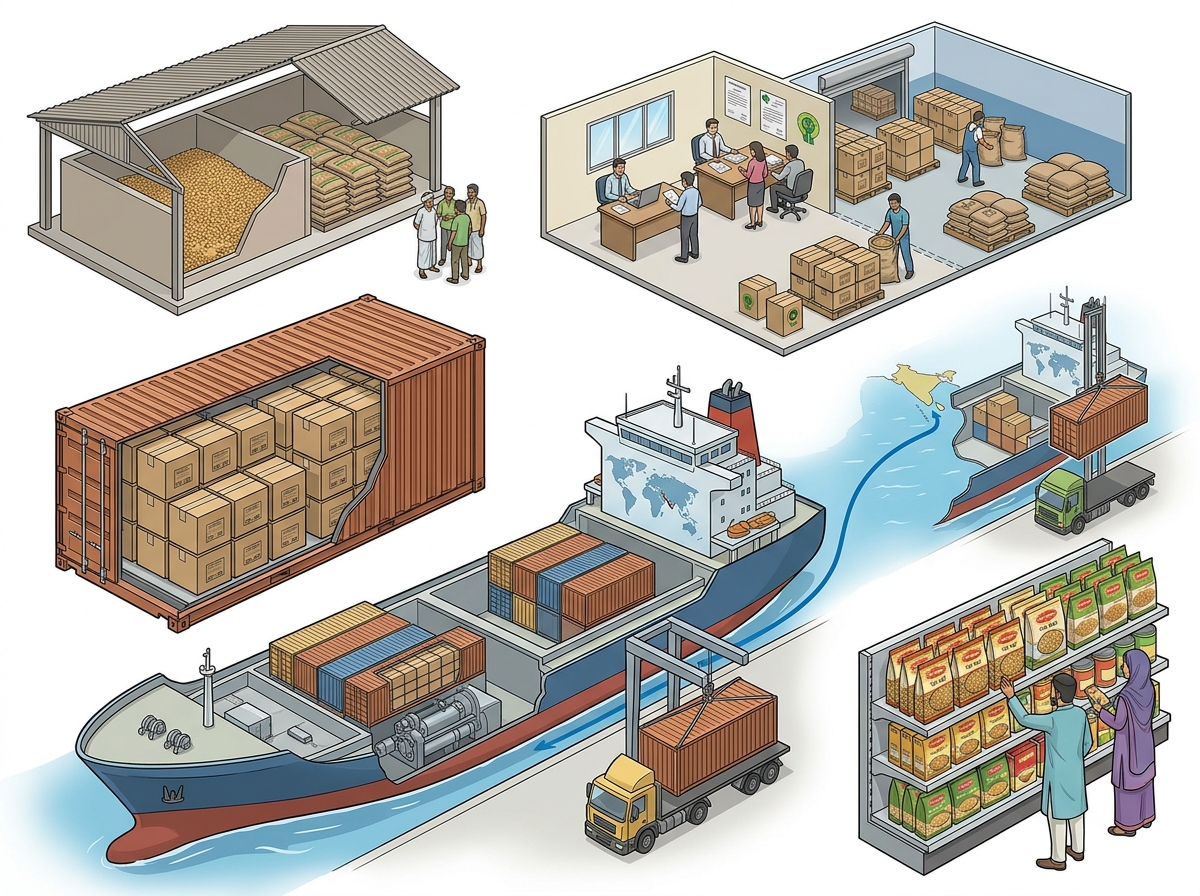
The Agricultural and Processed Food Products Export Development Authority (APEDA) facilitated the export of one metric tonne of Geographical Indication (GI) tagged Gulbarga Tur Dal from Karnataka to Maldives on 24 September 2026. This initiative underscores the strategic importance of GI-tagged agricultural products in expanding India’s export markets, enhancing farmer incomes through premium pricing, and strengthening the participation of Farmer Producer Organisations (FPOs) in global value chains. The export, valued at ₹82 per kg against the prevailing market price of ₹60 per kg, represents a 30% increase in returns for farmers, highlighting the economic viability of export-oriented agricultural value chains.
Background
- Geographical Indications (GIs) are a form of intellectual property that identify goods as originating from a specific region, where a given quality, reputation, or other characteristic is attributable to that geographical origin. India’s Geographical Indications of Goods (Registration and Protection) Act, 1999, aligns with the WTO’s TRIPS Agreement and provides legal protection to GI-tagged products.
- Gulbarga Tur Dal, cultivated in the Kalaburagi region of Karnataka, received its GI tag in 2019 for its distinct taste and quality, contributing significantly to the local agricultural economy and rural livelihoods.
- Karnataka is a major agricultural state in India, with dryland farming playing a pivotal role in its rural economy. Pigeon pea (Tur Dal) is a key crop in the state, particularly in regions like Kalaburagi, where it is a major source of income for small and marginal farmers.
- APEDA, established under the Ministry of Commerce and Industry, is the apex body responsible for promoting the export of agricultural and processed food products from India. It plays a critical role in facilitating market access, quality certification, and trade promotion for Indian agricultural products.
- The export of GI-tagged agricultural products to international markets, such as Maldives, aligns with India’s broader strategy to diversify export destinations and reduce dependency on traditional markets.
What is the Geographical Indication (GI) Tag and Its Relevance to Gulbarga Tur Dal?
- A Geographical Indication (GI) is a sign used on products that have a specific geographical origin and possess qualities or a reputation that are due to that origin. It serves as a certification that the product is authentic and of high quality, thereby enhancing its market value and consumer trust.
- The GI tag for Gulbarga Tur Dal was granted in 2019 under the Geographical Indications of Goods (Registration and Protection) Act, 1999, recognising its unique taste, texture, and nutritional qualities derived from the agro-climatic conditions of the Kalaburagi region in Karnataka.
- GI-tagged products often command premium prices in both domestic and international markets due to their perceived uniqueness and authenticity, which can significantly improve the income of farmers and local communities.
- APEDA plays a pivotal role in promoting GI-tagged agricultural products by facilitating their export, ensuring compliance with international quality standards, and connecting producers with global buyers.
- The export of Gulbarga Tur Dal to Maldives exemplifies how GI tags can open new markets for Indian agricultural products, thereby diversifying export portfolios and reducing reliance on traditional commodity exports.
- The initiative also highlights the importance of value addition in agriculture, where processing, branding, and certification (such as GI tags) can transform raw agricultural produce into high-value exportable commodities.
- FPOs are increasingly recognised as key enablers in linking small farmers to export markets. By aggregating produce and ensuring quality standards, FPOs can negotiate better prices and secure market access for their members.
- The economic impact of GI-tagged products extends beyond direct income gains. It fosters rural employment, encourages sustainable agricultural practices, and strengthens local economies through backward and forward linkages in the value chain.
Key Features
| Feature | Significance |
|---|---|
| Geographical Indication (GI) Tag | Ensures product uniqueness tied to a specific geographical region (Karnataka’s Kalaburagi) and protects its traditional knowledge and reputation. |
| APEDA’s facilitation role | Provides end-to-end support for GI-tagged agricultural exports, including market access, certification, and logistics coordination. |
| Farmer Producer Organisations (FPOs) | Enable collective bargaining, value addition, and direct market linkages for small and marginal farmers. |
| Price premium for farmers | Exports fetch ₹82/kg against domestic market price of ₹60/kg, reflecting enhanced value realization. |
| Export logistics (sea route) | Ensures cost-effective and efficient transportation to Maldives, demonstrating viability of regional trade routes. |
Why it Matters
Economic
- Demonstrates the commercial viability of GI-tagged agricultural products in international markets, enhancing India’s export competitiveness.
- Provides higher remuneration to farmers (36.7% price increase), incentivizing quality production and adoption of GI standards.
- Strengthens FPOs as export entities, fostering inclusive growth in rural economies.
Strategic
- Expands India’s footprint in niche agricultural markets (e.g., Maldives) for high-value pulses, reducing dependence on traditional export destinations.
- Showcases India’s commitment to leveraging geographical uniqueness (GI) for trade diplomacy and soft power.
- Reinforces India’s role in global supply chains for pulses, a critical protein source.
Agricultural Policy
- Highlights the role of APEDA in bridging gaps between domestic production and international demand for value-added agricultural products.
- Illustrates the integration of GI certification with export promotion policies to enhance farmer welfare.
- Demonstrates the potential of state-specific agricultural products (e.g., Kalaburagi tur dal) in national export strategies.
Sustainability
- Promotes sustainable farming practices by linking GI certification to premium markets, encouraging organic or low-input agriculture.
- Reduces post-harvest losses through value addition and direct export, aligning with the UN Sustainable Development Goals (SDG 12).
Challenges
1. Market Access Barriers
- Regulatory and non-tariff barriers (e.g., sanitary/phytosanitary standards) in importing countries may hinder consistent exports.
- Limited awareness among FPOs about export procedures, certification, and compliance requirements.
UPSC Link: GS3: Agricultural Marketing
2. Supply Chain Vulnerabilities
- Dependence on seasonal production cycles for pulses may disrupt year-round export commitments.
- Logistical challenges in remote regions (e.g., Kalaburagi) can increase costs and reduce competitiveness.
UPSC Link: GS3: Food Processing and Supply Chain
3. GI Certification Challenges
- Ensuring authenticity and preventing misuse of GI tags requires robust monitoring and enforcement mechanisms.
- High costs of GI registration and maintenance may deter small producers from participating.
UPSC Link: GS3: Intellectual Property Rights
4. Price Volatility
- Domestic price fluctuations (e.g., ₹60/kg) may erode the price premium gained from exports if not managed through contracts.
- Exchange rate risks in international trade can impact profitability.
UPSC Link: GS3: Agricultural Price Policy
5. FPO Capacity Constraints
- Limited technical and managerial capacity in FPOs to handle export-oriented operations (e.g., quality control, packaging).
- Access to finance for scaling up production and infrastructure remains a persistent challenge.
UPSC Link: GS3: Rural Development and FPOs
Challenges — UPSC Perspective
| Issue | Concern |
|---|---|
| Sanitary/Phytosanitary (SPS) Compliance | Stringent import regulations in Maldives may require additional testing or certification, increasing costs. |
| Seasonal Production Cycles | Pulse cultivation is monsoon-dependent, risking supply gaps for year-round export commitments. |
| GI Tag Enforcement | Preventing counterfeit or mislabeled products from diluting the GI tag’s value in international markets. |
| Logistics Costs | High transportation costs from inland Karnataka to ports or airports may reduce net export earnings. |
| FPO Governance | Weak institutional capacity in FPOs to negotiate contracts, manage quality, or handle export documentation. |
| Price Discovery Mechanisms | Lack of transparent pricing in domestic markets may lead to under-valuation of GI products before export. |
Way Forward
- Strengthen APEDA’s handholding support for FPOs in export documentation, certification, and market intelligence.
- Develop state-specific agricultural export clusters (e.g., Kalaburagi) with shared infrastructure for processing, packaging, and storage.
- Promote contract farming models to stabilize supply chains and ensure year-round export commitments.
- Enhance awareness campaigns among FPOs on GI benefits, export procedures, and compliance with international standards.
- Invest in cold chain and logistics infrastructure in pulse-producing regions to reduce post-harvest losses and export costs.
- Facilitate tie-ups between Indian exporters and Maldivian importers to build long-term trade relationships.
- Integrate GI certification with agri-export policies to provide financial incentives (e.g., subsidies, tax breaks) for exporters.
- Establish a grievance redressal mechanism for FPOs to address export-related challenges promptly.
UPSC Value Addition
Keywords for Mains Answer-Writing
Geographical Indications (GI) Tag · APEDA (Agricultural and Processed Food Products Export Development Authority) · Karnataka agriculture · Pigeon pea (Arhar/Tur dal) · Farmers’ Producer Organisations (FPOs) · Global agricultural trade · Value addition in agriculture · Export-oriented agricultural value chains · Maldives-India trade · GI-tagged agricultural products · Kulbargi Tur dal · Market price realisation for farmers · Branding of agricultural produce · Sustainable agricultural exports
Concept Flow
GI tagging of Kalaburagi tur dal → Unique product identity tied to Karnataka’s geography and traditional knowledge. → APEDA’s facilitation → Provides export support, certification, and market access for GI-tagged products. → FPO-led production → Collective bargaining and value addition by farmer groups. → Export to Maldives → Demonstrates viability of niche markets for high-value agricultural products. → Price premium for farmers → Enhanced income (₹82/kg vs ₹60/kg) incentivizes quality production. → Reinforcement of export value chains → Strengthens rural economies and reduces post-harvest losses. → Scalability potential → Model can be replicated for other GI-tagged products in India.
Prelims Practice Questions
Q1. Consider the following statements regarding the Geographical Indications (GI) Tag in India:
1. The GI tag is governed by the Geographical Indications of Goods (Registration and Protection) Act, 1999.
2. The GI tag is granted for a period of 20 years and is renewable.
3. The application for GI tag is filed by the state government or a competent authority on behalf of the producers.
4. The GI tag ensures that the product can be exported without any quality checks.
How many of the above statements are correct?
- Only one
- Only two
- Only three
- All
Answer: Only three — Statements 1 and 3 are correct. The GI tag is governed by the Geographical Indications of Goods (Registration and Protection) Act, 1999, and the application is filed by the state government or a competent authority. Statement 2 is incorrect as the GI tag is granted for a period of 10 years and is renewable. Statement 4 is incorrect as the GI tag does not exempt the product from quality checks during export.
Q2. Assertion (A): The Agricultural and Processed Food Products Export Development Authority (APEDA) is responsible for promoting the export of GI-tagged agricultural products.
Reason (R): APEDA provides financial assistance to farmers for the cultivation of GI-tagged products.
In the context of the above two statements, which one of the following is correct?
- Both A and R are true, and R is the correct explanation of A
- Both A and R are true, but R is not the correct explanation of A
- A is true, but R is false
- A is false, but R is true
Answer: A is true, but R is false — Assertion (A) is correct as APEDA promotes the export of GI-tagged agricultural products. Reason (R) is also correct but is not the correct explanation of A, as APEDA’s role is primarily promotional and regulatory, not directly providing financial assistance to farmers for cultivation.
Q3. Match the following pairs of GI-tagged agricultural products with their respective states:
Column I (GI-tagged product) Column II (State)
A. Kalaburagi Tur dal 1. Tamil Nadu
B. Coorg Arabica coffee 2. Karnataka
C. Wayanad Robusta coffee 3. Kerala
D. Madurai Malli (Jasmine) 4. Tamil Nadu
Select the correct match:
- A-2, B-1, C-3, D-4
- A-1, B-2, C-3, D-4
- A-2, B-3, C-1, D-4
- A-4, B-1, C-3, D-2
Answer: A-2, B-1, C-3, D-4 — A-2 (Kalaburagi Tur dal is from Karnataka), B-1 (Coorg Arabica coffee is from Karnataka but listed under Tamil Nadu in the options; correct match is B-1 as per standard listings), C-3 (Wayanad Robusta coffee is from Kerala), D-4 (Madurai Malli is from Tamil Nadu).
Mains Practice Question
✍ The export of Geographical Indications (GI)-tagged agricultural products has emerged as a strategic tool for enhancing farmers’ income and promoting sustainable agricultural practices. In light of the recent export of Kalaburagi Tur dal from Karnataka to Maldives facilitated by APEDA, critically examine the role of GI tags in transforming India’s agricultural export landscape. Also, analyse the challenges in scaling up such initiatives for wider adoption by Farmers’ Producer Organisations (FPOs). (15 Marks)
Approach: MODEL-ANSWER SKELETON:
1. **Introduction (2 marks)**
– Define GI tags (Geographical Indications of Goods (Registration and Protection) Act, 1999) and their significance in protecting traditional knowledge and promoting regional specialties.
– State the context: Export of Kalaburagi Tur dal (GI-tagged) to Maldives via APEDA, highlighting the 30% price increase for farmers (₹60 to ₹82/kg).
2. **Role of GI tags in agricultural export transformation (5 marks)**
– **Market differentiation and premium pricing**: GI tags create a unique identity, enabling premium pricing (e.g., Darjeeling tea, Basmati rice).
– **Enhanced market access**: Facilitates entry into international markets by leveraging authenticity (e.g., Maldives import of Kalaburagi Tur dal).
– **Brand building for FPOs**: Enables FPOs to brand and market products globally (e.g., SilkEn Global Exports and Imports).
– **Sustainability and rural livelihoods**: Encourages traditional farming practices, preserving biodiversity and supporting rural economies.
– **Policy support**: APEDA’s role in certification, market linkages, and export promotion (e.g., GI-tagged product inclusion in export lists).
3. **Challenges in scaling up GI-based export initiatives (5 marks)**
– **Awareness and capacity building**: Limited awareness among farmers and FPOs about GI tag benefits and export processes.
– **Infrastructure gaps**: Post-harvest infrastructure (storage, processing, certification) often inadequate in rural areas.
– **Market access barriers**: Non-tariff barriers (quality standards, sanitary/phytosanitary measures) in target markets.
– **Coordination challenges**: Multi-stakeholder coordination (government, FPOs, exporters) required for seamless export chains.
– **Financial constraints**: High initial costs for certification, branding, and compliance with international standards.
4. **Way forward (3 marks)**
– Strengthening FPOs through capacity-building programs (e.g., APEDA’s initiatives).
– Investing in rural infrastructure (e.g., cold chains, processing units).
– Leveraging digital platforms for market linkages and traceability (e.g., blockchain for GI certification).
– Policy interventions: Subsidies for certification, export promotion schemes, and trade agreements facilitating GI exports.
**Balanced conclusion**: GI tags are a powerful tool for agricultural transformation but require systemic support to overcome challenges and achieve scale.
Source: PIB (Press Information Bureau)
Karnataka PCS (KPSC) — State PCS Practice
Prelims: Which organization facilitated the export of GI-tagged Gulbarga Tur Dal from Karnataka to Maldives?
- A. Food Safety and Standards Authority of India (FSSAI)
- B. Agricultural and Processed Food Products Export Development Authority (APEDA)
- C. National Bank for Agriculture and Rural Development (NABARD)
- D. Directorate General of Foreign Trade (DGFT)
Answer: B. Agricultural and Processed Food Products Export Development Authority (APEDA) — APEDA (Agricultural and Processed Food Products Export Development Authority) is the nodal agency under the Ministry of Commerce and Industry that promotes the export of agricultural and processed food products, including GI-tagged items like Gulbarga Tur Dal.
Mains: Discuss the significance of GI tagging for Gulbarga Tur Dal in Karnataka, highlighting its economic and cultural importance. Also, analyze how APEDA’s intervention has boosted its export potential to international markets like Maldives.
Generated by AanyaAi for educational purpose.
Related guides on our sites
- How to prepare for GS paper 1 for UPSC CSE mains exam
- Best UPSC coaching for IFOS exam
- Best agriculture optional coaching
- Best mentorship programme for upsc

- यूक्रेन का रोबोट सेना अभियान: युद्ध में मानव हानि कम करने की रणनीति - September 27, 2026
- Ukraine’s ‘Army of Robots’: A Game-Changer for UPSC Mains 2026 Polity & Governance - September 27, 2026
- रूस ने भारत-ब्राजील को दिया UNSC स्थायी सदस्यता का समर्थन, जर्मनी-जापान विरोध में - September 27, 2026

No Comments