


26 Sep Australia’s UN Address: Climate, AI & Global Law for UPSC 2026
✎ Multilateralism in the 21st century must balance technological innovation with ethical governance, climate action with equitable development, and sovereign rights with collective security, as articulated in the UN Charter and…
Subject Relevance — Where This Topic Fits
- GS Paper II — International Relations: International Organisations (UN and its organs), Regional and Global Groupings and Agreements involving India and/or affecting India’s interests | GS Paper III — Science and Technology: Awareness in the fields of IT, Space, Computers, Robotics, Nano-technology, Bio-technology and issues relating to Intellectual Property Rights | GS Paper III — Environment: Conservation, Environmental Pollution and Degradation, Environmental Impact Assessment | GS Paper II — International Relations: Important International Institutions, agencies and fora—their structure, mandate
- Prelims: United Nations General Assembly (UNGA), United Nations Security Council (UNSC), UN Charter, International Law, Sovereignty, Climate Change, Artificial Intelligence (AI), Multilateralism, Non-permanent membership of UNSC, Social Media Regulation, Digital Rights, Transnational Crime, Economic Security, Energy Security
- Essay: The efficacy of multilateral institutions in addressing existential global challenges, Balancing technological advancement with ethical governance and human rights
Quick Revision: Multilateralism in the 21st century must balance technological innovation with ethical governance, climate action with equitable development, and sovereign rights with collective security, as articulated in the UN Charter and reinforced by middle-power diplomacy.
Why is this in the news?
The address by the Prime Minister of Australia at the 81st Session of the United Nations General Assembly underscores the urgent need for global cooperation to address interconnected challenges such as climate change, the governance of emerging technologies like artificial intelligence, and the erosion of international legal norms. The speech highlights Australia’s advocacy for multilateral reform, its candidature for a non-permanent seat on the UN Security Council, and its domestic policy measures such as social media restrictions for minors, positioning these initiatives within the broader framework of international law and sovereign choice.
Background
- The United Nations was established in 1945 following the devastation of World War II, with the primary objective of preventing future global conflicts through multilateral cooperation, as enshrined in the UN Charter.
- The post-Cold War era has witnessed a proliferation of non-state actors, technological disruptions, and transnational challenges that have strained the efficacy of traditional multilateral institutions.
- Climate change has emerged as a defining existential threat, necessitating coordinated global action to mitigate emissions, adapt to impacts, and finance sustainable transitions, as recognised in frameworks such as the Paris Agreement (2015).
- Artificial intelligence (AI) and other emerging technologies pose dual-use risks, including ethical dilemmas, security threats, and socio-economic disruptions, prompting calls for international governance frameworks.
- The principle of sovereignty remains a cornerstone of international law, but its interpretation is increasingly contested in the context of cyber operations, economic coercion, and humanitarian interventions.
- The UN Security Council, as the primary organ responsible for maintaining international peace and security, faces criticism for its unrepresentative structure and inability to address contemporary crises effectively.
Key Dimensions of Global Cooperation in the 21st Century: Climate, AI Governance, and International Law
- The UN Charter (1945) establishes the foundational principles of multilateralism, including sovereign equality of states, peaceful settlement of disputes, and collective security, which remain central to global governance despite contemporary challenges.
- Climate change governance operates through a multi-layered framework comprising the UN Framework Convention on Climate Change (UNFCCC), the Paris Agreement, and national contributions (NDCs), alongside initiatives such as the Green Climate Fund and the Loss and Damage Fund established at COP27 (2022).
- Artificial Intelligence governance is evolving through a patchwork of national policies, regional regulations (e.g., EU AI Act), and international initiatives such as the Global Partnership on AI (GPAI) and UNESCO’s Recommendation on the Ethics of AI, reflecting the need for harmonised standards.
- International law, including the UN Charter, the Vienna Convention on the Law of Treaties, and customary international law, provides the normative framework for state behaviour, but its enforcement remains contingent on political will and institutional capacity.
- The concept of ‘middle powers’—states that are neither global superpowers nor small states—plays a critical role in bridging divides, advocating for reform, and amplifying the voices of smaller nations in multilateral forums.
- Sovereign capability refers to a state’s ability to make independent choices free from external coercion, encompassing economic, technological, and strategic autonomy, which is increasingly challenged by geopolitical pressures and technological dependencies.
- Transnational crime, including cybercrime, human trafficking, and illicit financial flows, necessitates cross-border cooperation through frameworks such as the UN Convention against Transnational Organized Crime (Palermo Convention) and INTERPOL.
Key Features
| Feature | Significance |
|---|---|
| Global Cooperation on Climate Change | Highlights the necessity of collective action to address the climate crisis, aligning with UN Sustainable Development Goals (SDGs) 13 and 17, which emphasize international collaboration for environmental sustainability and partnerships. |
| Regulation of Emerging Technologies (AI) | Underscores the need for global frameworks to govern AI, addressing ethical, security, and sovereignty concerns while ensuring equitable access and preventing misuse. |
| Reinforcement of International Law | Stresses adherence to the UN Charter and sovereignty of states, reinforcing the foundational principles of multilateralism and global governance. |
| UN Security Council Reform | Proposes non-permanent membership to amplify voices of small and middle powers, aiming for a more inclusive and representative decision-making process. |
| Social Media Regulation for Minors | Demonstrates national-level policy intervention to protect vulnerable groups, with potential global implications for digital rights and child welfare. |
Why it Matters
Multilateral Governance
- Reaffirms the UN’s role as a primary platform for addressing global challenges, including climate change, AI governance, and international law.
Middle Power Diplomacy
- Showcases Australia’s strategic positioning as a middle power, advocating for inclusive multilateralism and collective problem-solving.
Technological Sovereignty
- Emphasizes the need for states to retain control over emerging technologies like AI, preventing monopolization by private entities or great powers.
Rule-Based International Order
- Highlights the importance of upholding international law and the UN Charter to prevent fragmentation and ensure global stability.
Youth and Digital Policy
- Illustrates the intersection of digital governance and social welfare, particularly in protecting minors from online harms.
Challenges
1. Fragmentation of Multilateralism
- Rising nationalism and great-power rivalries threaten the unity and effectiveness of international institutions like the UN.
UPSC Link: UN reforms and global governance
2. Climate Inaction and Policy Gaps
- Despite global agreements like the Paris Agreement, implementation remains uneven, with gaps in financing, technology transfer, and accountability.
UPSC Link: Climate change and international cooperation
3. AI Governance and Ethical Dilemmas
- Rapid advancements in AI pose challenges in regulation, including bias mitigation, privacy concerns, and potential misuse in cyber warfare or disinformation.
UPSC Link: Emerging technologies and governance
4. Sovereignty vs. Global Cooperation
- Balancing national interests with collective action remains a persistent challenge, particularly in areas like trade, security, and technology.
UPSC Link: Sovereignty and international law
5. Digital Divide and Inequality
- Uneven access to digital technologies exacerbates global inequalities, particularly in education, healthcare, and economic opportunities.
UPSC Link: Digital divide and global development
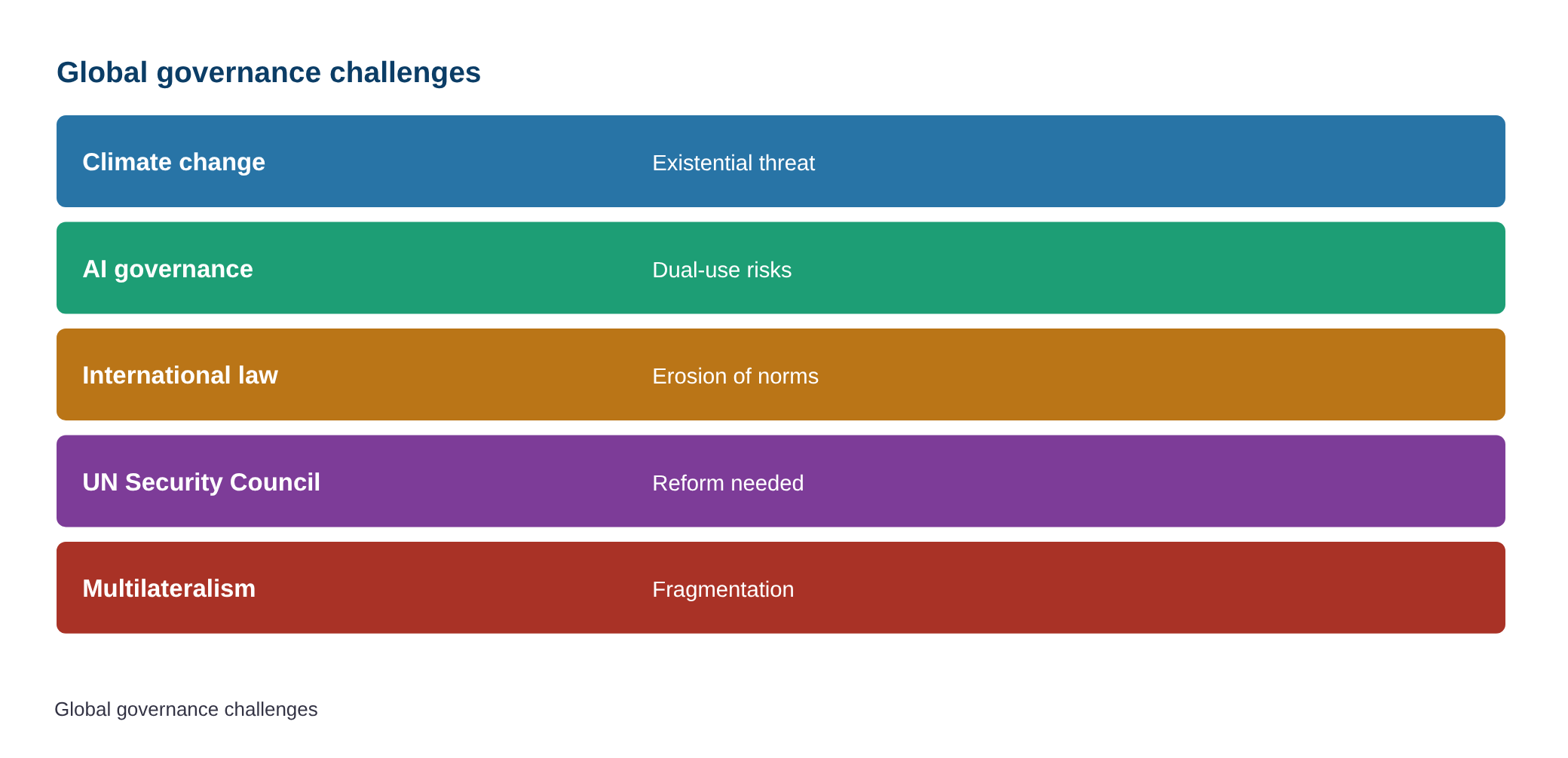
Challenges — UPSC Perspective
| Issue | Concern |
|---|---|
| Climate Change | Inadequate global coordination and funding to meet emission reduction targets under the Paris Agreement. |
| AI Regulation | Lack of universally accepted ethical frameworks and enforcement mechanisms for AI systems. |
| UN Security Council Reform | Overrepresentation of permanent members and underrepresentation of small and middle powers in decision-making. |
| Social Media Regulation | Balancing free speech with the need to protect minors from online harms and misinformation. |
| Technological Sovereignty | Risk of dependency on foreign technologies, particularly in critical sectors like AI and cybersecurity. |
| Trust in Multilateralism | Erosion of trust in international institutions due to perceived inefficacy and geopolitical tensions. |
Way Forward
- Strengthen multilateral institutions like the UN by reforming the Security Council to include more non-permanent members from diverse regions.
UPSC Value Addition
Keywords for Mains Answer-Writing
global governance · United Nations Security Council reform · climate change governance · Artificial Intelligence regulation · international law · multilateralism · middle power diplomacy · UN Charter principles · sovereignty of states · non-permanent membership of UNSC · AI governance frameworks · climate mitigation commitments · sustainable development · international cooperation · rule-based international order
Concept Flow
Climate change and technological advancements → Increased global interdependence → Need for international cooperation → Strengthening of multilateral institutions like the UN → Breakdown of trust in global governance → Erosion of international law → Rise of nationalism → Fragmentation of multilateralism → Rapid AI development → Ethical and security concerns → Demand for global regulation → Sovereignty debates → Social media harms to minors → National policy interventions → Global movement for digital rights → Regulatory alignment → Middle power diplomacy → Advocacy for inclusive multilateralism → Reform of UN Security Council → Enhanced representation of small states
Prelims Practice Questions
Q1. Consider the following statements about the United Nations Security Council (UNSC):
1. The UNSC has 15 members, including 5 permanent members with veto power.
2. Non-permanent members are elected by the UN General Assembly for a term of 2 years.
3. The UNSC can impose binding resolutions under Chapter VII of the UN Charter.
4. The UNSC’s permanent members include India, Brazil, Germany, and Japan.
How many of the above statements are correct?
- Only one
- Only two
- Only three
- All
Answer: Only three — Statements 1, 2, and 3 are correct. Statement 4 is incorrect as India, Brazil, Germany, and Japan are not permanent members of the UNSC. The permanent members are the five victors of World War II: China, France, Russia, the United Kingdom, and the United States.
Q2. Assertion (A): The concept of ‘sovereignty’ in international law implies absolute and exclusive authority of a state over its territory and domestic affairs.
Reason (R): The UN Charter, under Article 2(1), reaffirms the principle of sovereign equality of all its Members.
Code:
- Both A and R are true, and R is the correct explanation of A
- Both A and R are true, but R is not the correct explanation of A
- A is true but R is false
- A is false but R is true
Answer: Both A and R are true, but R is not the correct explanation of A — Both the Assertion and Reason are true. The principle of sovereignty in international law grants states exclusive authority over their territory, while Article 2(1) of the UN Charter explicitly states that the organization is based on the sovereign equality of all its Members, reinforcing the principle.
Q3. Match the following international agreements with their respective domains of governance:
Column I (Agreement) | Column II (Domain)
———————————————–|——————————-
A. Paris Agreement (2015) | 1. Artificial Intelligence regulation
B. UNESCO Recommendation on AI Ethics (2021) | 2. Climate change mitigation
C. UN Convention on the Law of the Sea (1982) | 3. Ocean governance and maritime law
D. Arms Trade Treaty (2013) | 4. Global arms control
Select the correct match:
- A-2, B-1, C-3, D-4
- A-1, B-2, C-3, D-4
- A-2, B-3, C-1, D-4
- A-4, B-1, C-2, D-3
Answer: A-2, B-1, C-3, D-4 — A-2: Paris Agreement addresses climate change mitigation; B-1: UNESCO’s Recommendation on AI Ethics pertains to AI governance; C-3: UN Convention on the Law of the Sea governs ocean and maritime issues; D-4: Arms Trade Treaty regulates global arms control.
Mains Practice Question
✍ Evaluate the proposition that ‘effective global governance in the 21st century requires a reformed multilateralism that balances the interests of middle powers, small states, and emerging technologies like AI with the foundational principles of the UN Charter’. (15 Marks)
Approach: MODEL-ANSWER SKELETON:
1. **Introduction**: Define multilateralism and its evolution post-WWII; highlight the UN Charter’s foundational principles (sovereign equality, peaceful settlement of disputes, prohibition of use of force under Articles 2(3) and 2(4)).
2. **Challenges to Contemporary Multilateralism**:
– **Power asymmetry**: Dominance of P5 in UNSC undermines inclusivity (cite recent debates on UNSC reform).
– **Emerging technologies**: AI governance lacks binding global frameworks; risks include algorithmic bias, surveillance, and loss of human agency (reference UNESCO Recommendation on AI Ethics, 2021).
– **Climate governance**: Paris Agreement’s non-binding nature and inadequate NDCs highlight gaps in enforcement (cite IPCC AR6 findings).
– **Sovereignty vs. global public goods**: Tension between state sovereignty and collective action (e.g., pandemic response, climate mitigation).
3. **Role of Middle Powers and Small States**:
– Middle powers (e.g., Australia, Canada) act as bridging states; their advocacy for rule-based order can counterbalance great-power dominance.
– Small states’ vulnerability to climate change and technological disruption necessitates amplified representation (cite Alliance of Small Island States).
4. **Reforms for Inclusive Multilateralism**:
– **UNSC reform**: Expand permanent and non-permanent seats; abolish veto for atrocity crimes (cite Uniting for Peace Resolution, 1950).
– **AI governance**: Propose a UN-led binding treaty on AI ethics and accountability (reference Canada’s Global Partnership on AI).
– **Climate governance**: Strengthen compliance mechanisms in Paris Agreement; integrate loss and damage fund operationalization.
– **Institutional innovation**: Expand use of UN General Assembly’s Uniting for Consensus Group for equitable representation.
5. **Critique and Counterarguments**:
– **Realist critique**: Great powers may resist reforms to preserve strategic advantages.
– **Sovereignty concerns**: States may resist binding frameworks on AI or climate due to domestic political constraints.
6. **Conclusion**: Reformed multilateralism must institutionalize checks on great-power dominance, integrate technological governance, and ensure equitable representation to address 21st-century challenges effectively. Emphasize that the UN’s founding purpose—preventing global conflict—remains valid but requires adaptive mechanisms.
Source: news.un.org
Generated by AanyaAi for educational purpose.
Related guides on our sites
- Current affairs for upsc 2026
- Best PSIR optional coaching for upsc
- Best Law optional coaching for upsc
- Best PSIR optional teacher for upsc

- Himachal CM Sukhu: All Doctor Vacancies to be Filled by March - September 27, 2026
- कैसे पुलिस की AI तकनीक पहचान कर रही है अस्पष्ट शवों को - September 27, 2026
- Jai Jyoti: 106 km Bisalpur Pipeline to End Jaipur Water Crisis - September 27, 2026

No Comments