


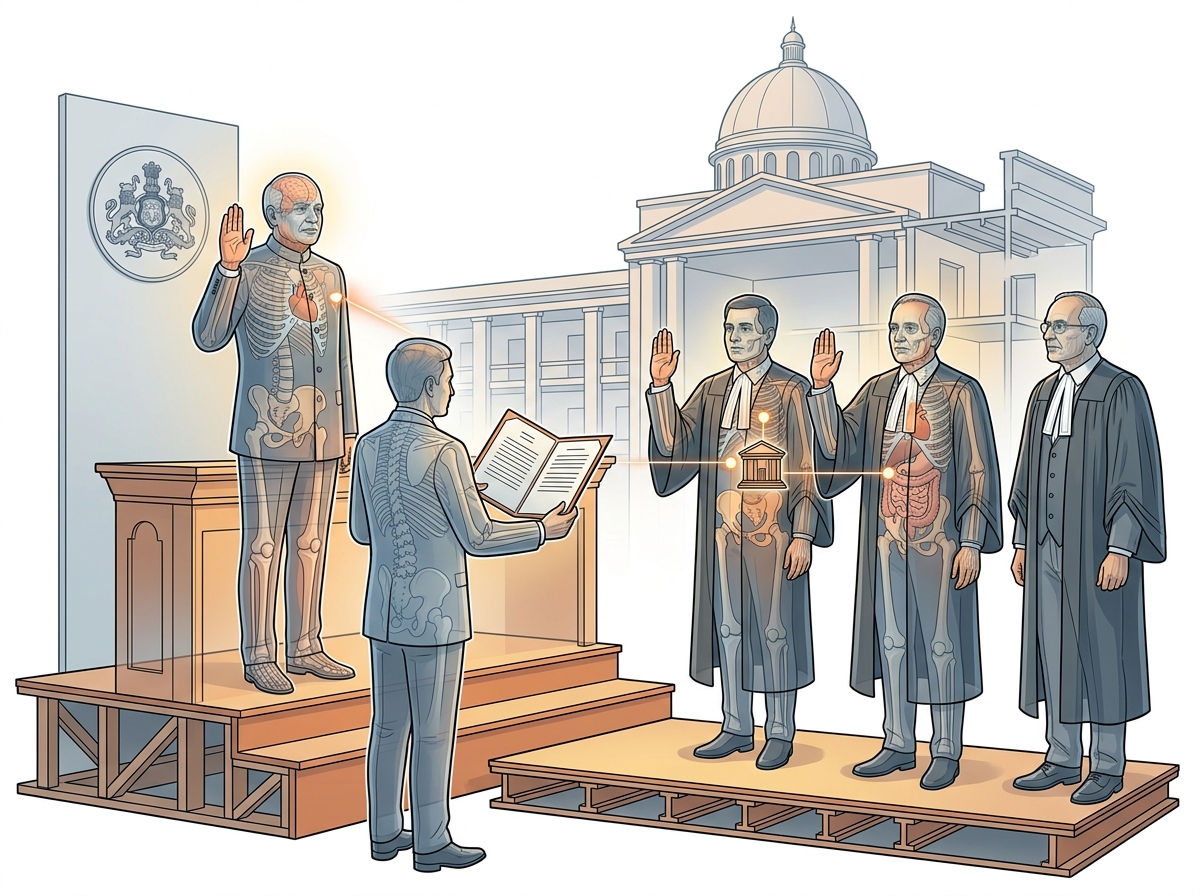
26 Sep Karnataka HC Gets 3 New Judges: Governor Swears-In Ceremony Explained for UPSC
✎ Judicial appointments to the High Court are made under Article 217 of the Constitution, with the Governor performing a ceremonial role in the swearing-in process, while the actual selection is governed by the Collegium System.
Subject Relevance — Where This Topic Fits
- GS Paper II — Polity and Governance
- Prelims: Judicial Appointments Commission, Collegium System, Article 217, High Court Judges (Appointment) Rules, 1954, Governor’s role in judicial appointments
Quick Revision: Judicial appointments to the High Court are made under Article 217 of the Constitution, with the Governor performing a ceremonial role in the swearing-in process, while the actual selection is governed by the Collegium System.
Why is this in the news?
The swearing-in of three new judges to the Karnataka High Court by the Governor highlights the constitutional process of judicial appointments in India, particularly the elevation of district judges to the High Court. This event underscores the role of the executive (Governor) and the judiciary in ensuring the functioning of the higher judiciary under the Constitution of India.
Background
- The Constitution of India, under Article 217, empowers the President to appoint judges to a High Court in consultation with the Chief Justice of India and the Governor of the State.
- The appointment process for High Court judges typically involves elevation from the district judiciary or direct recruitment, with recommendations made by the High Court Collegium.
- The Governor acts as the constitutional head of the State and performs ceremonial functions, including the swearing-in of judges, as per the constitutional scheme.
- The Karnataka High Court, established in 1884, is one of the oldest High Courts in India and has jurisdiction over the State of Karnataka.
Appointment of High Court Judges: Constitutional and Procedural Framework
- Article 217 of the Constitution stipulates that a judge of a High Court shall be appointed by the President after consultation with the Chief Justice of India and the Governor of the State concerned.
- The Governor’s role in the appointment process is primarily ceremonial, as the actual selection is made by the Supreme Court Collegium, which evaluates the suitability of candidates based on their judicial experience and integrity.
- Elevations to the High Court are typically drawn from the pool of district judges, advocates with substantial practice, or legal academics with proven expertise in constitutional or legal matters.
- The Collegium System, evolved through judicial pronouncements, ensures that judicial appointments are insulated from political interference and are based on merit and seniority.
- The Governor’s swearing-in ceremony is a constitutional obligation that formalises the appointment, though the substantive decision-making authority rests with the judiciary and the executive.
- The appointment of judges from the district judiciary, as seen in the case of the Karnataka High Court, reflects the principle of promoting judicial talent from the grassroots to the higher judiciary.
Key Features
| Feature | Significance |
|---|---|
| Appointment of judges from district judiciary | Ensures representation of grassroots judicial experience in higher judiciary, enhancing diversity in decision-making. |
| Judicial elevation process | Demonstrates the structured career progression within the Indian judicial system from subordinate to higher judiciary. |
| Governor’s role in swearing-in | Highlights the constitutional function of the Governor as the nominal executive head in judicial appointments within the state. |
| Judicial service tenure and experience | Reflects the importance of judicial experience in lower courts as a prerequisite for higher judicial appointments. |
Why it Matters
Judicial Administration
- The elevation of district judges to the High Court reinforces the principle of meritocracy and experience-based progression in the Indian judiciary.
- It ensures continuity of judicial expertise at the appellate level, particularly in states with high case pendency like Karnataka.
- The inclusion of judges from diverse backgrounds (e.g., family of lawyers, direct recruits) promotes inclusivity in the higher judiciary.
Constitutional Framework
- The appointment process adheres to the constitutional provisions under Article 217(1) and Article 224(1) of the Constitution of India, which govern the appointment of High Court judges.
- The Governor’s role in the swearing-in ceremony underscores the separation of powers, where the executive (Governor) performs a ceremonial function in judicial appointments.
Judicial Reforms
- The elevation of judges from the district cadre highlights the need for systemic reforms to streamline judicial appointments and reduce delays in the higher judiciary.
- It reflects ongoing efforts to address the shortage of judges in High Courts, which impacts judicial efficiency and case disposal rates.
Challenges
1. Judicial Appointment Delays
- Prolonged vacancies in High Courts due to procedural delays in appointments can lead to case backlogs and judicial inefficiency.
- The process of identifying and elevating suitable candidates from the district judiciary often faces bureaucratic and administrative hurdles.
UPSC Link: Judicial Appointments Commission (JAC) and Collegium System
2. Representation and Diversity
- Ensuring equitable representation across gender, caste, and regional backgrounds in judicial appointments remains a persistent challenge.
- The lack of a formalized diversity policy in judicial appointments may perpetuate existing imbalances in higher judiciary composition.
UPSC Link: Article 15(1) and Article 16(4) – Equality and Reservation
3. Judicial Infrastructure
- Inadequate infrastructure in subordinate courts, such as insufficient courtrooms and staff, can hinder the career progression of judges and their eventual elevation.
- Poor working conditions in district judiciary may deter talented legal professionals from pursuing judicial careers.
UPSC Link: Judicial Infrastructure and Case Management
Challenges — UPSC Perspective
| Issue | Concern |
|---|---|
| Vacancy in High Courts | Leads to increased pendency of cases and delays in justice delivery. |
| Lack of standardized appointment criteria | May result in subjective decisions and potential biases in judicial appointments. |
| Inadequate training for district judges | Limits their preparedness for higher judicial roles and appellate work. |
| Regional disparities in judicial appointments | May marginalize certain states or communities in the higher judiciary. |
Way Forward
- Strengthen the judicial appointment process by expediting the identification and evaluation of candidates from the district judiciary.
- Introduce structured training programs for district judges to prepare them for higher judicial roles, including appellate work.
- Enhance transparency in judicial appointments by publishing selection criteria and reasons for elevation.
- Address judicial infrastructure gaps in subordinate courts to improve working conditions and career incentives.
- Promote diversity in judicial appointments through targeted policies for gender, caste, and regional representation.
- Encourage state governments to fill vacancies in district courts promptly to ensure a steady pipeline for higher judicial appointments.
UPSC Value Addition
Keywords for Mains Answer-Writing
Judicial Appointments in India · Karnataka High Court · Constitutional provisions for judicial appointments · Collegium System · Governor’s role in judicial appointments · Article 217 of the Indian Constitution · Judicial hierarchy in India · Judicial independence · Appointment of High Court judges · Constitutional provisions for oath of office
Constitutional & Policy Linkages
- Article 217(1) – Appointment of High Court judges
- Article 224(1) – Appointment of additional judges
- Article 233 – Appointment of district judges
Concept Flow
District judges gain experience through adjudication in subordinate courts → Judicial service rules govern career progression and eligibility for elevation → High Court Collegium or Governor (as per constitutional provisions) recommends appointments → Governor swears in the appointees, formalizing their role in the High Court → New judges contribute to judicial decision-making at the appellate level → Case disposal rates and judicial efficiency are influenced by the composition of the High Court
Prelims Practice Questions
Q1. Consider the following statements regarding the appointment of High Court judges in India: 1. The Chief Justice of India (CJI) is the sole authority for recommending names for appointment as High Court judges. 2. The Governor of the State is required to administer the oath of office to the newly appointed High Court judges. 3. The appointment of judges is governed by Article 217 of the Indian Constitution. 4. The collegium system is a statutory provision under the Constitution. How many of the above statements are correct?
- Only one
- Only two
- Only three
- All
Answer: Only three — Statements 2 and 3 are correct. The Governor administers the oath (Article 219), and Article 217 governs the appointment of High Court judges. Statement 1 is incorrect as the collegium system (a judicial convention) recommends names, and Statement 4 is incorrect as the collegium system is not a statutory provision but a judicial convention.
Q2. Assertion (A): The Governor of a State plays a significant role in the appointment of High Court judges. Reason (R): The Governor is required to administer the oath of office to the newly appointed judges under Article 219 of the Indian Constitution.
- Both A and R are true, and R is the correct explanation of A
- Both A and R are true, but R is not the correct explanation of A
- A is true, but R is false
- A is false, but R is true
Answer: ? — Assertion (A) is false because the Governor’s role in the appointment process is largely ceremonial; the real power lies with the collegium system. Reason (R) is true as the Governor does administer the oath under Article 219, but it does not explain the Governor’s role in the appointment process.
Q3. Match the following provisions with their respective articles under the Indian Constitution: Column I: A. Appointment of High Court judges B. Oath of office for High Court judges C. Appointment of Governor D. Powers of Governor Column II: 1. Article 155 2. Article 217 3. Article 219 4. Article 166
- A-2, B-3, C-1, D-4
- A-1, B-2, C-3, D-4
- A-3, B-2, C-4, D-1
- A-4, B-1, C-2, D-3
Answer: A-2, B-3, C-1, D-4 — A-2 (Article 217 governs the appointment of High Court judges), B-3 (Article 219 governs the oath of office for High Court judges), C-1 (Article 155 governs the appointment of the Governor), D-4 (Article 166 governs the powers of the Governor).
Mains Practice Question
✍ Examine the constitutional framework governing the appointment of High Court judges in India, with particular reference to the role of the Governor and the collegium system. Also, discuss the implications of such a framework for judicial independence and federalism. (15 Marks)
Approach: MODEL-ANSWER SKELETON:
1. **Constitutional Framework**:
– Article 217(1) of the Indian Constitution: Appointment of High Court judges requires consultation with the CJI and the Governor of the State.
– Article 222: Transfer of High Court judges.
– The Governor’s role is ceremonial under Article 219 (administering the oath) and Article 166 (executive powers).
2. **Collegium System**:
– Evolution: Originated from the Second and Third Judges Cases (1993, 1998).
– Composition: The Supreme Court Collegium consists of the CJI and four senior-most judges.
– Process: The collegium recommends names to the Government, which then seeks the Governor’s opinion (a formality).
3. **Governor’s Role**:
– **Appointment**: The Governor’s role is limited to seeking the State’s opinion (Article 217(1)), which is often a formality.
– **Oath**: The Governor administers the oath under Article 219.
– **Federalism**: The Governor acts as a link between the Centre and the State, ensuring constitutional propriety.
4. **Judicial Independence**:
– **Merits**: The collegium system insulates judicial appointments from executive interference, preserving autonomy.
– **Criticisms**: Lack of transparency, absence of legislative or executive checks, and potential for nepotism.
– **Recent Developments**: The Supreme Court’s emphasis on transparency (e.g., disclosure of reasons for recommendations) and the introduction of the Memorandum of Procedure (MoP).
5. **Federalism Implications**:
– **State Autonomy**: The Governor’s role is a safeguard against arbitrary appointments by the Centre.
– **Centre-State Relations**: The collegium system centralises judicial appointments, raising questions about federalism.
6. **Conclusion**:
– Balance between judicial independence and federalism is delicate. The collegium system, while imperfect, has been pivotal in maintaining judicial autonomy. Reforms should focus on transparency and inclusivity without compromising independence.
Source: The Hindu
Karnataka PCS (KPSC) — State PCS Practice
Prelims: Who administered the oath of office to the three newly appointed judges of the Karnataka High Court in 2023?
- A. The Chief Justice of India
- B. The Chief Justice of the Karnataka High Court
- C. The Governor of Karnataka
- D. The President of India
Answer: C. The Governor of Karnataka — The Governor of Karnataka, as the constitutional head of the state, administers the oath of office to judges of the Karnataka High Court.
Mains: Analyze the constitutional role of the Governor in the appointment and swearing-in of judges to the Karnataka High Court. Discuss the significance of this process in maintaining the independence of the judiciary within the state.
Generated by AanyaAi for educational purpose.
Related guides on our sites
- Current affairs for upsc 2026
- Best PSIR optional coaching for upsc
- Best PSIR optional teacher for upsc
- Best teacher of PSIR optional for upsc

- Himachal CM Sukhu: All Doctor Vacancies to be Filled by March - September 27, 2026
- कैसे पुलिस की AI तकनीक पहचान कर रही है अस्पष्ट शवों को - September 27, 2026
- Jai Jyoti: 106 km Bisalpur Pipeline to End Jaipur Water Crisis - September 27, 2026

No Comments