


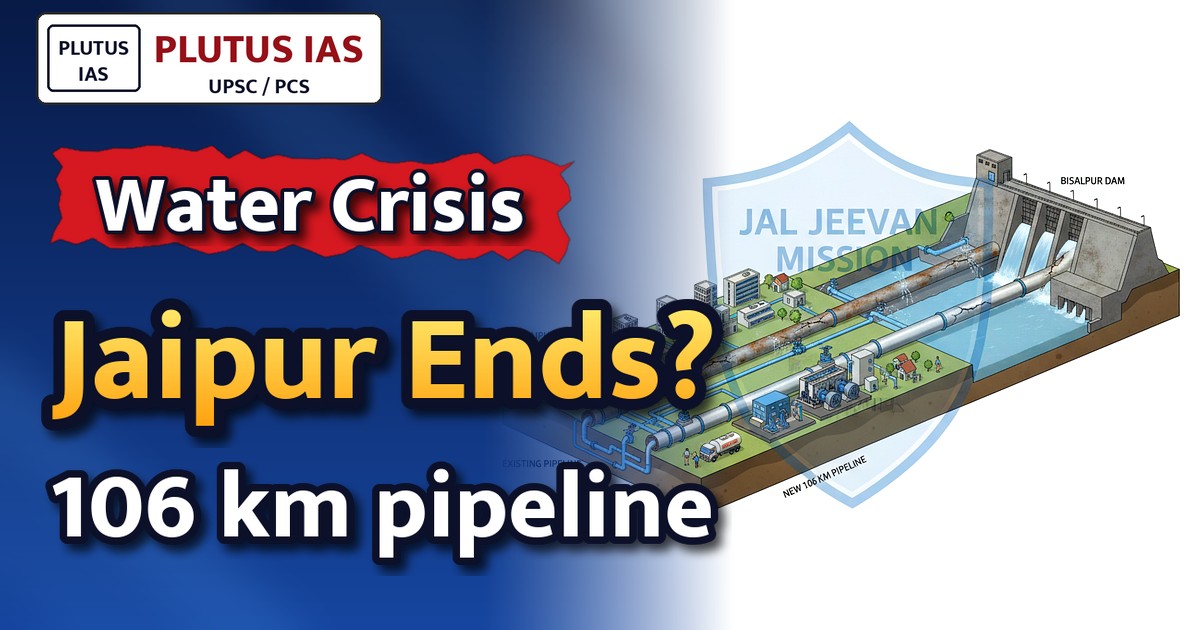
27 Sep Jai Jyoti: 106 km Bisalpur Pipeline to End Jaipur Water Crisis
✎ The Bisalpur-Jaipur pipeline project exemplifies integrated urban water management, combining large-scale infrastructure with long-term demand forecasting to address chronic water stress in arid urban centres.
Subject Relevance — Where This Topic Fits
- GS Paper II — Governance, Transparency and Accountability | GS Paper III — Infrastructure: Energy, Ports, Roads, Airports, Railways and Urban Infrastructure
- Prelims: Jal Jeevan Mission, Urban Water Supply, Bisalpur Dam, National Water Policy 2012, Public-Private Partnership in Infrastructure, Water Stress and Urbanisation, National Urban Mission
- Essay: Water Security: A Prerequisite for Sustainable Urban Development, Balancing Development and Environmental Sustainability
Quick Revision: The Bisalpur-Jaipur pipeline project exemplifies integrated urban water management, combining large-scale infrastructure with long-term demand forecasting to address chronic water stress in arid urban centres.
Why is this in the news?
The Detailed Project Report (DPR) has been finalised and submitted for administrative approval, marking a significant intervention under the Jal Jeevan Mission and the State’s urban water supply strategy.
Background
- Jaipur, the capital of Rajasthan, faces severe water stress due to its arid climate, rapid urbanisation, and reliance on distant water sources such as the Bisalpur Dam, located approximately 120 km away.
- The existing 2,300 mm diameter pipeline from Bisalpur to Jaipur, commissioned around 2009, is now 17 years old and operates under high pressure, leading to frequent leakages and inefficiencies.
- Approximately 45% of Jaipur’s urban areas currently experience low-pressure water supply, compelling residents to rely on expensive private tankers, particularly in newly developed localities like Prithviraj Nagar Phase-II.
- The National Water Policy 2012 emphasises sustainable urban water management, prioritising augmentation of supply, reduction of leakages, and long-term planning for growing demand.
- The Jal Jeevan Mission (Urban), under the Ministry of Housing and Urban Affairs, aims to provide functional tap connections to all households in urban areas by 2024, integrating water supply with infrastructure development.
- Rajasthan’s State Water Policy (2010) and Urban Water Supply Master Plan highlight the need for inter-basin water transfers and large-scale infrastructure projects to mitigate recurring droughts and urban water crises.
What is the Bisalpur-Jaipur Pipeline Project?
- The pipeline is engineered to meet the projected water demand of Jaipur for the next 30 years, aligning with demographic growth projections and urban expansion trends.
- A dual-supply system will be implemented: the new pipeline will operate alongside the existing one, ensuring uninterrupted water distribution and redundancy in case of maintenance or failure.
- The project includes modernisation of pumping stations, installation of pressure-reducing valves, and integration with Jaipur’s existing water distribution network to enhance efficiency and reliability.
- The Detailed Project Report (DPR) incorporates environmental safeguards, including assessment of ecological impacts on river basins and mitigation measures for land acquisition and resettlement.
- The project is expected to reduce dependence on groundwater extraction in Jaipur, which has led to declining water tables and increased vulnerability to droughts.
- Funding is envisaged through a mix of state budgetary allocations, central government grants under the Jal Jeevan Mission (Urban), and potential public-private partnerships (PPP) for operation and maintenance.
Key Features
| Feature | Significance |
|---|---|
| 106 km new pipeline (2,100 mm diameter) | Augments raw water transmission capacity from Bisalpur Dam to Jaipur, replacing an aging 2,300 mm line under increasing stress. |
| Dual-supply system | Maintains uninterrupted water distribution by operating both the new and existing pipelines simultaneously. |
| 30-year design horizon (up to 2058) | Aligns infrastructure with projected demographic growth, ensuring long-term water security for Jaipur. |
| Rs 2,228 crore investment | Reflects the scale of capital required for large-scale urban water transmission infrastructure in a metropolitan context. |
| Pressure normalization for 45% of city | Addresses chronic low-pressure zones, reducing reliance on expensive private tankers and improving service equity. |
Why it Matters
Urban Governance and Service Delivery
- Demonstrates integrated planning in municipal water supply, linking source augmentation (Bisalpur Dam) with end-user distribution networks.
- Highlights the need for periodic asset replacement in aging urban infrastructure systems to prevent systemic failures.
- Emphasises the role of long-term demographic projections in designing resilient public utilities.
Resource Security and Sustainability
- Reinforces the importance of inter-basin water transfers in mitigating localised water scarcity within a growing metropolis.
- Underscores the necessity of diversifying raw water sources to reduce vulnerability to drought and seasonal variability.
- Aligns with national frameworks such as the National Water Mission’s emphasis on augmenting storage and distribution infrastructure.
Fiscal and Institutional Capacity
- Illustrates the fiscal burden on state exchequers for large-scale urban water projects, necessitating prudent financial planning.
- Showcases the institutional capacity required for project preparation, including Detailed Project Report (DPR) formulation and multi-stakeholder coordination.
Challenges
1. Aging Infrastructure and Replacement Lag
- Existing 2,300 mm pipeline, operational for ~17 years, is structurally compromised due to chronic overloading and wear.
- Replacement timelines often lag behind demand growth, exacerbating service disruptions and leakage risks.
UPSC Link: Urban infrastructure management
2. Demand-Supply Mismatch in Metropolitan Context
- Jaipur’s population growth outpaces incremental water supply augmentation, leading to persistent deficits.
- Peripheral urban extensions (e.g., Prithviraj Nagar Phase-II) face acute shortages due to inadequate network expansion.
UPSC Link: Urbanisation and water stress
3. Financial Viability and Cost Recovery
- High capital intensity (Rs 2,228 crore) raises questions about long-term cost recovery mechanisms, including user charges and state subsidies.
- Risk of underutilisation if demand projections are overestimated or population growth deviates from projections.
UPSC Link: Public finance and infrastructure economics
4. Environmental and Ecological Trade-offs
- Inter-basin transfer from Bisalpur Dam may impose ecological costs on the donor basin, necessitating environmental impact assessments.
- Energy intensity of long-distance water transmission increases the project’s carbon footprint.
UPSC Link: Sustainable water resource management
5. Operational and Maintenance Challenges
- Ensuring seamless transition between old and new pipelines without service disruptions requires meticulous commissioning and monitoring.
- Post-project maintenance demands skilled manpower and robust asset management systems to sustain performance.
UPSC Link: Urban local body capacity
Challenges — UPSC Perspective
| Issue | Concern |
|---|---|
| Technical obsolescence | Aging pipeline infrastructure unable to meet current and projected demand due to material fatigue and capacity constraints. |
| Demographic pressure | Rapid urbanisation in Jaipur outstrips incremental water supply augmentation, creating structural deficits. |
| Financial sustainability | High capital cost (Rs 2,228 crore) necessitates sustainable funding models to avoid fiscal strain on state resources. |
| Ecological impact | Large-scale inter-basin water transfer may alter downstream hydrology and biodiversity in the donor basin. |
| Institutional coordination | Multi-agency involvement (state, municipal, and water resource departments) requires streamlined governance for timely execution. |
| Equity in service delivery | Peripheral urban areas face chronic water shortages, exacerbating socio-economic disparities in access. |
Way Forward
- Conduct rigorous environmental impact assessment (EIA) for inter-basin water transfer to mitigate ecological risks.
- Develop a phased implementation plan with clear milestones for pipeline construction, testing, and commissioning.
- Establish a dedicated asset management cell within the Jaipur Municipal Corporation to oversee post-project maintenance.
- Introduce progressive water pricing mechanisms to ensure cost recovery while protecting vulnerable households.
- Integrate the project with broader urban water security plans, including rainwater harvesting and wastewater recycling initiatives.
- Strengthen inter-departmental coordination between the Water Resources Department, Public Health Engineering Department, and Jaipur Development Authority.
- Undertake public awareness campaigns to educate citizens on water conservation and efficient usage practices.
- Monitor and evaluate the project’s performance against predefined benchmarks to ensure accountability and transparency.
UPSC Value Addition
Keywords for Mains Answer-Writing
Urban water supply governance · Inter-state water resource management · Rajasthan water policy · Bisalpur-Jaipur water pipeline project · Public infrastructure financing · Urban water scarcity mitigation · Detailed Project Report (DPR) in infrastructure · Dual water supply systems · Water demand projection for 2058 · State-level water resource allocation
Constitutional & Policy Linkages
- Article 243W: Empowers Municipalities to manage urban water supply as a civic function.
- Article 243ZD: Mandates planning for economic development and social justice in urban areas, including infrastructure provision.
Concept Flow
Urban population growth → Increased per capita water demand → Chronic supply deficits in Jaipur → Aging transmission pipeline → Structural failures and leakage → Service disruptions and low pressure → State government initiates feasibility study → Bisalpur Dam identified as primary source → DPR prepared with 30-year horizon → Dual-supply system designed to ensure redundancy → Rs 2,228 crore investment approved → Construction of 106 km, 2,100 mm pipeline initiated → Post-commissioning monitoring → Asset management and maintenance protocols enforced → Sustainable water security achieved → Reduced reliance on private tankers and improved service equity
Prelims Practice Questions
Q1. Consider the following statements regarding the Bisalpur-Jaipur water pipeline project:
1. The project involves laying a 106-kilometre pipeline from Bisalpur to Jaipur.
2. The pipeline is designed to meet the water demand of Jaipur for the next 30 years.
3. The project is being implemented under the National Mission for Clean Ganga (NMCG).
How many of the above statements are correct?
- Only one
- Only two
- All
- None
Answer: Only two — Only statements 1 and 2 are correct. Statement 3 is incorrect as the project is not linked to the National Mission for Clean Ganga; it is a state-level initiative by the Government of Rajasthan.
Q2. Assertion (A): The Bisalpur-Jaipur water pipeline project aims to address the low-pressure water supply issues in Jaipur.
Reason (R): The existing 2,300 mm diameter pipeline is nearly 17 years old and insufficient to meet the current and projected water demand of Jaipur.
Options:
A. Both A and R are true, and R is the correct explanation of A.
B. Both A and R are true, but R is not the correct explanation of A.
C. A is true, but R is false.
D. A is false, but R is true.
Answer: ? — Both the assertion and reason are true, and the reason correctly explains the assertion. The project is designed to replace the aging pipeline and ensure adequate water pressure.
Q3. Match the following columns related to water resource management in India:
Column I (Institution/Project) | Column II (Associated State/Region)
1. Bisalpur-Jaipur Pipeline | A. Rajasthan
2. Sardar Sarovar Project | B. Gujarat
3. Krishna-Cauvery Link Project | C. Inter-state
4. National Mission for Clean Ganga | D. Uttar Pradesh
Options:
A. 1-A, 2-B, 3-C, 4-D
B. 1-B, 2-A, 3-C, 4-D
C. 1-A, 2-B, 3-D, 4-C
D. 1-C, 2-B, 3-A, 4-D
Answer: ? — 1-A: Bisalpur-Jaipur Pipeline is in Rajasthan.
2-B: Sardar Sarovar Project is in Gujarat.
3-C: Krishna-Cauvery Link Project is an inter-state project.
4-D: National Mission for Clean Ganga is associated with Uttar Pradesh and other Ganga basin states.
Mains Practice Question
✍ The Bisalpur-Jaipur water pipeline project exemplifies the challenges and strategies in managing urban water supply in India. Critically examine the governance mechanisms, financial arrangements, and long-term sustainability concerns associated with such large-scale water infrastructure projects. Also, discuss the role of Detailed Project Reports (DPRs) in ensuring transparency and accountability in infrastructure development. (15 Marks)
Approach: MODEL-ANSWER SKELETON:
1. Governance Mechanisms:
– Role of state agencies (e.g., Public Health Engineering Department, Rajasthan) in planning and execution.
– Inter-state water sharing agreements (Bisalpur Dam is shared between Rajasthan and Madhya Pradesh).
– Compliance with the National Water Policy (2012) and Rajasthan Water Resources Regulatory Authority.
– Public participation and grievance redressal mechanisms.
2. Financial Arrangements:
– Budgetary allocations and public-private partnership (PPP) models.
– Role of financial institutions (e.g., NABARD, World Bank) in funding.
– Cost-benefit analysis and fiscal sustainability over 30 years.
3. Long-term Sustainability Concerns:
– Climate change impacts on water availability (e.g., erratic monsoons).
– Groundwater depletion and recharge strategies.
– Technological innovations (e.g., leak detection, smart meters).
– Institutional capacity for maintenance and operation.
4. Role of Detailed Project Reports (DPRs):
– Purpose of DPRs in infrastructure projects (feasibility, cost estimation, environmental impact).
– Transparency and accountability: public disclosure, stakeholder consultations.
– Legal compliance (Environment Impact Assessment, Forest Clearance).
– Case study: How the DPR for Bisalpur-Jaipur pipeline addresses these aspects.
5. Challenges and Recommendations:
– Land acquisition and rehabilitation.
– Ensuring equitable water distribution across urban and peri-urban areas.
– Monitoring and evaluation frameworks for project success.
Balance of Views:
– Proponents argue that such projects are essential for urban resilience and economic growth.
– Critics highlight environmental costs, displacement risks, and fiscal burden on states.
Source: amarujala.com
Rajasthan PCS (RPSC / RAS) — State PCS Practice
Prelims: Under the ‘Beesalpur to Jaipur 106 km pipeline project’ worth ₹2228 crore, which of the following is the primary objective?
- A. To provide 24×7 water supply to Jaipur city by diverting water from Beesalpur dam
- B. To construct a new dam in Jaipur to address water scarcity
- C. To promote groundwater recharge in Jaipur district
- D. To supply water to industrial units in Jaipur only
Answer: A. To provide 24×7 water supply to Jaipur city by diverting water from Beesalpur dam — The project aims to divert water from Beesalpur dam to Jaipur city to ensure 24×7 water supply and mitigate water scarcity.
Mains: Discuss the significance of the ‘Beesalpur to Jaipur 106 km pipeline project’ in addressing water scarcity in Rajasthan, highlighting its potential impact on urban water management and sustainability. (Word limit: 200)
Generated by AanyaAi for educational purpose.
Related guides on our sites
- Current affairs for upsc 2026
- Best PSIR optional coaching for upsc
- Best PSIR optional teacher for upsc
- Best teacher of PSIR optional for upsc

- Jai Jyoti: 106 km Bisalpur Pipeline to End Jaipur Water Crisis - September 27, 2026
- यूक्रेन का रोबोट सेना अभियान: युद्ध में मानव हानि कम करने की रणनीति - September 27, 2026
- Ukraine’s ‘Army of Robots’: A Game-Changer for UPSC Mains 2026 Polity & Governance - September 27, 2026

No Comments