


26 Sep Andhra Pradesh Revises Textbooks to Challenge Gender Stereotypes in Early Education
✎ Andhra Pradesh’s education reforms integrate gender equity, value-based learning, experiential pedagogy, and technology (e.g., LEAP App, AI exposure) to align school education with NEP 2020 and Viksit Bharat goals.
Subject Relevance — Where This Topic Fits
- GS Paper II — Social Justice (Education, Gender Issues) | GS Paper III — Issues relating to development and management of Social Sector/Services relating to Education
- Prelims: National Education Policy (NEP) 2020, Gender Stereotypes in Education, Curriculum Reforms, Value-Based Education, No Bag Day, LEAP App, Experiential Learning, Artificial Intelligence in School Curriculum
- Essay: The Role of Education in Building an Equitable Society, Technology and Human Values: Striking the Right Balance in Modern Education
Quick Revision: Andhra Pradesh’s education reforms integrate gender equity, value-based learning, experiential pedagogy, and technology (e.g., LEAP App, AI exposure) to align school education with NEP 2020 and Viksit Bharat goals.
Why is this in the news?
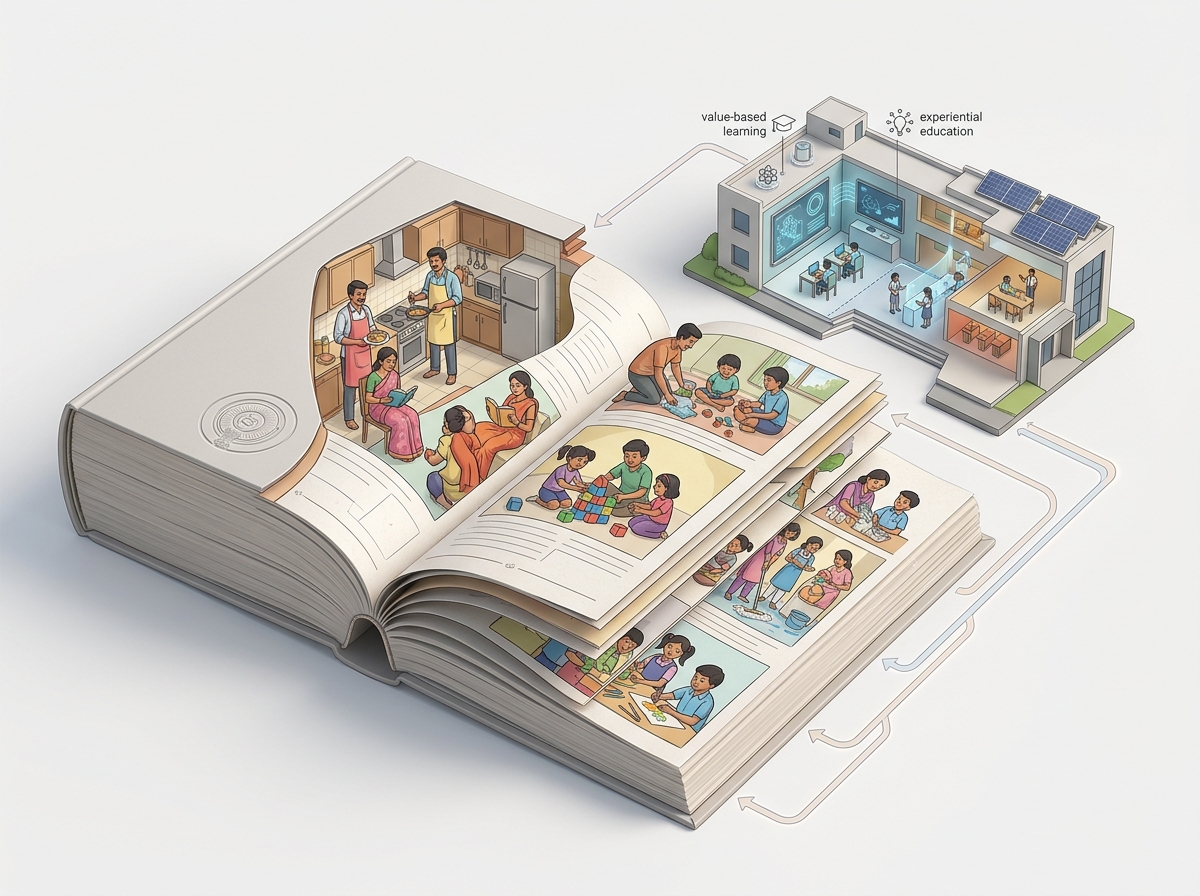
The Government of Andhra Pradesh has undertaken a significant revision of school textbooks for Classes I and II to challenge gender stereotypes by depicting an equitable distribution of household responsibilities between men and women. This initiative, announced by the State’s HRD Minister, forms part of a broader set of education reforms aimed at fostering value-based learning, integrating technology, and enhancing experiential education in schools. The reforms are aligned with the vision of Viksit Bharat and reflect a systematic approach to curriculum transformation.
Background
- The National Education Policy (NEP) 2020 emphasises the elimination of gender-based stereotypes and the promotion of inclusive and equitable education.
- Andhra Pradesh has historically lagged in teacher-student ratios and infrastructure, prompting systemic reforms in school education.
- The State has conducted two rounds of curriculum reform, indicating a phased and incremental approach to educational transformation.
- The introduction of ‘No Bag Day’ aligns with global best practices in reducing student stress and promoting holistic learning.
- Teacher recruitment drives, including the recent addition of 16,000 teachers, aim to improve classroom learning outcomes and reduce the teacher-student ratio.
- The integration of Artificial Intelligence (AI) and gamification in education reflects a shift towards technology-enabled learning environments.
Key Dimensions of Andhra Pradesh’s Education Reforms
- **Gender-Inclusive Curriculum Design**: Textbooks for Classes I and II have been revised to depict men and women sharing household responsibilities equally (50% each), challenging traditional gender roles and stereotypes from early childhood education.
- **Value-Based Learning**: The reforms prioritise the inculcation of ethical values, civic responsibility, and social awareness as core components of the curriculum, in line with the vision of ‘Viksit Bharat’.
- **Experiential Learning Initiatives**: The designation of Saturday as a ‘No Bag Day’ facilitates practical, hands-on learning activities such as managing family and agricultural budgets, field visits, and exposure to AI tools.
- **Technology-Enabled Education**: The State has introduced initiatives like the LEAP App to enhance engagement, accessibility, and personalised learning through digital platforms.
- **Curriculum Reform Process**: The reforms are structured as a multi-year, grade-wise transformation, ensuring incremental improvements and continuous updates to the curriculum.
- **Teacher Recruitment and Capacity Building**: The State has recruited approximately 16,000 teachers and aims to conduct annual recruitments to improve the teacher-student ratio and enhance instructional quality.
- **Industry-Linked Skilling**: The reforms incorporate vocational and skill-based education to align school learning with industry requirements, preparing students for future employment.
- **AI Education Framework**: Students are taught both the benefits and risks of AI, fostering critical thinking and responsible technology use in academic and real-world contexts.
Key Features
| Feature | Significance |
|---|---|
| Revision of textbooks for Classes I and II to challenge gender stereotypes | Promotes gender equality from early education, countering traditional norms that assign domestic roles exclusively to women. |
| Equal distribution of household chores (50% men, 50% women) in textbook illustrations | Normalises shared responsibility, fostering respect for gender parity in domestic and societal roles. |
| Designation of Saturday as ‘No Bag Day’ in schools | Encourages experiential and practical learning, reducing academic pressure and promoting holistic development. |
| Introduction of value-based learning in curriculum reform | Aligns education with moral and ethical development, essential for character-building and societal cohesion. |
| Integration of AI education with risk-benefit analysis | Prepares students for a technology-driven future while instilling critical awareness of ethical and security concerns. |
| Teacher recruitment drive (16,000 teachers) and ‘one class, one teacher’ policy | Improves pupil-teacher ratios, enhancing instructional quality and classroom management. |
| Technology-enabled initiatives like the LEAP App and gamification of learning | Enhances engagement, accessibility, and adaptability of educational content through digital tools. |
Why it Matters
Social
- Reinforces constitutional principles of equality (Article 14) and non-discrimination (Article 15) by addressing gender bias in foundational education.
- Contributes to Sustainable Development Goal 5 (Gender Equality) by embedding egalitarian values in early childhood learning.
- Promotes intergenerational change by shaping attitudes of young learners toward gender roles and responsibilities.
Pedagogical
- Demonstrates systemic curriculum reform as a tool for social transformation, aligning with NEP 2020’s emphasis on experiential and value-based learning.
- Illustrates the role of textbooks as instruments of normative change, not merely repositories of information.
- Highlights the importance of incremental, grade-wise curriculum evolution rather than abrupt overhauls.
Governance
- Shows state-led innovation in education policy, leveraging administrative and fiscal resources for systemic reform.
- Demonstrates the integration of technology in governance (LEAP App, gamification) to enhance educational delivery and monitoring.
- Emphasises the need for continuous teacher recruitment and professional development to sustain reform outcomes.
Challenges
1. Implementation Gaps in Curriculum Reform
- Risk of superficial adoption without deep-rooted cultural change in schools and communities.
- Potential resistance from stakeholders accustomed to traditional gender roles or pedagogical methods.
- Challenge of ensuring consistency in textbook content across all schools, including those in rural and marginalised areas.
UPSC Link: GS2: Education Policy
2. Teacher Preparedness and Training
- Insufficient training for teachers to deliver value-based and gender-sensitive education effectively.
- Need for ongoing professional development to integrate new pedagogical approaches and digital tools.
- Ensuring equitable teacher distribution, particularly in remote or underserved regions.
UPSC Link: GS2: Teacher Training
3. Equity in Access to Technology
- Digital divide may limit the reach of technology-enabled initiatives like the LEAP App and AI education.
- Rural schools may lack infrastructure for gamification and experiential learning activities.
- Ensuring inclusive access to devices and internet connectivity for all students.
UPSC Link: GS2: Digital Divide
4. Sustainability of Reforms
- Long-term commitment required to maintain curriculum updates and teacher recruitment without policy reversals.
- Need for periodic assessment and feedback mechanisms to evaluate the impact of reforms.
- Balancing immediate educational outcomes with long-term societal behavioural change.
UPSC Link: GS2: Policy Implementation
5. Cultural and Societal Resistance
- Deep-seated gender norms may persist despite educational reforms, requiring community engagement and awareness campaigns.
- Potential backlash from conservative groups opposing progressive gender narratives in textbooks.
- Need for multi-stakeholder collaboration to foster acceptance of reformative educational content.
UPSC Link: GS1: Social Change
Challenges — UPSC Perspective
| Issue | Concern |
|---|---|
| Textbook content consistency | Ensuring uniform adoption and understanding of revised gender-sensitive narratives across all schools. |
| Teacher training quality | Equipping educators with skills to impart value-based and experiential learning effectively. |
| Digital infrastructure | Providing equitable access to technology-enabled learning tools in all educational institutions. |
| Community buy-in | Addressing societal resistance to progressive gender norms embedded in educational materials. |
| Policy continuity | Maintaining reform momentum despite changes in political leadership or administrative priorities. |
| Assessment and evaluation | Developing metrics to measure the impact of curriculum reform on gender attitudes and learning outcomes. |
Way Forward
- Conduct periodic teacher training programmes focused on gender sensitivity, experiential pedagogy, and digital literacy.
- Establish a monitoring and evaluation framework to assess the effectiveness of revised textbooks and ‘No Bag Day’ activities.
- Expand digital infrastructure in rural and tribal schools to ensure equitable access to technology-enabled learning tools.
- Launch community awareness campaigns in collaboration with local leaders, parents, and NGOs to reinforce gender-equal norms.
- Integrate AI education with ethical frameworks, including data privacy and algorithmic bias, to foster responsible technology use.
- Develop supplementary learning materials (e.g., activity books, audio-visual aids) to complement textbook revisions.
- Encourage peer-reviewed research on the socio-educational impact of curriculum reforms to inform future policy adjustments.
- Strengthen the ‘one class, one teacher’ initiative by addressing teacher shortages in remote and high-need areas.
UPSC Value Addition
Keywords for Mains Answer-Writing
Curriculum reform · Gender sensitization in education · Value-based education policy · Pedagogical innovations in school education · Experiential learning frameworks · Teacher recruitment and capacity building · Technology-enabled education · Gender stereotypes in textbooks · National Education Policy (NEP) 2020 · Experiential learning days in schools · Artificial Intelligence in school curriculum · Inclusive education practices
Concept Flow
Identification of gender bias in early education materials → Policy intervention through textbook revision → Promotion of gender equality in pedagogical content → Implementation of experiential learning (e.g., ‘No Bag Day’) → Integration of technology and value-based learning → Teacher training and capacity building → Monitoring and evaluation of reform outcomes → Feedback loop for continuous improvement → Long-term societal behavioural change.
Prelims Practice Questions
Q1. Consider the following statements regarding the recent curriculum reforms in Andhra Pradesh’s school education system:
1. The revised textbooks for Classes I and II now depict men and women sharing household responsibilities equally to challenge gender stereotypes.
2. The State government has designated every Saturday as a ‘No Bag Day’ to promote experiential learning.
3. The government has achieved universal coverage of ‘one class, one teacher’ in all schools.
How many of the above statements are correct?
- Only one
- Only two
- All three
- None
Answer: Only two — Statement 1 is correct as the HRD Minister explicitly mentioned the revised textbooks depicting equal sharing of household responsibilities. Statement 2 is correct as the Minister stated Saturday has been designated as a ‘No Bag Day’. Statement 3 is incorrect as the Minister noted that the proportion of schools meeting the ‘one class, one teacher’ standard rose from 3% to 33%, indicating it is not universally achieved.
Q2. Assertion (A): The National Education Policy (NEP) 2020 emphasizes the integration of value-based education and experiential learning in school curricula.
Reason (R): The NEP 2020 mandates the inclusion of Artificial Intelligence as a compulsory subject from Class VI onwards in all Indian schools.
- Both A and R are true, and R is the correct explanation of A
- Both A and R are true, but R is not the correct explanation of A
- A is true, but R is false
- A is false, but R is true
Answer: A is true, but R is false — Assertion (A) is correct as NEP 2020 indeed emphasizes value-based education and experiential learning. Reason (R) is incorrect because while NEP 2020 promotes AI education, it does not mandate it as a compulsory subject from Class VI onwards universally; rather, it encourages its inclusion as part of the curriculum.
Q3. Match the following initiatives of the Andhra Pradesh government’s education reforms with their respective objectives:
Column I (Initiative) | Column II (Objective)
———————|———————–
A. LEAP App | 1. Gamification of learning
B. ‘No Bag Day’ | 2. Teacher recruitment drive
C. Teacher recruitment every year | 3. Technology-enabled education
D. Gamification | 4. Experiential and practical learning
- {‘A’: 3, ‘B’: 4, ‘C’: 2, ‘D’: 1}
- {‘A’: 1, ‘B’: 2, ‘C’: 4, ‘D’: 3}
- {‘A’: 4, ‘B’: 1, ‘C’: 3, ‘D’: 2}
- {‘A’: 2, ‘B’: 4, ‘C’: 1, ‘D’: 3}
Answer: {‘A’: 3, ‘B’: 4, ‘C’: 2, ‘D’: 1} — A-LEAP App is a technology-enabled initiative for education. B-‘No Bag Day’ aims at experiential and practical learning. C-Teachers are recruited annually to improve the teacher-student ratio. D-Gamification is used to make learning more engaging.
Mains Practice Question
✍ The recent revision of school textbooks in Andhra Pradesh to challenge gender stereotypes and the introduction of ‘No Bag Day’ reflect a broader shift towards experiential and value-based learning in school education. Critically analyse the significance of these reforms in the context of the National Education Policy (NEP) 2020 and their potential impact on achieving Sustainable Development Goal 4 (SDG 4). (15 Marks)
Approach: MODEL-ANSWER SKELETON:
1. **Context and Objectives of the Reforms**
– Brief description of Andhra Pradesh’s textbook revision: equal portrayal of household responsibilities (50% men, 50% women) to challenge gender stereotypes.
– Introduction of ‘No Bag Day’ for experiential learning (e.g., managing family/agricultural budgets, field visits, AI exposure).
2. **Alignment with NEP 2020**
– NEP 2020’s emphasis on **value-based education** (Chapter 6: Curriculum and Pedagogy) and **experiential learning** (Section 4.3: Experiential Learning and Flexibility).
– NEP’s focus on **gender sensitization** in curricula (Section 6.2: Gender Inclusion Fund and gender-sensitive textbooks).
– NEP’s promotion of **technology integration** (Section 22.5: Use of Technology in Education) and **AI exposure** in schools.
3. **Link to SDG 4 (Quality Education)**
– SDG 4.5: Eliminate gender disparities in education through inclusive and gender-sensitive curricula.
– SDG 4.7: Ensure all learners acquire knowledge and skills needed for sustainable development (e.g., experiential learning on budgets, AI literacy).
– Role of **teacher capacity building** (SDG 4.c) in implementing these reforms effectively.
4. **Potential Impact and Challenges**
– **Positive Outcomes**: Early socialization against gender stereotypes, enhanced critical thinking, and practical life skills.
– **Implementation Challenges**: Teacher training gaps, resource constraints, and ensuring uniform adoption across schools.
– **Comparative Perspective**: Cite examples from other states (e.g., Kerala’s gender-sensitive textbooks) or countries (e.g., Finland’s experiential learning models).
5. **Conclusion**
– Summarize the reforms as a progressive step toward NEP 2020’s vision and SDG 4 targets.
– Highlight the need for continuous monitoring, teacher support, and community engagement to sustain these initiatives.
Source: The Hindu
Generated by AanyaAi for educational purpose.
Related guides on our sites
- Best sociology optional teacher
- Best sociology optional teacher
- Best teacher of sociology optional for upsc
- Best sociology optional coaching

- यूक्रेन का रोबोट सेना अभियान: युद्ध में मानव हानि कम करने की रणनीति - September 27, 2026
- Ukraine’s ‘Army of Robots’: A Game-Changer for UPSC Mains 2026 Polity & Governance - September 27, 2026
- रूस ने भारत-ब्राजील को दिया UNSC स्थायी सदस्यता का समर्थन, जर्मनी-जापान विरोध में - September 27, 2026

No Comments