


26 Sep UPSC Focus: AIIA & Army Team Up for Arid Herbal Revival in Aravali
✎ The AIIA–132 Infantry Battalion (Territorial Army) Eco Rajput initiative exemplifies the integration of Ayurvedic medicinal plant cultivation with ecological restoration in degraded mine-lands, contributing to biodiversity…
Subject Relevance — Where This Topic Fits
- GS Paper II — Governance, Transparency and Accountability (Institutional Collaborations) | GS Paper III — Environment and Biodiversity Conservation | GS Paper III — Science and Technology (Traditional Knowledge Systems and Scientific Validation)
- Prelims: Aravalli Range, Ashwagandha (Withania somnifera), National Medicinal Plants Board (NMPB), Territorial Army, Ayurveda, Biodiversity conservation, Eco-restoration, Ayurvedic medicinal plants
- Essay: The convergence of traditional knowledge and modern science in sustainable development, Balancing ecological restoration with economic incentives for local communities
Quick Revision: The AIIA–132 Infantry Battalion (Territorial Army) Eco Rajput initiative exemplifies the integration of Ayurvedic medicinal plant cultivation with ecological restoration in degraded mine-lands, contributing to biodiversity conservation, livelihood generation, and evidence-based policy formulation under India’s national missions for green India and medicinal plants.
Why is this in the news?
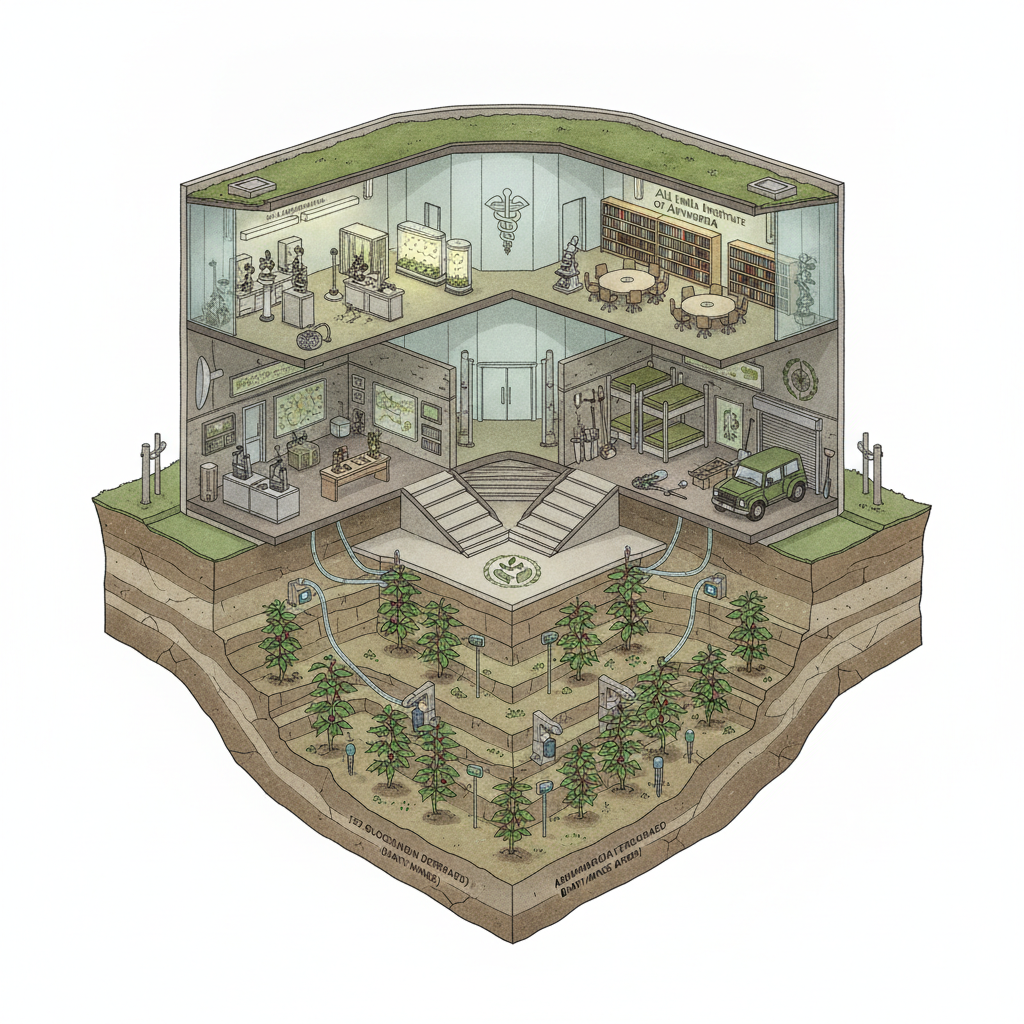
On 24 September 2026, the All India Institute of Ayurveda (AIIA), New Delhi, and the 132 Infantry Battalion (Territorial Army) Eco Rajput jointly launched a pilot initiative in the ecologically degraded Bhati Mines area of the Aravalli Range, South Delhi. The initiative involves the plantation of 10,000 Ashwagandha (Withania somnifera) saplings and their scientific monitoring to assess growth patterns, ecological adaptation, and medicinal potential in degraded mine-land ecosystems. This collaboration exemplifies the integration of Ayurvedic pharmacognosy with field-based ecological restoration, aligning with national priorities for biodiversity conservation and sustainable utilisation of medicinal plants.
Background
- The Aravalli Range, spanning approximately 692 km across Haryana, Rajasthan, and Delhi, is one of India’s oldest mountain systems and a critical ecological corridor for the National Capital Region (NCR).
- Historical and unscientific mining activities in the Delhi segment of the Aravallis, particularly in Bhati Mines, have led to severe land degradation, soil erosion, and loss of native biodiversity.
- The National Green Tribunal (NGT) and the Supreme Court of India have repeatedly directed state governments to restore degraded mine lands and enforce the ‘no-go’ policy for mining in ecologically sensitive zones.
- Ayurveda, a 5,000-year-old system of medicine, relies heavily on medicinal plants, with over 6,000 species documented in classical texts. Ashwagandha (Withania somnifera) is a Rasayana (rejuvenative) herb widely used for stress management, immune modulation, and anti-inflammatory properties.
- The National Medicinal Plants Board (NMPB), under the Ministry of AYUSH, promotes cultivation, conservation, and sustainable utilisation of medicinal plants through schemes such as the ‘Medicinal Plants Cultivation Promotion Scheme’ and ‘National Mission on Medicinal Plants’.
- The Territorial Army, a part of the Indian Army’s reserve forces, undertakes ecological restoration projects under its ‘Eco Task Force’ initiatives, particularly in degraded forest and mine-land areas.
What is the AIIA–132 Infantry Battalion (Territorial Army) Eco Rajput Initiative?
- The initiative is a collaborative pilot project aimed at integrating Ayurvedic pharmacognosy with ecological restoration in the Aravalli Range’s degraded mine-land ecosystems, specifically at Bhati Mines in South Delhi.
- Under the project, 10,000 Ashwagandha (Withania somnifera) saplings are being planted and subjected to systematic scientific monitoring to evaluate their growth, survival rates, and adaptability to local microclimatic conditions.
- The project leverages the scientific expertise of the All India Institute of Ayurveda (AIIA) in medicinal plant cultivation, pharmacognosy, and Ayurvedic pharmacology, combined with the ecological restoration experience of the 132 Infantry Battalion (Territorial Army) Eco Rajput in degraded land rehabilitation.
- The initiative includes long-term data collection on soil health, microclimate variables, and plant physiological responses, which will contribute to evidence-based policy formulation for large-scale medicinal plant cultivation in degraded ecosystems.
- Ashwagandha is selected for its high medicinal value, adaptability to arid and semi-arid conditions, and its potential to generate livelihood opportunities for local communities through cultivation and value addition.
- The project aligns with the National Biodiversity Action Plan (2019) and the National Mission for a Green India (GIM), which emphasise the restoration of degraded lands, promotion of native biodiversity, and integration of traditional knowledge systems with modern science.
- The AIIA will provide technical guidance for the maintenance, scientific management, and documentation of the herbal garden at Bhati Mines.
- The initiative underscores the role of institutional collaborations in achieving the Sustainable Development Goals (SDGs), particularly SDG 13 (Climate Action), SDG 15 (Life on Land), and SDG 3 (Good Health and Well-being).
Key Features
| Feature | Significance |
|---|---|
| Collaborative initiative between AIIA and Territorial Army | Demonstrates integration of traditional medicinal knowledge with modern ecological restoration practices for sustainable development. |
| Scientific monitoring of 10,000 Ashwagandha plants | Provides empirical data on growth patterns, adaptability, and ecological impact in degraded Aravalli terrain. |
| Restoration of degraded mining land in Bhati Mines | Contributes to rejuvenation of biodiversity and soil health in a critical urban forest fringe zone. |
| Technical guidance by AIIA for herbal garden maintenance | Ensures scientifically validated cultivation practices for medicinal plants in arid and semi-arid ecosystems. |
| Multi-institutional coordination (AIIA, NMPB, Territorial Army) | Highlights synergy between research institutions, defence establishments, and government bodies for environmental governance. |
Why it Matters
Environmental Conservation
- Mitigates land degradation in the Aravalli range, a critical water-shed and biodiversity hotspot.
- Enhances carbon sequestration potential through afforestation of medicinal plants in degraded zones.
- Supports restoration of native flora in urban peripheries, improving microclimate and air quality.
Healthcare & Traditional Knowledge
- Promotes systematic cultivation and conservation of Ashwagandha, a key adaptogen in Ayurveda.
- Facilitates integration of Ayurvedic pharmacopeia with modern botanical research for evidence-based validation.
- Strengthens ex-situ conservation of medicinal plants, ensuring availability for future therapeutic use.
Institutional Synergy & Governance
- Demonstrates inter-ministerial collaboration (AYUSH, Defence, Environment) for sustainable land-use planning.
- Showcases role of research institutions in guiding field-level ecological restoration projects.
- Highlights Territorial Army’s engagement in non-combat environmental stewardship.
Climate Resilience
- Contributes to India’s commitments under the National Action Plan on Climate Change (NAPCC) for afforestation.
- Supports urban greening initiatives in Delhi’s southern ridge, a critical heat-island mitigation zone.
- Enhances resilience of medicinal plant species to climate variability through scientific monitoring.
Challenges
1. Ecological Vulnerability of Aravalli Region
- High susceptibility to soil erosion and desertification due to historical mining activities.
- Limited natural regeneration capacity in degraded terrains necessitating active restoration.
- Climate-induced stress on medicinal plants requiring adaptive cultivation techniques.
UPSC Link: GS3: Land degradation & desertification
2. Scalability of Restoration Models
- Ensuring long-term viability of planted species in arid conditions with minimal irrigation.
- Balancing medicinal plant cultivation with ecological restoration priorities in biodiversity hotspots.
- Addressing potential conflicts between commercial cultivation and conservation objectives.
UPSC Link: GS3: Sustainable agriculture & biodiversity
3. Institutional Coordination Gaps
- Aligning research priorities of AIIA with field-level implementation by Territorial Army.
- Ensuring sustained funding and technical support for multi-year restoration projects.
- Streamlining regulatory clearances for afforestation in protected or notified areas.
UPSC Link: GS2: Centre-State relations & cooperative federalism
4. Knowledge Integration Challenges
- Translating traditional Ayurvedic knowledge into scientifically measurable parameters for monitoring.
- Standardising cultivation protocols for medicinal plants across diverse ecological zones.
- Disseminating research findings to policymakers and practitioners for wider adoption.
UPSC Link: GS3: Science & technology in agriculture
Challenges — UPSC Perspective
| Issue | Concern |
|---|---|
| Soil degradation in Bhati Mines | High levels of heavy metals and altered soil structure hinder plant establishment. |
| Water scarcity for irrigation | Arid climate necessitates innovative water conservation techniques for survival of planted species. |
| Competition with invasive species | Risk of dominance by non-native flora in early stages of restoration. |
| Regulatory hurdles for land use | Restrictions on afforestation in notified forest areas may limit project scope. |
| Long-term funding sustainability | Dependence on external grants or CSR funds for maintenance beyond initial phase. |
Way Forward
- Establish a long-term monitoring framework with AIIA and Territorial Army for Ashwagandha growth metrics.
- Expand the initiative to include other medicinal plants native to Aravalli, ensuring genetic diversity.
- Develop community-based awareness programs to involve local stakeholders in maintenance and protection.
- Collaborate with the National Medicinal Plants Board (NMPB) for standardised cultivation protocols.
- Integrate findings into India’s National Biodiversity Action Plan for replication in similar degraded landscapes.
- Leverage geospatial technologies (GIS, remote sensing) for precision monitoring of restoration progress.
- Advocate for policy incentives for medicinal plant cultivation in degraded lands under afforestation schemes.
UPSC Value Addition
Keywords for Mains Answer-Writing
Ayurveda and biodiversity conservation · Medicinal plants and scientific research · Aravalli ecosystem restoration · Collaborative governance models · Traditional knowledge and modern science integration · National Medicinal Plants Board (NMPB) · Army’s ecological initiatives · Sustainable herbal gardens · Ayurvedic pharmacology · Ecological restoration in degraded landscapes
Concept Flow
Degraded mining land in Aravalli → Ecological restoration through afforestation → Selection of medicinal plants (Ashwagandha) → Scientific monitoring by AIIA → Data-driven validation of Ayurvedic knowledge → Policy integration for sustainable land-use → Climate resilience and biodiversity conservation.
Prelims Practice Questions
Q1. Consider the following statements regarding Ashwagandha (Withania somnifera):
1. Ashwagandha is classified as an adaptogen in Ayurveda.
2. The National Medicinal Plants Board (NMPB) under the Ministry of AYUSH has launched a campaign titled ‘Ashwagandha—A Health Promoter’.
3. Ashwagandha cultivation is exclusively promoted in the Himalayan region due to its climatic requirements.
4. The plant is scientifically documented for its potential to enhance cognitive functions.
How many of the above statements are correct?
- Only one
- Only two
- Only three
- All four
Answer: All four — Statements 1, 2, and 4 are correct. Statement 3 is incorrect as Ashwagandha is adaptable to diverse agro-climatic conditions, including arid and semi-arid regions like parts of the Aravalli landscape.
Q2. Assertion (A): The integration of traditional Ayurvedic knowledge with modern scientific research is essential for biodiversity conservation.
Reason (R): Traditional knowledge systems often lack empirical validation and cannot contribute meaningfully to contemporary ecological restoration efforts.
In the context of the above statements, which of the following is correct?
- Both A and R are true, and R is the correct explanation of A
- Both A and R are true, but R is not the correct explanation of A
- A is true, but R is false
- A is false, but R is true
Answer: A is true, but R is false — Assertion (A) is true as the integration of traditional knowledge with modern science enhances conservation efforts. Reason (R) is false because traditional knowledge systems, such as those in Ayurveda, are increasingly validated through scientific research and contribute significantly to ecological restoration.
Q3. Match the following initiatives with their respective organisations:
Column I (Initiative) | Column II (Organisation)
———————————————–|——————————-
A. Establishment of Teriaers Herbal Garden | 1. All India Institute of Ayurveda (AIIA)
B. ‘Ashwagandha—A Health Promoter’ campaign | 2. National Medicinal Plants Board (NMPB)
C. Ecological restoration in degraded areas | 3. 132 Infantry Battalion (Territorial Army) Eco Rajput
D. Scientific documentation of medicinal plants| 4. Ministry of Environment, Forest and Climate Change
Select the correct match:
- A-1, B-2, C-3, D-4
- A-3, B-2, C-1, D-4
- A-2, B-3, C-4, D-1
- A-1, B-2, C-3, D-4
Answer: A-1, B-2, C-3, D-4 — Correct matches: A (Teriaers Herbal Garden) is maintained by AIIA (1); B (‘Ashwagandha—A Health Promoter’ campaign) is run by NMPB (2); C (ecological restoration in degraded areas) is undertaken by 132 Infantry Battalion (Territorial Army) Eco Rajput (3); D (scientific documentation of medicinal plants) aligns with AIIA’s role (1).
Mains Practice Question
✍ The convergence of traditional Ayurvedic knowledge and modern scientific research represents a paradigm shift in biodiversity conservation and ecological restoration. Critically analyse this statement with reference to the collaborative initiative between the All India Institute of Ayurveda (AIIA) and the 132 Infantry Battalion (Territorial Army) Eco Rajput in the Aravalli region. Also, examine the role of such partnerships in achieving India’s commitments under the Convention on Biological Diversity (CBD). (15 Marks)
Approach: MODEL-ANSWER SKELETON:
1. **Introduction (2 Marks)**:
– Define traditional knowledge systems (TKS) in Ayurveda and their relevance to biodiversity conservation.
– Highlight the significance of the Aravalli ecosystem as a biodiversity hotspot and its degradation due to anthropogenic pressures.
– State the collaborative initiative: AIIA and 132 Infantry Battalion (Territorial Army) Eco Rajput’s joint effort to plant 10,000 Ashwagandha (Withania somnifera) saplings in the Teriaers Herbal Garden, Bhati Mines.
2. **Convergence of Traditional and Modern Knowledge (5 Marks)**:
– **Ayurvedic Perspective**: Discuss Ashwagandha’s medicinal properties (adaptogen, immunomodulator) and its classification in Ayurveda (Rasayana, Balya).
– **Scientific Validation**: Reference the National Medicinal Plants Board (NMPB) campaign ‘Ashwagandha—A Health Promoter’ and its empirical validation (e.g., studies on adaptogenic properties, clinical trials).
– **Collaborative Mechanism**: Explain how AIIA’s expertise in Ayurvedic pharmacology and the Army’s ecological restoration experience synergise to enhance biodiversity conservation.
– **Example**: Cite the scientific monitoring and documentation of Ashwagandha’s growth in the Aravalli region as a case of applied research.
3. **Role in Biodiversity Conservation and CBD Commitments (5 Marks)**:
– **CBD Objectives**: Link the initiative to India’s commitments under the CBD (e.g., Aichi Target 13: safeguarding genetic diversity; Target 14: restoration of degraded ecosystems).
– **Ecosystem Restoration**: Discuss how the initiative contributes to the restoration of degraded landscapes in the Aravalli region, a critical step towards achieving India’s Nationally Determined Contributions (NDCs) under the Paris Agreement.
– **Policy Integration**: Highlight the role of institutions like NMPB and the Ministry of AYUSH in promoting sustainable cultivation of medicinal plants.
– **Challenges**: Address limitations such as land degradation, water scarcity, and the need for long-term monitoring.
4. **Conclusion (3 Marks)**:
– Summarise the transformative potential of integrating traditional knowledge with modern science for biodiversity conservation.
– Emphasise the scalability of such models for other degraded ecosystems in India.
– Conclude with a balanced view: while partnerships are promising, sustained funding, community involvement, and policy support are critical for success.
Source: PIB (Press Information Bureau)
Generated by AanyaAi for educational purpose.
Related guides on our sites
- Current affairs for upsc 2026
- How to prepare for GS paper 1 for UPSC CSE mains exam
- Best UPSC coaching for IFOS exam
- Best geography optional coaching

- Himachal CM Sukhu: All Doctor Vacancies to be Filled by March - September 27, 2026
- कैसे पुलिस की AI तकनीक पहचान कर रही है अस्पष्ट शवों को - September 27, 2026
- Jai Jyoti: 106 km Bisalpur Pipeline to End Jaipur Water Crisis - September 27, 2026

No Comments