


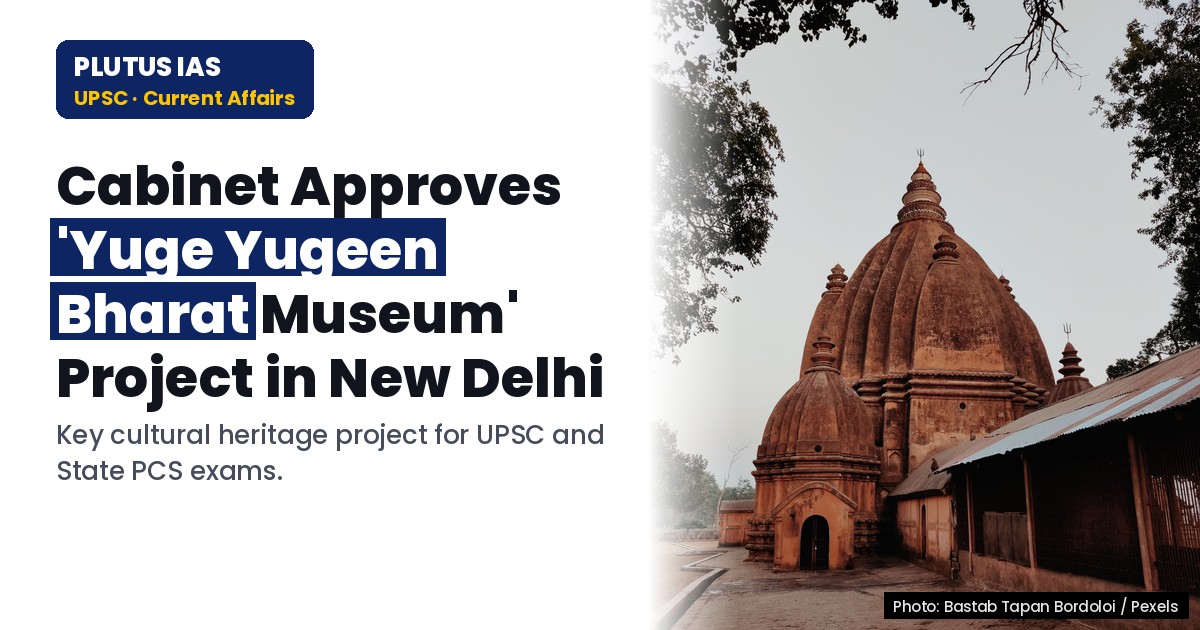
11 Nov Yuge Yugeen Bharat Museum: Cabinet Approves Project
✎ The 'Yuge Yugeen Bharat' National Museum, approved for the North and South Block complex, will be a comprehensive repository of India's history from ancient times to the present, integrating modern curatorial practices and…
Subject Relevance — Where This Topic Fits
- GS Paper I — Art and Culture | GS Paper I — History | GS Paper II — Government Policies and Interventions | GS Paper IV — Ethics (Cultural Heritage)
- Prelims: Yuge Yugeen Bharat National Museum, North and South Block Complex, Central Vista Redevelopment Project, National Museum, Janpath, Archaeological Survey of India (ASI), Cultural heritage preservation, Museum development in India, Ministry of Culture
- Essay: The role of museums in nation-building and cultural preservation., Balancing heritage conservation with modern urban development.
Quick Revision: The ‘Yuge Yugeen Bharat’ National Museum, approved for the North and South Block complex, will be a comprehensive repository of India’s history from ancient times to the present, integrating modern curatorial practices and relocating the existing National Museum’s collection.
Why is this in the news?
The Union Cabinet has granted approval for the establishment of the ‘Yuge Yugeen Bharat’ National Museum within the North and South Block complex in New Delhi. This initiative is a significant component of the broader Central Vista Redevelopment Project, aiming to create a comprehensive cultural institution that chronicles India’s history and heritage across various epochs.
Background
- The existing National Museum at Janpath, New Delhi, is slated for relocation to the new ‘Yuge Yugeen Bharat’ National Museum, signifying a major overhaul of India’s premier cultural repository.
- The North and South Blocks, iconic structures designed by Sir Herbert Baker, currently house key government ministries and are integral to the architectural heritage of Lutyens’ Delhi.
- The Central Vista Redevelopment Project encompasses a comprehensive plan for modernizing and enhancing the administrative and cultural infrastructure of India’s capital.
- The establishment of a new national museum aligns with the government’s vision to upgrade cultural institutions and make them more accessible and engaging for both domestic and international visitors.
- The project is anticipated to utilize advanced museum technologies and curatorial practices to present India’s diverse historical narrative effectively.
- This development underscores a strategic focus on cultural preservation and dissemination as a facet of national identity and public education.
About the Yuge Yugeen Bharat National Museum
- The ‘Yuge Yugeen Bharat’ National Museum is envisioned as a comprehensive institution chronicling India’s history from ancient civilizations to the present day.
- It is planned to be housed in the North and South Block complex, which will undergo adaptive reuse for this cultural purpose.
- The museum aims to provide an immersive and interactive experience, utilizing modern exhibition techniques and digital technologies.
- Its thematic scope will cover various periods, including the Indus Valley Civilization, Vedic Age, Mauryan, Gupta, Mughal, and colonial eras, up to contemporary India.
- The project is part of the larger Central Vista Redevelopment, which seeks to transform the administrative heart of New Delhi.
- The relocation of the existing National Museum’s vast collection to this new facility is a key aspect of the initiative.
- The museum is expected to serve as a significant educational and cultural resource, promoting a deeper understanding of India’s rich heritage.
- It will also contribute to cultural tourism, attracting visitors interested in Indian history and art.
Key Features
| Feature | Significance |
|---|---|
| Location | The museum will be developed at the North and South Block Complex in New Delhi, occupying a central and historically significant area within the nation’s capital. |
| Scope | Encompasses the entire historical trajectory of India, from ancient civilizations to the modern era, presenting a comprehensive narrative of the nation’s evolution. |
| Name | Titled ‘Yuge Yugeen Bharat National Museum’, signifying its intent to portray India’s continuous journey through various epochs. |
| Objective | Aims to serve as a national museum, providing an educational and immersive experience for visitors regarding India’s rich cultural heritage and historical achievements. |
| Architectural Integration | The development involves the adaptive reuse of existing structures within the North and South Blocks, integrating modern museum infrastructure with heritage architecture. |
Why it Matters
Cultural Preservation and Promotion
- The museum will act as a repository of India’s diverse cultural heritage, preserving artifacts, documents, and narratives that define the nation’s identity.
- It will promote a deeper understanding and appreciation of Indian history, art, and civilization among both domestic and international audiences, fostering cultural pride and awareness.
Educational and Research Hub
- Serving as a comprehensive educational resource, the museum will offer insights into various periods of Indian history, from prehistoric times to contemporary developments.
- It is expected to facilitate academic research and scholarship in history, archaeology, art, and cultural studies, contributing to the intellectual discourse on India’s past.
Tourism and Economic Impact
- The establishment of a national museum of this scale in a prominent location is anticipated to boost cultural tourism in New Delhi, attracting a significant number of visitors.
- Increased tourism can lead to economic benefits through job creation in the hospitality, transport, and ancillary services sectors, contributing to local economic development.
National Identity and Soft Power
- By showcasing India’s enduring legacy and civilizational achievements, the museum will reinforce a sense of national identity and unity among its citizens.
- It will project India’s rich cultural heritage on the global stage, enhancing its soft power and diplomatic influence through cultural exchange and understanding.
Challenges
1. Preservation of Heritage Structures
- Integrating modern museum facilities within the historic North and South Block buildings requires careful planning to ensure the structural integrity and heritage character of these iconic structures are maintained.
- Adherence to conservation principles and guidelines is crucial to prevent any irreversible alterations to the architectural and historical significance of the existing blocks.
UPSC Link: Art and Culture; Urban Planning
2. Curatorial Complexity and Narrative Cohesion
- Developing a comprehensive and engaging narrative that spans millennia of Indian history, encompassing diverse cultures, regions, and periods, presents a significant curatorial challenge.
- Ensuring historical accuracy, inclusivity, and a balanced representation of various perspectives while avoiding historical revisionism is paramount for the museum’s credibility.
UPSC Link: Art and Culture; History
3. Resource Mobilization and Management
- The development and long-term maintenance of a national museum of this magnitude will require substantial financial resources, skilled personnel, and advanced technological infrastructure.
- Effective project management, timely execution, and sustainable operational models are essential to ensure the museum’s successful establishment and continued relevance.
UPSC Link: Government Budgeting; Project Management
4. Visitor Engagement and Accessibility
- Designing an immersive and interactive visitor experience that caters to a diverse audience, including scholars, students, and general tourists, requires innovative exhibition techniques and digital integration.
- Ensuring physical and intellectual accessibility for all visitors, including those with disabilities, is crucial for the museum to fulfill its public service mandate.
UPSC Link: Social Justice; Tourism
Challenges — UPSC Perspective
| Issue | Concern |
|---|---|
| Architectural Sensitivity | Balancing the functional requirements of a modern museum with the need to preserve the historical and architectural integrity of the North and South Blocks. |
| Historical Interpretation | Crafting a balanced, inclusive, and accurate historical narrative that avoids bias and represents the multifaceted nature of Indian civilization across different eras. |
| Logistical Complexity | Managing the extensive logistical requirements for artifact acquisition, conservation, display, and security within a high-profile government complex. |
| Public Engagement | Developing compelling exhibitions and educational programs that resonate with a broad audience, fostering interest in Indian history and culture. |
| Sustainability | Ensuring the long-term financial viability and operational sustainability of the museum through diverse funding mechanisms and efficient management. |
Way Forward
- Implement a phased development approach, prioritizing critical infrastructure and exhibition components while ensuring minimal disruption to ongoing government functions.
- Constitute an expert advisory committee comprising historians, museologists, architects, and conservationists to guide the curatorial and design aspects.
- Integrate advanced digital technologies, including virtual reality and augmented reality, to create immersive and interactive exhibits that enhance visitor engagement.
- Develop a robust conservation and preservation strategy for artifacts and the heritage buildings, adhering to international best practices in museology and architectural conservation.
- Establish partnerships with leading national and international museums and academic institutions for knowledge exchange, research collaboration, and exhibition development.
- Formulate a comprehensive marketing and outreach strategy to promote the museum as a premier cultural destination, attracting diverse national and international visitors.
- Ensure accessibility standards are met for all visitors, including those with disabilities, by incorporating universal design principles in the museum’s infrastructure and exhibits.
UPSC Value Addition
Keywords for Mains Answer-Writing
Yuge Yugeen Bharat Museum · National Museum · North and South Block · Central Vista Redevelopment Project · Cultural Heritage Preservation · Museum Development · Architectural Heritage · Public-Private Partnership in Culture · Digital Museum Technology · Cultural Diplomacy
Concept Flow
Cabinet approves museum development → North and South Block selected as site → Adaptive reuse of heritage buildings → Establishment of ‘Yuge Yugeen Bharat National Museum’ → Showcasing India’s historical and cultural heritage → Promoting cultural understanding and national identity
Prelims Practice Questions
Q1. Consider the following statements regarding the ‘Yuge Yugeen Bharat’ National Museum:
1. It is being developed at the North and South Block complex in New Delhi.
2. The museum aims to showcase India’s rich cultural history spanning over 5,000 years.
3. The North and South Blocks were designed by Edwin Lutyens and Herbert Baker.
- Only one
- Only two
- Only three
- None
Answer: Only three — Statement 1 is correct as the Cabinet has approved the development of the Yuge Yugeen Bharat Museum at the North and South Block complex. Statement 2 is correct as the museum is envisioned to be a comprehensive national museum showcasing India’s cultural history over 5,000 years. Statement 3 is correct; Edwin Lutyens and Herbert Baker were the principal architects responsible for designing many buildings in Lutyens’ Delhi, including the North and South Blocks.
Q2. Which of the following is the nodal agency for the ‘Central Vista Redevelopment Project’, under which the North and South Block complex is being re-purposed?
- Ministry of Culture
- Ministry of Housing and Urban Affairs
- Archaeological Survey of India
- National Buildings Construction Corporation (NBCC)
Answer: Ministry of Housing and Urban Affairs — The Ministry of Housing and Urban Affairs is the nodal ministry overseeing the Central Vista Redevelopment Project, which includes the re-purposing of various government buildings and the development of new infrastructure in the Central Vista area.
Mains Practice Question
✍ The establishment of the ‘Yuge Yugeen Bharat’ National Museum within the North and South Block complex signifies a strategic re-purposing of historical administrative spaces for cultural preservation and public engagement. Discuss the potential benefits and challenges associated with transforming iconic government buildings into public museums, especially in the context of urban heritage and national identity. (15 Marks)
Approach: MODEL-ANSWER SKELETON:
1. **Introduction:** Briefly introduce the ‘Yuge Yugeen Bharat’ National Museum project and its location in the North and South Blocks as part of the Central Vista Redevelopment.
2. **Potential Benefits:**
* **Cultural Preservation & Promotion:** Enhanced accessibility to India’s 5,000-year history for citizens and tourists.
* **Urban Heritage Revitalization:** Adaptive reuse of historical buildings, preventing decay and ensuring their continued relevance.
* **National Identity & Education:** Fostering a deeper understanding of India’s heritage and promoting national pride.
* **Tourism & Economic Impact:** Potential to boost cultural tourism, generating revenue and employment.
* **Public Engagement:** Transforming exclusive government spaces into inclusive public domains.
* **Architectural Significance:** Highlighting the architectural grandeur of Lutyens’ Delhi.
3. **Challenges:**
* **Conservation vs. Modernization:** Balancing the need for modern museum infrastructure with the preservation of the original architectural integrity of heritage buildings.
* **Logistical & Technical Complexities:** Adapting old structures for new functions (e.g., climate control, security, accessibility for large crowds, digital displays).
* **Cost & Funding:** Significant financial outlay for renovation, maintenance, and curation.
* **Displacement & Relocation:** Managing the relocation of existing government offices and staff.
* **Public Perception & Criticism:** Addressing concerns regarding the re-purposing of iconic administrative buildings and the overall Central Vista project.
* **Curatorial Challenges:** Ensuring a comprehensive, inclusive, and historically accurate representation of 5,000 years of history.
4. **Conclusion:** Summarize the dual nature of the project – its potential for cultural enrichment and urban renewal, alongside the inherent complexities requiring careful planning and execution to achieve its stated objectives.
Source: PIB (Press Information Bureau)
Generated by AanyaAi for educational purpose.
Related guides on our sites
- Best PSIR optional coaching in delhi for UPSC
- How to prepare for GS paper 1 for UPSC CSE mains exam
- Best UPSC coaching for IFOS exam
- Best mentorship programme for upsc

- Yuge Yugeen Bharat Museum: Cabinet Approves Project - November 11, 2026
- कावेरी जल प्रबंधन प्राधिकरण: तमिलनाडु की सर्वोच्च न्यायालय में याचिका - November 11, 2026
- DGP-IGP Conference in Tirupati: UPSC & State PCS Analysis - November 11, 2026

No Comments