


26 Sep Himachal Pradesh: Panchayats Must Spend Sanitation Funds Only on 14 Specific Activities
✎ The Himachal Pradesh Panchayati Raj Department has restricted the utilisation of sanitation grants under the 16th Finance Commission to 14 specific activities, prescribing financial ceilings and mandating inclusion in development…
Subject Relevance — Where This Topic Fits
- GS Paper II — Constitutional and Statutory Bodies (Panchayati Raj Institutions) | GS Paper III — Environment and Pollution Control (Solid Waste Management)
- Prelims: 16th Finance Commission, Tied Grants, Panchayati Raj Act 1993, ODF Plus, Solid Waste Management, Swachh Bharat Mission 2.0
- Essay: Decentralisation and Local Governance: Strengthening Grassroots Democracy, Financial Discipline in Public Expenditure: Balancing Accountability and Flexibility
Quick Revision: The Himachal Pradesh Panchayati Raj Department has restricted the utilisation of sanitation grants under the 16th Finance Commission to 14 specific activities, prescribing financial ceilings and mandating inclusion in development plans to ensure fiscal discipline and transparency in local governance.
Why is this in the news?
The Himachal Pradesh Panchayati Raj Department has issued a directive on 25 September 2026, restricting the utilisation of sanitation-related tied grants under the 16th Finance Commission to 14 specific activities. This measure aims to curb arbitrary expenditure by Panchayati Raj Institutions (PRIs) and ensure that funds are deployed strictly for sanitation and waste management purposes as envisaged under the constitutional framework of local self-governance.
Background
- Under Article 280 of the Constitution, the Finance Commission allocates funds to local bodies to supplement their resources for specified purposes, including sanitation and waste management.
- Panchayati Raj Institutions (PRIs) in India operate under the framework of the 73rd Constitutional Amendment Act, 1992, which empowers them to plan and execute local developmental activities.
- Himachal Pradesh, a Himalayan state, faces unique challenges in solid waste management due to its mountainous terrain, necessitating structured financial allocations for sanitation infrastructure.
- Prior to this directive, PRIs in Himachal Pradesh had discretion in utilising sanitation grants, leading to instances of fund misutilisation and suboptimal outcomes in waste management.
- The directive aligns with the broader national agenda of achieving ODF Plus status under Swachh Bharat Mission 2.0, which emphasises sustainable sanitation and solid waste management.
What is the directive issued by the Himachal Pradesh Panchayati Raj Department?
- The directive restricts the utilisation of sanitation-related tied grants to 14 specific activities, thereby eliminating arbitrary expenditure by PRIs.
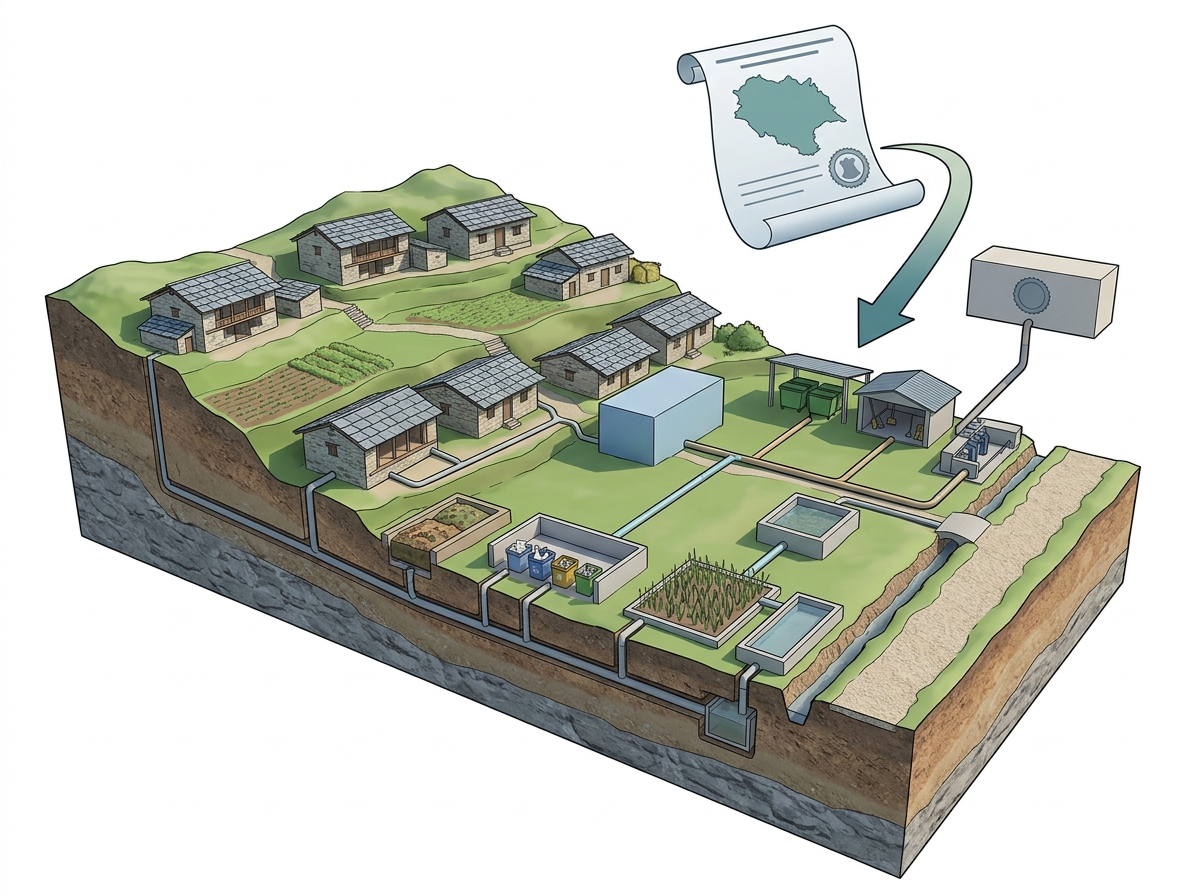
- The 14 permissible activities include the construction and maintenance of community soak pits, compost pits, segregation sheds, and sanitary complexes, among others.
- Financial ceilings have been prescribed for each activity to ensure fiscal discipline and prevent fund leakage. For instance, ₹10,000 per month is allocated for waste transportation services per Gram Panchayat.
- The Panchayati Raj Department has issued these instructions to Chief Executive Officers of Zilla Parishads, District Panchayat Officers, and Block Development Officers to ensure uniform implementation across the state.
- Non-compliance with the directive will be treated as unauthorised expenditure, and recovery proceedings may be initiated against the concerned PRI and its officials.
- The directive is part of a broader effort to institutionalise financial accountability in local governance, ensuring that funds are utilised for their intended purpose and yielding tangible outcomes in sanitation and waste management.
- The move is expected to enhance transparency, reduce corruption, and improve the efficiency of sanitation infrastructure at the grassroots level in Himachal Pradesh.
Key Features
| Feature | Significance |
|---|---|
| Specification of 14 permissible sanitation activities | Eliminates arbitrary expenditure by panchayats and ensures utilisation of sanitation grants for statutorily defined purposes only. |
| Ceiling limits on expenditure per activity (e.g., ₹10,000 per community soak pit, ₹20,000 for wet/dry waste segregation sheds) | Prevents cost overruns and ensures equitable distribution of funds across panchayats. |
| Mandatory inclusion in Gram Panchayat Development Plan (GPDP) and Block Panchayat Development Plan (BPDP) | Links sanitation expenditure to decentralised planning under the 15th Finance Commission’s recommendations. |
| Monthly/annual expenditure ceilings for recurring activities (e.g., ₹10,000/month for sanitation workers, ₹4 lakh/year for waste transport) | Ensures fiscal discipline while accommodating operational needs of sanitation infrastructure. |
| Verification and recovery provisions for unauthorised expenditure | Strengthens accountability mechanisms within the panchayati raj system. |
Why it Matters
Fiscal Governance
- Institutionalises transparent utilisation of sanitation grants under the 16th Finance Commission’s tied grants, reducing misallocation and leakages.
- Aligns with the principles of Outcome Budgeting by linking expenditure to measurable sanitation outcomes.
Decentralised Planning
- Integrates sanitation expenditure into the GPDP/BPDP framework, ensuring bottom-up planning and resource prioritisation.
- Enhances the role of gram sabhas in monitoring and approving sanitation-related expenditures.
Public Health & Environment
- Promotes structured waste management practices (e.g., segregation sheds, compost units, plastic waste facilities) to mitigate environmental degradation.
- Supports ODF Plus verification through IEC activities and community sanitation complexes.
Institutional Accountability
- Defines clear roles for CEOs, District Panchayat Officers, and BDOs in overseeing fund utilisation.
- Enables post-expenditure audits and recovery of unauthorised funds, reinforcing fiscal discipline.
Challenges
1. Implementation Gaps in Rural Areas
- Limited technical capacity in gram panchayats to design and execute sanitation projects within prescribed ceilings.
- Delayed release of tied grants from state exchequer may hinder timely execution of sanitation activities.
UPSC Link: 7th Schedule, State List (Local Government)
2. Monitoring and Verification Bottlenecks
- Absence of real-time digital monitoring systems to track expenditure against approved activities.
- Reliance on manual reporting may lead to discrepancies in utilisation certificates.
UPSC Link: Article 243G (Functions of Panchayats)
3. Sustainability of Recurring Expenditure
- Recurring costs (e.g., sanitation workers, waste transport) may strain panchayat finances beyond allocated ceilings.
- Lack of revenue diversification mechanisms at the panchayat level to sustain operations.
UPSC Link: 14th Finance Commission Recommendations
4. Community Participation Deficits
- Low awareness among villagers about permissible activities may lead to underutilisation of funds.
- Resistance to segregation practices or composting units due to behavioural inertia.
UPSC Link: Article 243A (Gram Sabha)
5. Data Asymmetry in Expenditure Tracking
- Inconsistent record-keeping across panchayats may complicate audits and utilisation verification.
- Absence of a unified state-level dashboard for real-time tracking of sanitation funds.
UPSC Link: Article 280 (Finance Commission)
Challenges — UPSC Perspective
| Issue | Concern |
|---|---|
| Technical Capacity of Panchayats | Inability to design and execute sanitation projects within prescribed ceilings. |
| Delayed Fund Disbursement | Hinders timely execution of sanitation activities. |
| Manual Reporting Systems | Prone to errors and discrepancies in utilisation certificates. |
| Recurring Cost Pressures | May exceed allocated ceilings, leading to unsustainable expenditures. |
| Low Community Awareness | Reduces participation in segregation and composting initiatives. |
| Data Fragmentation | Complicates audits and real-time tracking of sanitation funds. |
Way Forward
- Establish a state-level digital dashboard to monitor real-time utilisation of sanitation grants against approved activities.
- Conduct capacity-building workshops for gram panchayats on project design, expenditure ceilings, and record-keeping.
- Introduce a grievance redressal mechanism for villagers to report unauthorised expenditure or mismanagement.
- Link utilisation certificates to Aadhaar-based authentication to ensure transparency and reduce fraud.
- Pilot a performance-linked incentive system for panchayats that achieve predefined sanitation outcomes.
- Integrate sanitation expenditure tracking with the state’s Public Financial Management System (PFMS).
- Promote IEC campaigns in local dialects to enhance community participation in waste segregation and composting.
- Mandate quarterly reviews by District Planning Committees to assess fund utilisation and address bottlenecks.
UPSC Value Addition
Keywords for Mains Answer-Writing
Panchayati Raj Institutions (PRIs) · Fourteenth Finance Commission · Tied grants for sanitation · Swachh Bharat Mission (SBM) · Panchayat Development Plan (PDP) · Convergence of funds · Local self-government · Sanitation infrastructure · Plastic Waste Management · Gobar-Dhan scheme · Sustainable Development Goals (SDGs) · Fiscal federalism
Constitutional & Policy Linkages
- Article 243G: Functions of Panchayats (11th Schedule, State List)
- Article 243A: Gram Sabha
- 7th Schedule, State List (Local Government)
Concept Flow
Tied grants under 16th Finance Commission → Specification of 14 permissible activities → Ceiling limits per activity → Mandatory inclusion in GPDP/BPDP → Expenditure tracking and verification → Outcome-based sanitation improvements.
Prelims Practice Questions
Q1. Consider the following statements regarding the Panchayati Raj system in India:
1. The 73rd Constitutional Amendment Act, 1992 mandates the establishment of three-tier Panchayati Raj Institutions (PRIs) in every state.
2. The Fourteenth Finance Commission recommended the devolution of funds to PRIs as untied grants.
3. The Swachh Bharat Mission (Gramin) provides tied grants to PRIs exclusively for sanitation infrastructure.
How many of the above statements are correct?
- Only one
- Only two
- All three
- None
Answer: All three — Statements 1 and 3 are correct. Statement 2 is incorrect as the Fourteenth Finance Commission recommended both tied and untied grants to PRIs, not exclusively untied grants.
Q2. Assertion (A): The Panchayati Raj Institutions (PRIs) in India are constitutionally mandated to prepare and implement plans for economic development and social justice.
Reason (R): The 73rd Constitutional Amendment Act, 1992 empowers PRIs to levy taxes and collect revenue to fund local development projects.
Options:
A. Both A and R are true, and R is the correct explanation of A.
B. Both A and R are true, but R is NOT the correct explanation of A.
C. A is true, but R is false.
D. A is false, but R is true.
Answer: ? — Both Assertion (A) and Reason (R) are true. The 73rd Amendment mandates PRIs to prepare plans for economic development and social justice (A). It also empowers PRIs to levy, collect, and appropriate taxes, duties, tolls, and fees (R), which enables them to fund local development.
Q3. Match the following pairs related to sanitation funding in Panchayati Raj Institutions:
Column I (Activity) | Column II (Maximum Expenditure Limit)
————————————————–|—————————————-
1. Construction of community soak pits | A. ₹10,000 per month
2. Maintenance of community sanitary complexes | B. ₹90,000 per complex
3. Transportation of waste by motor vehicle | C. ₹10,000 per soak pit
4. Operation and maintenance of Gobar-Dhan plants | D. ₹2,00,000 per annum
Options:
A. 1-C, 2-A, 3-B, 4-D
B. 1-C, 2-B, 3-A, 4-D
C. 1-A, 2-B, 3-C, 4-D
D. 1-D, 2-A, 3-B, 4-C
- A
- B
- C
- D
Answer: B — 1-C (Construction of community soak pits: ₹10,000 per soak pit), 2-A (Maintenance of community sanitary complexes: ₹10,000 per month), 3-B (Transportation of waste by motor vehicle: ₹10,000 per month), 4-D (Operation and maintenance of Gobar-Dhan plants: ₹2,00,000 per annum).
Mains Practice Question
✍ The Panchayati Raj Institutions (PRIs) in India are increasingly being subjected to fiscal discipline through earmarked tied grants for specific purposes, as recently exemplified by Himachal Pradesh’s directive restricting sanitation funds to 14 pre-approved activities. Critically examine the implications of this trend for local self-governance, fiscal federalism, and the achievement of Sustainable Development Goals (SDGs) in India. (15 Marks)
Approach: MODEL-ANSWER SKELETON:
1. **Context and Background (2 Marks)**
– Define PRIs and their constitutional mandate under the 73rd Amendment Act, 1992.
– Explain the concept of tied grants and their distinction from untied grants in the context of the Fourteenth Finance Commission recommendations.
– Briefly describe the Swachh Bharat Mission (Gramin) and its role in sanitation funding.
2. **Fiscal Discipline vs. Local Autonomy (4 Marks)**
– Discuss the rationale for restricting tied grants to specific activities (e.g., preventing misuse, ensuring accountability, and aligning with national priorities like SDGs).
– Critically analyse the potential erosion of local autonomy in decision-making, particularly in resource allocation and prioritisation of local needs.
– Cite examples from other states or schemes (e.g., MGNREGA) where tied grants have been used, highlighting both successes and challenges.
3. **Fiscal Federalism and Centre-State-Local Relations (4 Marks)**
– Examine the principles of fiscal federalism and the role of PRIs as the third tier of governance.
– Discuss how earmarked grants may strengthen or weaken the fiscal federal structure, with reference to Article 280 (Finance Commission) and the 15th Finance Commission’s recommendations.
– Highlight the importance of convergence between centrally sponsored schemes (CSS) and local plans for effective implementation.
4. **Achievement of SDGs and Local Governance (3 Marks)**
– Link sanitation funding to SDG 6 (Clean Water and Sanitation) and SDG 11 (Sustainable Cities and Communities).
– Discuss how targeted expenditure on sanitation infrastructure (e.g., soak pits, compost pits, waste management units) contributes to achieving these goals.
– Critically assess whether earmarking funds enhances or limits the ability of PRIs to address localised SDG targets.
5. **Way Forward and Balanced Approach (2 Marks)**
– Suggest measures to balance fiscal discipline with local autonomy, such as participatory planning, capacity building, and performance-based grants.
– Highlight the role of the State Finance Commission in ensuring equitable distribution of resources to PRIs.
– Conclude with a balanced view on the necessity of tied grants for achieving national priorities while preserving the spirit of local self-governance.
Source: amarujala.com
Himachal Pradesh PCS (HPPSC (HAS)) — State PCS Practice
Prelims: As per the recent Himachal Pradesh government directives, the funds allocated for cleanliness under the Panchayati Raj institutions can now be utilized exclusively for how many specific works?
- 10 works
- 12 works
- 14 works
- 16 works
Answer: 14 works — The Himachal Pradesh Panchayati Raj Department has restricted the expenditure of cleanliness funds to only 14 designated works, as per the newly issued directives.
Mains: Discuss the significance of the Himachal Pradesh government’s recent directive restricting the expenditure of cleanliness funds under Panchayati Raj institutions to only 14 specific works. How does this decision align with the broader goals of rural development and sanitation in the state?
Generated by AanyaAi for educational purpose.
Related guides on our sites
- Current affairs for upsc 2026
- Best PSIR optional coaching for upsc
- Best PSIR optional teacher for upsc
- Best teacher of PSIR optional for upsc

- पेंशन भुगतान में विभाजन से बुजुर्गों को मुश्किल, अधिकार समूहों की चिंता - September 26, 2026
- UPSC Alert: Pension Split Policy Raises Hardship Concerns for Elderly in AP - September 26, 2026
- पीएम स्मृति चिह्न ई-नीलामी 2026: ओडिशा की सांस्कृतिक विरासत का अनूठा प्रदर्शन - September 26, 2026

No Comments