


26 Sep Super El Nino: 451,000 Excess Deaths Explained for UPSC & State PCS
✎ Excess mortality during super El Niño events is estimated by combining seasonal temperature forecasts with temperature-mortality relationships, accounting for lag effects and regional vulnerabilities to inform climate-resilient…
Subject Relevance — Where This Topic Fits
- GS Paper II — International Relations (Climate Change Diplomacy) | GS Paper III — Environment, Ecology, Biodiversity and Climate Change | GS Paper III — Science and Technology (Climate Modelling and Public Health)
- Prelims: El Niño, La Niña, ENSO, heat-related mortality, excess deaths, temperature-mortality relationship, seasonal climate forecasting, public health vulnerability
- Essay: Climate change as a multiplier of health risks: Evidence from extreme weather events, The intersection of environmental governance and public health: Mitigating climate-induced mortality
Quick Revision: Excess mortality during super El Niño events is estimated by combining seasonal temperature forecasts with temperature-mortality relationships, accounting for lag effects and regional vulnerabilities to inform climate-resilient public health policies.
Why is this in the news?
A recent study by the University of Chicago’s Energy Policy Institute has projected approximately 451,000 excess deaths globally during a ‘super El Niño’ event, with India potentially accounting for 15,800 of these deaths over six months. The co-author’s explanation of the methodology—combining seasonal temperature forecasts with temperature-mortality relationships—underscores the critical role of climate science and public health modelling in anticipating climate-induced health impacts. This analysis is significant for UPSC aspirants as it integrates climate dynamics, epidemiological forecasting, and governance frameworks essential for climate-resilient health policies.
Background
- El Niño-Southern Oscillation (ENSO) is a naturally occurring climate phenomenon characterised by periodic warming (El Niño) and cooling (La Niña) of sea surface temperatures in the central and eastern tropical Pacific Ocean.
- A ‘super El Niño’ refers to an exceptionally strong El Niño event, such as those observed in 1982–83, 1997–98, and 2015–16, which are associated with severe global climatic disruptions, including heatwaves, droughts, and altered precipitation patterns.
- Extreme heat events are recognised as a significant public health threat, with the World Health Organization (WHO) estimating that between 2000 and 2019, over 166,000 deaths annually were directly attributable to heatwaves.
- India’s vulnerability to heat-related mortality is exacerbated by high population density, urban heat island effects, and socioeconomic factors such as limited access to cooling infrastructure in vulnerable communities.
- The Intergovernmental Panel on Climate Change (IPCC) in its Sixth Assessment Report (2021–2023) highlights that climate change is intensifying the frequency and intensity of extreme weather events, including El Niño events, thereby increasing health risks.
- Public health governance frameworks, such as India’s National Action Plan on Climate Change and Health (NAPCCH), aim to integrate climate risk assessments into health policies to mitigate adverse outcomes.
Understanding the Methodology Behind Excess Mortality Estimates During Super El Niño Events
- The study employs a **two-component methodology**: (1) **seasonal temperature forecasts** derived from climate models to predict temperature anomalies during the El Niño period, and (2) **temperature-mortality relationships** to estimate the impact of these anomalies on human health.
- Seasonal temperature forecasts utilise dynamical climate models, such as those developed by the National Oceanic and Atmospheric Administration (NOAA) or the European Centre for Medium-Range Weather Forecasts (ECMWF), which simulate atmospheric and oceanic interactions to project temperature trends months in advance.
- Temperature-mortality relationships are established through epidemiological studies that analyse historical data on heat-related deaths and correlate them with observed temperature thresholds. These relationships are often expressed as **excess mortality per degree Celsius above a baseline temperature**, accounting for acclimatisation and regional differences.
- The methodology incorporates **lag effects**, recognising that heat-related mortality may not occur instantaneously but can manifest over several days or weeks following extreme temperature events, particularly among vulnerable populations such as the elderly, infants, and those with pre-existing health conditions.
- The study’s estimate of 451,000 excess deaths is derived from a **global temperature-mortality model** that aggregates data from multiple regions, weighted by population density and baseline health vulnerabilities, to produce a cumulative impact assessment.
- Uncertainty in projections arises from limitations in climate models (e.g., resolution, parameterisation) and epidemiological data (e.g., underreporting of heat-related deaths, regional variations in healthcare access), which are addressed through sensitivity analyses and probabilistic modelling.
- The methodology aligns with the **IPCC’s risk framework**, which distinguishes between **hazard** (e.g., extreme heat), **exposure** (e.g., population density), and **vulnerability** (e.g., socioeconomic factors) to quantify climate-related risks.
- Policy relevance of such studies lies in their ability to inform **early warning systems**, **heat-health action plans**, and **adaptation strategies**, such as urban greening, public cooling centres, and targeted interventions for high-risk groups.
Key Features
| Feature | Significance |
|---|---|
| Seasonal temperature forecasts | Provides probabilistic projections of temperature anomalies during the El Niño phase, enabling early warning systems for heat-related health risks. |
| Temperature-mortality relationship models | Quantifies historical correlations between ambient temperatures and excess mortality, allowing estimation of potential health impacts under projected temperature scenarios. |
| Excess death estimation methodology | Combines forecasted temperatures with temperature-mortality relationships to compute projected excess deaths, facilitating evidence-based policy interventions. |
| Peer-reviewed data sources | Relies on validated datasets from meteorological and epidemiological studies, ensuring methodological rigour and reproducibility of findings. |
| Six-month temporal scope | Aligns with the typical duration of El Niño events, providing a focused timeframe for risk assessment and resource allocation. |
Why it Matters
Public Health Implications
- Demonstrates the direct linkage between extreme weather events and human mortality, underscoring the need for integrated climate-health governance.
- Highlights the disproportionate vulnerability of vulnerable populations (elderly, outdoor workers, urban poor) to heat stress, necessitating targeted protection measures.
- Provides a quantitative basis for anticipatory public health responses, including heat action plans and early warning systems.
- Reinforces the importance of intersectoral coordination between meteorological agencies, health departments, and local governments.
Climate Science and Policy
- Contributes to the empirical evidence base linking El Niño events to extreme weather patterns and associated health risks.
- Supports the integration of climate projections into public health planning, aligning with the National Action Plan on Climate Change (NAPCC).
- Enhances the credibility of climate-health impact assessments, aiding in the formulation of evidence-based adaptation strategies.
Governance and Institutional Capacity
- Illustrates the role of academic institutions (e.g., University of Chicago’s Energy Policy Institute) in generating actionable climate-health intelligence for policymakers.
- Emphasizes the need for strengthening meteorological and epidemiological data systems to improve the accuracy of such projections.
- Demonstrates the importance of multi-institutional collaboration in addressing climate-related health risks.
Challenges
1. Data Gaps in Temperature-Mortality Relationships
- Limited granularity of mortality data at sub-national levels, particularly in rural and remote areas, constrains accurate risk assessment.
- Lack of standardized protocols for heat-health impact modelling across states, leading to inconsistencies in risk estimation.
UPSC Link: GS-III: Climate Change and Health
2. Integration of Climate Projections with Health Planning
- Slow adoption of climate risk information into public health policies and local governance frameworks.
- Inadequate funding and institutional capacity for implementing heat action plans and early warning systems.
UPSC Link: GS-III: Disaster Management
3. Vulnerability of Marginalized Groups
- Insufficient targeted interventions for high-risk populations, including informal sector workers and socio-economically disadvantaged communities.
- Limited awareness and preparedness among vulnerable groups regarding heat-related health risks and protective measures.
UPSC Link: GS-II: Social Justice and Inclusion
4. Cross-Sectoral Coordination Deficits
- Fragmented responsibilities between meteorological agencies, health departments, and disaster management authorities hinder effective response.
- Lack of a unified national framework for managing climate-health risks, leading to ad-hoc and reactive measures.
UPSC Link: GS-II: Governance
5. Climate Projection Uncertainty
- Variability in El Niño forecasts and regional climate models introduces uncertainty in risk assessments, complicating policy planning.
- Need for probabilistic risk communication to policymakers and the public to manage expectations and guide adaptive actions.
UPSC Link: GS-III: Science and Technology
Challenges — UPSC Perspective
| Issue | Concern |
|---|---|
| Inadequate sub-national mortality data | Hampers precise estimation of heat-related excess deaths and targeted intervention design. |
| Slow translation of climate data into health policy | Delays implementation of heat action plans and early warning systems. |
| Limited institutional capacity at local levels | Restricts the ability of states and municipalities to respond effectively to heat-related health risks. |
| Insufficient funding for heat-health programmes | Undermines the scalability and sustainability of preventive and adaptive measures. |
| Poor inter-agency coordination | Leads to fragmented and inefficient responses to climate-health risks. |
| Uncertainty in climate projections | Complicates long-term planning and resource allocation for health adaptation. |
Way Forward
- Strengthen sub-national mortality and temperature monitoring systems to improve the accuracy of heat-health impact assessments.
- Develop standardized protocols for integrating climate projections into public health planning, in alignment with the National Action Plan on Climate Change (NAPCC).
- Enhance funding and institutional capacity for the implementation of heat action plans, particularly in high-risk states and urban areas.
- Launch targeted awareness campaigns for vulnerable populations, focusing on heat stress prevention and protective measures.
- Establish a national framework for cross-sectoral coordination between meteorological agencies, health departments, and disaster management authorities.
- Invest in probabilistic climate risk communication to improve policy decision-making and public preparedness.
- Promote research collaborations between academic institutions and government agencies to refine temperature-mortality models.
- Integrate climate-health risk assessments into urban planning and infrastructure development to mitigate future vulnerabilities.
UPSC Value Addition
Keywords for Mains Answer-Writing
El Niño-Southern Oscillation (ENSO) · climate variability · extreme weather events · heat-related mortality · temperature-mortality relationship · seasonal temperature forecasts · public health impact of climate change · climate adaptation strategies · vulnerability of vulnerable populations · intergovernmental climate governance · sustainable development goals (SDGs) · climate resilience
Concept Flow
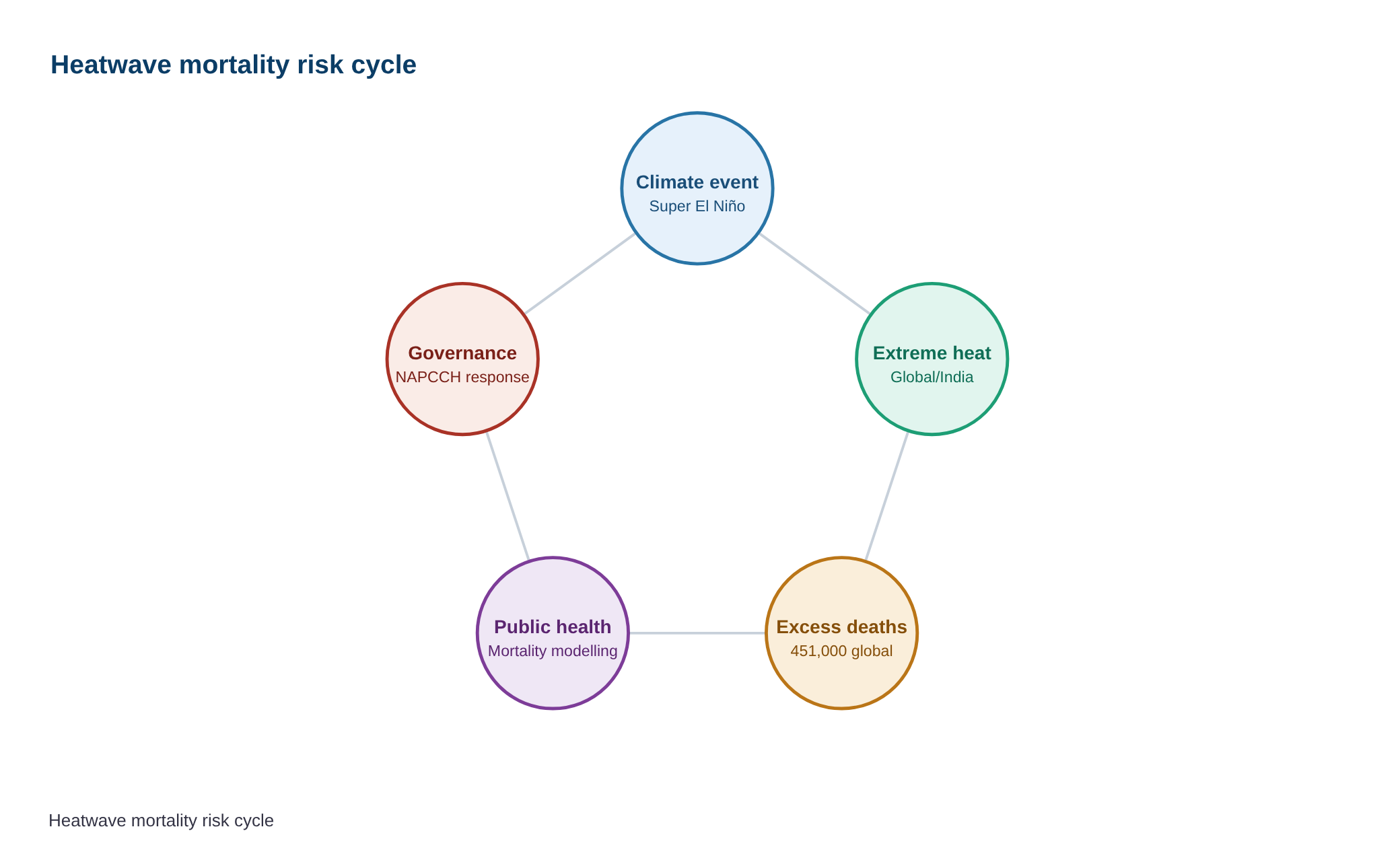
El Niño event triggers anomalous warming of Pacific Ocean → Alters global weather patterns, including increased surface temperatures in India → Elevated ambient temperatures correlate with higher heat-related mortality → Temperature-mortality models quantify excess deaths under projected scenarios → Early warning systems and heat action plans are activated to mitigate risks → Public health interventions reduce mortality, but challenges in data and coordination persist → Long-term adaptation requires integrated climate-health governance and institutional capacity building.
Prelims Practice Questions
Q1. Consider the following statements regarding the El Niño-Southern Oscillation (ENSO):
1. El Niño is associated with the warming of sea surface temperatures in the central and eastern tropical Pacific Ocean.
2. La Niña represents the cooling phase of ENSO and is typically linked to wetter conditions in India.
3. ENSO events have no significant impact on global temperature anomalies.
How many of the above statements are correct?
- Only one
- Only two
- All
- None
Answer: Only two — Statements 1 and 2 are correct. Statement 3 is incorrect because ENSO events significantly influence global temperature anomalies, with El Niño phases often associated with higher global temperatures.
Q2. Assertion (A): The Indian Meteorological Department (IMD) uses statistical models to predict El Niño events.
Reason (R): El Niño events are primarily driven by changes in ocean-atmosphere interactions in the tropical Pacific, which can be forecasted using historical data and climate models.
Options:
A. Both A and R are true, and R is the correct explanation of A.
B. Both A and R are true, but R is not the correct explanation of A.
C. A is true, but R is false.
D. A is false, but R is true.
Answer: ? — Both Assertion (A) and Reason (R) are true. The IMD indeed uses statistical and dynamical models to predict El Niño events, and the Reason correctly explains the scientific basis for these predictions.
Q3. Match the following phases of the El Niño-Southern Oscillation (ENSO) with their associated climatic impacts in India:
Column I (ENSO Phase) | Column II (Climatic Impact in India)
——————————-|—————————————
A. El Niño | 1. Above-normal monsoon rainfall
B. La Niña | 2. Deficient monsoon rainfall
C. Neutral ENSO | 3. Normal monsoon rainfall
| 4. Extreme heatwaves
Options for matching:
A-1, B-2, C-3
A-2, B-1, C-3
A-4, B-2, C-3
A-2, B-4, C-1
- A-2, B-1, C-3
- A-4, B-2, C-3
- A-2, B-4, C-1
- A-1, B-3, C-2
Answer: A-2, B-1, C-3 — El Niño (A) is typically associated with deficient monsoon rainfall (2) and increased likelihood of heatwaves (4). La Niña (B) is linked to above-normal monsoon rainfall (1). Neutral ENSO (C) generally results in normal monsoon rainfall (3).
Mains Practice Question
✍ The frequency and intensity of extreme weather events, such as the ‘super El Niño’ phenomenon, have raised concerns about their public health implications, particularly heat-related mortality. Critically examine the methodology used to estimate excess deaths during such events, with reference to the recent report estimating 451,000 excess deaths globally. Also, discuss the role of seasonal temperature forecasts in mitigating such risks. (15 Marks)
Approach: 1. **Methodology of Excess Death Estimation**:
– Define ‘excess deaths’ in the context of heat-related mortality.
– Explain the two-component methodology: (a) seasonal temperature forecasts (e.g., statistical/dynamical climate models), and (b) temperature-mortality relationships (e.g., epidemiological studies, historical data on heat-mortality correlations).
– Highlight the use of relative risk models, baseline mortality rates, and attribution studies.
– Cite the study by Emily Grover-Kopec (University of Chicago) and the Energy Policy Institute to ground the explanation.
2. **Public Health Impact and Vulnerabilities**:
– Discuss the disproportionate impact on vulnerable populations (e.g., elderly, outdoor workers, urban poor).
– Link to SDG 3 (Good Health and Well-being) and SDG 13 (Climate Action).
3. **Role of Seasonal Temperature Forecasts**:
– Explain how early warning systems (e.g., IMD’s seasonal forecasts) enable preparedness.
– Discuss interventions: heat action plans, public health advisories, and infrastructure adaptations (e.g., cool roofs, urban greening).
4. **Critique and Limitations**:
– Acknowledge uncertainties in climate models and epidemiological data.
– Highlight the need for granular, location-specific data to improve accuracy.
5. **Policy Implications**:
– Emphasise the role of intergovernmental climate governance (e.g., Paris Agreement) in addressing systemic risks.
– Stress the importance of climate-resilient public health systems.
Source: Hindustan Times
Generated by AanyaAi for educational purpose.
Related guides on our sites
- Best PSIR optional coaching for upsc
- Best economics optional coaching for upsc
- Best PSIR optional teacher for upsc
- Best teacher of PSIR optional for upsc

- Super El Nino: 451,000 Excess Deaths Explained for UPSC & State PCS - September 26, 2026
- AI हैकिंग: ऑस्ट्रेलिया में मेडिकेयर पोर्टल पर सेंध, भारत को सीखना होगा सबक - September 26, 2026
- AI Breaches Australian Medicare Portal: Key Security Lessons for UPSC Aspirants - September 26, 2026

No Comments