


26 Sep Amit Shah inaugurates UP International Trade Fair 2026: Key highlights for UPSC & PCS
✎ The Uttar Pradesh International Trade Fair exemplifies the synergy between national industrialisation policies like ‘Make in India’ and state-level reforms, positioning Uttar Pradesh as a pivotal growth engine in India’s economic…
Subject Relevance — Where This Topic Fits
- GS Paper II — Functions and Responsibilities of the Union and the States, Issues and Challenges Pertaining to the Federal Structure | GS Paper III — Indian Economy and Issues Relating to Planning, Mobilisation of Resources, Growth, Development and Employment
- Prelims: Make in India, Double Engine Government, One District One Product (ODOP), Defence Industrial Corridors, Logistics Efficiency, Ease of Doing Business (EoDB), Fragile Five, Top 5 Economies
- Essay: Economic Reforms and Their Impact on Inclusive Growth, Federalism and Cooperative Federalism in India: A Case Study of Uttar Pradesh
Quick Revision: The Uttar Pradesh International Trade Fair exemplifies the synergy between national industrialisation policies like ‘Make in India’ and state-level reforms, positioning Uttar Pradesh as a pivotal growth engine in India’s economic transformation.
Why is this in the news?
The fourth edition of the Uttar Pradesh International Trade Fair, inaugurated by the Union Home and Cooperation Minister in Greater Noida, marks a significant milestone in the state’s industrial and trade policy trajectory. It symbolises the convergence of national initiatives like ‘Make in India’ with state-level reforms, particularly in Uttar Pradesh, which has positioned itself as a key investment destination under the ‘double engine’ governance model. The event underscores the state’s transition from a fragile economic narrative to one of the top five global economies, driven by policy clarity, proactive governance, and robust law-and-order conditions.
Background
- The ‘Make in India’ initiative was launched by the Prime Minister on 25 September 2014, aiming to transform India into a global manufacturing hub by improving ease of doing business, fostering innovation, and attracting foreign direct investment (FDI).
- Uttar Pradesh, historically perceived as an investment laggard, has undergone a structural shift under the ‘double engine’ governance model, wherein the same political dispensation governs both the Centre and the state, enabling coordinated policy implementation.
- The state’s economic trajectory has been reinforced by the establishment of dedicated industrial corridors, including the Uttar Pradesh Defence Industrial Corridor and the Uttar Pradesh Medical Device Park, aligning with national priorities in defence and healthcare manufacturing.
- The ‘One District One Product’ (ODOP) scheme has been instrumental in promoting localised industrialisation, enhancing value addition, and creating employment opportunities in rural and semi-urban areas.
- Uttar Pradesh’s Gross State Domestic Product (GSDP) growth has outpaced the national average in recent years, with the state targeting a $1 trillion economy, a goal underpinned by improved infrastructure, policy stability, and investor confidence.
- The state’s law-and-order situation has significantly improved, reducing petty crimes and enhancing investor sentiment, as reflected in its improved ranking in the Ease of Doing Business (EoDB) assessments.
What is the Uttar Pradesh International Trade Fair?
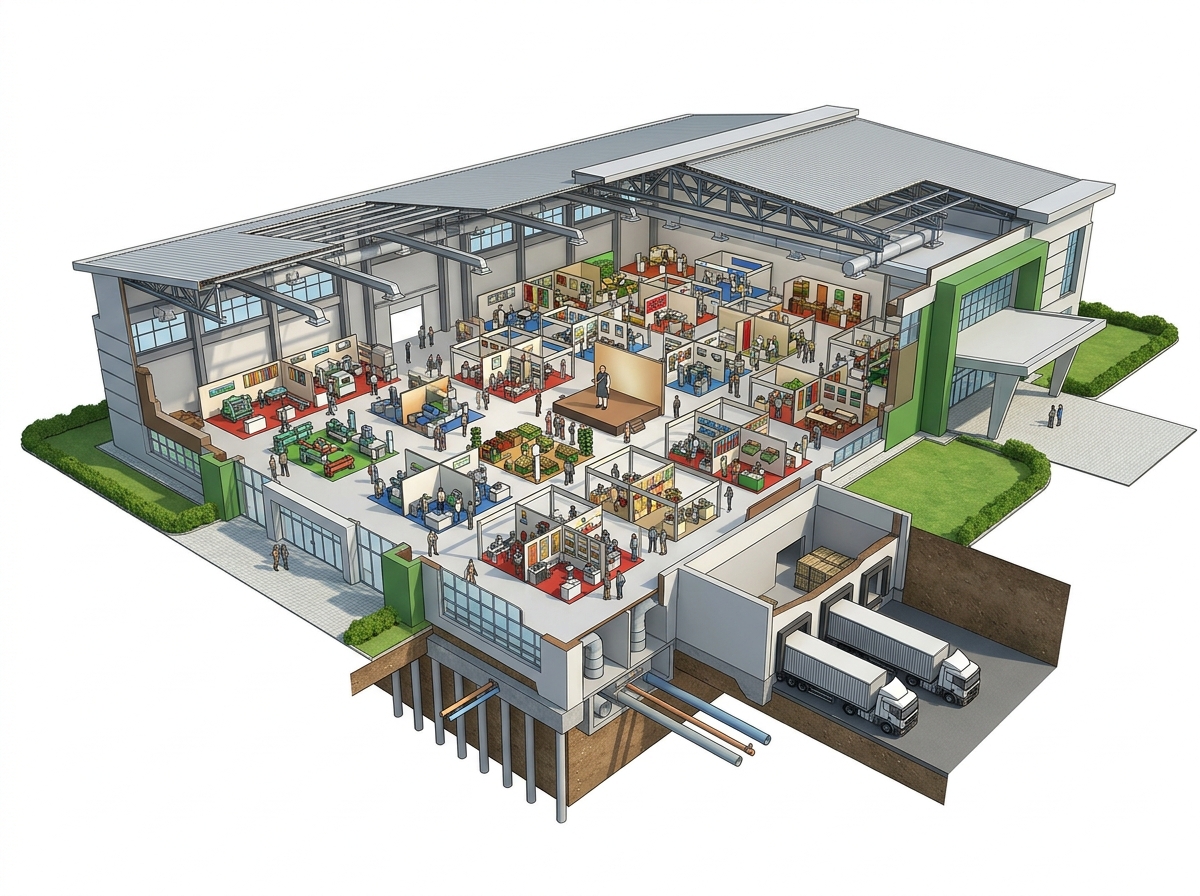
- The Uttar Pradesh International Trade Fair is an annual multi-sectoral trade exhibition designed to showcase the state’s industrial capabilities, agricultural produce, handicrafts, and technological innovations to a global audience.
- The fair serves as a platform for business-to-business (B2B) and business-to-government (B2G) interactions, facilitating investment MoUs, technology transfers, and market linkages for MSMEs and large-scale industries alike.
- It aligns with the ‘Make in India’ vision by highlighting Uttar Pradesh’s emerging sectors such as defence manufacturing, medical devices, electronics, textiles, and agro-processing, thereby positioning the state as a critical node in India’s supply chains.
- The fourth edition of the fair, held in Greater Noida, features participation from over 50 countries and 1,000 exhibitors, with a focus on sectors identified under the ODOP scheme and industrial corridors.
- The event is structured around thematic pavilions, including ‘Ease of Doing Business’, ‘Defence and Aerospace’, ‘Agri-Business’, and ‘Startups and Innovation’, to provide a holistic view of the state’s economic ecosystem.
- The trade fair is a testament to the state’s proactive governance model, which combines policy incentives, infrastructure development, and streamlined regulatory frameworks to attract investment.
- It also serves as a barometer for the state’s economic diplomacy, enabling Uttar Pradesh to engage with global buyers, investors, and policymakers to enhance its trade competitiveness.
Key Features
| Feature | Significance |
|---|---|
| Uttar Pradesh International Trade Fair (4th Edition) | A multi-sectoral platform to showcase state’s industrial capabilities, attract foreign direct investment (FDI), and facilitate trade linkages with global buyers, thereby enhancing export competitiveness and economic integration. |
| Double Engine Government Model | Synchronised policy implementation between the Union and state governments to create an enabling environment for investment, industrialisation, and infrastructure development, exemplified by Uttar Pradesh’s economic transformation. |
| Law and Order Enhancement | Strengthened public safety and reduced economic disruptions through proactive policing, curbing petty crimes (e.g., vehicle theft, chain snatching), and fostering investor confidence in industrial corridors. |
| Industrial Corridors and Parks | Strategic development of defence corridors (e.g., Aligarh), medical device parks, and manufacturing hubs (e.g., vehicle production) to diversify industrial base and integrate with global value chains. |
| One District One Product (ODOP) Scheme | Cluster-based industrialisation initiative promoting localised production, skill development, and market access for traditional and niche products, thereby empowering MSMEs and rural artisans. |
Why it Matters
Economic Transformation
- Demonstrates Uttar Pradesh’s transition from a state perceived as investment-deficient (e.g., 2013 Delhi Investment Summit) to a trillion-dollar economy aspirant, driven by policy consistency and institutional reforms.
- Highlights the role of international trade fairs in positioning states as global manufacturing and export hubs, aligning with India’s ‘Make in India’ and ‘Atmanirbhar Bharat’ initiatives.
- Showcases the integration of defence manufacturing (e.g., BrahMos missiles, AK-203 rifles) into civilian industrial ecosystems, enhancing technological spillovers and national security.
Policy Continuity and Institutional Strength
- Illustrates the sustained impact of economic liberalisation policies initiated by leaders like Pandit Deendayal Upadhyay, later institutionalised through reforms under successive governments.
- Emphasises the synergy between central and state policies (e.g., ‘Double Engine’ governance) in creating an investment-friendly ecosystem through law-and-order stability, industrial policies, and facilitation mechanisms.
Global Competitiveness
- Reinforces India’s position among the world’s top five economies, a shift from its earlier classification as part of the ‘Fragile Five’, attributed to structural reforms and industrialisation policies.
- Demonstrates Uttar Pradesh’s emergence as a preferred destination for global buyers, with sectors like automobiles, medical devices, and defence manufacturing attracting international participation.
Challenges
1. Infrastructure Bottlenecks
- Inadequate logistics and transport connectivity in hinterland regions of Uttar Pradesh, limiting the reach of industrial corridors and trade fairs to potential investors.
- Power supply inconsistencies and high industrial tariffs in certain districts, deterring energy-intensive manufacturing units.
UPSC Link: GS-III: Infrastructure
2. Skill Mismatch and Labour Productivity
- Disparity between vocational training outputs and industry demands, particularly in emerging sectors like medical devices and defence manufacturing.
- Low formalisation of the workforce in MSMEs, leading to productivity gaps and compliance challenges.
UPSC Link: GS-III: Employment
3. Regulatory Compliance and Ease of Doing Business
- Complexity in land acquisition and environmental clearances for large-scale industrial projects, despite state-level reforms.
- Fragmented implementation of labour laws and multiple compliance requirements across central and state jurisdictions.
UPSC Link: GS-II: Governance
4. Global Economic Volatility
- Protectionist trends in major economies (e.g., tariffs, non-tariff barriers) affecting export-oriented industries in Uttar Pradesh.
- Currency fluctuations and geopolitical uncertainties impacting investment flows into manufacturing sectors.
UPSC Link: GS-III: Economy
Challenges — UPSC Perspective
| Issue | Concern |
|---|---|
| Logistics and Connectivity | Limited multimodal transport infrastructure (e.g., inland waterways, dedicated freight corridors) increases cost and time for goods movement. |
| Power Reliability | Frequent outages and high tariffs in certain districts undermine industrial competitiveness. |
| Land Acquisition Delays | Protracted legal and administrative processes for land consolidation in industrial corridors. |
| Vocational Training Gaps | Mismatch between industry-specified skill sets and curriculum outcomes in ITIs and polytechnics. |
| Export Market Access | Non-tariff barriers (e.g., sanitary and phytosanitary measures) in target markets for agricultural and processed food products. |
Government Initiatives — Must-Memorise for Prelims
- Uttar Pradesh Defence Industrial Corridor
- Uttar Pradesh Medical Device Park Policy
Way Forward
- Accelerate the development of multimodal logistics hubs (e.g., Dedicated Freight Corridors) to reduce transit costs and time for industrial goods.
- Expand vocational training programmes in partnership with industry to align skill development with emerging sectors like defence, medical devices, and electronics.
- Streamline land acquisition and environmental clearance processes through single-window clearance systems and digital land records.
- Enhance power infrastructure by integrating renewable energy sources into industrial grids and rationalising tariffs for MSMEs.
- Strengthen export promotion through trade facilitation agreements, participation in global trade expos, and addressing non-tariff barriers in key markets.
- Establish sector-specific skill councils to bridge the gap between industry requirements and educational outcomes.
- Promote public-private partnerships (PPPs) in industrial park development to leverage private investment in infrastructure and technology upgrading.
UPSC Value Addition
Keywords for Mains Answer-Writing
Make in India · Production-Linked Incentive (PLI) Schemes · Double Engine Government · Ease of Doing Business · Foreign Direct Investment (FDI) · Industrial Corridors · Defence Manufacturing · MSMEs and ODOP Initiative · Foreign Trade Policy · Investment Facilitation · Logistics and Supply Chain · Pandit Deendayal Upadhyay’s Integral Humanism
Constitutional & Policy Linkages
- Article 246: Distribution of Legislative Powers (State List: Industry, Trade, and Commerce)
- Seventh Schedule: Concurrent List (Economic and Social Planning)
- Article 280: Finance Commission (Fiscal Federalism and Resource Allocation)
Concept Flow
Decline in petty crimes and improvement in law-and-order → Enhanced investor confidence → Increased FDI inflows into industrial corridors. → Policy continuity (e.g., ODOP, defence corridors) → Cluster-based industrialisation → Growth of MSMEs and rural entrepreneurship. → International trade fair participation → Global buyer engagement → Export diversification and market access expansion. → Infrastructure development (e.g., logistics hubs, power supply) → Reduced cost of doing business → Attraction of large-scale manufacturing units. → Vocational training reforms → Skilled labour availability → Higher productivity in emerging sectors (e.g., medical devices, defence). → State-centre coordination (Double Engine) → Synchronised policy implementation → Accelerated economic transformation.
Prelims Practice Questions
Q1. Consider the following statements regarding the ‘Make in India’ initiative launched on 25 September 2014:
1. It was announced by the Prime Minister of India.
2. The initiative aims to transform India into a global design and manufacturing hub.
3. It is a sub-scheme under the ‘Atmanirbhar Bharat’ programme.
4. The initiative includes the Production-Linked Incentive (PLI) schemes for various sectors.
How many of the above statements are correct?
- Only one
- Only two
- Only three
- All four
Answer: All four — Statements 1, 2, and 4 are correct. Statement 3 is incorrect as PLI schemes are a separate but complementary policy under ‘Atmanirbhar Bharat’.
Q2. Assertion (A): The ‘Double Engine Government’ model in Uttar Pradesh has contributed to improved investment climate.
Reason (R): The model ensures political stability and policy continuity at both the Centre and State levels.
Options:
A. Both A and R are true, and R is the correct explanation of A.
B. Both A and R are true, but R is NOT the correct explanation of A.
C. A is true but R is false.
D. A is false but R is true.
- A
- B
- C
- D
Answer: A — Both A and R are true, and R correctly explains A as political stability and policy continuity facilitate investor confidence.
Q3. Match the following initiatives with their respective objectives:
Column I (Initiative) | Column II (Objective)
———————|———————-
1. ODOP (One District One Product) | a. Enhancing defence manufacturing capabilities
2. PLI (Production-Linked Incentive) | b. Promoting MSMEs and localised industrialisation
3. Defence Industrial Corridors | c. Boosting domestic manufacturing with financial incentives
4. Ease of Doing Business Reforms | d. Simplifying regulatory processes for businesses
Select the correct match:
A. 1-b, 2-c, 3-a, 4-d
B. 1-a, 2-b, 3-c, 4-d
C. 1-d, 2-c, 3-b, 4-a
D. 1-c, 2-b, 3-a, 4-d
- A
- B
- C
- D
Answer: A — 1-b (ODOP promotes MSMEs and localised industrialisation), 2-c (PLI provides financial incentives for domestic manufacturing), 3-a (Defence Industrial Corridors enhance defence manufacturing), 4-d (Ease of Doing Business reforms simplify regulatory processes).
Mains Practice Question
✍ The fourth edition of the Uttar Pradesh International Trade Fair, inaugurated on 25 September 2026, underscores the state’s emergence as a global manufacturing and investment hub. In this context, critically examine the role of state-led industrial policies in transforming regional economies. Also, assess the extent to which such policies can address structural challenges like infrastructure deficits and skill gaps while ensuring inclusive growth. (15 Marks)
Approach: MODEL-ANSWER SKELETON:
1. Introduction: Define state-led industrial policies and their objectives (e.g., Make in India, PLI schemes, ODOP).
2. Role of state-led policies in transforming regional economies:
a. Policy frameworks: Production-Linked Incentive (PLI) schemes, Defence Industrial Corridors, Ease of Doing Business reforms.
b. Institutional mechanisms: Single-window clearance, land acquisition reforms, and investment facilitation agencies.
c. Case study: Uttar Pradesh’s transformation under ‘Double Engine Government’ model (e.g., defence manufacturing, MSME growth via ODOP).
3. Addressing structural challenges:
a. Infrastructure deficits: Industrial corridors (e.g., Delhi-Mumbai Industrial Corridor), logistics parks, and connectivity projects.
b. Skill gaps: Integration with National Skill Development Mission, vocational training under PMKVY, and industry-academia partnerships.
4. Ensuring inclusive growth:
a. Balancing large-scale industries with MSMEs and local entrepreneurship (e.g., ODOP’s focus on traditional crafts and agro-based industries).
b. Regional equity: Distributive justice through targeted interventions in backward districts.
5. Critique and limitations:
a. Over-reliance on incentives vs. structural reforms.
b. Risk of elite capture and exclusion of marginalised groups.
c. Environmental sustainability concerns in rapid industrialisation.
6. Conclusion: State-led policies are necessary but not sufficient; they must be complemented by robust public-private partnerships, continuous monitoring, and adaptive governance to ensure sustainability and inclusivity.
Source: PIB (Press Information Bureau)
Uttar Pradesh PCS (UPPSC) — State PCS Practice
Prelims: Which of the following statements about the 4th edition of the Uttar Pradesh International Trade Fair inaugurated by the Union Home and Cooperation Minister in Greater Noida is correct?
- The fair was inaugurated by the Chief Minister of Uttar Pradesh, not the Union Home Minister.
- The fair aims to promote industrial and trade collaborations exclusively within Uttar Pradesh.
- The event was organized under the aegis of the Uttar Pradesh State Industrial Development Corporation (UPSIDC).
- The fair focuses solely on agricultural products and rural economy of Uttar Pradesh.
Answer: The event was organized under the aegis of the Uttar Pradesh State Industrial Development Corporation (UPSIDC). — The 4th edition of the Uttar Pradesh International Trade Fair was inaugurated by the Union Home and Cooperation Minister, Shri Amit Shah, and was organized by the Uttar Pradesh State Industrial Development Corporation (UPSIDC) to boost industrial and trade collaborations in the state.
Mains: Discuss the significance of the Uttar Pradesh International Trade Fair in promoting industrial growth and economic development in the state. How can the state government leverage such events to attract investment and enhance the ease of doing business in Uttar Pradesh? (200 words)
Generated by AanyaAi for educational purpose.
Related guides on our sites
- Best economics optional coaching for upsc
- Best economics optional teacher for upsc
- How to prepare for GS paper 1 for UPSC CSE mains exam
- Best UPSC coaching for IFOS exam

- Amit Shah inaugurates UP International Trade Fair 2026: Key highlights for UPSC & PCS - September 26, 2026
- हैती: UN में PM ने कहा- अंतरराष्ट्रीय बल की पूरी मदद ज़रूरी, सुरक्षा बलों को मज़बूत करना होगा - September 26, 2026
- Haiti’s PM Urges UN for Full Backing Against Gangs at UNGA 2026 - September 26, 2026

No Comments